Chapter 23: Jim Hussey— The Tao, the Coyote, and the Goodness of Life

“The Tao that can be named is not the Tao”
—a reminder that ultimate reality can never truly be captured by words or human ideas. I offer it as a preface to this eulogy for Jim Hussey, knowing I can never fully do him justice, yet taking quiet pleasure in the attempt all the same. I ask your forgiveness in advance, for this will inevitably be my version of Jim’s story—shaped, as everything I write is, by my own slant on the life we shared.
Jim was my closest friend. And now, like Marty before him, he is gone—dissolved into something I can name only imprecisely, and only in the language of metaphor and quiet grief.
On Friday, August 21st, 2026—two days after his seventy-seventh birthday—Jim Hussey made the crossing. I am not yet sure what to do with that fact, except to write it down and expose my grief to the light of other eyes. Perhaps that is what a eulogy is: grief made visible, so that it can no longer hide inside a single body, and its weight can be shared among all who knew and loved him.
The Architecture of a Life Well-Lived
I do not know much of Jim’s childhood, but, in some ways, he did not have an easy beginning.
He grew up in Alaska, in a home where his father—a sheriff with the Anchorage police—wielded authority over Jim through violence. Jim took the beatings in stride and, for years, saw them as simply part of life. When cruelty is all a child knows, the child calls it normal.
It took a counselor, years later, to say plainly what Jim had never been given permission to hear:
“You were abused by your father.”
That sentence briefly cracked something open in him. He told me it had never dawned on him that he had been a traumatized child. And yet—this is the first of many places where our paths would fork—he declined to follow me down the road I had walked into my own early wounds. Two men shaped by similar injuries, choosing different medicines. It was a pattern that would define our friendship.
He entered the Vietnam War in 1968 through the Navy. When he returned, he did not retreat into bitterness or isolation. He traveled instead—Spain, France, and other places whose names he carried like postcards—leaving genuine marks on the people whose lives briefly intersected with his. There was something in Jim constitutionally incapable of passing through an experience without making real contact with it.
Back in America, he settled in Oregon. His first marriage, in the early 1980s, did not survive her infidelities—but Jim, with characteristic grace, never allowed bitterness to become a personality trait. He metabolized the pain and moved forward. That was always his way. In the late 1980s he met Jo, and they found a connection that held to the very end.

I
What followed was a life built on curiosity, community, and an almost gravitational pull toward those who were suffering. He immersed himself in the Transcendental Meditation movement, collecting friendships and insights along the way. He took up clogging and folk dancing—where he met Frank Hartley and David O’Dell—not as hobbies exactly, but as additional rooms in which to show up fully. He played cards well, using his fine memory to count them and place mere mortals at a disadvantage.
He attended a meaningful workshop with Haven Boggs in the mid-1980s and became one of the first members of the Living Enrichment Center of Oregon, which grew to several thousand people in the early 1990s under its charismatic New Thought minister, Mary Manin Boggs (Morrisey). And in one of his most quietly significant chapters, he became the first paid employee of the Dougy Center—a nonprofit devoted entirely to helping grieving children navigate loss.
Jim studied and practiced Nonviolent Communication, and it shaped everything downstream of it—his marriage, his friendships, his life’s work. Marshall Rosenberg’s framework moves a conversation from blame to compassion, and Jim lived inside it: listening deeply, without judgment; expressing his own needs clearly and without weaponizing them; and forever looking for the solution that honored everyone in the room.
He worked in mental health throughout the Portland area, including at Columbia River Mental Health—where, long before he knew me well, he had already crossed paths with my first wife, Donelle, who was in treatment there for dissociative disorder. The world Jim inhabited was always more interconnected than it appeared. Through Green Cross, he was deployed to Aceh, Indonesia, in the aftermath of the 2004 tsunami—a magnitude 9.2 megathrust earthquake that killed nearly 228,000 people across fourteen countries. There he sat with survivors and taught them techniques for immediate relief from trauma, including tapping, offering his presence as a form of medicine in a place where medicine alone was not enough.
He came home, earned his doctorate at Lewis and Clark College, and became a licensed psychologist. He eventually joined the staff at Kaiser Sunnyside Hospital in Clackamas County, where he worked as a therapist until his retirement in 2023.
Here is one of those coincidences that seemed to follow Jim and me everywhere: he worked in the Brookside wing—the very building I had wired for electrical construction in 2006, just before I left the trades for the City of Portland’s Water Bureau. Jim moved in two years later and built a successful fifteen-year career inside those walls. We had been in the same building, in different roles, without knowing it.
I made sure he had all the lights and power he needed to work his healing magic.
A man devoted to helping the living heal, to helping them gain insight into themselves, and to helping them grieve fully when the time came.
And now, the living must grieve him.
The Architecture of a Friendship
Jim and I first met in 1992, at an Empowerment Center workshop that Sharon and I supported alongside its creators, Diane and Michael Sutton. It was the kind of workshop that sorts people quickly—those performing their growth, and those actually doing it.
Jim was doing it.
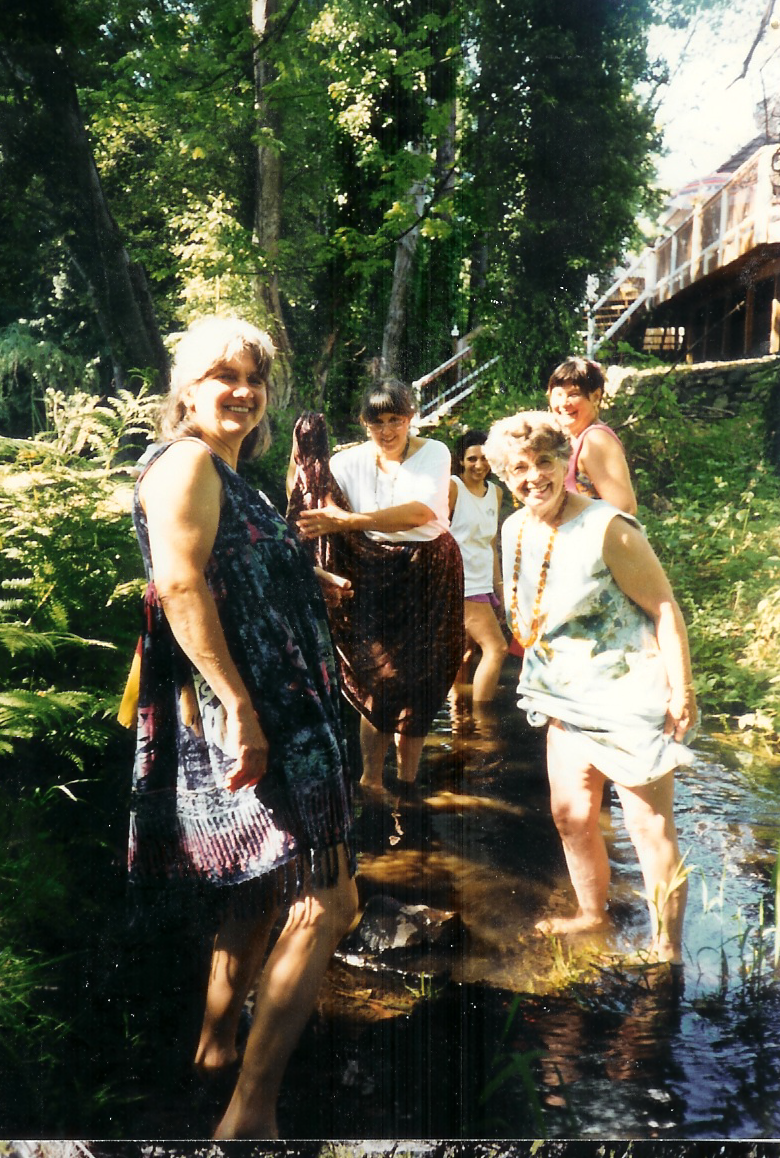
Sharon, Jo, Cynthia, Jeanette, and Mickey Brown, circa 1994 in the healing waters of our creek
Our wives—Sharon, Jo, and Eddy—later found each other through a women’s group they co-created in 1994, inspired by that same community. With characteristic wisdom and mild conspiracy, they arranged for their husbands to meet in a couples group. That is how Jim, Marty, and I became friends, and how the wives became closer still. We showed up initially out of obligation to their vision. Gratitude followed, as it tends to when you stop resisting what is good for you.
The couples group began meeting monthly in 1996. What was built inside that gathering—over years and seasons and the slow accumulation of shared life—is something I will never fully be able to articulate. It was simply one of the genuine gifts of my life.

Jim, me, and Marty, after a fruitful couple’s group gathering, 2008
Whenever anyone asked how he was doing, Jim would answer:
“Life is good.”
He was so consistent about it that I had to marvel. He said it two weeks before his death—proof of how absolutely that recognition of life’s inherent goodness was embedded in him.
He would sometimes say there would be no complaining from guests on the luxury liner—his metaphor for the good fortune of a middle-class life lived with a measure of spiritual awareness. He used it in therapy rooms and at the card table alike, whenever he wanted to keep the atmosphere warm and the conflict low.
Jim loved television and the movies, and I could always count on him to see the latest film with me. We loved Outlander, and later Foundation and Picard. It was usually Jim who made the call to see if I was free.
He especially loved The Big Lebowski.
Jeff Bridges plays Jeff “The Dude” Lebowski—an unemployed slacker in Venice, California, unbothered by money and unhurried by life, who gets tangled in a case of mistaken identity. What makes the Dude so memorable is his worldview, and two of his lines say everything:
“The Dude abides.”
“Yeah, well, you know, that’s just, like, your opinion, man.”
Jim didn’t smoke the Dude’s marijuana, but he enjoyed the occasional White Russian and, of course, his golf. He owned the coffee cups and the T-shirts. And Jim, without question, was the most colorful protagonist of his own life narrative.
And so the Dude abides.
In our couples’ group, we shared countless adventures. We hiked, cross-country skied, camped in Eastern Oregon, danced at Contra venues, dined at the best restaurants, celebrated each other’s birthdays, and made every effort to treat one another like family.

And, for a long time, we were.
Marty left us on September 11, 2017—six months of malignant melanoma, a cancer he had believed himself cured of in 2013 after enduring six excruciating months of Interleukin II therapy. When it returned in March of 2017, he met it first with terror, then with a genuine curiosity about the spiritual life and the possibility of healing, until he ultimately chose Oregon’s Death with Dignity to end his life on a day of his own choosing. His passing ended the couples group.
Grief of that magnitude tends to end things.
The Circuit Running at Higher Voltage
Jim loved to teach, inform, and bring humor to his friends, family, patients, and the wider public. He kept a steady YouTube presence, dispensing his wisdom for free.
https://www.youtube.com/@jimhusseylpc
He took up golf in this period, and it became a real passion. He’d get Frank Hartley, Sharon, and me out on the course regularly, and those hours together were a genuine pleasure. The golf course was Jim’s primary relationship with the natural world—he had little interest in the hikes that Sharon, Marty, and I took into the Columbia River Gorge. He also golfed often with Jo’s family, including her son Ben and her son-in-law Brad.

1998 Dog Mountain Hike, Marty and me
Then the body began to speak around 2019. Jim showed distressing new limits—struggling to walk uphill on warm days, wearying faster than before. A major blockage in a coronary artery, the LAD or the widow-maker, had been quietly doing its work. A stent was placed in time and gave him a path back toward normal life.
But something else began shortly afterward. Blood work revealed abnormalities, and Jim was diagnosed with multiple myeloma—the same disease that took my mother’s life. He broke a bone in his back and began to rely, now and then, on morphine for the pain. He tried four treatment protocols, each one leaving him more diminished than the last, each one followed by long hospitalizations. He refused the fifth, considered the most brutal of all.
And still he gave. His brother Jerry, facing a bladder cancer diagnosis, was deteriorating; Jim—despite his own ebbing energy—stepped in to manage the hospital visits and the practical wreckage of a life coming apart. He ministered to his brother with care and consistency even as his own reserves ran dry. Jerry died earlier this year.
Jim was placed on palliative care, which helped for a time. Hospice came two weeks before the end. He was able to remain at home, and to die in a way that honored his spiritual life.
Jim saw himself as a traveler on the path of the Tao. In the terms I think in most, he was someone who had faced his second death long before the first. The ego-bound self—the part that clings, defends, and builds elaborate structures around its own importance—had been largely dismantled in him years before cancer rendered the question moot.
He was something of a Bodhisattva: a soul who had quietly seen through the fabric of ordinary illusion, yet still chose to remain present for others, to help them move through their suffering with greater ease and dignity.
In my electrician’s terms, the energy running through Jim was at a higher voltage than most people could handle. He never overloaded anyone with it—he shared just enough to match their openness. Most of the time he was a saint in human form. Now and then he’d flash with anger if Frank or I did something on the golf course or at the card table that set him off. That was his paradox: deeply detached, yet fully engaged when it mattered. In tune with the Tao, but present enough to make you feel truly heard in any conversation.
In most social settings Jim wasn’t much of a talker. You might get a friendly jab; a genuine compliment took more effort to earn. In the couples group he often needed a small push to speak—though he could go on forever about Apple products with Marty. His best conversations came when he was leading a group or teaching. Everywhere else, he seemed content to listen.
Here is the deepest fork in our long road, and I want to lay it out plainly, because the friction was part of what made the friendship real.
Jim had been meditating since around 1977, and he knew how to tell the difference between spiritual fact and spiritual fantasy. He didn’t put much stock in the personal narrative—yet, ironically, he had one of his own. He distrusted the ego’s messages and often disagreed when I argued that the ego is not the enemy. His view owed a great deal to Byron Katie, whom he studied closely.
In her words: “I discovered that when I believed my thoughts, I suffered, but that when I didn’t believe them, I didn’t suffer… I found that suffering is optional. I found a joy within me that has never disappeared, not for a single moment.”
I came to a different peace with it. We are human beings having a human experience, and there will be stories to tell. I have finally understood that our stories are like psalms we sing to a loving universe—a way to express gratitude for this life. There is no shame in telling them, unless they are resentful, hateful, or unconscious trauma-driven control dramas.
We both studied Eckhart Tolle. After a three-day workshop with him in 2019, and a canceled one in Hawaii in 2021, I felt my time learning from Eckhart had run its course. Jim kept on with the online trainings, hoping to fill any remaining gaps on his way back to the present moment. I used to tease him that if I spoke with a German accent, he might take my experience a little more seriously.
Our paths diverged in some places even as they resonated deeply. That was the shape of us. Jim did not mirror people.
He met them.
The Last Tee Shot
Three weeks before his death, Jim joined Sharon, Frank Hartley, and me for what would be his final round of golf.
There is a video of that day—his last tee shot on the 8th hole at Kohl Creek, a par 3. I have watched it more than once. I will not describe it in full, except to say that watching a man give everything he has left to a single moment—knowing, or sensing, that the moments are running out—is one of the most honest things I have ever witnessed. No performance. No commentary. Just the swing, and the ball, and the particular grace of a body doing what it loves while it still can.
He was too tired to play the 9th hole.
I think about that sentence more than I should.
The Last Hug
His birthday came just two days before the end.
I visited him the day before it. I was the last person he was able to rise from bed to embrace. My visit tired him so deeply that he canceled all other visitors that day. He made the turn not long after I left.
There are moments you carry differently than others. They do not sit in memory the way ordinary recollections do. They settle into the body—in the sternum, in the hands—the way an electric field lingers around a wire for an instant after the power is cut.
That hug is in my core now.
I expect it will remain there.
What He Declined to Leave Behind
In the weeks before his death, I offered Jim a series of questions. I wanted to give him the chance to leave a verbal legacy—a gift for those who would remain. He had once expressed regret that he never submitted a chapter for a friend’s book about her Dougy Center experience, and I wanted his voice on the permanent record.
He declined. He called the idea too self-indulgent.
I understood, even if I did not agree. Jim’s way of moving through life was never about recording himself, though he spent years on a book—never published—some of it inspired by Spiral Dynamics. His gift was always in his presence, not in the preservation of it.
So, Jim—I have shared only the tiniest part of your story here, as gently as I can. You may express any displeasure with me on the other side. But first you’ll have to wait for Jesus, the Buddha, Mohammed, Lao Tzu, and Krishna to finish their lectures with me.
You’ll have plenty to add to that conversation. Of that I have no doubt.
The Day That Held It All
That final Friday morning, I went to see Jim right after a death in Troutdale during my TIP work. I was still carrying the fragile, unnamed weight of a stranger’s grief—a woman my age who had suddenly lost her husband. Then there was Jim: unconscious, laboring to breathe, and gone within an hour of my leaving, after I performed a shamanic practice for him. Later that same afternoon came yet another loss in downtown Portland—a young man dead from an overdose.
Friday was not a gentle day.
The universe, apparently, had decided I needed the full curriculum.
The Coyote Returns
Shortly after Jim passed, Sharon walked through North Clackamas Park and came upon a white coyote.
The coincidence of it stopped us both.

Because Marty—our Marty, gone nine years now—had written about a coyote in his final creative work, penned just two weeks before his own death. We had been attending the OHSU men’s cancer survivors’ writing group together for several months. I too once carried a diagnosis of malignant melanoma, though I was graced with a remarkable intervention that spared my life. (Thank you, Dr. Steiger.)
Marty’s last piece was a story of release—from societal expectation, from rigid structure, from the slow oppression of the human spirit—and of the infinite freedom that waits beyond all of it. The coyote was his symbol. His avatar. His sign. And now, it seems, Jim’s too.
Marty’s story deserves to be read in full, and so I offer it here:
“We visited the Riverview Cemetery last week, Doyle and I. Truth be told, I dragged Doyle there with me. I’m a green burial plot owner, and I wanted to see my plot and its surroundings in the morning sun from the East.
Although the hour was early, a couple of parties were already there—an early graveside service, and a couple visiting a recently interred loved one with their dog. I was also looking for a sign of completion—a sign that Eddy and I had arranged a ‘final rest’ in a good way.
I looked up the hillside and remarked to Doyle, ‘Look—a coyote, loping through the midst of the people and their pets with such obvious self-confidence. You can always recognize a coyote, even if you’ve never seen one before. They are never frightened—just there, immune to danger and above the fray.’
Yes, I recognized my sign—the age-old sign of the trickster, the shape-shifting presence of the coyote. May he safely inhabit this place forever.”
Two friends. Two coyotes. One symbol, crossing the same threshold from opposite sides of a decade.
I do not know what to make of this, except that I know better than to dismiss it.
The Numerology of 77
In numerology, dying at seventy-seven carries particular resonance. The doubled seven speaks to deep inner wisdom, spiritual awakening, and the completion of a profound inner journey. It suggests a peaceful transition—a soul that has finished its earthly curriculum and moves forward into something vast and unencumbered.
Jim has arrived at the singularity point, where the individual dissolves into the Cosmos. Chronological time has collapsed. What remains is the eternal constant—his energy within the field of the universal life force, the awareness without the form, the Tao moving through everything, unimpeded at last.
Seventy-seven years of energy transmission. A lifetime spent radiating a field that the most blessed among us were lucky enough to resonate with.
And now, Jim’s energy is free to roam the universe’s unlimited bandwidth of being.
To Jo
Jo, we are so deeply sorry for your loss.
Your love for Jim—and his for you—was one of the most quietly sustaining things I have ever had the privilege of witnessing. You were the axis around which so much of his later life turned with grace. The warmth the two of you created together was visible to everyone who entered your orbit. It made rooms warmer. It made people feel, without anyone needing to say it, that love like this was still possible.
The couples group you helped build was one of the genuine gifts of my life. What grew inside that circle—over years and seasons and the slow accumulation of shared life—I will carry forward as long as I am here to carry anything.
Thank you for sharing him with us.
A Final Word Across the Threshold
Jim—I will not insult you with vain attempts to reach you through thoughts and prayers alone.
I already know that I am with you, eternally, in this mysterious and loving heart of mankind.
You were my closest friend. And you were, without performance or announcement, one of the finest human beings I have ever known.
You were never frightened.
Just there.
Helping others.
Immune to danger and above the fray.
May you now inhabit that something vast and unencumbered—pure, unembodied, moving through the universe the way a coyote moves through a cemetery, with such obvious self-confidence that even the nearly dead stop to watch, and, perhaps, write the final chapter in their own life story.
Life was good for Jim.
Life was better for all of us who knew and loved him.
We all miss you, Jim.
I miss you.

