- Insights on Consciousness: Voices, Silence, and the Evolution of Inner Awareness
- The Adjunct to June 22, 1987: Grammar of Existence: How Pronouns Shape Our Shared Reality
- Chapter 20: The Three Levels of Thought: Charting a Course Through Reality
- Chapter 5: All You See Is Yourself: The Art of Exploring Perception and Reality
- Chapter 8: Man Was Created in God’s Image — But What Does That Mean?
- Chapter 37: The Illusion of Divinity: Is God Just a Concept?
Insights on Consciousness: Voices, Silence, and the Evolution of Inner Awareness
What does it mean to hear a voice from within? To feel the presence of something greater—sometimes comforting, sometimes unsettling—emanating from the silent corners of the mind? My own experience has taken me from the softened threads of childhood imagination, tethered to a beloved doll, to the overwhelming and fractured lens of psychosis, and finally to a profound silence that feels, paradoxically, alive with insight. For anyone exploring the intersection of spirituality, neuroscience, and mental health, this personal narrative offers fertile ground for discovery.
When I was a child, I believed my doll, Perci, spoke to me over the telephone. It wasn’t so outlandish at the time—children often assign personalities and voices to their cherished objects. But this early phenomenon speaks to something more universal and primal within the human mind, reminiscent of reports where young children claim to hear the voice of God. Is this the byproduct of an evolving consciousness? Or is it the unfiltered access to the imagination and intuition that adulthood slowly numbs as our rational mind takes precedent?
Years later, in 1986, I experienced a schizophrenic break. The voices I heard during this time weren’t malevolent but observers of my reality, narrating my environment. Occasionally, I even convinced myself that I could hear others’ thoughts. For anyone who has faced something similar, such moments of perception blur the line between reality and distortion, creating a crack through which profound insight or crushing fear might emerge.
Later, I experienced something that felt akin to both a spiritual awakening and neurological healing. The voices softened and then dissolved into something else—a profound internal silence. Yet, this silence was not an absence or void. It became a source of clarity, the place where intuition and spontaneous insights arise. It took me years to understand that this personal evolution mirrored aspects of Julian Jaynes’s theories on human consciousness and the bicameral mind.
Jaynes’s controversial theory proposed that early human consciousness lacked the introspective, self-aware qualities we now possess. Instead, humans heard “voices”—the commands of gods or ancestors—as auditory hallucinations stemming from the right hemisphere of the brain. Over time, as societal complexity demanded a more flexible and cohesive self-awareness, the “bicameral mind”—with its auditory hallucinated directives—evolved into our modern brain configuration of introspection and independent thought.
Does my story align with that progression? My childhood experience of a voice speaking through Perci, my schizophrenic break filled with narrated observations, and the eventual arrival at an inner silence provide a deeply personal lens through which to consider Jaynes’s work. Whether spiritual or neurological in origin, these “voices” might unlock valuable insights about our brain’s structure and its evolution.
Stepping into the nexus of spirituality, neuroscience, and mental health demands a surrender of the binaries we often lean on—consider, for example, the dichotomy of “symptom” versus “spiritual experience.” What if hearing voices, while disruptive, isn’t merely a malfunction of the brain? What if it’s also an invitation—though perhaps not a welcome one—into the landscape of the mind, an unmasking of layers of thought and perception often hidden from ordinary consciousness?
Therapists, clinicians, and spiritual seekers alike could benefit from questioning these boundaries. The modern push toward de-stigmatizing mental illness encourages us to explore how individuals can move through moments of neural or psychological disruption toward healing. My eventual inner silence might symbolize what healing looks like for some—a restoration of balance that creates space for intuition and insight to thrive. But each person’s evolution is unique; not all paths will lead to silence. Some may find their healing in active dialogue with these inner “voices,” just as others may find peace within solitude.
Consciousness, I’ve found, is more ephemeral and layered than I once imagined. It shifts and reconfigures, adapting to the unfolding needs of the mind and spirit. For business professionals, scientists, or meditators, the implications of this fluid nature of awareness are immense.
Neuroscientists may explore the brain’s capacity to adapt following trauma or psychosis while meditation practitioners refine techniques to access internal silence—adding nuance to practices thought to “quieten the mind.” Therapists must wrestle with the construct of normalcy and whether the diffuse boundaries labeled as hallucinations and “God-experiences” might dislodge valuable insights into both trauma and transcendence.
For so much of my life, I had thought I was departing further from normalcy, flying into great distances of disconnection or delusion. What I have learned instead is this—the mind and spirit are resilient explorers. Even if they wander too close to chaos, there is always the potential for them to return, bearing treasures of insight and transformation.
Whether hearing voices, connecting to intuition, or dwelling in inner silence, we as humans are products of an extraordinary evolutionary process. It is the same process that allows us to feel broken and whole, disconnected and connected, silent, and profound.
What treasures might the “voices” or silence reveal to us if we approached them not simply as symptoms, but as part of the ongoing evolution of human consciousness? This is the question I pose to mental health practitioners, spiritual seekers, and neuroscience enthusiasts alike. And perhaps it is through this inquiry that we might all travel closer to understanding the self—and the divine whisper it occasionally hears.
The Grammar of Existence: How Pronouns Shape Our Shared Reality
We often operate under the illusion that our internal monologue is merely a commentary on the world—a passive ticker tape of thoughts running in the background of our consciousness. Yet, this view is a profound underestimation of the power of the mind. The language we use within the quiet chambers of our own skulls does not merely describe our reality; it constructs it. Perception is the architect of our existence, and the pronouns we choose—the “Is,” the “yous,” and the “theys”—are the bricks with which we build either bridges to our colleagues or walls that ensure our isolation.
When we examine the nature of our internal references, we frequently find a reliance on the second and third person. We project outwards. We define the “other.” But what happens when that projection turns inward? What does it mean when the voice in our head addresses us not as “I,” but as “you,” or even more distantly, as “he” or “she”?
The Architecture of Separation
To understand the weight of these internal references, we must first dissect what it means to speak in the second and third person within the theater of the mind. The third person—”they,” “them,” “he,” “she”—is the language of the observer. It places the subject at a distance. When applied to colleagues, it turns a team into a monolith. “They need to fix this.” “He is difficult.” It is a linguistic push, a subtle act of dissociation that places the speaker safely on the shore while watching the ship drift away.
However, this dissociation takes on a darker hue when applied to the self. Consider the individual who narrates their own life in the third person: “She needs to do better,” or “He always messes this up.” This is not merely an eccentricity; it is a profound alienation from the self. It suggests a fracture in self-knowledge, a viewing of one’s own soul as an object to be critiqued rather than a subject to be inhabited. It hints at a fragile self-worth that can only be managed by stepping outside of one’s body and judging it from a safe, critical distance.
The Duality of “You”
The second person—”you”—is more intimate, yet it remains distinct. It creates a duality: the “I” and the “Thou.” When we use “you” in self-talk—”You can do this,” or “Why did you say that?”—we split ourselves in two. There is the actor and the critic, the coach and the player.
While sometimes a useful tool for motivation, relying on “you” for internal dialogue can signal a lack of integration. It presupposes a separation within the psyche. It is the language of confrontation and address, even if that confrontation is benevolent. In our internal narratives, these choices are rarely accidental; they are defense mechanisms of the ego, designed to keep the raw vulnerability of existence at a manageable arm’s length. To refuse the “I” is to refuse full ownership of the experience.
The Illusion of Objectivity vs. The Truth of Interconnection
The danger lies in how these references calcify our perception. If perception creates reality, then utilizing the third person creates a reality of fragmentation. When we view our organization as a collection of “theys,” we sever the spiritual tendon that binds the collective body. We create a schism where there should be unity.
Consider the implications of a controlled experiment within a tech company, which revealed a startling truth about the power of direct address. Teams that received communications utilizing second-person references (“you”) demonstrated 25% greater engagement in collaborative tasks compared to those receiving third-person (“they”) directives. The shift from “they should do this” to “you are part of this” collapses the distance. It transforms a task from an abstract obligation into a personal calling.
This data suggests that the “othering” inherent in third-person language dampens the vitality of the human spirit. It renders the vibrant, chaotic, living organism of a company into a sterile machine of separate parts. Conversely, when we inadvertently create separation through language, we deny the fundamental truth of our interconnectedness. We deny that the success of the “other” is inextricably linked to the salvation of the self.
Bridging the Gap: The Power of the Inclusive Narrative
Some may argue that the third person is necessary for objectivity—that to assess a situation fairly, one must detach. There is a prevailing belief in business that emotional distance equates to professional competence. However, this perspective confuses clarity with detachment. One can see clearly without severing the heartstring of empathy.
True resilience and organizational health are found not in detachment, but in the radical embrace of the collective. Research from the Harvard Business Review illuminates this path, indicating that companies with inclusive language policies boast 70% higher rates of employee satisfaction. This is not merely about politeness; it is about the soul’s need for belonging.
Even the self benefits from a thoughtful approach to pronouns. A study by the University of Sussex showed that individuals who regularly use first-person pronouns in self-talk report higher levels of self-awareness and emotional regulation. If the “I” grounds us in the self, and the “We” grounds us in the collective, then the unexamined “He,” “She,” or “You” leaves us floating in a void of disconnection.
Choosing Unity in a Fragmented World
We stand at a crossroads of perception. Every time we formulate a thought about a coworker, a department, or even ourselves, we are making a metaphysical choice. We are choosing whether to reinforce the illusion of separation or to acknowledge the reality of our union.
The challenge, then, is to move our internal references from the alienating third person toward the integrated first person. We must strive to rewrite the script of our minds. We must catch ourselves when we refer to ourselves as “you” or “him/her” and ask why we are afraid to say “I.” We must catch ourselves when we say “they” about our team and ask if we can truthfully say “we.” In doing so, we do not just change our sentences; we change our souls, and by extension, the very reality of the world we inhabit. Let us choose words that bind, rather than words that break.
Chapter 20: The Three Levels of Thought: Charting a Course Through Reality
Every thought is an echo of a thinker, a ripple in the vast ocean of consciousness. We often assume the “I” we identify with is the sole architect of these thoughts. Yet, neuroscience reminds us that the origin of consciousness remains one of science’s most profound mysteries. When we think about ourselves, is it merely the “I” reflecting on its own subjective existence, confined by its personal experience? And what happens when our thoughts venture beyond ourselves, to the “You” we encounter?
This exploration will guide you through the three fundamental levels of thought. We’ll journey from the intimate landscape of self-perception to the shared space of interaction, and finally, into the abstract realms of theory and speculation. By understanding these levels—the “I,” the “You,” and the “Them”—we can begin to appreciate the intricate relationship between our thoughts, our perceptions, and the very nature of reality itself. This framework offers a map for navigating our inner and outer worlds, helping us discern where our personal reality ends and a collective or even speculative one begins.
Level 1: The “I” — The Seed of Personal Reality
The first level of thought is the domain of the “I.” This is the realm of self-perception, the internal universe where your personal reality takes shape. It encompasses your thoughts about who you are, your strengths and weaknesses, your deepest desires, and your most persistent fears. The “I” is the thinker contemplating itself, a consciousness looking inward.
Imagine standing before a mirror. The reflection you see is a manifestation of this first level. It’s not just a physical image but a complex collage of your self-assessments, memories, and aspirations. This is your subjective reality, a universe uniquely yours, built from the raw material of your personal experiences. Every thought tethered to “I am,” “I feel,” or “I believe” is rooted in this foundational level of consciousness. It is the seed from which all other perceptions grow, the anchor point of our existence.
However, this personal reality is, by its nature, limited. It is a viewpoint from a single position in the vastness of existence. While it feels all-encompassing, it is just one interpretation of the world. Understanding the “I” is the first step in recognizing the boundaries of our subjectivity and preparing to engage with realities beyond our own.
Level 2: The “You” — The Growth of Interactive Reality
Moving beyond the self, we encounter the second level of thought: the “You.” This level represents our engagement with the world outside our consciousness. The “You” is everything and everyone we can interact with, a collective reality we negotiate through our senses and thoughts. It is the bridge between our subjective world and the objective world we appear to share with others.
Picture a conversation with a friend. As you exchange words, ideas, and emotions, you are operating within the level of “You.” Your personal reality (“I”) intersects with another’s, creating a shared space—an interactive reality. This collective experience is shaped by the constant interplay of individual perspectives. Your thoughts influence your friend, and their thoughts, in turn, influence you. This dynamic exchange is how we build relationships, form communities, and create a shared understanding of the world.
This interactive reality is not limited to people. It includes any object or entity we can perceive and engage with directly. When you touch a tree, read a book, or listen to music, you are interacting with an objective reality or a “You.” Your senses provide data, and your thoughts interpret that data, creating a consensual reality that feels objective and stable. It is the world we navigate daily, a tangible plane of existence built on direct experience and mutual understanding. It is the plant that grows from the seed of the “I,” reaching out to connect with its environment.
Level 3: The “Them” — The Forest of Abstracted Reality
The third and most expansive level of thought is the “Them.” This is the realm of abstraction, speculation, and theory. It deals with concepts, ideas, and entities that exist beyond our direct sensory experience. While the “I” is personal and the “You” is interactive, the “Them” is purely conceptual. It is the world we build with our minds, populated by thoughts about what might be, what could have been, or what exists in places we cannot reach.
Consider a scientist formulating a theory about a distant galaxy. This galaxy is not something they can touch or interact with directly. It exists for them as a collection of data points, mathematical models, and imaginative leaps. This is the essence of the “Them.” It encompasses everything from historical events and philosophical ideas to scientific theories and spiritual beliefs. It is a reality constructed through logic, intuition, and speculation.
This level is also the most susceptible to illusion and fantasy. Because it is not grounded in direct experience, our thoughts about “Them” can easily stray from what is objectively real. This is where grand narratives, complex belief systems, and even personal delusions are born. The analogy of the forest is fitting here. The seed of the “I” grew into the plant of the “You,” and now it contemplates becoming part of a vast forest. This forest of “Them” represents a potential cosmic consciousness, a universal reality that is both subjectively and objectively true. Yet, whether this forest is real or a grand illusion remains a central question of human existence.
A Synthesis of Thought
The three levels of thought—the “I,” the “You,” and the “Them”—are not separate silos but interconnected dimensions of our consciousness. Our personal reality shapes how we interact with the world, our interactions inform our abstract thinking, and our abstract ideas can, in turn, reshape our sense of self.
By understanding this framework, you gain a powerful tool for self-awareness and critical thinking. You can begin to distinguish between your subjective feelings, your shared experiences, and your speculative beliefs. This clarity allows you to navigate the complexities of life with greater wisdom, recognizing the limits of your own perspective while appreciating the vastness of what lies beyond.
Embracing these levels of thought is an invitation to a deeper mode of being. It encourages you to honor your personal truth, engage authentically with the world around you, and explore the limitless horizons of your own mind with both courage and humility. The journey through these levels is the journey of consciousness itself, a path of continual growth and discovery.
Chapter 5: All You See Is Yourself: The Art of Exploring Perception and Reality
Have you ever found yourself startled by your own reflection in a window, a mirror, or a fleeting glimpse of glass? One moment of unexpected recognition stirs curiosity, perhaps discomfort, as it pulls you momentarily into a state of self-awareness deeper than usual.
Who is it that I am seeing?
Is it merely my body, my image, or something entirely internal and imagined?
This mundane yet profound interaction with our own reflection mirrors a larger truth about how we perceive not only ourselves but the world around us. At every moment, what we see, feel, and believe isn’t the external world or reality itself but our mind’s exquisite, personalized reconstruction of it. Neuroscience, philosophy, quantum physics, and ancient spirituality each offer fascinating ways to understand this phenomenon, yet they all converge at one undeniable idea—we are witnessing ourselves in everything.
Our senses offer a rich, stunningly detailed experience of the world, yet what we experience is an intricate creation of the mind. Neuroscience shows that perception is not direct input; rather, the brain actively interprets sensory information to build a unique inner reality.
Take vision as an example. The eyes take in light, but the brain processes and reconstructs that input into coherent images to make sense of what surrounds us. But as Nobel Prize-winning neuroscientist Gerald Edelman argued, this process is interpretive, and each individual’s perception results in slightly different inner realities.
When we extend this understanding to others, it becomes clear that no one sees us as we see ourselves. Their brains, informed by their own sensory inputs, personal histories, and imaginations, construct an entirely different “you” than the one you hold within your mind.
These revelations are not new to human thought. Philosophers like Immanuel Kant posited centuries ago that reality, as we perceive it, is shaped more by our mind’s faculties than by external objects themselves. Kant argued that the world we “see” is phenomena, shaped by the categories of time, space, and causality that our minds impose.
Similarly, Plato’s allegory of the cave suggested that the images we perceive are mere shadows of the ultimate reality. Everything we see is filtered through a subjective lens that limits us to glimpses of the truth.
Bringing this understanding into contemporary conversations, consider the implications of quantum theory. The observer effect reveals that the very act of observing at the quantum level alters reality. Are we, through our perceptions, creators as much as we are observers?
The way we perceive ourselves fundamentally affects how we perceive and interact with the external world. Psychological research confirms that self-perception and confidence influence how we interpret experiences, from personal relationships to career decisions.
For example, people with high self-esteem are more likely to see opportunities in ambiguous situations, while those with low self-esteem may perceive obstacles instead.
Could it be, then, that changing how we perceive ourselves could alter how we see the entire universe?
As we gaze upon our world, the multitude of other humans, plants, animals, geography and scenery, the sky and the nighttime stars, are we not also only witnessing ourselves, and our own internal imaginal representations? We carry those perceptions of the objective reality within our minds, forever linking us, at least perceptually.
what is “out there” and physically separate from us is not connected in any material way, for as our bodies move in one direction the objects of perception do not move in tandem in any obvious physical way. Yet, mysteriously, we are also fundamentally and perpetually linked beyond the purview of our perceptions.
The challenge lies in going beyond this constructed world of perception and ego. The ego, that sum total of our judgments, conditioning, trauma, and experiences, tends to act as a filter over reality, comforting us with familiarity but limiting us to our own patterns of thought and assumptions.
What if we could release this filter—to see without judgment, without time, and without the observer imposing itself on the observed? Here, spirituality offers wisdom. Teachings from Zen Buddhism and Advaita Vedanta often point to the interconnectedness of all things and encourage practices like mindfulness and meditation to dissolve these artificial boundaries created by the ego.
Once, during an evening meditation, I whispered a mantra born of a deep desire for truth. “Master teacher of the light,” I repeated slowly, seeking focus and surrender. The next moment was a shift of breathtaking magnitude—I had a choice to continue steering my mind along its usual grooves or release control entirely.
I chose release. What unfolded was an exhilarating rush that moved me beyond myself, beyond identity, and into a space of infinite silence. I was home in emptiness, my essence merging with something vast and unnamable. A joyous “voice” emerged through me, affirming truths I had never understood before, like how perception binds us and how freedom comes in its mastery.

One statement echoed in my mind for years to follow, “You can’t be real.” It was not a threat but an invitation, reminding me that the ego is not the truth, just a structure obscuring the vast reality of interconnectedness.
The question remains, how can we, in our daily lives, step beyond the chains of perception and ego to witness the infinite reality within ourselves and the world?
Practices such as meditation and mindfulness offer pathways to peel back layers of constructed reality. Sitting quietly and observing thoughts without judgment can help dissolve the barriers between the observer and observed, allowing pure awareness to emerge.
Conversations in quantum physics suggest we are not passive participants, observation shapes reality. Why not become conscious of the countless ways our perceptions limit us and experiment with how releasing judgment, rigid self-perception, or attachment to past experiences and traumas amplifies freedom and clarity?
To perceive the universe as vast, interconnected, and infinite is to glimpse something extraordinary about ourselves. Indeed, all you see is yourself—but not in the limited sense you might imagine.
If all that we perceive is ourselves, are we as vast as the earth, or even the universe itself? Certainly, we could never perceptually experience that, even if it is the truth, as long as we cling to isolating, limited perceptions of ourselves and others.
You are not merely the person reflected in the mirror.
You contain multitudes.
The universe, in its infinite wisdom, uses our awareness as a channel to see itself.
If this is so, what responsibility and privilege do we have to clear the lens of perception as cleanly as we can?
Whether through the introspection of neuroscience, the wisdom of philosophy, or the silent stillness of meditation, a clearer, freer way of seeing is within your reach. Start small—with a few minutes of mindfulness a day. Reflect on how your perceptions shape your experience. Explore interconnectedness in quantum theory or ancient spiritual traditions.
The universe awaits our clear vision. The question is, will we allow ourselves to see it?
Could we observe without the past being present, the past observer, of course, being US?
What would we then see?
Because, in the absolute, all that we see is ourselves.
With pure awareness, the Universe has a chance to witness itself through the channel of OUR pure awareness.
Now how exciting of a prospect is that?
Would you not want to get rid of everything in your mind that would obscure that most glorious vision?
What are you waiting for?
Everything you perceive waiting outside of yourself begins within.
“If the doors of perception were cleansed everything would appear to man as it is, infinite.“-–William Blake
Understanding the Fundamental Mechanism of Perception

In the historic pantheon of human behavior, religion has stood as one of civilization’s oldest pillars. Belief systems and sacred rituals have sculpted societal norms and individual identities. Yet, despite generations of spiritual and religious training and education, humanity collectively fails to grasp the fundamental mechanism of perception. All that we see, and will ever see, unto eternity, is our self.
To understand this concept is to recognize the absolute necessity of broadening our limited vision. We must strive to be more inclusive of the needs of Mother Earth, our animal kingdom, and our international, national, and local neighbors, regardless of their religious, sexual, philosophical, and political beliefs. In fact, the very mechanism of religious and political belief often acts as a pillory, entrapping the conditioned mind, and limiting its intelligence and curiosity.
The concept of universally loving the world and all its inhabitants is undoubtedly beautiful. It paints a utopian vision where compassion and benevolence dominate human interactions. But this is not merely an idealistic endeavor; expanding our vision and fostering inclusivity are vital for the collective survival and spiritual growth of humanity.
Despite the profundity of spiritual teachings throughout history, humanity continues to struggle with the concept of perceiving oneself in everything. Why?
Conditioning and Bias:
Spend time in nature to connect with the larger web of life. Reflect on the interdependence of all living things.
Contemplate the vastness of the cosmos and your place within it to foster a sense of unity and oneness.
A lack of introspection and self-awareness keeps many from realizing the profound truth that all external experiences are reflections of the inner self.
Without this awareness, people continue to operate within the confines of their conditioned perceptions.
From birth, individuals are conditioned by their surroundings—family, society, religion, and politics. These forces shape perceptions and create biases that are hard to dismantle.
Dualistic thinking, which separates “self” from “other,” perpetuates conflict and division.
Ego and Self-Identification:
The ego thrives on the identification with individual and collective beliefs, which hinders the perception of a unified existence.
This identification creates a false sense of separateness, making it difficult to see the interconnectedness of all life.
Lack of Awareness
For spiritual seekers yearning to broaden their vision and understanding, here are practical steps to take:
Practice Mindfulness and Meditation:
Daily mindfulness and meditation practices help cultivate self-awareness and dissolve the illusion of separateness.
Focus on the breath, observe thoughts without judgment, and connect with the present moment.
Engage in Self-Inquiry:
Question your beliefs and perceptions. Ask yourself why you hold certain views and examine their origins.
Explore the teachings of various spiritual traditions to gain different perspectives.
Cultivate Compassion and Empathy:
Practice loving-kindness meditation (Metta) to develop compassion for all beings, including yourself.
Engage in acts of kindness and service to others, recognizing that their well-being is intertwined with yours.
Expand Your Horizons:
Read books, attend workshops, and participate in discussions that challenge your existing beliefs and expand your understanding.
Travel and experience different cultures to appreciate the diversity of human experience.
Reflect on Nature and the Cosmos:
In the vast expanse of cosmic consciousness, where the fabric of existence weaves itself into the tapestry of reality, there lies a profound yet simplistically beautiful truth: all that exists is but a reflection of ourselves. By expanding our vision and fostering inclusivity, empathy, and awareness, we can transcend the limitations of conditioned perceptions and experience the interconnectedness of all life.
In a divisive world increasingly polarized by dualistic notions of right and wrong, us and them, the concept of cosmic consciousness offers a refreshing yet profound alternative. My personal experiences have shown me that the path to true understanding begins with acknowledging that all we see is a reflection of our inner self. Join us in this exploration and discover the profound truth that awaits.
Perception as the Sculptor of Reality
“Mind, the master power that molds and makes, and man is mind. Evermore he takes the tools of thought, and thinking what he wills, creates a thousand joys, a thousand ills. He thinks in secret, yet it comes to pass. Environment is but his looking glass.”
These words by poet James Allen encapsulate a profound truth about the nature of our existence and the universe. They suggest that our reality is not a static, external construct but a dynamic creation of our own minds. This perspective challenges conventional thinking and invites us to explore the depths of our perception and its impact on our lives.
At the core of this contemplation lies the power of perception. Our mind, acting as an intricate filter, processes every shred of information we receive from the world. It interprets, judges, and ultimately colors our experiences. Whether we perceive a situation as joyful or sorrowful, meaningful or mundane, depends largely on our mental framework.
Studies in cognitive psychology support this notion. Our beliefs, biases, and prior experiences shape the way we interpret new information. For instance, a person with an optimistic outlook may see a setback as a learning opportunity, while someone with a pessimistic view might see it as a confirmation of their failures. Thus, our perception has the power to transform our reality, influencing not only how we see the world but also how we interact with it.
The concept that our thoughts and beliefs shape our reality is not new. It resonates with theories from various schools of thought, including cognitive-behavioral psychology and even quantum physics. Cognitive-behavioral theory posits that our thoughts influence our emotions and behaviors, which in turn determine our life outcomes. This idea is echoed in quantum mechanics, where the observer effect suggests that the act of observation can alter the state of what is being observed.
Our minds, therefore, do not passively receive reality; they actively create it. By focusing on positive, empowering thoughts, we can mold our environment to reflect those beliefs. Conversely, dwelling on negativity can manifest adverse outcomes. This creation of reality emphasizes the responsibility we hold over our thoughts and the potential to harness them for personal and collective growth.
Traditionally, the environment is seen as a significant factor in shaping who we are. From our upbringing to our social interactions, external influences are believed to mold our character and destiny. However, when viewed through the lens of perception, the environment becomes a reflection of our inner state.
Consider the metaphor of a mirror. The environment, like a mirror, reflects our thoughts, feelings, and attitudes. A cluttered mind might perceive the world as chaotic, whereas a focused mind sees order and opportunity. By changing our internal landscape, we can alter the reflection we see in the world around us.
Understanding perception as the ultimate reality-shaping tool has profound implications for personal empowerment. It places the power of change firmly in our hands. Instead of being passive recipients of our circumstances, we become active creators of our destiny.
This perspective fosters resilience. When faced with challenges, recognizing that we have the power to reshape our perception can transform obstacles into steppingstones. It encourages continuous self-improvement, as we strive to align our thoughts with our desired outcomes.
Moreover, it promotes a sense of agency. Knowing that our thoughts influence our reality empowers us to take control of our life narrative. We are no longer at the mercy of external forces; we are the architects of our existence.
The mind, indeed, is the master power that molds and makes our reality. By understanding the profound impact of perception, we unlock the potential to transform our lives consciously. The universe, in all its vastness, is a reflection of our inner world. The environment is but a looking glass, mirroring our thoughts and beliefs.
I invite you to reflect on your own experiences. How have your perceptions shaped your reality? What changes can you make within your mind to create a more fulfilling, empowered life? The answers lie within your thoughts, waiting to be discovered and harnessed.
In exploring these concepts, we take a step towards greater self-awareness and spiritual growth. Let’s challenge the conventional, embrace the introspective, and shape our universe through the power of our mind.
The Power of Forgiveness and Observational Influence
When we see an alienated friend and choose to forgive them, we have not changed the friend; we have changed our internal atmosphere. This act of forgiveness is an alchemical process that transforms our emotional landscape, providing us with a sense of relief and liberation. It is crucial to understand that forgiveness is a gift we give to ourselves, a way to cleanse our internal environment. While this act may eventually heal the relationship, its success depends on numerous factors beyond our control. The friend might not even be aware of the forgiveness extended to them, yet the profound change occurs within us.
Consider the simple act of observing the sun as it rises in the morning sky. If our mood is good, the sun is a welcome friend, casting a warm and comforting glow over our day. However, if we greet the sun with a bad attitude, the sun remains unchanged, yet our perception of it can color our entire day with negativity. This analogy underscores the power of our consciousness and how our attitudes and perceptions shape our experiences. The sun, a constant and indifferent celestial body, serves as a mirror reflecting our internal state.
On the quantum level, the act of observation always influences the behavior of what is observed. This phenomenon, known as the observer effect, illustrates the profound interconnectedness between the observer and the observed. It suggests that our very act of perception can alter reality at the most fundamental level. While some changes in perception and observation have a direct impact on our reality, others may appear to have no immediate effect, possibly due to the vast differences in scale between the observer and the observed.
This intricate dance between consciousness and the quantum world implies that our observations, even those seemingly insignificant, contribute to a cosmic rhythm of influence. Our thoughts, feelings, and attitudes ripple out into the universe, creating waves of change that may not be immediately perceptible but are nonetheless impactful. This understanding encourages a more mindful and intentional approach to life, recognizing the potential power of our internal states.
By acknowledging the effects of our observations and attitudes, we can cultivate a more mindful and intentional way of living. This awareness can lead to greater emotional well-being, improved relationships, and a deeper connection with the world around us. Forgiveness, in this context, becomes not just an act of compassion towards others but a profound practice of self-care and spiritual growth.
The interplay between our consciousness and the universe reveals the extraordinary power we hold within ourselves. By choosing to forgive, by shaping our perceptions positively, and by understanding the quantum dance of observation, we can transform our internal and external worlds. This perspective invites us to explore the depths of our consciousness, to engage in self-discovery, and to participate actively in the cosmic rhythm of life.
The Manifestation of the Infinite
I am hardwired to accept that I am the very manifestation of an infinitely loving, creative principle. The universe screams,
“I AM JOYFULLY ALIVE!”
If our heart does not scream this out every moment, that is the distance we have to travel back to our Creator.
Our existence is not a random occurrence but rather an intricate tapestry woven by the threads of an infinitely loving and creative principle. We are not separate from the universe; instead, we are its very expression, each heartbeat a testament to the connection we share with the cosmos. This realization is more than a comforting thought; it is the essence of our being.
Personal growth and fulfillment are deeply rooted in recognizing and embracing this intrinsic connection. By acknowledging that we are manifestations of this boundless creative force, we gain profound insights into our place in the universe. This awareness transforms how we perceive ourselves and our surroundings, fostering a sense of unity and purpose.
The universe’s declaration of life should resonate within us, echoing through our hearts and minds. This resonance serves as a personal compass, guiding us toward spiritual growth and a deeper understanding of our existence. When our heart fails to echo this cosmic proclamation, it signals a disconnection that we must strive to mend.
Bridging the gap between ourselves and our Creator requires daily practices that nurture this awareness. Meditation, self-reflection, and mindful living are essential tools in this journey. These practices help us attune to the universal frequency, allowing us to experience the creative force in every moment.
Living in alignment with the principle of being a manifestation of the infinite leads to a life filled with purpose and compassion. When we understand our role as expressions of an infinitely loving and creative force, we naturally extend this love and creativity to others. Our actions become more meaningful, our relationships more profound, and our impact on the world more significant.
To the spiritual seekers and creative thinkers, the philosophers and dreamers, I pose this challenge: cultivate an awareness of your connection to the universe. Allow your heart to scream,
“I AM JOYFULLY ALIVE,”
and bridge the distance back to our Creator. Through this awareness, we can live lives rich with purpose, love, and creativity, forever resonating with the infinite principle that binds us all.
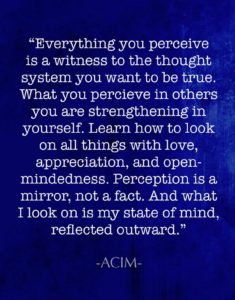
From “A Course In Miracles”. or ACIM.
Chapter 8: Man Was Created in God’s Image — But What Does That Mean?
“If the doors of perception were cleansed every thing would appear to man as it is, Infinite. For man has closed himself up, till he sees all things thro’ narrow chinks of his cavern.”― The Marriage of Heaven and Hell
What does it mean to be created in God’s image? Is it a divine mystery etched in ancient scriptures, a theological ideal meant to inspire humanity, or something far more personal and immediate? Perhaps it’s all of these. Yet, beyond these interpretations lies a more profound question—are we truly seeing one another, or even ourselves, as creations of divine love, or are we merely projecting our inner narratives onto the world around us?
Human perception is a powerful force. It colors every interaction, extending its bias to how we see others, the world, and God. If we fail to see with clarity and love, how can we truly understand the image of God—not just in others, but in ourselves?
We all view the world through a personal lens carved out by our experiences, beliefs, and biases. This is as true for the devout theologian as it is for the casual seeker. Ancient scribes inscribing wisdom may have described God’s image through parables, poetry, and powerful brevity, but today’s interpretations often scratch only the surface.
The roots of the challenge lie in the limitations of our perception. When you look at a friend, a lover, or even someone at odds with you, are you truly seeing them for who they are? Or are you crafting a version of them “in your image,” shaped by judgment, assumptions, biases, or maybe even fear? To gaze upon another unconditionally and without judgment is to break free of the shackles of perception and align with what could be God’s image—pure, unfiltered love.
But this is no easy task. Ancient scripts and doctrines may teach us lofty ideals but seldom prepare us for the gritty human challenges of seeing as God sees. It requires faith and intentional practice—the willingness to purify perception. This frontier seeks to bridge spirituality with practical, everyday existence.
If God is love, as many sacred traditions suggest, then it follows that seeing through the lens of love is the way we perceive God’s image. Picture this profound shift in consciousness;
What if you saw all others—friends, enemies, strangers—as extensions of that very same love?
What kind of world would you experience?
What kind of person would you become?
To see someone in love’s image is to accept every facet of their being—their beauty and their flaws—with grace and compassion. And when we remain in this loving consciousness, the very universe shifts around us. Love becomes the prism through which we experience all things. The barriers dissolve. Suddenly, you’re no longer standing apart from the world—you are a living, breathing reflection of it.
But this transformation must start from within. Before we can see others in God’s image, we must confront how we see ourselves. If your inner reflections are filled with judgment, guilt, or self-loathing, how can you expect to perceive others—or the divine—with clarity? The shift begins when we redirect the gaze inward and invite healing into our own hearts.
The phrase “created in God’s image” has inspired thousands of years of theological debate. It’s been weaponized to divide and uplifted to unite. But today, within a world increasingly defined by diversity, conflicting ideologies, and fractured relationships, understanding this ancient concept has never been more critical.
One of the core challenges is navigating the intersection between religious doctrine and modern interpretations. To many, the phrase still conjures literal notions tied to physical form, but what if “image” was never meant to describe outward appearances? Consider instead the essence of being—the deep compassion, wisdom, and oneness that mirrors divine qualities.
The dissonance arises when we fail to see past our own fragmented awareness. If our perception is clouded by prejudice, fear, or anger, then the divine image becomes obscured. But when those clouds lift—whether through faith, revelation, or self-work—clarity emerges. We begin to see, as one ancient tradition describes it, “closer than breathing, nearer than hands and feet.”
Personal spiritual awakenings often provide a glimpse of this deeper truth. Imagine standing on a mountain peak, the wind carrying the scent of pine, every sound muffled by the canopy of solitude. Suddenly, a stillness descends, and everything you’ve known falls away. At this moment, there is no separation between you and the world—every geological curves, every stream and boulder is not “out there” but inexplicably a part of you.
This revelation, as profound as it is humbling, was my experience in 1987, and at later times, and it uncovers an eternal truth. To know oneself deeply—to shed layers of identity and judgment—is to know God. And to know God is to recognize the inherent unity in all expressions of life. At such a level of awareness, one question lingers in every waking moment:
“How will I see myself today?”
When we begin to see all humanity as our family—all individuals as our brothers and sisters—it becomes impossible to perpetuate hatred, division, or isolation. Anger and pain, while natural, lose their grip. We are no longer bound by the wounds that once kept us trapped in separation.
The call to recognize humanity in God’s image is not reserved for scholars or mystics alone. It’s woven into the fabric of everyday interactions. It beckons us in simple yet radical ways—choosing peace when stirred by conflict, embodying love towards those who oppose us, or offering compassion to ourselves in moments of failure.
Reducing spiritual concepts to practicality doesn’t diminish their power; it amplifies them. Seeing God’s image in all life reminds us of our responsibility not just to humanity but to the Earth itself. When we care for plants, animals, and ecosystems with the same love we extend to a new child, we honor the divine in its fullest expression.
And even those moments of conflict—the family member whose actions spark anger, the stranger whose words wound us—become opportunities for transformation. Love, when extended in these moments, becomes the ultimate act of creating “God’s image” within and around us.
Religious and philosophical debates will always exist. Interpretations will vary across cultures and generations. But the question that persists is not “Who interprets this correctly?” but “How does this truth shape how we live?”
This broader view asks us to cross boundaries and extend dialogue. It challenges us to step outside fixed paradigms and engage in genuine, open discussions that foster collaboration rather than conflict. Love does not demand ideological conformity—it only asks for receptivity.
The phrase “Man was created in God’s image” carries an expansive truth waiting to be rediscovered. It’s not an abstract theological doctrine or a simple adage. It’s a calling—to see ourselves, others, and the divine with authenticity and love.
The dependency of perception on our worldview is no small thing. Begin by confronting your own filters. Reflect on how you see yourself and others. Ask yourself the question, “How will I view the world today?”
Start with love, carry it into every interaction, and watch the divine image reveal itself in ways you never imagined. The transformation begins within you. Don’t wait for tomorrow—embrace the reflection of truth today.
Do you want to begin a conversation with me about this subject? Be the first reader this year, other than my wife, to share your thoughts in the comments section.
Chapter 37: The Illusion of Divinity: Is God Just a Concept?
For millennia, humanity has looked toward the heavens and asked a singular, haunting question. We want to know if a supreme being orchestrates the cosmos or if we are entirely alone in an indifferent universe. This quest for meaning has sparked wars, built civilizations, and shaped the very foundation of human culture. Yet, the question itself might be fundamentally flawed, rooted in the limitations of our own language and perception.
Human beings are inherently bound by linguistic dualities. We understand light only because we experience darkness. We define silence by its contrast with noise. When we approach the concept of the divine, we drag this binary framework along with us, forcing the infinite into a rigid box of “is” or “isn’t.” We demand a definitive answer to a question that transcends the boundaries of human speech.
By examining the origins of our beliefs, we can begin to see that our spiritual debates might be nothing more than the restless chatter of a conscious mind trying to understand itself. The struggle to define divinity reveals far more about human psychology than it does about the architecture of the universe. To find any real truth, we must critically examine the mental constructs we have built around the idea of a creator.
For many, God is a concrete reality, a guiding force that provides comfort and moral direction. However, from a philosophical standpoint, this version of God is often an idea constructed in the mind of an ignorant human being. We create a deity in our own image, projecting human emotions like anger, jealousy, and love onto a cosmic scale. This anthropomorphic God serves to explain the unexplainable and soothe the terrifying realization of our own mortality.
Atheism, while positioning itself as the rational rejection of this deity, often falls into the exact same cognitive trap. The atheist vehemently denies the existence of a supreme being, but this denial still relies heavily on the original, human-made concept of God. By dedicating energy to opposing a specific conceptual framework, atheism remains tethered to it.
Both the devout believer and the staunch atheist are playing a game with the same set of linguistic rules. They are arguing over the existence of a concept born entirely from the human imagination. Neither side steps outside the boundary of thought to experience reality as it truly exists, free from the labels and definitions that constrain our understanding.
The Safe Harbor of Agnosticism
Recognizing the futility of this binary argument, many intellectual seekers retreat into the realm of agnosticism. Agnosticism asserts that the existence of the divine is unknown and perhaps fundamentally unknowable. On the surface, this appears to be the most logical and humble approach to the mysteries of the universe.
Yet, agnosticism often functions as a strategic avoidance of a debate that simply cannot be won by humans. It is a non-committal stance that acknowledges the limitations of human knowledge without actively trying to transcend them. The agnostic remains trapped in the world of linguistic dualities, paralyzed by the inability to prove or disprove a human-made concept.
While agnosticism provides a safe intellectual harbor, it does not offer profound spiritual liberation. It leaves the individual lingering at the threshold of understanding, aware of the conceptual mind’s limitations but unwilling or unable to quiet that mind. True realization requires stepping past the neutral zone and directly confronting the nature of consciousness itself.
The Birth of Duality and the Garden of Eden
To understand how we became so entangled in these conceptual traps, we can look to ancient myths. The story of the Garden of Eden is often read as a literal history or a simplistic moral fable, but it points to a truth that few will ever truly comprehend. The myth serves as a profound metaphor for the birth of human consciousness and the trauma of separation.
Before eating from the Tree of Knowledge, the first humans existed in a state of unity with their environment. There was no concept of nakedness, no shame, and no division. The act of eating the fruit symbolizes the sudden awakening of the conceptual mind. It brought the knowledge of good versus evil, right versus wrong, and self versus other.
In that sudden, glaring light of self-awareness, mankind created a God separated from itself. Divinity was pushed into the sky, while humanity was cast down to the earth. This psychological eviction from the garden represents the moment we began categorizing, labeling, and dissecting the universe, forever losing our innate sense of oneness with existence.
Since that metaphorical awakening, the human mind has achieved incredible feats. We have mapped the stars, split the atom, and built sprawling digital networks. The conceptual mind can evolve, adapting to complex problems and expanding its database of knowledge. Yet, despite all this progress, it never quiets itself enough to recognize the underlying truth of its own existence.
The mind is a machine designed to generate thoughts, categorize threats, and project future scenarios. It thrives on problems to solve and debates to win. When faced with the profound silence of true existence, the conceptual mind panics. It quickly fills the void with theories, theologies, and philosophies.
We try to think our way into spiritual enlightenment, reading sacred texts and debating metaphysical concepts. But thought itself is the barrier. The very tool we use to seek the divine is the instrument that keeps us separated from it. As long as we rely on the noisy, conceptual mind to understand the universe, we will remain lost in a maze of our own making.
The debate over whether God is, or isn’t, will continue to rage in academic halls and places of worship. However, the true spiritual journey begins when we finally lose interest in the debate. The evolution of human thought may eventually lead us to a point of exhaustion, where we realize that our words and concepts will never capture the infinite.
To experience the underlying truth of existence, we must cultivate the courage to sit in absolute silence. We have to observe the relentless chatter of the conceptual mind without attaching our identity to it. By creating space between our awareness and our thoughts, the illusion of separation begins to dissolve. We stop looking for a deity in the clouds and start recognizing the profound, unnamable presence that permeates every breath.
Drop the need to define the universe, and you might finally experience it.
