Here is the proposed logical structure for the 31 chapters, organized into distinct parts with a contemplative and philosophical tone.
Part I: The Foundations of Self and Consciousness
This section lays the groundwork, exploring the nature of existence, consciousness, and the individual’s place within the cosmos. It invites the reader to question the fabric of reality, the origins of thought, and the illusion of the separated self.
- The Birth of Consciousness and the Sacred Power of the Word
- The Three Minds: Understanding Your Cosmic, Collective, and Individual Self
- Human and Cosmic Resonance: A Guide to Spiritual Life
- Mysticism, Sensorial Joy, The Symphony of Silence and Sound in Human Perception
- Resonance, Rhythm, and the Musical Road to Cosmic Consciousness
Part II: The Inner Landscape and the Path of Healing
Here, we turn inward to examine the internal forces that shape our experience. This part delves into the complexities of trauma, grief, and addiction, guiding the reader through the often-turbulent terrain of the inner world toward healing and spiritual rebirth.
- The Power of Then: The Process of Reclaiming Disassociated Parts of Ourselves, And Healing Traumas from Present or Past Lives
- The Art of Inner Alchemy: How to Transform Trauma into Miraculous Healing
- No More Turning Away: Recovering From Suicidal Grief and the Lifelong Effects From Trauma
- Breaking the Silence – From Darkness to Divine Maternal Love: A Journey Through Trauma, Addiction, and Spiritual Rebirth
- The Journey from Suffering to Awakening
- When Dreams Die and the Path of Awakened Service
- Part of My Journey Through Love, Loss, and Our Collective Mental Health Crisis
- Exploring Healing Through Cosmic Energy and Divine Love
- June 22, 1987 Revisited: Beyond the Self: Healing Trauma and Finding the Divine Within
- July 21, 1987 Revisited: Finding Truth Within Yourself: A Journey Beyond the Mind’s Conditioning
Part III: The World of Dreams and Altered States
This section explores the mysterious realms of the subconscious and non-ordinary states of consciousness. It examines dreams, mindfulness, and psychedelics as gateways to deeper self-understanding, healing, and connection to the divine.
- The Contemplative Practice of Insight and Mindfulness: A Journey Through Waking Life and Dreams
- Insight and Mindfulness: A Journey Through Dreams
- The Nocturnal Nexus: Where Dreams Unify Brain, Soul, and Self
- Exploring the Mystical Realms: Dreams as a Gateway to Self-Healing and Empowerment
- Some Of My Important Dreams from 1964-2018
- Life, Love, and Death on Unlimited Bandwidth: The Potential of Psychedelics For Healing and Insight
Part IV: Society, Spirit, and the Crisis of Meaning
This final section broadens the focus to the collective, examining the intersection of spirituality, politics, and social justice. It critiques the corruption of faith, the rise of toxic ideologies, and the urgent need for a new, healed masculinity and a trauma-informed approach to activism.
- The Transformative Power of Resonance, Empathy, and Shared Consciousness in Healing
22 Merged with 23?
- Empathy and the Mystery of the Path Between You and Me
- The Mind Virus at Work: How Propaganda Masters Twist Cultural Symbols to Influence Us
- Trump and The Deification of a Demon: Ignorance, Power, and a World Ablaze
- The Protest Movement Against Trump’s Autocratic Leadership and Trauma Responses
- The Contradictions of Faith and Power: Donald Trump and the Divergence from Historical Christianity
- Navigating Faith In A Dark Age: Disentangling Corrupted Christian Practices from Democracy’s Fabric
- Healing Our Nation: A Call for a New Masculinity
- Anger as Sacred Human Energy: A New Perspective on Spiritual Integrity
- Sexuality as a Sacred Gateway: Transcendence Through Intimate Connection
Chapters Recommended for Elimination or Merger
The following chapters are recommended for elimination or merger because their core concepts are either redundant or can be more effectively integrated into other, broader chapters. This consolidation will create a more focused and potent narrative arc.
The Transformative Power of Resonance, Empathy, and Shared Consciousness in Healing: This chapter can be merged with
Chapter 23: Empathy and the Mystery of the Path Between You and Me. Both explore the critical role of empathy and resonance in healing, and combining them will create a single, more comprehensive chapter on the subject.
Insight and Mindfulness: A Journey Through Dreams: This chapter’s themes are a direct overlap with
Chapter 16: The Contemplative Practice of Insight and Mindfulness: A Journey Through Waking Life and Dreams. Merging them will strengthen the primary chapter and avoid repetition.
Exploring Healing Through Cosmic Energy and Divine Love: The ideas in this chapter can be woven into
Chapter 13: Part of My Journey Through Love, Loss, and Our Collective Mental Health Crisis, as it provides a spiritual and cosmic perspective on the healing journey discussed.
Human and Cosmic Resonance: A Guide to Spiritual Life: This chapter’s content is foundational and can be absorbed into
Chapter 2: The Three Minds: Understanding Your Cosmic, Collective, and Individual Self to provide a practical guide within the broader theoretical framework.
The Journey from Suffering to Awakening: The principles discussed here, especially the 12-step methodology, can be integrated into
Chapter 10: Breaking the Silence… A Journey Through Trauma, Addiction, and Spiritual Rebirth to offer a practical framework for the transformation described.
June 22, 1987 Revisited & July 21, 1987 Revisited: These two highly personal and date-specific chapters could be merged into a single chapter titled “Revisiting 1987: A Journey from Trauma to Truth” or have their key insights integrated into
Chapter 12: Part of My Journey Through Love, Loss, and Our Collective Mental Health Crisis to serve as powerful case studies within the author’s broader narrative.
The Nocturnal Nexus: Where Dreams Unify Brain, Soul, and Self: This chapter should be merged into
Chapter 17: Insight and Mindfulness: A Journey Through Dreams, as it provides a deeper scientific and spiritual explanation of the dream process already being explored.
- Logical Reordering: The 31 chapters were analyzed and sorted into a logical progression, starting with the nature of self, moving through personal healing and altered states, and concluding with a critique of societal and political issues.
- Thematic Sectioning: Chapters were grouped into four distinct, thematically coherent parts, each with a title reflecting the introspective and philosophical tone of the work.
- Chapter Elimination/Merger: Seven chapters were identified as having overlapping content. Specific recommendations were provided for merging them into broader chapters to improve the book’s flow and eliminate redundancy.
Here is a proposed logical structure for the 33 chapters, organized into distinct parts with an introspective and philosophical tone.
Part I: The Foundations of Self
This section lays the groundwork, exploring the nature of existence, consciousness, and the individual’s place within the cosmos. It invites the reader to question the very fabric of their reality and identity.
- The Riddle of Existence
- Unveiling Consciousness
- The Illusion of the Self
- Beyond the Senses
- Our Cosmic Connection
- The Nature of Reality
Part II: The Inner Landscape
Here, we turn inward to examine the internal forces that shape our experience. This part delves into the complexities of thought, emotion, and the subconscious mind, guiding the reader through the often-turbulent terrain of their inner world.
- The Labyrinth of Thought
- Navigating the River of Emotion
- Shadows and Light: The Duality Within
- The Power of Intention
- Memory and Identity
- The Roots of Suffering
Part III: The Dance of Duality and Union
This section explores the fundamental polarities of life and the path toward their integration. It addresses the tension between opposing forces—love and fear, ego and soul—and illuminates the journey toward wholeness.
- The Ego’s Domain
- The Soul’s Purpose
- Love as a Universal Force
- The Echoes of Fear
- The Balance of Masculine and Feminine
- Solitude and Connection
Part IV: The Path of Transformation
Building upon the foundational concepts, this final part offers pathways for conscious evolution. It moves from theoretical understanding to practical application, focusing on the transformative practices that awaken higher states of being.
- The Art of Surrender
- Awakening the Inner Healer
- Creation and Manifestation
- Synchronicity and Flow
- Embracing Impermanence
- Transcending the Known
- The Journey of Ascension
- Living in Higher Truths
Chapters for Elimination or Merger
The following 7 chapters are recommended for elimination or merger as their core concepts are either redundant or can be more effectively integrated into other, broader chapters. This consolidation will create a more focused and potent narrative arc.
- Thinking and Being: Can be merged into Chapter 7: The Labyrinth of Thought. “Thinking and Being” is a foundational concept that is naturally explored when dissecting the nature of thought itself.
- The Mystery of Life: The themes are too broad and are better addressed throughout Part I: The Foundations of Self, particularly within Chapter 1: The Riddle of Existence.
- Understanding Emotions: This is a direct conceptual overlap with Chapter 8: Navigating the River of Emotion and should be merged to avoid redundancy.
- Healing the Past: Can be integrated into Chapter 20: Awakening the Inner Healer, as healing the past is a fundamental aspect of the inner healing process.
- Finding Your Path: This idea is a central theme woven through the entire book, but its essence can be specifically absorbed into Chapter 14: The Soul’s Purpose.
- The Nature of Love: This is fully encompassed by the more expansive Chapter 15: Love as a Universal Force. Merging them will strengthen the core chapter.
- Spiritual Growth: This concept is the overarching goal of the entire manuscript. Rather than being a standalone chapter, its principles should be woven into Part IV: The Path of Transformation, especially Chapter 26: Living in Higher Truths.
Summary of Changes:
- Logical Ordering: The 33 chapters were organized into a 26-chapter structure, flowing from foundational concepts to practical transformation.
- Thematic Sections: The chapters were grouped into four distinct parts (“The Foundations of Self,” “The Inner Landscape,” “The Dance of Duality and Union,” and “The Path of Transformation”) to create a clear narrative progression for the reader.
- Chapter Elimination/Merger: Seven chapters were identified as redundant or too narrow in scope. Recommendations were provided to merge them into more comprehensive existing chapters to improve flow and eliminate repetition.
- Tone Alignment: Section titles and descriptions were written to align with the introspective, philosophical, and thought-provoking brand voice.
Chapter 34-64 Full Versions
Chapter 34: Healing Our Nation: A Call for a New Masculinity
(formerly 50) The floodwaters of gun violence cannot be contained by building higher walls of defense. The dam of our collective mental health has already burst. We must go upstream and address the source. This requires a radical reimagining of masculinity itself.
The path forward is not through more guns, but through healing the wounds that make them seem necessary. It demands:
- Insight: We must become conscious of the destructive mental programming—the toxic masculinity—that our culture has passed down through generations. We need to confront our collective darkness and acknowledge the damage our fears have inflicted.
- Collaboration and Unity: The divisive, hateful reasoning that pits citizen against citizen must be rejected. We must build coalitions across political and social divides, united by a common goal of creating a safer society for all. This means elevating the voices of women and others who offer different perspectives on power and community.
- Justice: True justice involves holding accountable those who profit from this cycle of violence—from gun manufacturers to the politicians who feed at their trough. It means enacting common-sense regulations that treat gun violence as the public health crisis it is.
- Love: Ultimately, the antidote to fear is love. It is the conscious cultivation of empathy, compassion, and a recognition of our shared humanity. If we truly love ourselves and our fellow citizens, we have no need for weapons of war.
It is time for men to lay down their arms—both physical and philosophical—and begin the difficult work of healing. It is time to stop letting emotionally stunted children, trapped in adult bodies, run our world into ruin.
This is not a political statement; it is a declaration of common sense, reason, and love. Let us challenge the defective ideas that have held our country hostage for too long. Let us vote out of office every politician who supports politically sanctioned mass murder. And let us have the courage to build a culture where a man’s strength is measured not by the weapon in his hand, but by the integrity in his heart.
An American society dominated by the self-destructive and other-destructive fantasies of sick minds, including the pseudo-Christian “Christian Nationalists” who believe in Armageddon, and who are doing everything in their power to create the conditions for it), have created this unsafe, upside down world where weapons of mass destruction are worshiped as tools of freedom and safety, rather than being seen for what they are, which are tools for murder, propagation of fear, bullying, and self-righteousness.
I wrote this chapter as a direct reaction to my relationships with my father and my male friends and acquaintances over my lifetime, and my employment experience while working with toxic men in the electrical trades from 1987 to 2016, and at the US Postal Service from 1975-1985. The historical legacy of the American white man, and his support network of unconscious, disempowered, fearful and/or cowardly family, religious, and community members, continues unto today. America has normalized that which should never have been acceptable.
How can we possibly “make America great, again”?
Greatness only comes after we, as a society, face our collective darkness, cease our threatening or bellicose behavior against all we disagree with, acknowledge the damaging impacts of our fears on others, makes amends to ALL we have harmed, and find integrity, and stay on a more humane path in the future.
I urge you to join this movement of healing. Raise awareness about the insidious influence of toxic masculinity. Support violence prevention programs in your community. Most importantly, have the courage to share these insights and challenge the dangerous narratives that have brought our nation to this breaking point. Our collective future depends on it.

- Service Over Ego “I recognize that leadership means service, and my purpose is to uplift others, not dominate them.” Unlike toxic narratives that place the self above all, the divine masculine sees himself as part of a larger whole. His worth is measured not by control, but by his ability to nurture and empower those around him.
- Love as Power, Not Weakness “I embody love as the highest form of spiritual and human strength.” The healed masculine understands that love is not a vulnerability but the essence of true power. This love is expressed openly and warmly, dissolving fear and building connection.
- Healing Wounds, Not Passing Them On “I face my own shadows with courage and release old patterns that harm myself and others.” A spiritually sound man takes accountability for his traumas and seeks healing so that generational wounds are not passed forward in cycles.
- Alignment with Nature and Spirit “I honor the Earth as sacred and align my actions with its well-being.” Instead of exploiting the natural world for profit, the divine masculine safeguards nature knowing it mirrors his own balanced inner world.
- Accountability Over Denial “I take full responsibility for my actions and view growth as a lifelong process.” Rather than brush off mistakes, the spiritual masculine embraces them as opportunities to grow, proving that vulnerability is a strength, not a flaw.
- Connection, Not Control “I seek collaboration and mutual respect in all relationships.” Rather than see others as tools or possessions, the healed masculine treats people as equals, fostering trust, respect, and honest communication.
- Wisdom in Transparency “I value truth and speak it with clarity and compassion.” Deception has no place in the divine masculine. Lies are replaced with honesty, and transparency is wielded as a tool for creating deep relationships.
- Fearless Emotional Expression “I invite my emotions to flow freely, knowing they connect me to my humanity.” Unlike the toxic suppression of feelings, the healed masculine is unafraid to cry, express joy, or admit when he feels fear. Emotional bravery becomes his strength.
- Protecting Through Peace “I protect not through aggression but through unwavering peaceful resolve.” The spiritual masculine has no need for needless violence. Protection comes from a calm inner strength capable of de-escalating hostility.
- Equality in Relationship “I view women and all people as complete and equal beings, deserving of dignity and respect.” Instead of seeing others as extensions or possessions of himself, the healed masculine seeks relationships built on mutual empowerment.
- Unity with the Feminine Within “I honor the divine feminine within myself and others as a source of balance and creation.” The spiritually sound man integrates both masculine and feminine energies, understanding this unity fosters a deeper connection to himself and the world.
- Power as Collective Growth “I use my strength, voice, and gifts in service of the collective good.” The healed masculine views power solely as a means to create abundance, connection, and progress for everyone around him.
- Anger Transformed into Action “I use my anger as a source of constructive change, never as destruction.” The spiritual masculine experiences anger without repression but channels it into just, non-violent action for progress and healing.
- Strength in Listening “I honor the voices of others, listening deeply before responding.” True strength is found in stillness and listening. His voice may be powerful, but it yields space when others need to share their truths.
- Honoring Life’s Cycles “I trust the wisdom of beginnings, middles, and endings in all things.” The spiritual masculine understands impermanence and accepts change not with fear, but with grace and adaptability.
- Partnership as Sacred Union “I cherish relationships as opportunities to co-create and worship the sacred in one another.” Rather than delegating relationships to dynamics of control, the spiritual masculine sees love as a realm where divinity is continually rediscovered.
- Truth Over Denial “I face and acknowledge even the most uncomfortable truths with openness.” The healed masculine does not retreat into escapism or denial but meets life’s challenges with clarity and integrity.
- Creativity as Manifestation “I wield my creativity not for conquest, but for beauty, healing, and connection.” The divine masculine brings forth his ideas not from a place of self-serving ambition but from love for humanity.
- Legacy of Healing, Not Harm “I seek to leave behind a world more healed and united than the one I entered.” The healed masculine builds legacies that inspire peace, foster equality, and create harmony for generations to come.
- A Soul Open to Transformation “I welcome transformation as the path to becoming my higher self.” The spiritual masculine is not rigid; he evolves, sheds, and grows as he seeks greater alignment with his true essence.
The divine masculine invites men, and all those wrestling with the wounds of toxic masculinity, to step into their fullest potential. It is time to heal ourselves and dismantle structures built on fear and domination, replacing them with systems grounded in empathy, balance, and love. Transformation begins with a single question, courageously whispered into the stillness of our hearts:
Who am I, and how can I embody love?
Chapter 35: The Birth of Consciousness and the Sacred Power of the Word
(formerly 51) We are about to embark on a creative, sweeping tour through the epochs of human history, traveling back perhaps a million years or more—to a time when our ancestors first stirred with the trembling awareness we now call consciousness.
What was our mental atmosphere like in those primordial days, when mankind was first becoming conscious of itself? With humanity’s violent history, the survival-of-the-fittest evolutionary imperative pressing upon every heartbeat, and the omnipresent fear of dangerous predators and hostile strangers, what can we speculate about the original nature of that nascent consciousness?
Based upon our present understanding of anthropology, psychology, and evolutionary biology, could we surmise that trauma and suffering have accompanied mankind from the very beginning of our conscious—and semi-conscious—presence upon planet Earth? Are the Garden of Eden narrative and countless other myths and legends from cultures around the world merely stories created by ancient peoples seeking answers to the same fundamental questions that haunt us still?
These questions are riddled with assumptions. The answers we supply are necessarily subject to speculation, interpretation, and the revisionist tendencies inherent in all historical inquiry. We must apply the combined tools of historical, anthropological, sociological, psychological, mythological, cinematic, and spiritual analysis in any endeavor of this magnitude. Yet even with these sophisticated instruments, I can only touch upon the highlights of this vast epoch of humankind. You should not believe me any more than you might believe the scientists, anthropologists, sociologists, and biblical scholars who have undertaken their own studies and sincere attempts at understanding.
We need only look within ourselves, examine our own pasts, to see how uncertain and malleable our memories truly are. Then extrapolate that fragility to our collective human history, which suffers from similar short-term, medium-term, and long-term memory loss. We begin to comprehend how nearly impossible it is to accurately recall and recreate memories from times long past—especially from the periods when we ourselves were infants or children, though the recollections of others, coupled with psychological insight, can assist in this daunting journey of discovery.
The last thing I wish to do is create “alternative facts” or implant false memories that were never real, mimicking the malicious tactics of modern fake news generators and conspiracy theorists. Without substantial recorded history and comprehensive archaeological evidence, careless investigation can devolve into yet another Rorschach test for inquiring minds—we see what we wish to see, confirm what we already believe. The best way to arrive at genuinely new answers is to ask radically new questions.
We attempt to create our best representation of what we believe the truths might have been in the earliest iterations of mankind—those times that existed before verbal accounts were passed down through generations, before the written word captured and preserved human experience. Though our present civilization possesses only about 4,500 years of written records, some cultures maintain historical narratives that appear to have been transmitted orally for at least 30,000 years.
The Aboriginal peoples of Australia claim an unbroken narrative stretching back 60,000 years. Central and South American indigenous peoples and their shamans similarly assert lineages spanning tens of thousands of years. These oral traditions, passed from elder to child across countless generations, represent humanity’s longest-running stories—though we in the Western world have only recently begun to honor their profound significance.
Western European civilization appears to be an outgrowth of migrations from African tribal communities at least 13,000 to 30,000 years ago. Cave drawings discovered in Spain and France demonstrate sophisticated artistic capabilities dating back approximately 30,000 years, along with apparent forms of animal and spirit worship. Other caves have revealed even earlier creative endeavors. In one amazing though controversial recent discovery, researchers uncovered a cave purported to possess chiseled storage cubicles that, according to carbon dating, may be one million years old.
These discoveries humble us. They remind us that the universe—and our place within it—extends far beyond the limited bandwidth of our conscious awareness, much as the electrical currents I worked with as an electrician flowed through systems largely invisible to the naked eye yet undeniably real and powerful.
From Grunts to Grammar: The Evolution of Language
The earliest human creatures communicated primarily through gestures, grunts, and body language. Their evolving vocal cords eventually joined the conversation at some unknown point in the distant past, adding another dimension to human expression. Gradually, they standardized certain verbal sounds—utterances that became words meant to represent what they were seeing, doing, using, or eating.
This was no small feat. Imagine the cognitive leap required to agree collectively that a particular sound—repeated with reasonable consistency—would forever represent the experience of water, or fire, or danger, or love.
Eventually, mankind made the quantum leap to symbolic writing. Animal and plant forms once etched to symbolically represent aspects of daily life were replaced by crude symbols, which evolved into hieroglyphics, and then into cuneiform alphabets. It must have seemed like magic to the first humans who realized—and then taught others—that their thoughts could be approximated and shared through an ever-evolving system of symbolic representation.
The creation or formation of a new world had been made possible through words and concepts arising in evolving consciousness. Formerly, there existed mainly biological systems with limited freedom of choice, responding to environmental influences with instinctual responses coupled with real-life experience conditioning—meeting the needs of the body and whatever family or community existed around them. We might call that realm the “real world,” as it dealt with the harsh realities of existence not yet under the subjugation of the human mind.
With the advent of symbolic representation of the real world, a concurrent yet alternate “reality” was created—one that existed solely in the minds of those entertaining these new concepts and symbols. Intelligent, abstract thinking emerged, though it has never been universal, even in our modern times.
To the extent that this alternate mental reality matched up with the conditions of the tangible world, we can say that becoming verbally conscious represented an extraordinary evolutionary leap for humanity. We now lived in two intimately related worlds: that of our biology, and that of our minds.
Once symbology enters the human mind, absolutely remarkable—if not miraculous—phenomena begin appearing. Consciousness expressing itself through symbology appears to possess a self-organizing principle innate to its nature. As it weighs, measures, and assigns names to the objects of its awareness, a personal sense of being is simultaneously introduced into the biological system entertaining the symbology.
Thus, the “word”—or the act of first recognizing that a verbal sound or specific set of symbols can represent an environmental influence—becomes the initial generative force behind the creation, or awakening, of the personal sense of self. The word was made flesh, as the mystical literature proclaims. Our identity emerged from language itself.
This process appears irreversible under normal circumstances, though many seekers of truth and spiritual knowledge throughout time have claimed that by meditating upon their body, their biology, and their breath—rather than the endless stream of words, thoughts, and concepts that seem constantly present—a door may open, revealing the possibility of experiencing consciousness beyond or before language.
Helen Keller: A Modern Witness to the Birth of Self
I began this chapter with a question about when mankind first became “conscious,” and the remarkable story of Helen Keller provides an extraordinary account of that very process—a process each of us underwent in early childhood, though few remember it with such clarity.
Helen Keller was born in 1880 in Tuscumbia, Alabama. At nineteen months old, she contracted an illness—possibly scarlet fever or meningitis—that left her both deaf and blind. Trapped in a world without sight or sound, Helen existed in what might be described as a pre-linguistic state, communicating through crude signs and physical gestures, often erupting in fits of frustration and rage when her needs went unmet or misunderstood.
Her family hired Anne Sullivan, a partially blind teacher who had overcome her own difficult childhood, to work with Helen. Anne’s task seemed nearly impossible: to reach a child who could neither see her face nor hear her voice, to somehow bridge the chasm between Helen’s isolated consciousness and the symbolic world of language and meaning.
For weeks, Anne spelled words into Helen’s hand using the manual alphabet, hoping Helen would make the connection between the finger movements and the objects they represented. Helen learned to mimic the finger movements, but without comprehension—they were merely a game, patterns without meaning, gestures without substance.
Then came the transformative moment that Helen would later describe as her spiritual and intellectual birth.
On April 5, 1887, Anne brought Helen to the water pump in the yard. As cool water flowed over one of Helen’s hands, Anne spelled out the word “W-A-T-E-R” into Helen’s other hand, slowly and deliberately. In that singular instant, Helen made the connection between the tactile sensation of the liquid and the finger-spelled word. Her world exploded open.
Helen later wrote about this pivotal experience: “I stood still, my whole attention fixed upon the motions of her fingers. Suddenly I felt a misty consciousness as of something forgotten—a thrill of returning thought; and somehow the mystery of language was revealed to me. I knew then that ‘w-a-t-e-r’ meant the wonderful cool something that was flowing over my hand. That living word awakened my soul, gave it light, hope, joy, set it free!”
Understanding the word and its symbolism opened the miraculous door to Helen’s sense of self. Both phenomena—the comprehension of symbolic representation and the emergence of individual identity—arose concurrently, inseparable and mutually generative.
Before that moment, Helen existed in a more purely biological, instinctual state—what we might call a pre-symbolic consciousness. After that moment, she possessed a self that could name, categorize, understand, and communicate. She had entered the world of language, and with it, the world of human culture, history, and collective meaning.
Helen Keller’s awakening provides a window into what may have occurred at the dawn of human consciousness itself. When was mankind’s first “W-A-T-E-R” moment? When did the first human being grasp that a sound or symbol could represent an object or experience, and in that recognition, suddenly possess a self that was separate from—yet connected to—the world around them?
One of the most mystical quests in understanding human evolution is the search for the very first word uttered at the dawn of consciousness—that primordial utterance that began our inexorable transition out of a previous, purely nature-connected state into the symbolic realm we now inhabit.
Helen Keller’s new sense of self arose from a life-giving, sustaining symbol—water, that essential element without which no life can exist. She grew into a creative, profound, and spiritually wise human being, beloved by all who knew her, despite obstacles that would have crushed most people. Her consciousness, awakened by language, flourished into wisdom, compassion, and extraordinary insight.
I often reflect that I might have had a profoundly different early childhood had the first word I learned been the unifying, life-giving word “W-A-T-E-R” rather than the divisive, confused, abandoned experience I had around the words “M-O-T-H-E-R” and “F-A-T-H-E-R.” My experience was definitely not of the same nature as Helen’s, though I have found my own path to understanding and am now loved by my wife and even my pets.
The Word Made Flesh: Biblical and Mystical Perspectives
In the mystical literature of the Bible, as recorded through the words of the New Testament scribe John: “In the beginning was the Word, and the Word was with God, and the Word was God… And the Word became flesh and dwelt among us.”
This profound statement resonates with what we observe in human development. The word—language, symbolic representation—does indeed become flesh. It incarnates in our neural pathways, shapes our perceptions, structures our reality, and ultimately creates the sense of individual selfhood that we carry throughout our lives.
We cannot be certain what the first words taught to each other in the dawning times of human consciousness were. However, based on historical and anthropological evidence, it seems likely that the language of survival, defense, hunting, eating, and sexual activity probably dominated early language-building cultures. Words for immediate needs—danger, food, water, shelter, family—would have provided the most obvious survival advantages.
Yet we must ask: Does anyone really know the way back “home”? Would we return to a pre-verbal or non-verbal state of being, or would we recognize words for what they are—useful tools rather than ultimate reality—and use them with more consciousness, love, and care? Perhaps we will discover that words possess only limited, relative value rather than absolute value in the search for our deepest origins and truest nature.
Jesus himself, in the New Testament, makes cryptic statements that seem to point toward this understanding: “Unless you are born again, you cannot enter the kingdom of God,” and “It is easier for a camel to go through the eye of a needle than for a rich man to enter the kingdom of God.”
Even biblical writers understood the profound difficulty of returning to—or discovering for the first time—a state of consciousness that transcends our identification with words, concepts, and the symbolic structures we’ve built around ourselves. The “rich man” might represent not merely material wealth but the accumulated conceptual wealth—the thick layers of beliefs, ideas, and linguistic structures—that separate us from direct experience of reality.
The Emergence of Individual and Collective Identity
With the advent of community-shared symbology, yet another evolutionary development occurs: our cultural identity, or the collective sense of self. We now live not only in two worlds—the biological and the mental—but also carry two identities: our individual sense of self and our collective/cultural self. Though rarely unified into one harmonious whole, both travel with us wherever we go.
Our history—particularly our written “recorded history”—has been crafted to accommodate the prevailing victorious powers and understandings of the age in which it was first composed. There are two or more sides to every story, and the epic of mankind certainly could be defined historically by its nearly infinite number of interactions between members of its worldwide community, with all the resultant stories derived through those connections, whether ordered or chaotic in nature.
Yet in the interest of brevity and our need to create order from the apparent chaos of limitless multitudes, we tend to select the stories that appear to carry the ethos of the age in which they originated and which support our own perceptual agendas. Thus is history created and maintained by institutionalized powers, then transferred to all members of the community as accepted truth.
This process mirrors what I observed throughout my career as an electrician, and later in “An Electrician’s Guide to Our Universe and a Life, Love, and Death on Its Unlimited Bandwidth”—the way complex systems can be understood through simpler organizing principles, the way invisible forces shape visible realities, the way energy flows through structured pathways that both enable and constrain its expression.
In the distant past, and even today among the few remaining uncivilized indigenous tribes, the mother, father, and whatever supportive community existed passed all their wisdom and knowledge about hunting, tool construction and use, gathering, childbirth and child-rearing, wound care, fire building, and survival to the children until they reached maturity. Today, our parents and our culture continue this same process, transferring knowledge—sacred or mundane—to our children.
We have more than biological evolution; we also experience ongoing emotional, intellectual, and spiritual evolution. Our recorded history shows our capacity to philosophize and form creative narratives about what the world once was, what it is now, and where it might be heading. Our vision of what the world once was remains necessarily speculative, and just as our ancestors wrote their own histories, they proposed myths and legends to explain what pre-existed their own lives.
The Feminine Principle: Suppressed Wisdom
Our myths and legends serve us well in preserving ancient wisdom, and many times they complement what we have discovered through the sciences, spiritual literature, and our intuitive natures. Yet we must examine critically whose stories get told, and whose get suppressed.
Who tells the story? Many times, the greatest, most courageous and intelligent heroes of our species remain anonymous, though their stories were captured by others. They died before they could create their own narratives, so the survivors—usually less qualified and relatively more uninformed—become the historians. Their version, not the story of the real heroes, gets accepted as the authoritative account. Religious texts abound with such revisionism. American history has similarly suffered under the need to present the prevailing propaganda of each era, looking back and interpreting others’ historical accounts of what actually transpired, molding them into more self-supporting and self-aggrandizing cultural narratives.
When we lived under the law of “survival of the fittest,” we needed to use all our physical, emotional, and intuitive resources at maximum capacity, coupled with community and individual wisdom, to avoid becoming a meal for a stronger, hungrier predator. Biologically, males of our species were usually blessed with greater physical strength and size, while females, through their capacity for pregnancy and childbirth, were the literal carriers of the species’ future—plus messengers from a deeper realm of human potential through their heightened intuition and earth-centered wisdom.
Women within many ancient cultures were regarded as healers and carriers of “medicine.” They were loved, honored, respected, and protected by the community for these very reasons. Modern anthropological studies continue to confirm that early indigenous women were held in at least as high esteem as the hunter-gatherer-warriors of ancient times. We can therefore surmise that in our prehistory, a balance between masculine and feminine—through mutual understanding, acknowledgment, and equality—existed and supported the good of all.
Yet as communities grew larger and resources became scarcer, this equilibrium became disturbed. Size indicated prosperity, and larger communities either traded with friendly neighbors or defended against—or attacked—others seeking resources for their own tribes. As our history shows an almost universal, steady progression of conflict and warfare, cultures took their strongest citizens and made them into defenders or aggressors to preserve tribal rights to resources.
Biologically, male warriors were usually considered the best choice for this role, and an entire consciousness eventually developed around that biological difference. A destructive pattern emerged: the best male might be considered the one who brought home the most game, gathered the most resources, raised the most crops (a later development), or proved most fearless and aggressive within certain community-prescribed limits.
The best female, by contrast, became defined as the one most willing to support the hunter-gatherer and defenders through family support, home maintenance, meal preparation, healing of wounds, and birthing and raising children—especially while the men pursued their “important” business.
The Serpent’s Wisdom: Reclaiming Earth-Centered Consciousness
There exists a profound imbalance within the field of human spirit. Masculine energy has dominated our species’ relationship with the universe, the world, the plants and animals, and with each other for most of recorded time—and well before the human race possessed any capacity to keep records.
In the Hebrew-based mythological story of the Garden of Eden, we even witness the scapegoating of the female for listening to the voice of the serpent, which represents the very voice of developing consciousness itself. With eating of the fruit from the tree of knowledge of good and evil, man and woman approach divine knowledge, forever leaving their original unconscious state of being.
The serpent in this ancient narrative remains a fascinating, enlightening archetypal image. The serpent maintains constant contact with the ground or with the limbs of trees, depending on where it lives, so it serves as a powerful metaphor for those in continuous contact with our planet. Mothers possess a much more earth-centered understanding of life, being the literal bearers of human life itself. As the Earth gave life to us, so did woman give life to humanity.
Women learned early about Earth’s capacity to heal through judicious application of its plants and herbs. Women tended to perceive a more complete picture than men, due to the very constitution of their neural networks and hormonal systems. Women tended to see the forest while men obsessed about individual trees. And in a tragic later development, these more earth-attuned women were actually persecuted and burned at the stake for being “witches”—their earth wisdom reframed as evil sorcery.
The serpent is also recognized for the way it instinctively strikes when feeling threatened, so as a continuation of the metaphor, it represents our instinctual needs—our natural reflexes, sexual drives, and self-preservation impulses. In some early cultures, the serpent was worshiped as a deity; in others, it was feared as a demon—probably because of the pain, suffering, and sometimes death that resulted from failing to honor its nature or avoid those species with venom.
Neurological Differences: The Science Behind Gender Perception
Before delving deeper into how these historical patterns manifest in our modern consciousness—what I call “the Common Knowledge Game” in “An Electrician’s Guide to Our Universe”—it’s beneficial to examine some physiological similarities and differences between male and female brains, and how we process information and express ourselves as a result.
Research reveals major distinctions between male and female brains in four primary areas: processing, chemistry, structure, and activity. The differences in these areas appear across cultures worldwide, though scientists have also discovered exceptions to every gender-based rule. Some boys display great sensitivity, talk extensively about feelings, and generally don’t conform to stereotypical “boy” patterns. As with all generalizations, no one way of functioning is inherently better or worse—these are simply typical patterns in brain functioning.
Processing: Male brains utilize nearly seven times more gray matter for activity, while female brains utilize nearly ten times more white matter. Gray matter areas are localized information and action-processing centers in specific regions of the brain. This can translate to a kind of tunnel vision when deeply engaged in a task or activity—they may not demonstrate much sensitivity to other people or their surroundings during focused work.
White matter constitutes the networking grid connecting the brain’s gray matter and other processing centers. This profound difference probably explains why females tend to transition between tasks more quickly than males and why, in adulthood, women are often superior multitaskers while men excel in highly focused, task-specific projects.
Chemistry: Male and female brains process the same neurochemicals but to different degrees and through gender-specific body-brain connections. Dominant neurochemicals include serotonin (which helps us sit still), testosterone (our sex and aggression chemical), estrogen (a female growth and reproductive chemical), and oxytocin (a bonding and relationship chemical).
Because of differences in processing these chemicals, males on average tend to be less inclined to sit still for extended periods and tend to be more physically impulsive and aggressive. Additionally, males process less of the bonding chemical oxytocin than females. A major takeaway: our boys sometimes need different strategies for stress release than our girls.
Structural Differences: Females often possess a larger hippocampus—our primary memory center—and frequently have higher density of neural connections into the hippocampus. Consequently, girls and women tend to absorb more sensory and emotional information than males. By “sensory,” we mean information from all five senses. Observation confirms that females tend to sense significantly more of what’s happening around them throughout the day and retain that sensory information more effectively than men.
Additionally, before birth, male and female brains develop with different hemispheric divisions of labor. The right and left hemispheres aren’t organized identically. For instance, females tend to have verbal centers on both sides of the brain, while males tend to have verbal centers only in the left hemisphere. This represents a significant difference.
Girls tend to use more words when discussing or describing incidents, stories, people, objects, feelings, or places. Males not only have fewer verbal centers generally but also often have less connectivity between their word centers and their memories or feelings. When discussing feelings, emotions, and sensory experiences together, girls tend to have both an advantage and greater interest.
Blood Flow and Brain Activity: The female brain, thanks to greater natural blood flow throughout the brain at any given moment (more white matter processing) and higher blood flow concentration in a region called the cingulate gyrus, will often ruminate on and revisit emotional memories more than the male brain.
Males, generally, are designed somewhat differently. They tend to reflect more briefly on emotional memories, analyze them somewhat, then move to the next task. During this process, they may choose to shift to active, feeling-unrelated activities rather than continue analyzing emotions. Thus, observers may mistakenly believe boys avoid feelings compared to girls or rush to problem-solving prematurely.
These four natural design differences represent just a sample of how males and females think differently. Scientists have discovered approximately one hundred gender differences in the brain, and the importance of these differences cannot be overstated. Understanding gender differences from a neurological perspective not only opens the door to greater appreciation of the different genders but also calls into question how we parent, educate, and support our children from young ages.
Biblical Oppression and Its Lasting Impact
There appears to be a physiological reason in brain structure for why men and women experience life differently. Men and women tend to process information and emotions somewhat differently. Women tend to think more globally and network outwardly with others—and within all centers of their own brains—better than males.
Yet both men and women have access to various processing styles depending on their internal natures and intentions. Through proper training, intention, and insight, men can process information and emotions in more intelligent, balanced, loving ways. Men can become significantly more interested in and sensitive to others’ needs and their own emotional needs if this becomes a conscious intention. Studies show that internal brain structure can change even after reaching adulthood. Men can become much more “feminine” in how their brains process emotions and information, demonstrating the powerful transformative force that conscious “nurture” exerts upon “nature.”
The Bible contains numerous revealing statements about the subjugation and disempowering of women, all in the name of maintaining “Godly” relations. The Christian Bible is replete with pronouncements relegating women to the background of the church and all relations with life. This oppression of women and repression of so-called “feminine characteristics” within males have been historically inculcated into the traditions of religious institutions, reflected in diseased and imbalanced relationships between certain Christian and Jewish bodies of thought and the world generally.
Consider these passages:
“For man was not made from woman, but woman from man.” (1 Corinthians 11:8)
“Likewise, wives, be subject to your own husbands, so that even if some do not obey the word, they may be won without a word by the conduct of their wives.” (1 Peter 3:1)
“The women should keep silent in the churches. For they are not permitted to speak, but should be in submission, as the Law also says. If there is anything they desire to learn, let them ask their husbands at home. For it is shameful for a woman to speak in church.” (1 Corinthians 14:34-35)
“I do not permit a woman to teach or to exercise authority over a man; rather, she is to remain quiet. For Adam was formed first, then Eve; and Adam was not deceived, but the woman was deceived and became a transgressor.” (1 Timothy 2:12-14)
“To the woman he said, ‘I will surely multiply your pain in childbearing; in pain you shall bring forth children. Your desire shall be for your husband, and he shall rule over you.'” (Genesis 3:16)
These religious principles have become established as conscious and unconscious norms for perception within the collective consciousness of Western civilization and humankind generally. Simply maintaining political and philosophical separation between church and state proves insufficient to establish healthier norms for relationships between the sexes.
An unfortunate and dangerous outcome of this artificial division between masculine and feminine is that men are unconsciously conditioned to view the “feminine” aspects of themselves in an objectified manner. They attempt to oppress, control, and dominate those aspects, emotions, and tendencies as if those parts were their “Christian wife” rather than integrate them into complete wholeness within themselves.
Our feminine nature has been minimized and marginalized, mythologically and practically, since consciousness first emerged. Oh, empowered, divine, feminine human being! We have missed you for thousands of years! How do we heal this ancient wound?
The Path to Integration and Wholeness
So how on Earth—or in Heaven—do we bring balance back to ourselves, to our relationships with each other and with women, and to our relationship with planet Earth itself?
This question lies at the heart of “An Electrician’s Guide to Our Universe and a Life, Love, and Death on Its Unlimited Bandwidth.” Just as electrical systems require proper grounding to function safely and effectively, our consciousness requires grounding in both masculine and feminine principles, in both verbal and non-verbal awareness, in both symbolic understanding and direct experience.
The answer begins with recognizing that enlightenment may be the realization that the words we use to define ourselves and our worlds are only symbols. As we evolve, so must the symbols we employ to construct our perceptual reality. When we realize that we are the timeless awareness behind the formation of symbols—not the symbols themselves—we can erupt with joy and laughter at the recognition that ideas about past and future possess only relative reality, not ultimate or eternal value.
Words are a convenience for communication, pointing toward truth but never becoming truth itself. This understanding doesn’t diminish language’s profound importance—Helen Keller’s breakthrough demonstrates language’s power to awaken the soul, give it light, hope, and joy, and set it free. Rather, this understanding places language in proper perspective: an extraordinary tool, but a tool nonetheless.
Helen Keller’s experience and our own developmental experiences reveal that our brain’s symbolic activity becomes another source of sensory information—perhaps the most uniquely human sense we possess. We don’t just see, hear, touch, taste, and smell the world; we also mean the world into being through language. We story ourselves and each other into existence.
Yet we must remember: before the word came biology, breath, being itself. The universe existed for billions of years before any creature possessed language. Stars were born, lived, and died. Planets formed. Life emerged, evolved, flourished—all without words, without names, without the symbolic structures we now take for granted.
When we balance our verbal consciousness with awareness of our pre-verbal, biological, earth-connected being—when masculine and feminine principles find harmony within us—we may discover we’ve been living in the Garden all along. We never truly left. We only thought we did, because language created the very concept of exile, the very possibility of separation.
The bandwidth of the universe—unlimited, as my book’s title suggests—includes both the frequency of words and the silence between them, both the electrical impulse of symbolic thought and the grounding current of embodied presence, both the masculine thrust toward focused achievement and the feminine capacity for relational awareness.
Our task, as conscious beings blessed and burdened with language, is not to choose between these polarities but to integrate them—to become whole humans who can think clearly and feel deeply, who can focus intensely and connect broadly, who can honor both the power of the word and the wisdom of the wordless.
This integration represents the next evolutionary leap for our species—not a return to pre-linguistic innocence but a movement forward into post-linguistic wisdom. We cannot unlearn language, nor should we wish to. But we can learn to hold it more lightly, to remember it’s a map rather than the territory, a menu rather than the meal.
Helen Keller, that luminous being whose awakening into language we’ve explored, understood this paradox. Despite her profound disabilities—or perhaps because of them—she developed extraordinary spiritual insight. She wrote: “The best and most beautiful things in the world cannot be seen or even touched—they must be felt with the heart.”
She knew that language opened the door to her humanity, yet ultimate reality transcends all words, dwelling in the heart’s direct knowing.
The Continuing Evolution of Consciousness
As we trace the arc of consciousness from our earliest ancestors—grunting, gesturing, struggling to survive—through the revolutionary emergence of symbolic language, to Helen Keller’s miraculous awakening, to our own complex modern minds entertaining abstract philosophical questions, we witness an extraordinary journey.
Yet the journey continues. Each of us recapitulates this evolutionary path in our own development, moving from wordless infancy through language acquisition into adult consciousness. And each of us has the opportunity to take the journey further—to question our identification with words and concepts, to investigate the awareness that perceives all symbols, to discover the consciousness that existed before we learned our names.
The word was made flesh in Helen Keller’s remarkable life. The word becomes flesh in each of our lives as we develop language and self-awareness. And perhaps, if we’re willing to undertake the spiritual work that traditions across cultures have always pointed toward, the flesh can remember what it was before it became a word—can experience itself as inseparable from the vast, unlimited bandwidth of existence itself.
In “An Electrician’s Guide to Our Universe,” I explore these themes through the lens of my work with electrical systems—the way invisible forces flow through structured pathways, the importance of proper grounding, the relationship between resistance and flow, the need for transformers to step energy up or down depending on context.
Language works similarly. It’s the structured pathway through which the invisible force of consciousness flows. When properly grounded in biological awareness and balanced between masculine and feminine principles, it illuminates our world and powers our culture’s most impressive achievements. When ungrounded or imbalanced, it shorts out, causing suffering for ourselves and others.
Our ancient trauma—the trauma of becoming conscious, of eating from the tree of knowledge, of discovering our separateness and mortality—can be healed not by returning to unconsciousness but by moving forward into a more complete consciousness. One that honors both masculine and feminine, word and silence, self and other, human and Earth.
The serpent in the garden wasn’t the villain of the story. The serpent was earth-wisdom itself, offering the gift of consciousness. Yes, that gift came with the price of leaving innocent unconsciousness behind. But it also came with the possibility—the unlimited bandwidth—of evolving toward wisdom, compassion, love, and understanding that transcends mere survival.
We stand now at a critical juncture in human evolution. The same symbolic capacity that lifted us out of pure biological existence and enabled unprecedented technological achievement has also created weapons capable of destroying all life, ideologies that justify unspeakable cruelty, and economic systems that ravage the Earth that birthed us.
The path forward requires integration—bringing feminine wisdom back into balance with masculine drive, reconnecting symbolic consciousness with biological and planetary reality, remembering that we are not merely selves living in a world but expressions of the universe knowing itself.
When Helen Keller felt that cool water flowing and understood the word spelled into her hand, she didn’t just learn a symbol. She awakened to relationship—to the connection between sensation and meaning, between self and other, between inner experience and outer reality. That relational awareness, that capacity to bridge apparent separation, represents consciousness at its finest.
May we all have our “water” moments—may we awaken not just once in childhood but repeatedly throughout our lives, discovering ever-deeper layers of meaning, connection, and love beneath the symbols we use to navigate our days.
The universe awaits our fuller participation, our more complete consciousness, our healed and integrated humanity. The bandwidth is unlimited. The question is: how much of that infinite possibility will we allow ourselves to receive and transmit?
Chapter 36: Empathy and the Mystery of the Path Between You and Me
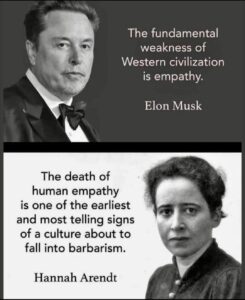
(formerly 52) In my work with the Nuremburg trial defendants from 1945-1949 I was searching for the nature of evil, and I now think I have come close to defining it: a lack of empathy. It’s the one characteristic that connects all the defendants, a genuine incapacity to feel with their fellow men. Evil, I think, is the absence of empathy.--Captain G.M. Gilbert, Army psychologist.
Are our connections with each other the key to healing the world?
My previous commentaries on the common knowledge game and the lemming effect suggests a profound potential within our social bonds, both for corruption and for healing. If we collectively acknowledge this universal truth, we can find ways to reduce disease and distress without merely relying on the pharmaceutical industry and advanced medical technology to heal wounds caused by social stress and maladjustment.. Instead, we can tap into the profound depths of our connections to each other, and uncover hidden reservoirs of our healing potential..
Today, multiple pandemics rage across America, including lack of meaning and purpose, loneliness, political deceit, cultural divisiveness, alcoholism and addictions, obesity, cancer, and gun violence. These crises fuel anxiety and trauma, amplifying the effects of pain already in our lives. A conscious effort to understand how others’ actions in the world and how our responses to them can introduce additional traumatic influences to ourselves and each other has become essential if we want to maintain any sort of emotional balance. Those on the healing path strive to be spiritually present for others, recognizing that healing hidden internal trauma dramas enables ourselves to bring more compassionate, empathetic action into the world..
Empathy and Compassion: Healing the Wounds Within
What if the world was built on empathy and compassion instead of indifference and hate? This is the question that today’s mental health advocates, spiritual seekers, human resource professionals, educational leaders, administrators, and the socially engaged public must answer to create a more caring and resilient society.
Empathy is more than just a moral compass—it’s a neurological function deeply ingrained in our brains. Research has shown that when we observe someone in distress, our brain activates in areas associated with our own experiences of pain. Yet, this natural response can be nurtured or suppressed by our personal experiences and environmental factors. In a world where competition and individualism often overshadow collective well-being, understanding these mechanisms is crucial.
Indifference and hate have been normalized in modern society, which has a profound impact on our mental health. Mental health professionals emphasize that unresolved personal traumas can hinder our capacity for empathy, leading to a cycle of apathy and detachment. To break free, we must look within ourselves and address these wounds. Therapeutic approaches, including cognitive behavioral therapy and mindfulness practices, can be effective tools in this healing process.
The challenge lies in fostering empathy and compassion in environments that prioritize individual success over collective growth. However, change is possible. Organizations and communities worldwide serve as beacons of transformation, demonstrating how a shift towards empathetic cultures can yield significant benefits. By incorporating empathy into their core values, these entities have enhanced employee well-being, boosted morale, and fostered an inclusive, supportive atmosphere.
Education plays a pivotal role in cultivating empathy from a young age. Current practices often overlook this critical aspect, focusing instead on academic achievement. Yet, integrating empathy and compassion into formal education can pave the way for a more empathetic society. Practical suggestions include implementing social-emotional learning programs and encouraging open dialogues about emotional intelligence in classrooms.
In previous chapters I have offered several personal stories of triumph over trauma that serve as a powerful testimonial to the human spirit’s resilience. There are countless other Individuals who have transcended societal pressures to become champions of empathy and compassion, and they continue to inspire us all. Our journeys underscore the intersection between empathy, compassion, and resilience, proving that these qualities are not only attainable but essential for individuals attempting to support an evolving, thriving society.
Much of mankind is unconscious, and we often can’t keep from harming each other, and the whole of the animal kingdom, let alone ourselves.. Mankind has “dehumanized-de-sentienced” other humans for political or social gain. Our animal friends have faired extremely poorly, as well, often tortured and subjected to extreme cruelty and suffering as they are prepared to become food on our dinner plates. Our civilization continues to justify cruel and destructive relationships, as well as the destruction of the natural world that supports us. Patriarchal values and the Judeo-Christian Western religious tradition and their misunderstanding of the wholeness and unity of life, with its subsequent influence on thinkers throughout the ages, has been at the forefront of this travesty for millennia.
Empathy Is A Guiding Light
Human beings can be quite empathetic beings. Studies are showing that all animals, especially those mammalian in nature, share in this oftentimes sublime characteristic. It is very difficult to harm another person if we can sense the suffering that they are presently experiencing, or that we may be causing them. The exceptions are when one is in an extremely hateful state, or those whose indifference arises from overzealous self-protection or from sociopathic or psychopathic natures. A conscious person would never abuse any person, or animal of any species, including eating it, unless there were no other choices for food, after recognizing the unity of sentience that exists in our natural world. Conscious individuals who recognize this unity of sentience refrain from harming others, including animals, unless absolutely necessary to reduce the unnecessary further suffering of others caused by acts of violence or war by unconscious people or nations.

Are we ready to feel the whole of existence, or just continue our lives in the cramped, little box that our egos live in ?
I want no limitations to the expression and sharing of love that is at the foundation of all of Life.
Love, Hate, and Indifference and Their Relationship With Empathy: Navigating the Emotional Landscape of Human Experience
The word “empathy” has a secret message built into it, by doing creative interpretation.
Let’s take the word apart into three components: em—path —y (ou).
Empathy is now seen to be the (path) between me (em) and (y)ou.
When the concepts of ‘you’ and the “me” are realized to be spiritually ONE,
Em-path-y becomes just the “path” we all may.travel upon, hopefully in the spirit of love..
Empathy, in both its positive and negative expressions, is a name for the mechanism for transporting emotional energy to create a form of resonance or attunement between sentient beings and is always in play in both love and hate relationships. In positive empathy, energy flows freely in both directions, between the giver and the receiver. There is a shared sense of the expansion of the self. And, in a radical variation of positive empathy, one may even experience shared mental images- telepathy- and non-local spiritual healing. In negative empathy, energy flow is uneven, and dominated by one party, resulting in forms of oppression of the other, and repression of aspects of the self, by the giver, and, potentially, the repression of aspects of the self by the receiver. There is a strong sense of the contraction of the the energy field of the self by both parties in this energy exchange.
Contemporary research into neuroscience tells us that our brains, like those of other primates, contain mirror neurons. These neurons are triggered in our brains when someone else is sad, angry, or happy, and those mirror neurons, in coordination with other pre-cognitive and cognitive functions, help us to feel what that other person is feeling. What they help us to feel is what we would experience if we were in that person’s place. If our experiences are similar enough, we can empathize in a way that promotes a connection that can be soothing to the other person. The effort to understand someone else, when made in good faith, can go a long way towards helping them feel better and even, sometimes, to change their behaviors. This can be considered to be a collaboration between the spirit of the individuals in communication. The changing of another’s behavior is not the conscious intention of empathy, though most find that through the empathetic connection, each participant is taken beyond the former boundaries of their understanding of self and others..
What if the keys to improving our emotional well-being lies not only in understanding our capacity for love but also in reconciling our experiences of hate and indifference with the intention of evolving into our fullest spiritual potential? The digital age has redefined how we connect, often making it easier to express hate or indifference behind the anonymity of a screen. This detachment from face-to-face interaction can normalize negative behaviors, creating a breeding ground for emotional disengagement and dehumanization.
Love, hate, and indifference are powerful forces that shape our relationships. These emotions drive our actions, influence our perceptions, and define the quality of our interactions. Despite their differences, they share a common thread—they are all energy exchanges that bind us to each other, or to ourselves, in unique ways. The interplay of love, hate, and indifference is a complex dance that defines our human experience. By understanding and addressing these emotions, we can foster healthier, more compassionate communities. It’s time to challenge ourselves to engage in discussions on fostering compassion and empathy.
Love, the most celebrated of emotions, is an open system of friction-free energy exchange. It is the conduit through which empathy and compassion flow freely, fostering connection and understanding. Research reveals that experiencing love and compassion can lead to a reduced risk of heart disease and a stronger immune system. While love has been extensively studied for its benefits, the darker sides of human emotion warrants equal attention.
Hate, in contrast, is the equivalent of negative empathy, and is a closed system. It blocks positive energy, creating barriers and trauma for both the hater and the hated. Indifference is the silent void, an emotional detachment that isolates the individual from the world around them. Hatred and indifference are not just emotional states—they have tangible impacts on our physical and psychological health. Hate and indifference trigger stress hormones that increase inflammation and lead to significant health consequences, including higher rates of depression and a decline in overall well-being.
Indifference is a quality of attention that attempts to keep everybody and everything separate from the observer, and the emotionally detached individual is choosing to live in a closed system or spiritual vacuum. Those practicing total indifference live in an isolated world, with little real emotional connection with anybody or anything other than their own emotions, thoughts and feelings. Indifference is oftentimes the result of traumatic influences and results in the emotional and spiritual oppression of others, and a repression of the personal spirit, as well. For most normal people, indifference is only applied to special situations and is not applied to a complete life experience. Yet, the quality of indifference gives the practitioner the illusory sense of having no personal accountability to that which is being witnessed. Personal responsibility for a collectively shared error in the heart is denied, and the potential for a shared healing experience is negated.
We live in a world in which we need to share responsibility. It’s easy to say ‘It’s not my child, not my community, not my world, not my problem.’ Then there are those who see the need and respond. I consider those people my heroes. — Fred Rogers
Recognizing and addressing the fine line between love, hate, and indifference is crucial for fostering empathy and comoassion, with healthier emotional exchanges. Here are some unique solutions and perspectives to combat these challenges:
1. Promote Empathy through Education
Social and emotional learning (SEL) programs have shown promise in fostering empathy and reducing hate. Integrating SEL into educational curriculums can teach individuals the importance of emotional intelligence and compassionate communication.
2. Encourage Open Dialogue
Creating safe spaces for open and honest discussions about emotions can help individuals understand and process their feelings. Encouraging conversations about love, hate, and indifference can demystify these emotions and promote emotional literacy.
3. Leverage Technology for Good
While the digital age presents challenges, it also offers opportunities. Technology can be used to foster connections and promote empathy. Initiatives like online support groups and virtual empathy-building exercises can bridge the emotional divide.
4. Implement Community-Based Initiatives
Communities play a vital role in shaping our emotional experiences. Successful initiatives, such as community-building activities and compassion training workshops, have been effective in promoting love and understanding within communities.
Numerous initiatives have successfully promoted love and compassion. Programs like Roots of Empathy, which brings babies into classrooms to teach children about emotional intelligence, have demonstrated significant reductions in bullying and increases in empathy. Similarly, organizations like The Compassionate Mind Foundation work to cultivate compassion in healthcare settings, leading to better patient outcomes and a more supportive work environment.
Empathy also has a dark side. Negative empathy can overwhelm us with others’ suffering, leading to mutual pain and emotional isolation. In extreme cases, empaths may manifest physical symptoms of others’ suffering, as seen in stigmata syndrome.
Empathy acts as a vehicle for human collective consciousness, carrying individual experiences back to the collective field. This shared consciousness contains the accumulated knowledge of humanity, passed down through generations. However, much of this knowledge is incomplete or outdated, leading to inappropriate responses. True empathy requires sacrificing outdated beliefs to make way for present truths.
Empathy, when embraced as a catalyst for healing and growth, can transform our world. By fostering genuine connections and recognizing the unity of sentience, we can address the challenges in healthcare, wellness, and social justice. Leaders in these fields must prioritize empathy, accountability, and inclusivity, combating misinformation and fostering trust.
Empathy is not just an emotion; it’s a path to a better world.
It’s time to walk this path together.
While empathy and compassion can be found in anyone, regardless of their background or profession, some categories of people are more likely to exhibit these traits due to their work, personal experiences, or values. If you are looking for support in your own intention to be empathetic, the following five categories of people may be more likely to be empathetic and practice compassion:
1. Mental Health Professionals: Psychologists, psychiatrists, therapists, counselors, and social workers are trained to understand and support people dealing with mental health issues, trauma, or emotional distress. Their work requires empathy, active listening, and compassion.
2. Healthcare Workers: Nurses, doctors, and other healthcare providers often develop strong empathetic skills due to their frequent interactions with patients experiencing pain, suffering, or stress. They understand the importance of kindness, care, and emotional support.
3. Teachers and Educators: Teachers often go above and beyond to support their students’ academic, social, and emotional growth. They may be more likely to be empathetic and understanding, especially when working with students facing challenges or difficulties.
4. Artists and Creative Professionals: Artists, writers, musicians, and other creative types often tap into their emotions and the human experience to create meaningful work. This can foster empathy and compassion, allowing them to connect with others on a deeper level.
5. Spiritual Leaders and Community Workers: Members of the clergy, spiritual leaders, and community workers often focus on supporting and serving others. Their roles encourage empathy, kindness, and compassion, helping them understand and address the needs of their communities.
These categories are not exhaustive, and individuals from a wide variety of backgrounds can exhibit remarkable empathy and compassion.
it is essential to recognize that anyone can cultivate these qualities and make a positive impact in the lives of others.
Unlocking the Power of Empathy in a Digital World
Have you ever wondered why a friend’s tears can bring you to tears yourself? Or why a stranger’s smile can lift your spirits? The answer lies deep within our brains, in a set of neurons known as mirror neurons. These cells fire when we observe someone else experiencing an emotion, helping us to feel what they feel. But in our increasingly digital world, where face-to-face interactions are dwindling, how can we preserve and even enhance our ability to empathize?
Our mirror neurons are the unsung heroes of human connection, yet it is tough to get them engaged in our digital discourses. One of the key challenges in today’s world is the overwhelming shift from in-person interactions to digital communication, where we cannot key off of each others’ non-verbal language. Text messages, emails, and social media posts lack the non-verbal cues that are crucial for empathy. The absence of facial expressions, tone of voice, and body language can make it difficult to fully understand and connect with others’ emotions.
To bridge this gap, we need to be more intentional in our digital communications. Use video calls instead of text messages whenever possible. When you can’t avoid texting, make an effort to be clear and expressive. Emojis and GIFs, while seemingly trivial, can add a layer of emotion to your messages.
Cultural and societal norms also play a significant role in shaping our ability to empathize. In some cultures, emotional expression is encouraged and valued, while in others, it may be seen as a sign of weakness. These differences can create barriers to empathy and understanding.
Educate yourself about different cultural norms and practices. Be open to learning and adapting your communication style to better connect with people from diverse backgrounds. Our upbringing and education significantly impact our empathetic abilities. Unfortunately, traditional education systems often prioritize intellectual development over emotional intelligence, leaving many with underdeveloped empathy skills.
Advocate for emotional intelligence and empathy training in schools. Parents and educators can foster empathy by teaching children active listening skills, encouraging them to express their emotions, and modeling empathetic behavior.
Empathy profoundly affects mental health and well-being. It can reduce feelings of loneliness and depression, improve relationships, and enhance overall life satisfaction. However, integrating empathetic communication into healthcare and mental health support systems remains a challenge.
Healthcare professionals should receive training in empathetic communication. Institutions can create policies that prioritize patient-centered care, ensuring that empathy is at the core of their service delivery.
In professions that require high levels of empathy, such as healthcare, social work, and counseling, empathy fatigue is a real and pressing issue. Constantly caring for others’ emotional needs can lead to burnout and emotional exhaustion.
Self-care and setting boundaries are crucial. Professionals should be encouraged to take regular breaks, seek peer support, and engage in activities that replenish their emotional reserves.
Empathy is not just a nice-to-have trait; it is an essential skill that can transform our personal and professional lives. In our digital age, where genuine human connection can sometimes feel like a rare commodity, practicing empathy is more important than ever.
By understanding the science behind empathy, addressing the barriers that impede it, and actively incorporating empathetic practices into our daily interactions, we can foster deeper connections and create a more compassionate world.
If we practice active listening and empathy in our daily interactions, and challenge orurselves to truly understand others’ perspectives, watch as our relationships and sense of fulfillment grow. We can take the first step today—whether it’s reaching out to a colleague for a heartfelt conversation or simply offering a listening ear to a friend. Our efforts can make a world of difference.
Let’s challenge the conventional thinking that has led us here and strive for a future where empathy and compassion are the cornerstones of our society.
Now, more than ever, we need to take action. Start conversations with friends, family, and children about the importance of empathy. Implement or improve empathy-building practices in your community or workplace. When we find and heal the wounds within ourselves, we can truly transform the world around us.
What Does It Mean When We Carry Our Leaders Within Our Consciousness? 
What does it mean when we carry our leaders within our consciousness? This probing question invites us to explore the profound impact that leaders have on our minds and lives. In a world where leadership influences every facet of our existence—from personal identity to societal norms—the impressions left by those in power are deeply embedded within us.
Leadership, at its core, is more than decision-making or directive-giving; it’s about embodying values and vision. When a leader of high integrity emerges, one who leads with morality and a strong ethical compass, people naturally gravitate toward them. This gravitational pull is not just about admiration; it’s an evolutionary adaptation. We, as social beings, learn from success and failure alike, patterning our behaviors and attitudes after those we perceive as successful.
In today’s socio-political landscape, however, the integrity of leadership comes under constant scrutiny. For example, the polarizing figure of Donald Trump has ignited intense reactions across the spectrum. Our knee-jerk reaction may be to despise him, but a more conscious approach encourages us to see him as a flawed individual—one who is perhaps suffering or mentally ill. This shift in perception opens doors to compassion, sympathy, and love, counteracting the toxic effects of long-held anger and resentment.
When we allow our anger towards leaders like Trump to solidify into hatred, we create new neural pathways for institutionalized hatred, adding to the collective suffering. This phenomenon manifests daily in the forms of religious persecution, xenophobia, misogyny, racism, and other destructive energies. It is essential to recognize that constructive anger—anger that arises from witnessing injustice and is directed towards change—is distinct from hatred. Constructive anger is spontaneous and productive, offering opportunities for collective healing and justice.
Understanding the psychological impact of divisive leadership on our social fabric and individual well-being is crucial. Leaders who project hatred and self-loathing can trap us in a cycle of negative empathy, where we inadvertently absorb their darkness. This negative empathy, driven by the mirror neuron phenomenon, can lead us to share in their self-hatred and loathing, imprisoning us in a psychological state of reactivity rather than mindfulness.
Our perceptions are often not reflections of reality but constructs of our consciousness. Predictive coding—a cognitive process where the brain anticipates and constructs experiences based on past information—reinforces this idea. When we encounter figures like Trump, our pre-existing beliefs shape our perceptions, often leading us to see what we expect rather than what is. This cognitive bias underscores the importance of self-awareness and emotional intelligence in managing our responses to political figures.
Holding leaders accountable while preventing personal hatred from influencing collective consciousness is a delicate balance. Accountability is essential for a functioning society, but it must be rooted in constructive criticism and empathy rather than vindictiveness. Historical and contemporary leaders who have inspired positive change—such as Nelson Mandela and Mahatma Gandhi—demonstrate the power of compassionate leadership. Their ability to foster unity and understanding, even in the face of adversity, highlights the potential for intentional leadership to shift collective consciousness towards greater empathy and cohesion.
In a society marked by polarization, fostering constructive debate and dissent is increasingly challenging. Media and technology play pivotal roles in shaping public perception, often amplifying divisive rhetoric. It is incumbent upon educators, thought leaders, and business professionals to cultivate spaces for meaningful dialogue. Encouraging diverse perspectives and critical thinking can bridge divides and promote mutual understanding.
Compassion and empathy are antidotes to the corrosive effects of hatred and anger. These qualities enable us to see beyond the flaws and failures of leaders to their shared humanity. By cultivating compassion, we mitigate the negative impact of divisive leadership on our mental well-being and societal harmony. This approach aligns with insights from social and political psychology, which emphasize the importance of group dynamics and the formation of public opinion in shaping collective consciousness.
History offers numerous examples of leaders whose consciousness and actions have inspired positive change. From Abraham Lincoln’s commitment to unity during the Civil War to Jacinda Ardern’s empathetic response to the Christchurch mosque shootings, these leaders exemplify the power of intentional leadership. Their ability to transcend personal biases and foster collective well-being provides a blueprint for navigating the complexities of modern leadership.
Our leaders profoundly influence our consciousness and, by extension, our society. By understanding the psychological impact of leadership, fostering constructive debate, and cultivating compassion, we can transform our collective consciousness. Engaging in thoughtful discourse on leadership and consciousness, fostering empathy in our interactions, and sharing this article to inspire collective reflection are small but significant steps toward a more harmonious and enlightened world.
Beyond the Boomerang of Hate: Navigating the Psychological Impact of Divisive Figures 
Have you ever pondered the true cost of “wasting our hate” on someone like Donald Trump?
In today’s politically charged landscape, it’s easy to become ensnared in the visceral reactions provoked by divisive figures. Yet, we often fail to recognize that the vitriol we direct outwardly towards these individuals may be a reflection of our own collective unconscious negative self-image.
At its core, the image of Donald Trump—or any polarizing leader—regardless of their presence in the so – called objective reality, also exists in the mind as a conceptual construct. The mental blows we aim at these figures often ricochet back, wounding us in the process. This phenomenon isn’t merely a psychological quirk; it’s a reflection of a deeper spiritual reality. We are, in essence, grappling with creations of our and/or our community’s making, of projections of fears, insecurities, and negative traits we harbor within ourselves.
Leaders like Donald Trump have mastered the art of one-way transmission of negative energy. They rarely place themselves in positions of vulnerability, where they might genuinely receive the abhorrent energy they emit. We see this often in debates or their confrontations with reporters, who become surrogates for the public’s pent-up frustration. Yet, as concerned citizens, we must continue to write to our congressmen, stage peaceful protests, and hold community meetings to maintain our sanity and speak our truth.
Jesus, along with other wise figures from history, cautioned against judging others lest we be judged ourselves. While this may seem like sound wisdom, it is not without its pitfalls. If taken out of context, this teaching can be perceived as spiritually bypassing necessary confrontation of truly egregious behavior under the guise of spiritual humility. Judging others is not inherently wrong—it is a necessary part of discerning right from wrong. However, it should be done with an awareness of our own fallibility and biases.
The dynamics of projection are complex yet enlightening. By projecting our negative traits onto others, we externalize our inner conflicts, making them easier to confront. This is especially evident in political arenas, where figures like Trump become lightning rods for the collective’s unresolved issues. By understanding this dynamic, we can begin to redirect our energy towards more constructive ends.
Social and traditional media play a significant role in perpetuating divisive narratives. These platforms thrive on controversy and conflict, often amplifying the worst aspects of public discourse. This constant stream of negativity poses a serious challenge to our mental and emotional well-being. We must find ways to engage with media critically and mindfully, avoiding the traps of echo chambers and confirmation bias.
In the face of extreme ideological differences, fostering empathy and understanding becomes paramount. This doesn’t mean condoning harmful behaviors or beliefs—it means recognizing the shared humanity that underlies even the most contentious issues. Constructive dialogue, grounded in empathy and a genuine desire for understanding, can help bridge the divides that threaten to tear us apart.
Our world is in dire need of voices that rise above the cacophony of discord. By choosing to engage in thoughtful, empathetic conversations, we can begin to heal the wounds inflicted by years of political polarization. Let’s commit to understanding before judging, to listening before speaking, and to building bridges rather than walls.
The task of navigating the psychological impact of divisive political figures is both challenging and necessary. By confronting our own projections, fostering empathy, and engaging in constructive dialogue, we can transcend the cycle of hate and judgment. Together, let’s create a more understanding and compassionate world.
Donald Trump and the Absence of Empathy in Leadership
Leadership is often tested during crises. A leader’s ability to respond with understanding, to connect with those who are suffering, and to make decisions informed by compassion defines their legacy. These traits, however, appear conspicuously absent in Donald Trump’s response to the DC plane and helicopter crash. Instead, his divisive and detached reaction exemplifies a broader pattern that raises important questions about his capacity for empathy—a fundamental quality that many believe is essential to effective leadership.
To better understand why this matters, we’ll explore the significance of empathy, its role in leadership throughout history, and the profound impacts of its absence.
At its core, empathy is the ability to understand and share the feelings of others. It is what allows us to connect on a human level, offering comfort during times of hardship and guiding us to make decisions that consider the well-being of those affected. Above all, empathy is what makes leaders relatable and trusted in the eyes of the people they serve.
When a leader demonstrates empathy, they signal that the struggles of their citizens matter deeply to them. This creates trust, motivates collaboration, and strengthens communities. Conversely, the lack of empathy—especially in positions of power—can have devastating consequences, fostering division, neglect, and alienation.
History offers us clear examples of leaders whose empathy enabled them to unite and uplift. Franklin D. Roosevelt, for instance, responded to the economic devastation of the Great Depression with urgency and compassion, spearheading social welfare programs that directly addressed the struggles of ordinary Americans. Similarly, New Zealand’s Jacinda Ardern has consistently shown empathy in her leadership, such as her heartfelt response to the Christchurch mosque attacks, which empowered grieving communities and reinforced national unity.
However, the absence of empathy in leadership has resulted in some of the darkest chapters of history. Captain G.M. Gilbert, the psychologist at the Nuremberg Trials, observed that the defining characteristic of many Nazi leaders was their utter inability to empathize—a quality he equated with evil itself. Empathy, or the lack thereof, can become a defining attribute that shapes the decisions of a leader and the fate of a nation.
Donald Trump’s response to the DC plane and helicopter crash serves as yet another example of his consistent failure to display empathy during national crises. Rather than offering condolences or unified reassurance, his remarks were divisive, demonstrating a focus on self-promotion rather than the communities affected.
This pattern is not new. From his handling of the COVID-19 pandemic to his public reaction to mass shootings, Trump’s responses have largely been viewed as cold, dismissive, or centered on personal grievances. For instance, his administration’s approach to family separations at the U.S.-Mexico border—where children were detained away from their parents—highlighted policies devoid of compassion, sparking widespread outrage and despair.
Such actions and rhetoric paint a picture of a leader who struggles, or outright refuses, to feel with or for others. Without empathy, leadership risks becoming transactional, self-serving, and isolated from the realities of those it is meant to serve.
The ripple effects of empathy—or the lack of it—in leadership cannot be overstated. Empathy shapes policies that prioritize the health, safety, and dignity of a population. It builds bridges between divided communities. It reassures citizens that their struggles will not be ignored.
On the flip side, a lack of empathy often leads to policies rooted in inequality and indifference. Without empathy, decisions appear motivated by the singular pursuit of power, wealth, or status, regardless of the human cost. Public trust erodes, polarization deepens, and societal progress stalls. Compassion, after all, is a key driver of common sense governance.
For leaders, empathy isn’t optional—it’s transformational.
The absence of empathy in some leaders raises an important question: can empathy be cultivated, or is it an inherent trait? Research suggests that while some individuals may naturally possess higher levels of empathy, it can indeed be developed through exposure to diverse perspectives, active listening, and deliberate reflection.
Leadership training programs increasingly emphasize emotional intelligence, of which empathy is a core component, as a critical skill. Learning to understand and prioritize the concerns of others requires humility, consistent practice, and a willingness to be vulnerable.
Yet cultivating empathy also requires societal effort. We must demand it not only from leaders but also within ourselves, fostering it in family, community, and educational settings.
To foster a society that values and demands empathetic leadership, we need a collective mindset shift. Here are some actionable ideas to pave the way forward:
- Strengthen Civic Engagement: Encourage transparent discussions among citizens, leaders, and organizations that prioritize human dignity and inclusivity.
- Educate the Next Generation: Schools and universities should emphasize empathy within curriculums, teaching students to understand perspectives beyond their own.
- Hold Leaders Accountable: Take actions that challenge and question leadership that lacks compassion, whether through activism, voting, or policy advocacy.
Empathetic leadership doesn’t only address immediate crises—it lays the foundation for a fairer, more united future.
As Captain G.M. Gilbert once noted, a lack of empathy lies at the heart of what we might consider evil. Whether or not his observations apply directly to Donald Trump is a matter of opinion, but the importance of empathy in leadership is undeniable. At a time when our world faces overlapping crises, leaders who can empathize, unite, and act compassionately are not just desired—they are essential.
The question now is this: in the face of divisive and heartless leadership, how will we, as individuals and as a society, ensure that empathy takes its rightful place at the helm of governance?
Why Do People Choose Division Over Unity? A Deep Dive into the Psychology of Polarization
Have you ever wondered why some people seem more inclined to watch the world burn rather than join the spiritual fire department and help douse the flames? The answer lies deep within the human psyche, and understanding it could be the key to fostering a more united, empathetic society.
Human beings are inherently tribal. Throughout history, our survival depended on belonging to a group, where shared beliefs and mutual support were crucial. This instinct persists in modern times, manifesting in various forms of social and political tribalism. People often align themselves with figures who reflect their unhealed and unawakened natures, celebrating these “dark heroes” rather than feeling ashamed.
For instance, many supporters of divisive figures like Donald Trump see aspects of their own unresolved issues and traumas mirrored in his behavior. By championing him, they find validation for not striving to be their best selves. This isn’t just about politics; it’s about deeply ingrained psychological patterns that resist change and healing.
The “Us vs. Them” narrative is a powerful tool for amplifying division. It dehumanizes those with differing viewpoints, making it easier to dismiss their perspectives and experiences. Social media and information bubbles exacerbate this, creating echo chambers where one’s beliefs are constantly reinforced, and opposing views are vilified.
Understanding the social and psychological roots of this tribalism is crucial for fostering empathy and reconciliation in a polarized society. We need to move beyond seeing others as adversaries and start recognizing the shared humanity that binds us.
Critical thinking and media literacy are essential in breaking these information bubbles. By questioning the sources of our information and seeking out diverse perspectives, we can develop a more nuanced understanding of complex issues. This isn’t just about being informed; it’s about fostering a mindset that values truth over convenience.
Successful initiatives like the “Braver Angels” movement in the United States have shown that it’s possible to bridge divides and foster unity in diverse communities. By promoting open dialogue and understanding, they help people see beyond their differences and work towards common goals.
Personal accountability and self-reflection are vital in this pursuit of healing and growth. We must first heal our own deficiencies and traumas to see the world through a clearer, more compassionate lens. Only then can we engage in constructive dialogue with those who hold opposing views, emphasizing empathy and active listening.
Technological innovations also hold promise in promoting greater understanding and connection. Platforms that encourage thoughtful discourse and provide tools for fact-checking and media literacy can play a significant role in bridging the divides that plague our society.
In the end, the path to a more united and empathetic society begins with us. We must commit to critical thinking and media literacy, continually seeking to understand the complex factors that drive division and working towards solutions that promote healing and unity.
By fostering a culture of empathy, accountability, and open dialogue, we can begin to heal the wounds that divide us and create a brighter, more connected future.
Commit to critical thinking and media literacy for a more informed society. Let’s turn our wounds into wisdom and build a world where unity and understanding prevail. It is time to challenge conventional thinking and encourage self-discovery and spiritual growth.
The Path to Spiritual Healing in a World of Toxicity
Can we truly find salvation if we persist in misunderstanding both ourselves and the world around us?
In today’s world, we are constantly bombarded with reminders of how far we are from collective healing. From toxic capitalism and masculinity to toxic politics and religion, the external world challenges our morals, ethics, and spiritual intentions daily. However, our salvation is not something that can be delivered by another, no matter how exalted their position is. True healing lies within, and it begins with sacrificing our misunderstandings and allowing universal truth to reshape our understanding of self and others.
Political, social, and religious spheres exhibit increasingly toxic behaviors, impacting both individual and collective spiritual well-being. Leaders like Donald Trump, who embody and perpetuate these behaviors, create environments of chaos and division. Is he a devil, a rattlesnake, or an angel? The truth likely lies somewhere in between, skewed toward darker qualities. Yet, our response should not be one of hatred or negative empathy, but of detached witness and emotional intelligence.
Empathing with toxic individuals like Trump only serves to draw us into their divisive energy. This “negative empathy” can lead us down a path of spiritual death—disconnection from our core values and common humanity. Instead, we must save our empathy for those who genuinely seek to change and grow despite suffering under disfiguring conditions.
We always retain the freedom to choose and must exercise personal responsibility for those choices. If our actions bring harm, we are free to choose again and make amends, keeping our empathy channels fully open. Engaging with toxic figures should be approached with a posture of detached witness, aiming to maintain our moral, ethical, and spiritual integrity without becoming indifferent to the world’s needs.
Understand Toxic vs. Healthy Forms: Differentiate between toxic and healthy forms of capitalism, masculinity, politics, and religion. The former leads to social harm and spiritual decay, while the latter can foster growth and unity.
- Discern Empathetic Responses: Recognize when empathy turns negative and avoid wasting energy on individuals resistant to change. Redirect your empathy towards those who can benefit from it.
- Reconnect with Core Values: Engage in conscious self-reflection and empathy-building exercises to stay connected to your core values and common humanity.
- Learn from Positive Examples: Study leaders who have effectively navigated toxic environments, demonstrating the possibility of spiritual growth and positive change. These case studies provide actionable insights for your own journey.
Ethical and empathetic leadership is crucial in today’s complex world. Leaders must balance personal and collective responsibility, fostering healing and unity in a society deeply divided by conflicting ideologies and beliefs. By maintaining a keen curiosity about the world and its people, including those who challenge our sensibilities, we can cultivate a better spiritual presentation for ourselves and others.
Empathy and moral grounding are essential for navigating and responding to toxicity. We must strive to understand the conditions that lead individuals like Trump to their destructive behaviors, without condoning their actions. By doing so, we can steer our own consciousness toward unity and understanding, rather than chaos and division.
Our salvation is a personal journey that cannot be outsourced or delegated. It requires us to sacrifice our misunderstandings and allow universal truth to transform our understanding of self and others. By maintaining our moral, ethical, and spiritual integrity in the face of societal challenges, we can contribute to a more compassionate and unified world.
Seek out and support leaders who embody ethical and empathetic values. Engage in conscious self-reflection and empathy-building exercises. Share this article to spark conversations on healing, unity, and sanity.
Let’s work together to create a world where empathy and understanding prevail over toxicity and division.
The Spiritual Lessons We Can Learn from Polarizing Figures Like Donald Trump
What if the very figures that polarize us the most, like Donald Trump, hold the keys to our collective spiritual growth?
In the world of spirituality, we often revere figures from history such as Jesus, Buddha, and Krishna for their wisdom and virtues. Yet, we often forget that learning can come from unexpected sources, even those who seem to embody traits we find disturbing or divisive.
Donald Trump is a polarizing figure who evokes strong emotions and reactions. But what if, instead of merely resisting or condemning, we saw him as a reflection of our own collective consciousness? By examining our emotional responses to such individuals, we can uncover our own internal blocks and biases. This introspection can pave the way for deeper understanding and healing.
The teachings of ancient spiritual leaders often seem worlds apart from today’s political and social dynamics. The challenge lies in integrating these timeless teachings into the reality of contemporary life. It’s essential to bridge this gap by finding relevance in ancient wisdom while addressing modern-day issues like toxic masculinity, capitalism, and politics.
Navigating the diversity of spiritual perspectives is another significant challenge. Differing opinions can lead to misunderstanding and conflict. Yet, we must remember that each viewpoint offers a unique piece of the puzzle of universal truth. Empathy and open dialogue are crucial in engaging with individuals who hold vastly contrasting views.
In the hustle and bustle of everyday life, maintaining personal spirituality and consciousness can be daunting. Societal pressures and norms often pull us away from our spiritual path. However, it’s in these moments of struggle that our true spiritual practice is tested. Authenticity in practice—being true to oneself despite external pressures—is vital for genuine growth.
True progress comes from fostering collective spiritual awakening and social change without imposing beliefs on others. Conscious activism, rooted in compassion, understanding, and a commitment to justice and equality, bridges the spiritual and material worlds. By acting from a place of love and empathy, we can inspire meaningful change in our communities.
One pertinent issue in integrating spirituality into personal and societal growth is the concept of spiritual bypassing. This occurs when individuals use spiritual beliefs and practices to avoid facing unresolved emotional or psychological issues. Authentic spiritual practice requires confronting and healing these issues rather than bypassing them.
Empathy and understanding are paramount in engaging with contrasting spiritual or political views. Genuine dialogue allows for mutual growth and the potential to bridge divides. The challenges posed by figures like Donald Trump can serve as catalysts for introspection, highlighting societal shadows that need addressing.
Authenticity in spiritual practice and teaching is essential. It involves self-awareness, humility, and the continual pursuit of truth over dogma or personal agendas. Authenticity fosters a genuine connection with oneself and others, paving the way for deeper spiritual growth.
Conscious activism is the bridge between the spiritual and material worlds. By aligning actions with compassionate intent, we can effect meaningful change. Actions rooted in empathy and understanding can address societal issues while fostering spiritual growth.
Donald Trump, like every individual we encounter, can be a mirror reflecting our own inner landscape. By seeing him as he is, we can identify and transcend the blocks within ourselves, moving closer to universal love and truth.
Engage in this introspective journey with us. Share this book with others to spark collective introspection and join the dialogue on how we can integrate spiritual wisdom into contemporary challenges. Together, we can co-create a more compassionate and enlightened world.
The Complex Dance Between Hatred and the Intolerance of Intolerance
Is the intolerance of intolerance itself a form of hatred, or a necessary stance to foster inclusivity? We must grapple with this nuanced question as we work to shape a more equitable future. In today’s interconnected world, understanding the subtle distinctions between raw emotional responses and ingrained societal behaviors is more crucial than ever.
Hatred often arises from fear and misunderstanding, manifesting in actions that marginalize and harm. It is reactionary, an emotional outburst settled deep within the human psyche. The intolerance of intolerance, however, emerges from a seemingly noble place—a desire to cultivate inclusivity and equality. Yet, both these forces, when left unchecked, can inadvertently stifle the very progress they aim to achieve.
At the heart of this discussion lies the challenge of distinguishing between spontaneous emotional reactions and behaviors deeply embedded within societal frameworks. Hatred, with its roots in fear and misinformation, tends to be impulsive—an eruption of emotions that can lead to destructive actions. These responses, while powerful, are often fleeting, fueled by individual biases and collective religious and social conditioning..
In contrast, the intolerance of intolerance is often institutionalized, finding its way into policies and regulations. It aims to curb hatred by silencing harmful rhetoric but may cross into oppressive territory, especially when used to quash dissenting voices under the guise of maintaining harmony. This can perpetuate systemic behaviors that resist the very change advocates strive for.
Freedom of expression is a cherished value in democratic societies, yet it often collides with the boundaries of hate speech. The distinction lies in intent—free speech seeks dialogue, debate, and the exchange of ideas, while hate speech aims to wound, exclude, and suppress. Navigating this line is fraught with challenges, as subjective interpretations vary widely, making it difficult to enforce consistently.
Enter social media, where the lines blur further. These platforms amplify voices, both those of hatred and those opposing it. The viral nature of social media accelerates the spread of both messages, necessitating nuanced moderation. Yet, these same platforms can serve as catalysts for dialogue and understanding if wielded with care.
Technology holds the potential to bridge divides, but it must be guided by ethical standards and community-driven norms. Without these, the intolerance of intolerance may lead to echo chambers where diverse perspectives are silenced rather than celebrated.
True societal transformation requires more than just banning harmful speech—it demands open dialogue, empathy, and a commitment to understanding root causes. This involves recognizing the sources of hatred, addressing fears through education, and fostering environments where constructive criticism and differing viewpoints are encouraged.
We are tasked with the delicate balance of protecting vulnerable communities while ensuring healthy discourse. This is no small feat, but it is possible through intentional listening and an inclusive mindset that seeks to understand before responding.
To effect meaningful change, we must all participate in this dialogue. Seek out diverse perspectives, ask difficult questions, and actively listen to understand rather than to reply. Only then can we hope to move beyond the simplistic dichotomy of hatred versus intolerance and toward a world where true inclusivity thrives.
In the end, it is not about silencing the voices of dissent but rather amplifying the voices of reason, empathy, and growth.
Let’s commit to this path together.
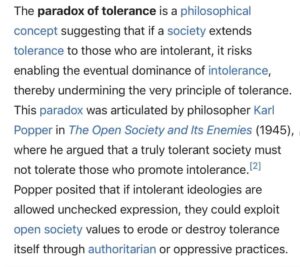
Making Necessary Choices Without Succumbing to the Illusion of Duality
In a world teeming with complexity, our minds often yearn for simplicity. We seek clarity and definitive answers, resorting to binary choices that can offer us a sense of control. Yet, this inclination towards duality—seeing things in black and white—can be a mental construct that limits our options and stifles creativity.
At its core, duality is the tendency to categorize and dichotomize experiences, problems, and solutions into two opposing camps. This “either-or” mindset often leads to a false dichotomy, where we feel compelled to choose between two extremes, disregarding the myriad of possibilities that lie in between. Whether in personal life, professional decisions, or political landscapes, dualistic thinking creates artificial boundaries that restrain our potential for nuanced, sustainable solutions..
To transcend the pitfalls of dualistic thinking, we must learn to embrace complexity and ambiguity in our decision-making processes. This involves accepting that most issues are not merely black or white but exist within a spectrum of possibilities. By doing so, we unlock the potential for more innovative and sustainable solutions.
Take, for another example, the business world. Companies that thrive in the face of uncertainty often do so by acknowledging and navigating the complexities inherent in their industries. Apple Inc., under the leadership of Steve Jobs, didn’t limit itself to the binary of producing either computers or phones. Instead, it embraced the potential for convergence, leading to the creation of groundbreaking products like the iPhone, which revolutionized multiple industries simultaneously.
Mindfulness and emotional intelligence play crucial roles in recognizing and overcoming the allure of duality. Mindfulness helps us stay present and aware, allowing us to see beyond the surface of our binary instincts. Emotional intelligence, on the other hand, equips us with the ability to understand and manage our emotions, fostering empathy and open-mindedness.
When making decisions, mindfulness can help us pause and reflect, rather than react impulsively to the urge for dichotomous thinking. Emotional intelligence allows us to consider the perspectives and emotions of others, leading to more holistic and compassionate decisions.
Several real-life examples illustrate the benefits of a non-dual approach to decision-making:
- Healthcare:
- Traditional healthcare models often present a binary choice between conventional medicine and alternative therapies. However, integrative medicine embraces the strengths of both, offering patients comprehensive care that addresses physical, emotional, and spiritual needs.
- Corporate Strategies:
- Netflix’s transition from a DVD rental service to a streaming giant is a testament to non-dual thinking. The company didn’t see itself confined to one business model but embraced the evolving landscape, blending old and new strategies for sustained success.
- Social Movements:
- The Black Lives Matter movement, while focused on racial justice, also acknowledges the intersectionality of various social issues, including gender, economic inequality, and LGBTQ+ rights. This holistic approach fosters a more inclusive and impactful movement.
Adopting a non-dual approach to decision-making requires intentionality and practice. Here are some strategies for individuals and organizations:
- Cultivate Mindfulness:
- Incorporate mindfulness practices such as meditation, journaling, or breathwork into your daily routine. These practices enhance self-awareness and help you stay present in the moment.
- Develop Emotional Intelligence:
- Invest in emotional intelligence training for yourself and your team. Understanding and managing emotions can lead to more empathetic and effective decision-making.
- Seek Diverse Perspectives:
- Surround yourself with individuals who offer different viewpoints. Encourage open dialogue and actively listen to understand, rather than to respond.
- Challenge Assumptions:
- Regularly question and reassess your assumptions. Ask yourself if there are other possibilities or perspectives you may have overlooked.
- Adopt a Growth Mindset:
- Embrace a mindset that views challenges and failures as opportunities for growth and learning. This mindset fosters resilience and adaptability.
In an age where binary choices often dominate discourse, it’s crucial to recognize the illusion of duality in decision-making. By embracing complexity and ambiguity, cultivating mindfulness, and developing emotional intelligence, we open the door to more nuanced, sustainable, and innovative solutions.
The upcoming national election is a poignant reminder of the dangers of succumbing to dualistic thinking. By seeking to understand the underlying truths in both political movements, we can foster deeper insights and spiritual intelligence, ultimately leading to a more enlightened and compassionate society.
Are you ready to transcend the illusion of duality in your decision-making? Begin by integrating mindfulness and emotional intelligence into your daily life and witness the profound impact it can have on your personal and professional growth. Together, let’s pave the way for a more adaptable, inclusive, and successful future.
What Is Truth? from original 2020 manuscript– unedited
A long-term friend of mine, who is also a long-term friend of the Dalai Lama has said that my understanding is contrary to the teachings of this Buddhist monk, but I will not let that deter me. Had the Dalai Lama been raised under the same conditions of life as I had, and vice versa, our spiritual theories and realities would have been significantly different from our present positions. There are millions of opinions as to how to best live life, and even my friend’s take on the Dalai Lama is only an opinion. Today I choose to not allow other people’s opinions to support my tendency to be repressive of my true nature, and I instead opt to be more fully present for my truest sense of self in this moment.
The conscious people, the people who have already embraced healing and transformation, are co-writing with me a new story for mankind. Together, with my spiritual brothers and sisters, we are co-creating the new religion, the new world order, the new blueprint for humanity and its eternal evolution through this universe. Together we are overcoming millennia of oppression and repression of the human, and the animal spirit. Together, we are defending and honoring our sacred Mother Earth, the true creator and sustainer of life on this planet.
We must remain spiritually vigilant as we continue to be a conscious presence engaging with a world still dominated by toxic masculinity, toxic politics, toxic capitalism, and toxic religion. We must be able to access our anger, not hatred, as we address the injustices wrought upon the human soul through the ignorance and toxicity of others. Love will be our guardian as we make the difficult confrontations with those who do not respect, or honor, the wholeness of life on our Mother Earth that we all share in love and in truth.
If we lose love and self-respect for each other, this is how we finally die.
—Maya Angelou
In case it was not directly observed, what I have presented here is a meditation on love, hatred, indifference, anger, and the process of forgiveness. Mindfulness allows for us to see what is immediately before us, and choose between the knowns of the past, and the unknown present. Forgiveness is an openness to the mystery of the present. Forgiveness, however, does not forget or excuse the offender from his misdeeds, especially while the offender continues abhorrent behavior. Forgiveness releases the practitioner from the damage of incurring negative perceptions of others. We still must act consciously and decisively against all forces that continue to imperil our lives, our family’s lives, and the life of our planet. We must continue to be willing to speak truth to power, whether the power is in the White House, or in our hearts.
Life’s spiritual journey is forever like a dotted line pathway. It is the quality of our connections with each other that fills in the space between the dots. Empathy is the major vehicle for our consciousness to transcend our apparent differences, enabling each of us to connect the dots in a mutually affirming manner. It is only through each other that we can see who we are. I am you, and you are me, and together we are everything, apart, we are still chained together by whatever separates us. We find our shared meaning, which links us together on our journey in Spirit.
Love unifies, while hate fragments and traumatizes. As human beings, we must be conscious enough to choose the best way to present ourselves to the world, and to ourselves, as we face the challenges of the insanity within our world. Our world is in greatest need of hearts that are expanding through mutual positive empathy, rather than contracting through negative empathy, or indifference. We did not create the world as it is now, we cannot control it, nor can we cure it. But we can evolve, and, collectively, we can address the disease of the spirit that is dominating our world civilization, and which continues to bring devastation to our world, and to all of the life upon it.
Each of us are beings with infinite potential. Yet, each of us must break free from the conditioning of our personal past, and our cultural past. Four pillars are supporting higher consciousness, which are (1) via negative- through negating what is not real, seeing what might be real, (2) via positiva-through constantly affirming the goodness inherent in life, reading the writings of mystical poets and saints, and being a grateful participant of life, we may experience Grace, (3) via transformativa- through re-creating or re-birthing ourselves through educational means and/or mystical connection, and bringing forth a new person, or our new understanding of our self, into the world, in the image and likeness of a more universal consciousness, and (4) via creativa- developing and/or expressing our innate ability to co-create with the Universe, by expressing ourselves through art, music, writing, or other means. We must access the deepest of desires to transcend the boundaries of self, and to reimagine our existence.
Neither do people pour new wine into old wineskins. If they do, the skins will burst; the wine will run out and the wineskins will be ruined. No, they pour new wine into new wineskins, and both are preserved.
– Matthew 9:17 (NIV)
We must travel new paths of consciousness, letting go of all controls that keep us tethered to the past, with its incomplete perceptions and understandings. In the end, no teacher will affect our salvation, for it is a personal journey, where we must accept responsibility for the totality of our lives, and make all necessary adjustments in the course that will take us to our spiritual goals. We can rebirth ourselves, into a new understanding that the Universe has birthed itself in an infinitude of forms through the portal of Mother Earth, and each of us is “one verse” of the song of creation.
As we see the totality of the movement of thought as time, and its nature of keeping us tethered to a past, or to a future that is always an extension of this past, we can free ourselves from those illusory controls. We can live more of a life based on the ever-unfolding now, or present moment, thus unleashing vast reservoirs of intuition and spiritual power. As we look upon all of life, we finally gain the insight that ALL is the extension of the “I am” that we are. All that we will ever see, unto eternity, is, thus, our SELF. for “I am” is distributed throughout all of creation. Everything that we see is our brothers and sisters in Spirit, and, in Truth, and all are extensions of the “I” that “I am”. Our collective error in understanding is believing that “You” has any reality in ultimate Truth, for “you cannot be real”. “You” is forever just an image of thought, created by the collective, or by the individual, mind of man, while believing that he is a separate, isolated being in a lonely universe.
The further along the path of Truth and Love that we travel, the more that we understand that all we will ever see, unto eternity, are extensions of our Self. How we see ourselves today determines the quality of Love and Truth that we manifest in our lives. How we see ourselves today determines how much spiritual power can be brought to our damaged planet, which is now dependent upon us. How we see ourselves today determines how much, as awakening beings, we can bring healing to our shared, damaged human consciousness. There is no power in Heaven or on Earth greater than “I am”. Yet our world suffers, because of the collective belief that we are not of this world, not of each other, or not of this Universe. The unconscious people of the world continue to bring harm to Mother Earth, and to all of her inhabitants, in the name of their religions, their own disfigured political and economic principles, and their ignorance. We all suffer accordingly.
I realize that I am an insignificant voice. I am yet another voice calling out from the wilderness of human misunderstanding, trying to locate lost fellow travelers and aid whoever I may make contact with, in whatever humble way that I can, in our shared journey towards healing. We will heal together, or die alone. I am one of the millions of spiritual “Johnny Appleseed’s”, spreading the seeds of our potential for transcendence on the rocky grounds of human consciousness on our planet Earth. I will not live to see the good that may arise from my work, and the greater works of others, and that is OK.
So, We Were Created In Who’s Image?
So, who are the ones we trust to guide us whenever we are uncertain of the next step on our path to our metamorphosis?
In a therapeutic relationship, the therapist attempts to create a bridge image to the patient’s innate healing possibilities. This bridge image is nothing more than an internalized representation of the therapist’s teachings, associated with and blended into the internal picture of the therapist, which eventually informs the patient of his/her better choices for making conscious, self-affirming decisions for their life, in the absence of the therapist’s physical presence. In the positive, this also helps the patient with any attachment to the therapist, for when the therapeutic relationship finally ends, the patient still carries the image of the therapist and the teaching, which brings comfort in the therapist’s absence. Yet, the bridge must be eventually discarded, lest the client just carries the bridge, the teacher and teaching, as an embedded narrative, which covers and obscures the natural light of pure awareness that being healed reveals. This therapeutic relationship has great healing potential and, of course, in the negative, manipulation, and abuse if the therapist had not previously reached an optimal personal healing quiescent point. The therapist must have risen beyond their own need to be emotionally manipulative to be of help. And, the therapist must NOT become financially dependent on payments made for services by specific clients, or abuse is inevitable.
This same principle of entrainment or neuro-linguistic programming is involved with the spiritual teachings embedded within a student and guru in any spiritual teaching relationship. Often, just seeing the picture of the guru stimulates memories of the teachings transmitted throughout the teaching relationship and brings a sense of warmth or comfort to the evolving student. The same potential for attachments form between guru and student, and the wise guru does not encourage emotional attachments, lest the student regress, and remain dependent on outside influences to affirm their value. It is well known that popular gurus profit immensely from the imaginary or real services provided to the student. See Eckert Tolle, Deepak Chopra, Tim Robbins, the Bhagwan Shree Rajneesh (aka OSHO), etc., etc. You better have a fat wallet if you want big-name guides providing direction for your next spiritual step.
Finally, this same principle resides at the foundation of all religions. Within the Christian faith, where the practitioners attempt to embody the teachings of their prophet, Jesus of Nazareth, they worship mostly unread bibles, paintings, sculptured works, idols, stained glass panels, and statues of Mary crying, Jesus’s face miraculously appearing in cloud formations, their morning toast, or wherever their imagination creates an image similar to their most revered teacher. Yet, the teacher and Mary have been dead for 2000 years, so the student must be taught through other less enlightened teachers and their often disfigured interpretations of the dated sacred texts. They try to teach the religious neophyte that this is one-stop shopping, and the practitioner is dependent on the church and its teachings for the rest of their lives for any hope for an eternity with the church’s distorted, though often sincere, images of God.
Jesus, his image and his teachings, were never intended to be utilized the way that so many churches, including those promoting “new age” and “new thought” understanding, now use him.. It is disgraceful that it is used to generate more income for the all too often corrupt leaders of the faiths. And, PLEASE, do not forget to tithe! Never mind that the Catholic church has more money than several countries. The more you pay, the happier that God, er, the church is! That pastor has a family to feed, too! Prosperity theology has an appeal to the unhealed, greedy money accumulator within all of us, eh Joel Osteen, and 100 million others? Come on, open up the wallet of the parishioner in the pew next to you, and give like you always wanted to! You have to give to receive! The surest sign that God loves you is that you have a big, fat bank account, with a big spiritualized ego to match! Just remember, the size of your bank account, or the account of the church of your choice, is no direct indication of the presence of the Spirit of the Universe. It does indicate how well you have adapted to the Capital-lust economic system, however.
The object, in truth, is to also internalize the teaching vs. just internalizing the teacher. When we internalize the teacher, we have created an idol, and yet another break, or fragmentation, is encouraged within our consciousness. The average human being has over a dozen (though some are plagued with “legions”) or more fragments of self or “the other, or you” images, floating around in the unconscious parts of their self. These may be historical archetypal images, including God, the Devil, the Trickster, and other disowned and unconscious or conscious and celebrated parts of our awareness of our self, along with the distortions in judgments of “the other or not me”. If God is still speaking to us, rather than through us, we are not ready for the real Kingdom of Wholeness and its Sublime Universe of non-duality. Similarly, if we are still plagued by the voices or the echoes of our unhealed past, we remain on the periphery of our true potential while still wrestling with hyperactive minds.
Either way, conscious or unconscious, healing is not possible until all of the exiled, disowned, and otherwise unconscious and conscious aspects, or images of self, and the misinformed judgments of “the other, or you” are integrated, or woven, back into the conscious fabric of our undivided being. You can tell how good of a job you have done by evaluating the sum total of your relationships with the outer world. If there is still a lot of trauma and drama with outer relationships, there probably is still work to be done on the inside, and/or it is time to “shake the dust off your feet” and move on to a new location.. You can also tell by how much negative self-talk remains. Whatever you imagine God to be, remember, that God has qualities that incorporate love of self, love of the other, and the peace that comes with resting in the assurance that our creation, or all of our created images and narratives, point to the inherent goodness of life.
There is no room for duality in truth. There is no room for The Father, The Son, and The Holy Ghost in Truth. There is only room for God seeing Itself, for God is omniscient. So, all past images, where relevant, just inform our present moment with their insight and wisdom rather than dominate and control our life experience, if we are to see as our Creator has created us to see, in the truth of who we are.
Each one of the images that we, or our culture, created in the past was to be yet another bridge to a new land, and potentially, closer to our truth, but often they were never completed, and thus continue to lead us astray, and to eventual dead-ends. Rather than just looking at Life through a revolving, hypnotizing collection of kaleidoscopic images, it is possible to achieve a vision where we are the unified wholeness of our healed Self, rather than unenlightened worshippers of some unknown, unknowable and unrealizable spiritual fantasy.
Social conformity attempts to maintain the rules of the teachings in a social setting. In a therapeutic setting, it is typically just a simple relationship between the therapist and the client, and the therapist establishes the majority of the rules of engagement, yet group therapy offers up a much more complex dynamic, where social dynamics become part of a healing intention. The guru/student relationship is similar to the therapeutic relationship, and parallels continue in the setting of an ashram, which is the community of followers. Christianity, and other religions rely almost exclusively on the social setting to practice and enforce tribal values, values that were once inspired by, and perhaps practiced by the originator of the faith.
There are over 2 billion human beings who claim to be Christians. Yet, as we see in America, to claim to be a Christian is to claim any number of differing and often conflicting ideals and values. The teachings of Jesus, especially the Sermon On The Mount, have been rejected by a sizeable portion of those claiming Jesus as their teacher. “What would Jesus do?” used to be an important question to those following his teaching, yet it has now morphed into “What can I get away with”, in the now disrespected names of Jesus and Donald Trump, while celebrating right-wing conservative billionaire values.
So, in whose image have you created yourself?
Are you willing to let go of all the controls of teachers, teachings, and their aging, corrupted images?
Are you willing to be healed, and made whole?
Free yourself of all idols, and images.
Free yourself from the ignorance of others, and social conformity.
Free yourself from religious hucksters, fundamentalists, and propaganda.
Free yourself!
You are the Teacher.
You are the Teaching.
You are the Taught.
You are, and that is enough!
We can’t buy a real stairway to heaven. We can’t even rent the steps to Heaven either.
There is real work to be done, and Jesus, your guru, or your therapist can not do it for you.
If your headlights are dirty, you cannot see clearly.
If your mind is cluttered with illusion and materialism, you can not see clearly.
You are heading for the ditch if you don’t take care of your consciousness.
The image remains forever materialistic, a mere limited placeholder, or bridge, to our fundamental, culturally obscured, infinite nature.
The chasm that exists between you and the other, which is another you, and between you and God is the image, and the nearly infinite narrative, that you, your family, your religion, and your culture created in ignorance and misunderstanding. That chasm is you until you see its unreality.
.Then, all that you see, and will ever see, unto eternity is the unified self, and its infinite expressions of its infinite loving creativity, which “you” are now a most conscious and active part of.
“Nevertheless, I tell you the truth. It is to your advantage that I go away, for if I do not go away, the Helper (Comforter) will not come to you. I will send him to you “—Jesus of Nazareth
God helps those who help themselves.
Do you get it now?
True guru’s know that no Teacher, no matter how popular, has any permanent effect on our so-called “salvation”, it is always up to the individual to work out their life’s details and heal from their childhood, and adult, traumas. Issues that aren’t addressed forthright and without reservation will haunt all of us like specters. Just because the “fickle finger of fate” has appeared to choose one writer, speaker, or teacher over another (or a million others) means only that the public, whatever that means, resonates with their message of hope, though verbal transience is once again masquerading as permanence. They market “hope”, and we are susceptible to messages that imply that we too can be wise, become enlightened, ascend to heaven after death, or whatever the empty promises of this type of marketed hope, and hype, imply. Writers who leave wishful thinking behind and directly confront Life’s issues may really have something to say, but in this capitalist world there is no guarantee that any promoters will rise up to support the work, or bored, disinterested readers will catch fire with the message, however. Sharon and I have a little personal experience with that one.
The ego was created as an intelligent, though misinformed, agent of our deep need for safety and love, in a world that still does not know how to be safe, and to love itself and each other. Our ego is a birthing canal for the energy of the Universe, so let us not be permanently stuck in it. The ego is the river water of consciousness that eventually carries us back into the ocean of Spirit, and is not our enemy. Never forget the world also has an ego, though every bit as fragmented as the most mentally ill among us. Attempting to fix the world will only drive one crazier than they already are, if the personal ego is still affirming its terminal uniqueness, and has not yet begun collaboration and reunification with what is true.
Patriarchy and misogyny (especially in religion, Eastern or Western based), capitalist systems gone socially awry, racism, hubris, and lack of empathy and compassion towards each other AND TO THE PLANT AND THE ANIMAL KINGDOM, continue to make the world an unsafe place for all life upon this planet. We forget that our biological origins are through the plant and animal kingdom, and if we don’t respect their rights, we have lost respect for ourselves. This only encourages more irrational, unskilled behavior from our most precious creation, our ego. Many won’t speak out against troubling social, ecological, and/or religious issues. One of ego’s avoidance subroutines is to ignore the evil of others, knowing that to judge others of misbehavior is to have to acknowledge the malfeasance within itself,
It is time to follow new paths of consciousness, the worn-out ruts of our world culture are about to become our graves if dramatic and lasting change is not made.
There is a timeless path, but we first must unhitch our ego from the overworked horses of our troubled individual, and collective, past.
There is much money to be made off of human suffering, in religion, in the legal and medical professions, or in work as undertakers. Unenlightened capitalism encourages profit-making at the expense of others, and from their misfortune.
People who don’t take the time to understand their own lives become hypnotized by the opinions of others, be they the power brokers of cultural, political, and/or religious/spiritual agendas.
Gee, you are you! Or, GURU.
Let me steal your watch from your pocket, then sell it back to you—-Alan Watt’s opinion about gurus, enlightenment, religion, and truth.
We are all enough.
The spiritual Path is the journey all must take to become reunited with our True Value. It is unique for each of us, and It will not be found along Capitalism’s competitive superhighway No saint, sage, guru, or prophet can walk the Path for us.
It is healing to have company along the way. Bring snacks, it will be a long walk into eternity.
Tread lightly, with a curious mind, and an open heart.
Gee, you are YOU!
TIME TO CELEBRATE OUR REAL LIFE TODAY.
And, your real Self is free!
Free is a very good price.
Radical Empathy and the Bridge to Shared Consciousness
In 2017, the final year of my friend Marty’s life, I discovered a profound, and often bewildering, connection between us—an insight that transcends conventional understanding and touches on the deepest aspects of human interaction. This connection, which some have termed radical empathy, revealed itself through our shared experiences and my own deep, spiritual practice.
Radical empathy is a concept that extends beyond mere emotional understanding. It involves a deep, almost psychic attunement to another’s inner world. In my case, this connection manifested as a profound sense of Marty’s presence within my own consciousness. Over the twenty-one years I knew him, I gradually increased my presence in his life caring for him and his wife in deeper, more spiritually intimate ways. In 2017 I even began to sense some of his thoughts, feelings, and even his physical ailments. This level of empathy occasionally blurred the lines between our individual selves, creating a shared experience that was both enlightening and unsettling.
The phenomenon I experienced raises intriguing questions about the nature of empathy and its potential overlap with telepathy. Traditionally, empathy is understood as the ability to emotionally resonate with another person’s feelings. Telepathy, on the other hand, implies a direct transmission of thoughts or sensations between individuals. My experience suggests that these two concepts might not be as distinct as we once thought. Through our deep emotional bond, Marty’s consciousness seemed to transmit aspects of his being directly into mine, creating a shared mental landscape.
Our consciousness plays a pivotal role in this process. It serves as the medium through which such profound connections can occur. Marty’s ego mind, his sense of self, somehow intertwined with my own consciousness, allowing me to access hidden truths about both him and me. This connection was not merely emotional; it was a temporary melding of our very beings, facilitated by love, compassion, concern, and the pursuit of spiritual, if not physiological, healing.
Compassion has the power to transcend conventional barriers of communication. Through my empathetic bond with Marty, I was able to articulate thoughts and feelings that had previously eluded me. This newfound capacity for expression was not just about understanding Marty’s experience but also about uncovering repressed aspects of my own consciousness. The compassion I felt for him acted as a bridge, enabling me to communicate around the metaphorical if not actual “black mass” in my psyche, a golf ball sized tumor I felt within my own brain, which informed me of an impending death..
One of the most startling aspects of our connection was the way Marty’s illness seemed to manifest within my own consciousness. I sensed the mass in my brain—not as my own cancer, but as Marty’s, even before he knew that his cancer had metastacized to his brain.. This experience challenges conventional views of illness as an isolated, individual affliction. It suggests that through deep empathetic connections, caregivers can share the burden of illness, potentially aiding in the healing process, or, in the negative, sharing directly in a deteriorating health outcome.
Empathy and shared consciousness have the power to reveal personal and shared repressions. Through my connection with Marty, I was finally able to confront and articulate the forces of oppression and repression within both of us. This process was not just about understanding Marty’s struggles but also about illuminating the dark corners of my own mind. The light of my awareness, filtered through Marty’s consciousness, cast shadows that formed words—words that bridged the gap between the unknown and the known parts of my being.
The transformative potential of such deep connections is profound. By sharing consciousness with another person, we can illuminate personal growth and understanding in ways that traditional methods cannot achieve. This process encourages self-discovery and spiritual growth, challenging us to redefine our understanding of empathy, consciousness, and human connection. It also is a potentially dangerous shared path to traverse, bouncing between the guardrails of spiritual attunement on one side, and the loss of life and/or sanity on the other.
The spiritual dimensions of empathy are vast and deeply impactful. My experience with Marty highlighted the role of empathy in achieving personal peace and spiritual enlightenment. By opening ourselves to such profound connections, we can transcend the limitations of individual consciousness and access a deeper, more unified understanding of existence.
My experience with Marty was a powerful testament to the potential of radical empathy and shared consciousness. It challenges conventional thinking about empathy, illness, and human connection, offering a novel perspective that can transform our approach to caregiving, self-awareness, and spiritual growth.
For those on a spiritual path, health professionals, and caregivers alike, the insights from this experience underscore the importance of deep, empathetic connections. They remind us that through love, compassion, and shared consciousness, we can uncover hidden truths, heal emotional wounds, and grow both personally and spiritually.
Awakening Through the Shadows: A Journey into Radical Empathy
For most of my life prior to age 31, I preferred intoxication over speaking my truth. Trauma, both personal and intergenerational, had relegated my self-expression to the lower realms of consciousness, leaving me disconnected from any creative potential within. But a series of profound experiences convinced me that I must speak up and honor the calling of my own spirit. This is the story of how I discovered my creative voice, and in doing so, stumbled upon the miracle of radical empathy.
It began on an ordinary evening in November 2016 when our book club hosted Sheila Hamilton, an author and five-time Emmy winning journalist who had written a memoir about her late husband’s struggle with bipolar disorder and his tragic suicide. As she spoke, her words struck chords deep in my soul. Her husband’s pain surfaced the submerged fragments of my own story. By the end of the night, I felt an urgent compulsion to write, to give voice to the unseen chains of oppression and repression that strangle human potential. I started a blog, posting unpolished reflections into a digital void. Most posts received no attention, yet I pressed on.
Amid the silence, my friend of twenty years, Marty, emerged as a reader. He resonated with my posts on toxic masculinity and its insidious ripple effects on society. Our friendship, once casual, began to deepen. I had always observed an unspoken restraint in Marty, a quiet shadow who retreated in the presence of his more dominant wife, Eddy. I recognized this dynamic intimately; it mirrored how society often silences voices that challenge its rhythm, filling any void with its own loud narrative. Marty, however, heard me. Our dialogues became a safe harbor in a world that seemed increasingly disinterested.
Through this process, I began to understand that oppression is not merely a social system inflicted by one group upon another. It is an infiltration of the spirit, a reinforced silence that dims our creative light. It is the main pillar supporting our collective conspiracy of silence. I saw this oppression not only in Marty but also in myself, where a lifetime of unacknowledged trauma had manifested as disease. Healing, I realized, requires taking radical responsibility for how we unconsciously perpetuate these systems. We are all both victim and perpetrator, and acknowledging this duality is essential for meaningful change.
The spiritual and emotional diseases of the heart and soul suffocate our creative potential. So how do we move truth forward when the world refuses to listen? The answer lies in breaking the silence, in breathing life back into the creative spirit lying dormant within us all.
My journey took an unexpected turn on January 11, 2017. I awoke at 2:45 a.m. with an inexplicable urgency. Sitting in my office, my body suddenly betrayed me. I lost all motor control, yet my awareness remained painfully sharp. Frozen, I became a silent witness to my own body’s rebellion. Within this state, I perceived a dark presence in the left hemisphere of my inner awareness—a black mass, the size of a golf ball. Fear took root, but I kept this unsettling discovery to myself.
Weeks later, on March 5, my dear friend Marty, a survivor of malignant melanoma, suffered a major seizure and was diagnosed with a brain tumor—golf ball-sized, in the left hemisphere of his brain. I couldn’t help but draw parallels between our experiences. I felt that Death had made itself known to me in a palpable form, and now it seemed our struggles were mirroring each other. As Marty was prepped for surgery, I was pummeled by waves of anxiety. Lying on my couch, it felt as though my consciousness was slipping away. My wife, Sharon, found me pale and broken. I believed this was not a physical illness but a spiritual unraveling, an event unfolding within the soul.
For years, I had allowed myself to be silenced by judgmental voices and my own fear. Now, with my own identity feeling like it was dissolving, I begged Sharon to carry my message to the world for me. With steadfast love, she refused. “Your message is your own to deliver,” she said. “It must be spoken through you.” Her refusal was an act of ultimate empowerment. In that pivotal moment, I turned inward and prayed. Compelled by an unseen force, I began to write.
Words poured through me, unfiltered and raw. For two days, I channeled fifteen pages of my story in a state of divine flow. This was not just writing; it was a resurrection of my creative spirit, long buried under the weight of oppression. Miraculously, the moment I completed my narrative—which coincided with Marty’s successful tumor removal—the dark mass of energy that had lingered within me vanished. It was then I understood: to heed the counsel of “so-called authorities” can never replace the authority of one’s own spirit. For those of us blessed with the power of expression, silence is Death’s closest ally.
This path led me to an insight I once struggled to decipher, a truth born from my relationship with Marty. Through my unwavering compassion, Marty’s essence began to resonate within me. This attunement, this deep resonance, turned me into a vessel for his experiences. This is the nature of radical empathy. It is not just feeling for another; it is an energetic convergence where the boundaries between self and other begin to blur. Our intense desire to help others overcome their limitations is often a subconscious longing to open ourselves to the deepest levels of our own consciousness, where we can tap into the universe’s unlimited bandwidth.
My love for Marty made it possible for me to perceive his reality—his cancer—pressing into my own awareness as that golf ball-sized mass. This psychic connection, forged through love, allowed me to articulate truths hidden in both our lives. His consciousness became a mirror, reflecting stark truths I had long buried within myself. Storytelling became the gateway to healing this shared energy. It provided a container for emotions we could not otherwise name, transforming chaos into coherence, a tumor of death into an expanding opening to life.
My own healing came from listening to the sacred silence within. For much of my life, the unrecognized effects of trauma drowned out my inner voice with external noise. The act of writing became a communion with energy, a disentangling of chaotic threads. This practice taught me that listening isn’t merely auditory; it’s spiritual. It is sending energy inward to meet the voice that calls from the depths of the soul.
During this time, I had an extraordinary dream. I was in a room with a wise, unfamiliar man who offered me a cup. I knew intuitively that drinking from it would leave me “intoxicated by spirit.” On a table lay a map with two types of paths: a single, dark, solid line, and a complex web of intersecting dotted lines with no clear beginning or end. I shared this dream with the mystic Matthew Fox, who advised, “Let it tell you its meaning.” The insight came in a flood: the solid line represented the well-worn paths of family and society, while the dotted lines symbolized the spirit-led journeys into the unknown, informed by creativity and intuition. I was being called to integrate these paths.
Marty’s recovery was followed by setbacks. New treatments left him wheelchair-bound. His energy was now devoted to navigating the chaos of his unraveling physical state. He confided in me how inarticulate he felt, unable to capture the disorienting transition from the vital man he was to the person he was becoming. I shared a metaphor with him: his struggle was like a forest fire, consuming the layers of identity he had cultivated, burning away illusions and attachments, leaving behind only the eternal truth of who we are. His pain was not a punishment but an invitation to uncover the unshakable strength beneath.
Slowly, Marty began to exist within the fire, allowing its searing heat to shape him into something freer. He was tormented by the thought of the cancer’s inevitable return and the waking dreams that blurred his reality. He even sought distance from his wife, whose constant presence, though loving, felt oppressive. He was waiting for a creative story to form in his mind, a container for his intention to move beyond all his knowns and into a new life, free from the fear of death.
On September 10, 2017, Marty exercised his right to Oregon’s Death with Dignity option. He chose to shield me and most others from this knowledge. A party celebrating his life and marriage, held the night before, became a surreal, liminal space straddling joy and finality. My own spirit had sensed a healing in him, a renewed coherence and vitality, and I grappled with disbelief. His primary fear was that the cancer would steal his identity. He chose instead to meet death on his own terms.
Marty’s death shattered parts of me I thought were unbreakable, yet in those broken places, something profound and resilient grew. His passing was not just an end but a transformation. His final creative writing piece described watching a coyote, the timeless trickster, loping confidently through a cemetery. In that creature, Marty saw a part of himself—a spirit unafraid to walk the line between worlds.
Marty’s spirit persists, not in some otherworldly place, but in the transformational energy he inspired. He showed me that to live fully, we must also learn to let go gracefully. His story is a testament to the truth that life is about listening to the whispers of the spirit, even amid the noise.
Reflect on your own story.
Where have you silenced your voice?
What truths remain unspoken?
Life is a fleeting invitation to explore, to create, and to be heard. Do not wait for permission. It is through this daring act that we heal not only ourselves but each other.
Create, reflect, and honor the storyteller within.
Final Thoughts: Empathy and the Mystery of the Path Between You and Me
In a world that seems to be constantly divided by politics, culture, and health crises, one might wonder if the key to healing lies not in new technologies or political systems, but in something much simpler—our own connections with each other. Could empathy be the balm that soothes the soul of humanity?
Empathy is often misunderstood as merely feeling sorry for someone else. However, it is a more complex and potent tool than often acknowledged. Empathy involves understanding and sharing the feelings of another. It allows us to resonate with another’s life experience and, through this resonance, foster healing.
Those on the path of healing know this well. By being spiritually present for others, they recognize that healing hidden internal traumas enables them to act with greater compassion and empathy. Such actions can ripple out into the world, creating pathways for others to follow.
The time has come for a collective awakening to the potential lying dormant within our connections. A conscious effort to understand the impact of our actions and reactions is crucial for maintaining emotional balance. By acknowledging that our interactions contribute to societal stress and maladjustment, and then choosing to respond differently, we can change the narrative.
What if instead of seeing others as adversaries, we viewed them as potential allies? What if we chose to listen more deeply, act more kindly, and connect more authentically? This shift requires courage and vulnerability, but it also holds the promise of profound transformation.
Empathy is not just an abstract concept; it is a practical path to healing the myriad wounds of our times. By cultivating empathy within ourselves and our communities, we can begin to address the deep-seated issues that technology and medicine alone cannot heal. Empathy can act as a unifying force, bridging divides and fostering cooperation.
In a world where meaning and purpose are often overshadowed by material pursuits, empathy can guide us back to what truly matters—our shared humanity. Therefore, I invite you, spiritual seekers, social advocates, and health enthusiasts, to explore the potential of empathy within your own lives. Engage with others in ways that are mindful and meaningful, and watch how the mystery of the path between you and me unfolds.


Chapter 37: No More Turning Away~Recovering From Suicidal Grief and the Lifelong Effects From Trauma A Search for Truth and a Journey Through the Abyss to Redemption
(formerly 53) Be mindful oh Mankind, of the painful secrets that we must keep, Through openness and honesty we may awaken, or by our suffering silence die alone and asleep—B.P. As a culture, we need to remember that the mentally ill population, which includes the addicts and the alcoholics, are society’s “canaries in the gold mine”. We are all susceptible to the damages incurred by spiritual asphyxiation, should we neglect to listen to the stories being told by our most vulnerable family members. Our culture’s compromised, sensitive and oppressed define the leading edge of the journey of our shared human experience and are indicators of the collective spiritual condition.
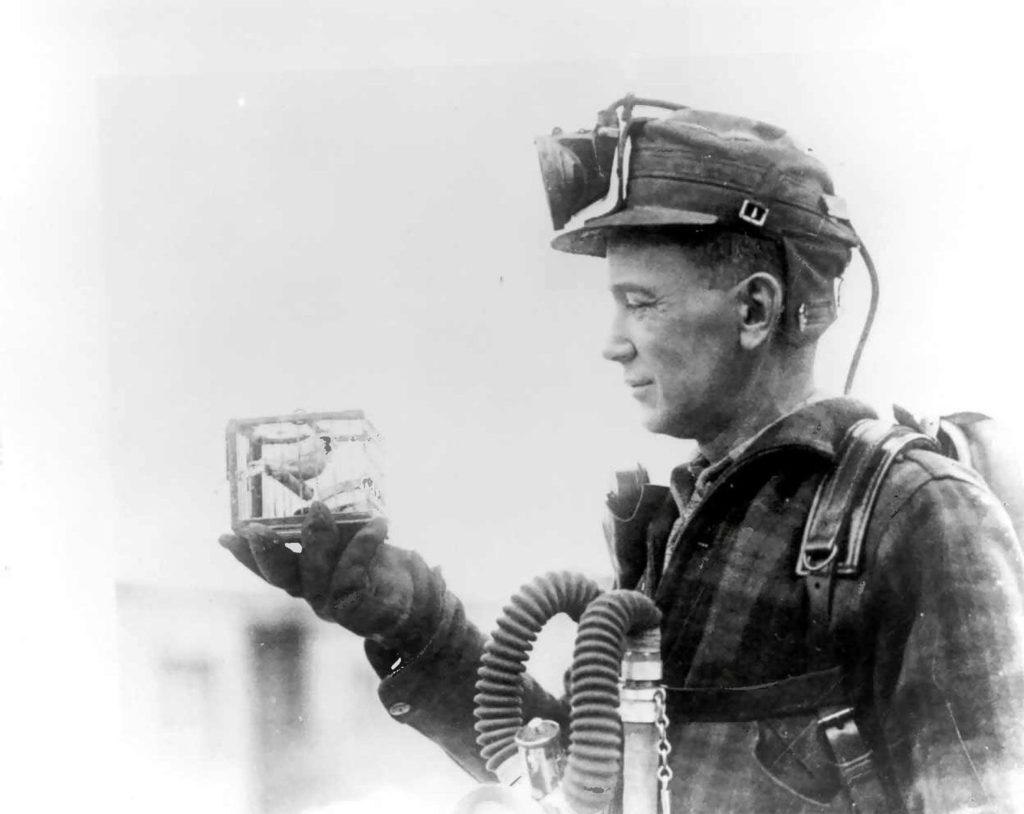
Invisible wounds—inflicted by social and familial trauma—are often the deepest, the most dangerous, and the easiest to deny. They linger, unacknowledged, shaping lives in unseen ways while the world turns a blind eye to the sanctity of human connection and the profound need for safety.
Addiction rarely emerges from society’s dark fringes or the inner shadows of a fractured mind. Instead, it originates in a profoundly human yearning—a quiet, unspoken desire to soothe a pain that refuses to be named or to chase the allure of life’s unknown thrills. What begins as a fleeting escape can swiftly devolve into a consuming labyrinth—a force so relentless that it wrestles the soul into submission, snuffing out hope’s fragile flame. Addiction’s trajectory is rarely straightforward; it weaves an intricate web of triumph and despair, exhilaration and desolation. Its presence is pervasive yet often obscured, so intimate in its devastation that it eludes even the closest of observers.
Mental illness, too, is born from a complex confluence of forces. Cultural and familial narratives intertwine with genetics and early childhood experiences to shape its emergence. The emotions imprinted on an unborn child, the subtle energy of parental interactions, and the delicate moments in the first three years of life plant seeds that may not sprout until years later.
Addiction and mental illness are often tethered—a dual storm of anguish, with each feeding into the other’s destructive power. Together, they form two sides of a coin that, when cast into the tumult of life, leaves in its wake not winners or losers but a deeply reverberating impact on individuals, families, and entire communities.
This chapter marks the unveiling of my deeply personal story shaped by addiction, unraveling mental health, and the pursuit of redemption. It is a tale not of ultimate defeat but of the raw fortitude of the human spirit, a search for light entrenched in chaos. For family members, psychologists, sociologists, spiritual seekers, and anyone who dares to explore the depths of human suffering and resilience, this is an invitation—a call to walk the fractured, uneven road toward understanding and healing. Through this narrative, may those caught in their own storms find the faint glimmer of a path forward and, perhaps, the courage to step onto it.
THE FOOLS
- You know who we are, there is no need for our names.
- We may be outwardly different, but inside are the same.
- Vacationing on chemical trips, playing strange mind games.
- Striving for our culture’s version of success, and its dubious fame.
- We remain graceless souls blended into life’s darkest mass.
- Affirming our uniqueness, though stuck in the same class.
- Parading around like winners but appearing just like an ass.
- Steering clear of self-awareness, Oh our transparency of glass!
- Spewing words of wisdom, but with only another dogs’ bark.
- Seeking to make a good life, but on life’s script leaving a shit mark.
- We may eventually see the light, but now life is always so dark.
- Needing purifying inner flames, while snuffing every divine spark.
- Hoping to someday blossom, yet we will never possess Love’s flower.
- Swimming in intoxicating sweetness and then drowning in its sour.
- Never realizing that, over life, we don’t hold any real lasting power.
- We avoid the dark reality of our lives, by living in a chemical tower.
- We bring up life’s rear, though we think that we should be first.
- We want all of the best, somebody else deserves the worst!
- Our life should be more blessed, why on earth do we feel cursed?
- Our dependency creates toxic bubbles, just waiting to be burst!
Some paths to clarity and healing cut through the deepest darkness. Mine was one of those. This is not a sanitized story; it is not here to soothe or smooth over jagged edges. I carry the wounds of sixteen years of addiction and a near suicide, the lifelong echoes of trauma, and the failures and losses that shaped me. But I also carry the truth earned from those depths—and the redemption that followed.
This is my testimony.
By 1986, my life resembled a long and painful cliché—a childhood steeped in chaos, a youth drowned by alcohol and other substances, and adulthood underpinned by broken relationships and unrealized dreams. In my sober moments I was able to secure a full ride scholarship with the US Air Force, but my disease forced me to give it up. The disease started with beer at age five, escalated through my teens, and by my twenties, addiction had hollowed out nearly everything.
On January 28, 1986, the Challenger space shuttle exploded. For many, it was a shared moment of tragedy; for me, it was a cruelly poetic metaphor. It mirrored the destruction of my aspirations—dreams beginning in early childhood of piloting planes and perhaps touching the stars as an astronaut—shattered by the far harsher reality of addiction.

Challenger Explosion January 28, 1986-The day I attempted suicide, and began my Search For Truth
I had promised myself at age 15, with unwavering resolve, that if I couldn’t quit drugs by the time I turned 30, I would end it all. At 30, after a failed suicide attempt on January 28, I secured yet more medicine for a second attempt. I carried those suicide drugs with me, waiting for the moment I’d finally again lose the energy to fight the effects of despair, emotional isolation, and grief.
From April of 1986 into the first three months of 1987, I lived out of a 1977 Datsun 310 or squatted in unoccupied homes, trying to put distance between myself and my family, friends, or anyone who could bear witness to my crumbling existence. Despite clinging to the spiritual principles of AA, abstinence wasn’t on my list. I existed in the tortuous realms of addiction, suicidal ideation, emotional isolation, despair, surrender, and, at times, a desperate rebellion. And, I carried the suicide drugs with me the whole time, hidden under the front seat of my car,

AA Book, carried with me in my car through my darkest days
The Poems of Pain
I wrote poems during this period. Consider the following desperate attempt to map the uncontainable agony inside my soul.
PAIN
- Growing without roots, with a will that won’t bend.
- Weathering life’s storms, which never seem to end.
- No longer waiting for the sun that was once promised to arise,
- How could truth’s light possibly shine in dimmed eyes?
- Having reached with futility for all the high goals of life,
- With no spiritual growth, while consumed by inner strife.
- Devoid of healing affection, and a stranger to real love,
- Unrealistic hope was what my failed dreams were all made of.
- Despair meets each day, summer has now changed into fall,
- Looking at life, I am totally disgusted by it all.
- Dying of loneliness, and holding life by only a thread,
- With me rotting inside, hopefully, I soon will be dead.
- Pain,
Why?
Words in their raw form were my only emotional connection to the dire truth of my life.
When you’re closer to death than life, the challenges of compromised free will and its limited choices carries unbearable weight. Born out of numb desperation, I replaced the act of taking my life with something else—a search for truth.
It wasn’t yet fully a noble quest. It wasn’t driven by insight, blinding light, or revelation. These blessings were to come after the emergence from the dark underworld. Perhaps similar to the hero’s journey acknowledged in ancient mythology and modern literature, I had to enter into a completely unknown world and fight my demons there. I had to scrape and fall and crawl to find the hidden healing vein of my long lost self. It was a last gasp attempt to find something—anything—worth holding onto.
I formed fragile bonds with people society doesn’t want to see—the homeless, the addicted, the criminal element, and the outcasts. Steve came into my life during this period. An undercover agent, he and others were investigating the Portland Police Department, and those who might have known and aided and abetted Steven Kessler, a notorious and evil criminal who had killed a prison guard, escaped jail, and ransacked the DEA’s office in 1982. I knew the man who supplied Kessler with his getaway car. I also was roomates for three weeks in the P&S Care Unit in 1984 with Tom C., one of Kessler’s co-conspirators in starting the infamous 1966 Oregon State Prison riot. Somehow I was a card carrying member of this disfigured community that Steve was investigating.
Agent Steve and I were from different worlds, but we occupied the same neighborhood for nearly a year during the investigation. I did not know that he was an undercover agent, though I sensed that he was keeping a big secret. Somehow he saw through my darkness. He was curious about my search for truth, and asked many questions over several months. This strange, one-sided friendship was a lifeline for me, as Steve became my big brother, giving good advice as I navigated an amazing cast of damaged characters ranging from murderers and motorcycle gang hit men through drug manufacturers. It was Steve who ultimately intervened when I hit my second rock bottom, the bottom where death again became inevitable. And he did so with sharp honesty, urging me not just to live—but to search differently and better.
Steve dropped me off at my father’s home in March of 2017, after he saved me from certain death. My parents were snowbirding in Arizona, and thankfully would not be home until the following month. He told me that my search would not be complete until I fully faced my father, and dealt with all the damage I had experienced through that relationship. Steve also removed and disposed of the suicide drugs from my car, unbeknownst to me. I had lost so much weight, had open sores on my body, heard “voices”, and shook badly, similar to Parkinson’s disease. I was too ashamed of my appearance to face my psychiatrist again, so suicide through medication became out of the question
My fight for recovery wasn’t a Hollywood montage of victories. One evening I downed a few bottles of wine from my father’s stash, and entered into a blackout. I drove in that blackout state and found a drug manufacturing friend who lived near my parent’s home, and hung out for a couple days with him. He sobered me up by shooting me up with speed, and, miraculously, a light then went off in my mind. I looked at him and myself with a new clarity, called both of us insane, and stopped using, drinking, and smoking on the spot.
I then drove to my beloved grandparent’s home, and began detoxing for five totured days. I then stumbled into AA, NA, and ACOA meetings, sometimes three a day, where recovery finally started to make sense. Jack Boland’s tapes on recovery and spirituality became a thread I clung to, giving structure to my raw beginnings of faith and self-awareness.
The real work was long and sometimes cruel when filled with facing deep wounds, though enlightening when blessed with apocalyptic revelations and spiritual experiences. I experienced setbacks and some regressions, but I stayed sober. Over time, healing came—not just through seeing and “fixing” what was broken in me, but through surrendering to something bigger than my pain. I reframed loss and failure as an evolution rather than a curse.
This shift allowed glimpses of joy, discovery, and eventually, finding my true nature and an unshakable sense of purpose.
The Death of Dreams and the Rebirth of Meaning
If grief is the culmination of love, what then is the death of a dream? It isn’t loud like funerals or heartbreak; it’s a quiet decay that smothers the soul. When I lost my dreams of becoming an Air Force pilot and later a NASA astronaut, I felt like I’d lost a part of my identity.
Dreams are the compass guiding us through life, and without them, I drifted into a debilitating fog of chronic self-doubt and cynicism. Yet, the darkness of losing those dreams became fertile ground for transformation.
The ultimate lesson? Redemption doesn’t mean going back to what was. It means finding beauty in what remains—in the jagged, shattered pieces that refuse to align perfectly. There was beauty to be witnessed through the kaleidoscope of my broken parts, but I had to develop the discernment to see it.
What I once saw as a barren wasteland became the birthplace of something greater. The death of those dreams stripped away illusions and made room for a purpose deeper than ambition, wider than a desire to just blend in and remain silent about what I have seen..
The New Normal of Addiction and Cultural Disease
Today, what concerns me is how deeply normalized addiction and self-destruction have become in our culture. We fragment our life force through adhering to patriarchal norms and toxicities, and build walls between each other through unchecked coping mechanisms, competitive burnout, and resistance to treating mental illness openly.
This is not a story about me; it is about us—all of us who unwittingly perpetuate a culture that denies vulnerability and glorifies survival at the expense of thriving.
We need a paradigm shift. Addiction and mental health issues are not a moral failure; they are a public health crisis. Mental health care must become accessible—not stigmatized. Dream-smothering despair must be met not with judgment, but with possibilities.
More than 10 books and countless blog posts later, my search for truth has evolved—not ended. I share this story not to wrap my experience in a neat narrative arc, but to connect with those who also walk along the edges.
To those overwhelmed by grief, broken dreams, or addiction, I offer this knowledge hard-won through decades of survival and healing:
- Love and loss are two sides of the same coin. The deeper the grief, the more meaningful the connection.
- The death of a dream doesn’t mean the death of hope. It is often a clearing—painful, painful space where something new can grow.
- Seek people, places, or practices that remind you of light.
My life’s purpose isn’t to pretend away the abyss but to show others that it’s possible to climb out of it and carry its truth forward.
My search for Truth, which had taken me through the darkest regions of hell, eventually gave me wings, and enabled me to fly to the sun, and beyond. I had a series of dramatic, miraculous healing experiences over the several years immediately following my suidal ideation that restored me to a physical, emotional, and spiritual sanity and understanding that I had never experienced before in this life. This transformation started being documented in 2016, by a man who had been trapped most of life by our culture’s conspiracy of silence. The prison guard with one of the primary keys to release me from my spiritual imprisonment was my unhealed relationship with my father and our sick patriarchal culture. Overcoming a lifetime of oppression and control by others is no easy task. It also must be done clean and sober, for the true depth and healing of the experience to permanently take hold. I began a new relationship with my father, starting with new-found sobriety. The real fruitage of healing from the relationship was not to become apparent until many, many years later. I also confronted toxic masculinity, toxic religion, and toxic capitalism, the three pillars of darkness upholding much of our culture, Much of that material is included in other chapters in this book.
 My journey through addiction was a profound challenge marked by despair, shattered dreams, and unexpected friendships. Yet, within this darkness, I discovered a powerful spark of hope and the unwavering strength to move forward. My story embodies the resilience of the human spirit and the transformative power of connection. One of the most painful realities I’ve faced is the tendency of people to turn away, not just from my struggles but from the struggles of many others. I’ve witnessed the stark lack of empathy and compassion that permeates our troubled culture. Adjusting to this sick, potentially terminally ill American society is not a hallmark of good mental health, but becoming part of its healing transformation is. Addiction, suicide, and mental illness have become pervasive issues, and their growth shows no signs of slowing down. We all can make a meaningful impact on each other’s lives. Our positive vibrations can resonate far beyond our immediate circles. However, on the darker side, each suicide typically affects around 140 people. If my suicide attempt had succeeded, it would have devastated my parents’ lives. But I realize that I might not have impacted many others, as I had few fulfilling relationships, and even fewer who cared about me.. My healing journey holds immense value, not just for me but also for those who still find themselves in the depths of despair. I aim to reach out to those who are open to my message of healing and hope. Perhaps one day, I will positively influence the lives of 140 people, contributing to their greater good. This is not an ending. It never is.
Chapter 38: When Dreams Die and the Path of Awakened Service
The Silent Grief of Our Guiding Light and the Calling to Ease Others’ Suffering
In the vast circuitry of human experience, few electrical failures carry the devastating weight of a complete system shutdown like the death of a child. It’s a catastrophic overload that leaves behind an emotional landscape stripped of all power, all light. Yet there exists another kind of death—equally crushing in its capacity to extinguish the soul’s illumination, though far less visible to the world around us.
The death of a dream.
This particular form of grief doesn’t manifest through tears shed at gravesites or the numb silence of mourners gathered in black. Instead, it lingers in the soul like a persistent short circuit, continuously darkening our inner worlds. Dreams, you see, are our guiding lights—the stars that illuminate pathways through the vast terrain of existence. When these lights extinguish, the dreamer finds themselves wandering in shadows of despair and confusion, fumbling for switches in the darkness.
The Architecture of Dreams
Dreams are far more than idle imaginings or lofty aspirations floating through consciousness like static electricity. They form the very scaffolding of our identity, the primary current that propels us forward when all other power sources fail. A cherished dream infuses us with purpose, energizes our days, and fills our nights with visions of what could be—like a generator humming with potential, ready to illuminate possibilities we’ve yet to discover.
To dream is to affirm life itself, to declare that there exists something more—a horizon worth reaching toward. The philosopher Søren Kierkegaard described despair as “being unconscious of having a self,” a state eerily parallel to losing the essence of what once inspired us. Without dreams, we risk losing the fundamental “self” that connects us to our inner voice, our deepest passions, and our highest aspirations. We become like electrical circuits without purpose—capable of conducting energy but with no destination for that power.
The death of a dream rarely arrives as a sudden power outage. More often, it resembles a slow dimming of lights, as obstacles and doubts accumulate like resistance in aging wiring until the horizon disappears entirely. Sometimes, however, it strikes with the violence of lightning—triggered by a catastrophic failure, an irreversible event, or perhaps harsh words that puncture our confidence like a surge protector failing at the crucial moment.
Consider the aspiring writer whose manuscripts collect rejection slips like dead batteries, eventually abandoning their craft when the power to continue finally fails. Think of the entrepreneur whose startup crumbles after years of relentless effort, leaving them financially and emotionally depleted—their dreams scattered like the components of an explosion. Or contemplate the man whose young wife suffers an irreversible medical condition, effectively short-circuiting all hopes for emotional stability and joy in their marriage. Their grief, though rarely acknowledged by society’s conventional meters, registers no less powerfully than mourning the loss of a loved one.
When external, tangible losses occur—death, divorce, financial ruin—the world often responds with the established protocols of condolence: rituals, support systems, casseroles, and time off work. But when dreams die, the response creates a peculiar void in our social circuitry. The grieving dreamer encounters dismissal (“Perhaps it wasn’t meant to be”), empty platitudes (“You’ll bounce back stronger”), or worse—complete silence.
Society, consciously or not, pressures individuals to “move on” without fully processing their loss, like demanding someone flip a breaker without first understanding why it tripped. This message amplifies shame, leaving the individual with a persistent sense of failure that hums beneath the surface of daily existence.
Such invalidation deepens the isolation exponentially. The dreamer feels prohibited from acknowledging their grief, rendering their loss invisible not only to others but eventually to themselves—a kind of psychological blackout that can persist for years.
The death of a dream often follows the familiar stages of traditional grief: denial, anger, bargaining, depression, and acceptance. It can leave individuals feeling completely disconnected from their power source, destructive toward themselves and others, or entirely swallowed by emotional numbness.
The symptoms of “dream grief” create their own diagnostic pattern:
- Loss of identity: “Who am I without this dream that defined me?”
- Chronic self-doubt: “Was I delusional to believe in it at all?”
- Fear of reinvestment: “What if I risk everything again only to fail spectacularly?”
- Pervasive cynicism: “If my most cherished dream has died, what’s the point of cultivating any aspirations?”
This psychological fog traps the dreamer in a kind of emotional purgatory—suspended between longing and resignation, where the future feels impossibly distant and the past remains an aching reminder of what might have been, like phantom voltage in severed wires.
The Path Through Darkness
Yet here lies a profound truth about the universe’s electrical system: even in the deepest darkness, the potential for illumination remains. The journey toward healing begins with radical honesty—acknowledging the loss and honoring it as a significant chapter in the human experience rather than a failure to be quickly forgotten or minimized. Acceptance doesn’t require abandoning all hope; instead, it creates space for reflection, allowing room for new aspirations to emerge from the fertile ground of transformed experience.
The death of a dream often clears the pathway for a greater, more authentic expression of life’s purpose. The artist, once paralyzed by rejection, may discover profound joy in collaboration rather than solitary perfection. The failed entrepreneur, stripped of their original vision, might find success through pivoting or mentoring others navigating similar territories. The promising student-athlete, derailed by injury and addiction, could eventually find recovery and then channel their hard-won wisdom into helping others still trapped in similar suffering.
This transformation begins by engaging with essential questions:
- What has this experience revealed about my authentic self?
- If I could reimagine this dream through the lens of accumulated wisdom, what would emerge?
- How might I repurpose the knowledge, skills, and resources I’ve gained to serve a new vision?
True transformation rarely follows linear progression, but it invites forward movement—not with blind optimism, but with compassionate realism that honors both the pain of loss and the possibility of renewal.
What does it mean to truly awaken from such profound loss? For some, awakening conjures images of personal enlightenment—an individual standing on a mountaintop, liberated from worldly concerns, basking in transcendent peace. But genuine awakening reveals itself as something far more complex and demanding.
For years, I lived entangled in layers of suffering that seemed to multiply like crossed wires in a deteriorating system. Trauma, addiction, and oppressive influences shaped my reality, each carrying its own destructive charge. Society and culture imposed their rigid circuitry, family expectations constricted identity like undersized conduits, and religious guilt applied pressure that threatened to overload the entire system. These forces collectively eroded my sense of authentic self until I felt like a damaged component, constantly at war with both inner and outer worlds.
Yet the human spirit possesses remarkable resilience—like a system designed with multiple backup power sources. Amidst the crushing weight of despair, something deeper persisted: a longing for genuine freedom. Through sustained introspection, developing awareness, and practices that connected me to what I call “Love’s universal bandwidth,” I gradually found a way through the darkness. The chains of addiction corroded and broke, trauma softened its grip on my system, and the oppressive expectations of others became mere whispers in the expanding silence of authentic being.
For the first time in decades, I stood fully as myself—an awakened being who had emerged from life’s deepest shadows into something approaching genuine illumination.
But here emerges awakening’s central paradox. Personal liberation never represents an endpoint; it serves as a beginning—a new lens through which reality gets reframed entirely. And like a radio receiver suddenly capable of detecting the faintest signals even amid powerful interference, I began attuning to something profound and unavoidable: the persistent suffering of others.
There exists a peculiar burden that accompanies awakening. Internal suffering may dissipate—the weight of fear, guilt, and resentment lifts like removing heavy chains—and the typical shackles of the human condition feel light enough to discard entirely. For extended periods, indescribable peace flows freely, unburdened and infinite.
Yet awakening doesn’t sever connection to humanity; it amplifies it exponentially.
Despite personal freedom, the world’s pain penetrates consciousness like water soaking through every fiber of a sponge. I witness it in the faces of grieving parents clutching photographs of children whose lives were extinguished by overdoses. I absorb it in homes where silence weighs heavier than words—families haunted by suicide, their questions forever unanswered, their loved ones carried away by invisible battles that left no apparent warning signals.
From trauma to addiction, from systemic injustices to inexorable loss, suffering continues threading through our shared existence like a persistent background frequency that never quite fades. What does this mean for the awakened individual? Are we condemned to shoulder the world’s anguish as our own perpetual burden? Or can we transform this heightened sensitivity into purposeful action?
This question confronts me constantly as I volunteer with bereaved families, sitting in the raw aftermath of life’s most devastating system failures. Through these experiences, practical insights have emerged—not as ultimate solutions, but as reliable principles for how awakened individuals can channel their awareness into meaningful service:
Hold Space Without Attempting Repair: Suffering often thrives in isolation yet hides behind veils of shame. Most people need the presence of another who will maintain a steady circuit for their pain without trying to fix, analyze, or redirect it. Simply being present—breathing with them, listening deeply without rushing to respond—often provides the most healing current an awakened person can offer.
Share Stories of Transformation: Immense power flows through authentic storytelling. When we openly share journeys of suffering and transcendence, we offer roadmaps to others trapped in seemingly hopeless circumstances. This reminds them that darkness represents a temporary condition, not a permanent state—a phase of experience that can be metabolized and transformed. Vulnerability, shared honestly and courageously, becomes a bridge connecting human hearts across vast distances of pain and isolation.
Educate with Compassionate Precision: Awakened beings can empower others through carefully shared knowledge. For those confused by their suffering—whether addiction, mental health challenges, or systemic oppression—pointing toward relevant resources and information can prove revolutionary. The goal isn’t preaching predetermined solutions but offering tools for self-discovery and organic healing.
Commit to Tangible Service: Compassion without action remains incomplete circuitry. Volunteer with organizations directly serving those in crisis. Whether supporting mental health initiatives, advocating for recovery programs, or simply helping neighbors navigate immediate needs, concrete acts of kindness create ripple effects that extend far beyond immediate visibility.
Guide Without Attempting Rescue: Awakened individuals must resist the overwhelming urge to eliminate all suffering they encounter. Attempting to solve others’ problems risks disempowering those who must walk their unique paths of growth and integration. Instead, empower others by offering gentle guidance, sharing perspectives when genuinely invited, and maintaining faith in their inherent capacity for healing and transformation.
Radiate Unconditional Love: Ultimately, awakening represents a return to Love itself—not as mere sentiment, but as the fundamental frequency underlying all existence. Every human interaction must occur through this lens. Whether engaging strangers, loved ones, or those we struggle to understand, the core principle remains constant: approach all beings with compassion, understanding, and the boundless love that connects every point of consciousness across the infinite bandwidth of being.
The Universal Bandwidth of Service
It’s tempting to perceive human suffering as an infinite abyss—vast, unyielding, and eternal. Yet awakening reveals a transformative truth: while we cannot eliminate suffering entirely from the universal system, we can create moments where its intensity softens significantly. We become sources of light within darkness, healing frequencies within chaos, steady currents within turbulent energy fields.
The death of dreams, like all profound losses, represents both ending and beginning simultaneously. When our cherished visions dissolve, we face a choice that determines the trajectory of everything that follows: we can allow the darkness to consume us entirely, or we can use that hard-won wisdom to become guides for others navigating similar territory.
To you, fellow traveler on this path of conscious service, standing at the crossroads between personal awakening and compassionate action, I offer this fundamental guidance: Live consistently on Love’s universal bandwidth. Whether you currently occupy the position of one suffering or someone seeking to uplift another, anchor yourself in that boundless love. Let it determine your actions, inform your presence, and define your ultimate purpose.
Being awakened doesn’t mean developing invulnerability to others’ pain—quite the opposite. It means becoming open enough to feel that pain fully, wise enough to transform it constructively, and compassionate enough to take meaningful action despite personal comfort or convenience. The smallest step toward offering genuine love creates changes that ripple outward in immeasurable and often unexpected ways.
We serve as keepers of the inner light—challenged certainly, but never truly extinguished. The path ahead may lack clear visibility, but by choosing to walk it with curiosity and unshakeable faith, we honor both the dreams we’ve lost and those yet to emerge from the fertile darkness of transformed experience.
In this grand electrical system we call existence, even the smallest light can illuminate vast territories of possibility. Even the gentlest current can restore power to systems long dormant. Even the most broken circuit can be rewired for entirely new purposes.
The universe operates on love’s unlimited bandwidth, and we—awakened, wounded, and willing—serve as its most essential conductors.
Chapter 39: Breaking the Silence – From Darkness to Divine Maternal Love
(56, 58 merged)
A Journey Through Trauma, Addiction, and Spiritual Rebirth
The human soul carries within it an extraordinary capacity for renewal—a truth I discovered not through theological study or philosophical contemplation, but through the raw crucible of personal devastation and subsequent spiritual awakening. What began as a descent into addiction and despair ultimately became my pathway to understanding the profound healing power that emerges when we courageously confront our deepest wounds and embrace the transformative presence of the Divine Feminine.
After reading earlier chapters in this book, it would be easy to assume that I had led a fairly well-organized life and had sufficient native spiritual and emotional intelligence to find my greatest good without too many problems. Nothing could be further from the truth! Conventional wisdom often suggests that a life imbued with uncommon knowledge follows a predictable path: religious study, gradual enlightenment, and methodical progress toward divine understanding. My journey shattered this assumption entirely.
This is not merely a personal testimony, but an invitation to examine how trauma—particularly that which stems from rigid gender roles and religious conditioning—can become the very catalyst for our most profound spiritual evolution. Through sharing this intimate journey, I hope to illuminate pathways toward healing that honor both our individual struggles and our collective need for authentic spiritual connection.
The Roots of Collective Trauma
Before we can understand the healing journey, we must first acknowledge the pervasive sources of trauma that shape our earliest experiences of self and world. Two primary wellsprings of collective wounding have dominated human consciousness for millennia, creating patterns of separation that echo through generations.
The first source emerges from the unconscious acceptance of rigid gender roles that extend far beyond biological distinctions between male and female. These culturally imposed expectations create artificial boundaries that limit the full expression of our humanity. Men are conditioned toward competitive individualism, encouraged to suppress emotional vulnerability, and taught to measure worth through dominance and achievement. This paradigm not only traumatizes masculine energy but also systematically devalues the collaborative, nurturing qualities that represent the essence of feminine wisdom.
Women, conversely, face their own constellation of limiting expectations. Religious traditions have often relegated feminine voices to subordinate positions, while broader cultural narratives reduce women to roles defined by their relationships to others—as objects of desire, vessels of procreation, or support systems for male achievement. These imposed limitations deny the profound creative and spiritual power that the feminine principle represents.
The second major source of collective trauma emerges from religious teachings that fundamentally misconstrue human nature and worth. From childhood, many of us absorb messages about our inherent sinfulness, our separation from the divine, and our need for external salvation. These doctrines create deep wounds of unworthiness that can persist throughout our lives, obscuring our recognition of the sacred presence that dwells within our very being.
My own journey into trauma began early, rooted in maternal absence during my most vulnerable months. Unable to breastfeed and consumed by work responsibilities, my mother could offer little of the nurturing presence my infant soul craved. Nights spent crying alone in a car in the garage, away from the household’s peace, created a foundational wound of disconnection that would echo through my formative years.
This early deprivation manifested as delayed speech, recurring nightmares, and a persistent sense of not belonging in the world around me. At school, my attempts to gain attention often resulted in disciplinary trouble, while my natural affinity for the gentler company of girls left me feeling alienated from male peers who seemed more at ease in their prescribed roles.
Religious dogma, which provided structure and meaning to many others, became objects of total scorn by me. The sacred texts, the rituals, the promises of salvation—all of it felt hollow, disconnected from any authentic experience of the divine. This wasn’t mere rebellion; it was a complete spiritual revulsion at organized religion that began in grade school and eventually left me adrift in a world devoid of meaning.
Adolescence brought little relief from these struggles. The competitive, often cruel dynamics of teenage social hierarchies amplified my existing wounds, while romantic relationships remained elusive mysteries that deepened my sense of inadequacy. An ill-fated early marriage and its subsequent dissolution in 1984 further compounded feelings of failure and despair.
The Descent into Darkness
What followed was a fifteen-year odyssey through the often-turbulent landscape of despair, loss of hope, and self-destruction. Drug and alcohol abuse became my primary spiritual practice, offering temporary escapes from the overwhelming emptiness that had consumed my existence. Each substance promised transcendence but delivered only temporary relief from the burden of self, and only deeper entanglement in cycles of craving and disappointment.
The casualties accumulated relentlessly. Friends eventually failed to provide comfort and companionship through the slow erosion of trust and connection that addiction inevitably brings. Family relationships, once sources of support and identity, crumbled under the weight of broken promises and repeated failures. Employment opportunities vanished as my reliability dissolved along with my sense of responsibility to anything beyond the next high, the next forgetfulness of the misery of the moment.
By 1986, these accumulated wounds had reached a breaking point. The pain of disconnection from love, from purpose, from any sense of belonging in the world became so overwhelming that I arrived at the logical conclusion of my trajectory.
The Ultimate Darkness: January 28, 1986
The descent reached its nadir in a moment of absolute clarity about the futility of my existence. The explosion of the Challenger spacecraft on January 28, 1986, became the exclamation point on my life of failure. I once aspired to be an Air Force pilot, with hopes of becoming an astronaut. But my relationship with a mentally ill wife and my own insouciance in the face of overwhelming odds against my success goaded me into taking extreme measures.
The Challenger explosion became a symbol of my life’s destruction, and there could be no resurrection from this. This wasn’t an impulsive decision born from temporary despair, but a calculated assessment that life, as I was experiencing it, held no value worth preserving.
The attempt failed, but the failure itself became a catalyst for transformation. Lying in the aftermath of my unsuccessful bid for self-annihilation, I experienced something unexpected: not relief, but conditional acceptance. I was confused at a universe that kept me trapped in an existence that felt meaningless, while amazed at some coincidences that prevented the successful ending of my own life.
In that moment of faux empowerment, I made a demand that would alter the entire trajectory of my journey. I reloaded my pill bottle—my insurance policy against continued suffering—and issued an ultimatum to existence itself. Unless I could find a truth worth living for, I would complete the work of self-destruction that I had been unconsciously pursuing for fifteen years.
This wasn’t a plea or a prayer in any conventional sense. It was an ultimatum to myself, a demand that I would stay alive only if I could unearth authentic meaning. I had moved beyond hope into something more primal: a raw insistence that truth, if it existed, must either reveal itself or I would face the consequence of my permanent departure from this most troubling game of existence.
The months that followed my ultimatum were characterized by gradual movement into the deepest levels of Portland’s underworld. Over the next year, until March 17, 1987, I was sucked into Portland, Oregon’s shadow realm—a community populated by those who, like me, had fallen through the cracks of conventional society.
Here, among the addicted, the lost, and the forgotten, I encountered a different kind of wisdom. It wasn’t the polished philosophy of academia or the comforting platitudes of mainstream spirituality, but the raw, unfiltered insights that emerge when all pretense, and often all hope, has been stripped away.
During this period, I encountered a competent confidant, an undercover DEA agent who happened to befriend me and who possessed the clarity to diagnose the foundational issues underlying my self-destructive patterns. His assessment was both simple and daunting: I needed to achieve sobriety and confront the unresolved father issues that had been driving much of my destructive behavior.
Getting clean required a complete restructuring of my relationship with consciousness itself. For fifteen years, I had relied on substances to mediate my experience of reality. Sobriety meant facing that reality directly, without chemical buffers or altered states to soften its edges. The withdrawal was not merely physical, but existential—a confrontation with the unadorned experience of being human without pharmaceutical assistance.
Addressing my father issues proved equally challenging. These weren’t simply matters of personal psychology, but fundamental questions about authority, masculinity, and my place in the larger patterns of existence. The work required examining not just my relationship with my biological father, but with the entire concept of paternal authority, divine and human.
Two months into sobriety, I discovered Jack Boland’s tape series “12 Steps To A Spiritual Experience.” These three hours of recordings contained the most powerful information about recovery and spirituality that I had ever encountered. Unlike the religious dogma I had scorned or the new-age platitudes that had left me cold, Boland’s teachings possessed an authenticity that spoke directly to my experience of spiritual bankruptcy and renewal.
Boland’s approach wasn’t about conforming to external religious structures, but about discovering the spiritual dimensions inherent in the recovery process itself. He presented the twelve steps not as mere psychological tools, but as a genuine spiritual path capable of producing profound transformation. His teachings suggested that the very experiences I had dismissed as purely destructive—addiction, loss, despair—could serve as doorways to spiritual understanding when approached with the right perspective.
The Vision of Divine Maternal Love: May 24, 1987
Two months into this new journey, on May 24, 1987, my yearning for healing culminated in an experience that forever altered my understanding of both divine love and my own nature. While driving through the West Hills toward a friend’s house, I was overwhelmed by a vision of extraordinary power and beauty.
The image that came to me was that of the Mona Lisa, serene and timeless, nursing a baby. But this was not merely a visual experience—it was a complete sensory and emotional encounter with what I can only describe as infinite maternal love. For an entire week, I felt enveloped in a profound sense of divine nurturing, as though all the maternal care that had been absent in my earliest months was now being bestowed upon me in transcendent form.
The light of this divine motherly love seemed to permeate every corner of my being, healing wounds I had carried since infancy. I had to stop my car on Canyon Boulevard, fall to my knees, and offer my gratitude to a Creative Force that had finally found me receptive to its presence.
This wasn’t a theological concept or a psychological projection, but a direct, felt experience of love unlike anything I had ever encountered. It possessed a quality of unconditional acceptance that made every human love I had experienced seem conditional and limited by comparison. This love didn’t require me to be different, better, or more deserving. It simply was, and I was held within it completely.
Understanding the Vision’s Deeper Meaning
This profound experience revealed layers of meaning that continue to unfold in my understanding. The choice of the Mona Lisa as the vessel for this divine communication was not arbitrary—Leonardo da Vinci himself is said to have painted this masterpiece as a self-portrait in feminine form, honoring the divine feminine aspect within his own consciousness. His message, interpreted through contemporary understanding, represents the recognition that all true creativity emerges from the mysterious, intuitive center where wonder, compassion, and sensitivity to others arise.
The image of the divine mother nursing represented my own spiritual rebirth. I was literally being re-mothered by the universe itself, receiving the unconditional love and nurturing that forms the foundation for all healthy development. This was not the conditional love we exchange in daily relationships, but Love itself—a generous, boundless essence that flows eternally through creation.
More significantly, this vision introduced me to the Divine Feminine—not as an abstract concept or theological metaphor, but as a living, healing presence that complements and balances the Divine Masculine. This revelation stood in stark opposition to the patriarchal religious narratives I had encountered, where feminine wisdom is diminished or entirely erased from spiritual understanding.
The Suppression of the Divine Feminine
The suppression of the Divine Feminine represents one of the most profound spiritual tragedies of our time. For centuries, patriarchal systems have systematically devalued the collaborative, nurturing, and intuitive qualities that the feminine principle embodies. This suppression has created a profound imbalance not only in our spiritual understanding but in our approach to relationships, governance, and our connection to the natural world.
The Divine Feminine brings qualities essential for our collective healing: the capacity to nurture growth rather than demand performance, to seek unity rather than perpetuate division, to honor the interconnectedness of all life rather than fragment existence into competing parts. When we suppress these qualities—whether in individuals or in society—we create the conditions for the very trauma and disconnection that plague our modern world.
My vision revealed that healing our deepest wounds requires not only personal work but also the restoration of this sacred balance. The maternal love I experienced was not simply divine comfort for my individual pain—it was a revelation of the healing presence that humanity desperately needs to rediscover.
The Second Experience: Healing and Restoration
The following month brought another spiritual experience, this one focused on healing rather than love. After a hike up to Larch Mountain’s observatory, years of physiological and psychological damage from drug abuse and neglect were simply erased in a single transformative moment. This wasn’t gradual recovery or slow healing, but instantaneous restoration that defied every assumption I held about the irreversible nature of the damage I had inflicted on my body and mind.
The healing was comprehensive, addressing not only the obvious physical deterioration from substance abuse, but also deeper psychological wounds that I had carried for decades. Patterns of thought and perception that had seemed permanently etched into my consciousness were suddenly absent, replaced by a clarity and vitality I had never experienced, even in childhood.
Most remarkably, this healing experience included a shift in perception that allowed me to see without words for the first time in my life. The constant mental commentary that had always mediated my experience of reality fell silent, leaving me in direct contact with what I can only call the underlying reality or foundational awareness that supports all experience.
This wordless perception revealed the extent to which ordinary consciousness is filtered through conceptual overlay. Without the constant stream of mental labeling and interpretation, I encountered the world as pure presence, unmediated by the categories and judgments that typically shape human experience. Colors became more vivid, sounds more immediate, and the sense of separation between observer and observed began to dissolve.
The Third Experience: Beyond Body Consciousness
Another month later, the most profound spiritual experience came in the form of what I can only describe as spiritual or psychological transportation beyond body awareness entirely. In this state, I found myself at what seemed to be the foundation of all perception and creativity, able to observe the mechanisms by which consciousness constructs the apparent reality based upon duality that most of humanity accepts as fundamentally real.
From this vantage point, I could see the utter unreality of what we typically consider real. The solid world of objects, the linear progression of time, the separation between self and other—all of these revealed themselves as constructions of consciousness rather than fundamental features of existence. They weren’t illusions in the sense of being false, but rather temporary formations arising within a more fundamental awareness.
This experience provided access to what I can only call the creative principle itself—the force by which consciousness manifests the apparent multiplicity of forms and experiences from its own unified nature. Most significantly, I was shown that the elimination of all time-based thoughts—those mental activities that reference past or future rather than the eternal present—leads directly to the doorstep of what Jesus called the kingdom of heaven, or what followers of the Buddha called the Buddha mind.
The journey toward spiritual healing and recovery requires both inner work and practical engagement with transformative practices. Based on my own experience and continued exploration, several key elements emerge as essential for anyone seeking to heal from trauma and connect with their authentic spiritual nature.
Acknowledge and understand your trauma. Healing begins with honest recognition of the wounds we carry, particularly those stemming from gender role conditioning and religious messaging about our fundamental worth. This acknowledgment is not about blame or victimization, but about creating the foundation for transformation.
Explore spirituality as a path to healing. Traditional recovery programs, while essential, often lack the spiritual depth necessary for complete transformation. Investigate practices that connect you with transcendent love—whether through prayer, meditation, time in nature, or other contemplative disciplines.
Embrace the Divine Feminine within yourself. Regardless of your biological gender, you carry within you both masculine and feminine spiritual qualities. Learning to honor and integrate the feminine aspects—intuition, collaboration, nurturing, and unity consciousness—is essential for balanced spiritual development.
Seek supportive community. Recovery and spiritual growth thrive in environments of authentic sharing and mutual support. Find others who are committed to genuine spiritual development rather than adherence to rigid doctrinal positions.
Practice radical honesty about your experience. One of the greatest barriers to healing is our tendency to present polished versions of ourselves to the world. True spiritual growth requires the courage to share our real stories, including our struggles and failures.
Master the elimination of time-based thinking. The most practical and transformative insight from my spiritual journey was the recognition that time-based thinking is the primary obstacle to experiencing eternal presence. Every thought that references the past or projects into the future pulls consciousness away from the only moment in which divine reality can be directly experienced: the eternal now.
Breaking the Conspiracy of Silence
Perhaps the most crucial aspect of spiritual healing is our willingness to break what I call the “conspiracy of silence” that surrounds authentic spiritual experience. Too often, fear of judgment or rejection keeps us from sharing the very experiences that could offer healing to others who desperately need to hear them.
When I shared my vision with others, I encountered a range of responses—from those who experienced physical reactions of recognition to others who attempted to redirect my experience into acceptable theological categories. These responses taught me that genuine spiritual experience often challenges established frameworks and may not be immediately welcomed by those invested in conventional approaches.
Yet sharing our authentic spiritual experiences—no matter how unconventional—serves not only our own integration but also provides permission for others to acknowledge their own encounters with the sacred. Each time we speak honestly about our spiritual journey, we create space for others to explore their own deeper truths.
Spiritual awakening is not a single event but an ongoing process of integration and deepening understanding. The vision of May 24, 1987, marked the beginning of my conscious relationship with divine love, but the work of embodying that understanding in daily life continues to this day.
This integration involves constantly choosing love over fear, connection over separation, and authentic expression over conformity to expectations that do not serve our highest good. It means recognizing that our individual healing contributes to the collective healing our world desperately needs.
The Divine Feminine presence that revealed itself in my vision continues to guide my understanding of what it means to live from spiritual authenticity. This guidance manifests not as external commands but as an inner knowing that draws me toward choices that honor both my own deepest nature and the interconnected web of life of which we are all part.
The trio of profound spiritual attunements happened over a fifty-eight-day period during the summer of 1987. This transformation still impacts my daily life thirty-eight years later. The fundamental shift in perception has been an ongoing evolution, integrating transcendent awareness with ordinary life. The ability to access the uncommon knowledge of wordless perception, divine love, and eternal presence hasn’t diminished, though I’ve had to learn how to function practically while maintaining awareness of these deeper dimensions.
Distinguishing Genuine Experience from Hallucination
How does anybody distinguish between genuine spiritual experience and hallucination, especially given historical accounts of religious delusional activity or even with my history with substance abuse? The distinction lies in the transformative effects and lasting insights that persist long after the experience itself.
Hallucinations, whether drug-induced or psychological, typically leave consciousness unchanged once they pass. Genuine spiritual experiences produce permanent shifts in perception, lasting healing, and practical wisdom that continues to function years later. The three experiences I describe weren’t temporary altered states but doorways to ongoing access to transcendent dimensions of consciousness.
Can someone achieve similar spiritual awakening without going through addiction and near-suicide? Absolutely. My path through the underworld was neither necessary nor recommended. Many achieve profound spiritual realization through meditation, mindfulness, practicing the Presence, service, study, or other traditional means. However, some individuals seem to require complete ego destruction before breakthrough becomes possible.
The key isn’t the specific path but the willingness to release everything that isn’t ultimately real, whether that release comes through discipline or devastation.
The time for spiritual pretense and surface-level healing has passed. Our world faces challenges that require the deepest wisdom traditions have to offer, integrated with courage to transcend the limitations of past religious and cultural conditioning.
Looking back across the landscape of this journey, I can see that every element—the religious disillusionment, the addiction, the losses, even the suicide attempt—served a function in dismantling false foundations to make space for authentic spiritual realization. What I had sought through destruction was actually construction: the building of a consciousness capable of directly experiencing divine reality.
The meaning I had demanded from the universe in my moment of ultimate despair wasn’t provided as a philosophical concept or belief system, but as direct access to the source of all meaning itself. The eternal presence that underlies all temporal experience, the divine love that embraces all beings regardless of their worthiness, the creative principle that manifests infinite possibility—these became not objects of faith but dimensions of immediate awareness.
Perhaps most significantly, I discovered that the kingdom of heaven that Jesus spoke of isn’t a reward for good behavior or a destination reached after death, but a dimension of consciousness available in any moment when temporal thinking ceases. The elimination of time-based thoughts serves as a perceptual key, unlocking access to the eternal presence that is always here, always now, always loving.
The journey from darkness to divine wasn’t an escape from human experience but a descent into its ultimate depths followed by recognition of its transcendent foundation. Every moment of suffering, every encounter with loss, every brush with annihilation contributed to the destruction of illusions that prevented direct contact with ultimate reality.
The universe had indeed provided truth worth living for, but not through comfortable revelation or gradual enlightenment. Instead, it offered complete transformation through complete destruction—death and resurrection played out in the theater of consciousness itself. The pearl of great price was discovered not in spiritual treasure hunting but in the ashes of everything I thought I was.
This is the paradox of authentic spiritual awakening: sometimes we must lose everything, including the desire to live, before we can discover what life actually is. The kingdom of heaven remains closer than our own breath, available not through achievement but through the simple recognition of what has always been present, waiting patiently for us to stop looking elsewhere and return home to the eternal now.
The time for silence is over. The time for transformation is now.
By acknowledging and honoring the Divine Feminine in all of us, by integrating spirituality into recovery, and by sharing our experiences freely, we serve not only ourselves but the greater good that our world desperately needs. Each of us has infinite capacities of insight and perception, and to avoid living a second-hand life experience, we must each directly make conscious contact with the infinite source within our heart and soul.
If your path is one of continuous conscious evolution without extraordinary pain and suffering, more power to you. Mine took me through the fires of hell to reach the promised land. Looking back, it could not have happened any other way. We each have a unique path to take to finally enter into the universe’s unlimited bandwidth of life, love, and death.
Will you answer the call?
Chapter 40: Part of My Journey Through Love, Loss, and Our Collective Mental Health Crisis
(formerly 57)
Mental health is interwoven with every aspect of our lives, forming an intricate tapestry too often neglected or misunderstood in its complexity and fragility. For countless individuals, the threads that hold their experiences together are frayed, pulling at the edges of their identities while revealing a deeply human struggle hidden beneath the surface. The startling reality—as much forty percent of America’s population suffers from loneliness, fifty-eight percent of younger adults suffer from lack of meaning and purpose, while one in five adults experiences mental illness within well-defined psychological categories each year—are not merely abstract data points. It is an invitation to confront the silent agony carried by those living in our cultural collective consciousness. What is this struggle if not a reflection of our society’s own imbalance? A world where compassion and empathy are judged as inferior to political cruelty, divisive attitudes, competition and control creates fertile ground for despair. The political party still known as Republican now supports Trump’s documented pedophilia, misogyny, rape, and a generalized hatred towards equality between sexes and races. For the vulnerable among us, this toxic cultural climate amplifies existing wounds, pushing many into isolated corners where the weight of personal pain becomes insurmountable. And yet, these individual stories are never isolated in impact. They are threads of a greater fabric, rippling across families, communities, and an intricate cultural web born of generations of silence and complicity. Mankind, which engages in devastating wars while also destroying our Earth through monetization and overuse of its resources and overpopulation, suffers from mental illness in a collective sense. The oppressed and victimized, the addict and alcoholic, and most innocent and sensitive people in our society are most vulnerable to developing destructive individual manifestations of this collective disease. ALWAYS REMEMBER, our mentally ill population are society’s canaries in the mine. We will all eventually die of spiritual asphyxiation, should we neglect to listen to the stories being told by our most vulnerable, and damaged, family members.

Our patriarchal culture’s emphasis on productivity, control, and emotional suppression creates environments where sensitive individuals become casualties. The suppression of compassionate responses and normalization of toxic masculine traits contribute to collective mental illness that manifests most clearly in our most vulnerable populations. Toxic men become the religious, cultural, and political leaders of society, making sure that our corrupted narrative never changes, and the conspiracy of silence around their malfeasance and culpability remains firmly institutionalized and normalized. The story I am sharing of mental illness, which will be interwoven with insights and calls to action, neither exists in isolation nor as entertainment. It is real, deeply human, and profoundly reflective of how family and society construct pain and fails to stitch the torn pieces of healing back together. I have lived a first-hand experience with a severely mentally ill person, while also entertaining my version of poor mental health. I have seen directly the helplessness and despair, not only of the mentally ill, but of many of those who attempt to support or have been selected to bring healing and hope to the diseased. My first wife, Donelle Mae Flick Paullin battled with mental illness all of her adult life. Her life and struggles stand as both a warning and an opportunity for transformation. Donelle was a bright light in a darkening world, a sensitive and caring young woman brimming with intelligence and kindness. She was admired by peers for her warmth, elegance, and striking brilliance. Our youth together had the intoxicating energy of innocent discovery, punctuated by laughter, exploration, and dreams of the future.

But the shadows that began to creep into her life soon clouded the brightness we had hoped would guide our shared future. The turning point came prematurely during the end of her senior year of high school when she suffered her first major breakdown. Diagnosed at the time with what professionals termed paranoid schizophrenia, her ailment began to unwind her identity in ways not easily comprehensible, even to those closest to her. Donelle’s beautiful voice was to be silenced by circumstances beyond her control—a tragedy that reflects our society’s failure to protect its most vulnerable members. Born into a family where neglect and poor choices created conditions ripe for exploitation, she had become a victim of sexual abuse at the tender age of six, setting in motion a lifetime of trauma that our systems were ill-equipped to address. Her mother Marlene, herself a product of brokenness, married Donald Flick in 1954. While Don worked tirelessly at the Crown Zellerbach paper mill to provide for his family or tended to two sections of farmland he owned in North Dakota for six weeks every summer, Marlene’s choices during his absence created dangerous situations for her children. The parties she hosted, filled with alcohol and unmarried men, left her young children exposed to predators. It was during these gatherings that Bud Barr, a man with a history of child abuse, targeted six-year-old Donelle repeatedly. It is not known if her two brothers were also molested. When Marlene’s marriage to Don ended, she made the devastating decision to marry her children’s abuser, Bud Barr. For the next decade, Donelle lived under the constant threat of assault, though family members later confirmed that safeguards were eventually put in place. However, the psychological damage was profound and irreversible. The instability continued as Marlene moved from relationship to relationship. After divorcing Bud in 1972, she began seeing Tom, a coworker from Parker Furniture. When Donelle graduated from high school, both Marlene and Tom insisted she leave home, attempting to transfer responsibility to her father. Her father’s new wife, Alice, initially tolerated the arrangement but eventually demanded Donelle’s removal, even while she was still receiving treatment for schizophrenia.

Donelle at South Dakota with her father, 1972
Faced with a young woman suffering from severe mental illness, Donelle’s family was prepared to abandon her to homelessness. This crisis forced me to leave my family home in 1974, much to the displeasure of my parents. It became up to me provide the protection and support her biological family had refused to give. I had to give up my full ride scholarship to the US Air Force and abandon the ROTC program at the University of Portland as a result. I began to work at the US Postal Service to bring income while attempting to get an engineering degree. It became overwhelming to balance all of the demands of school, work, and an often-damaged companion.

Donelle, 1976
At the age of 18, I was thrust into untamed waters I could scarcely understand. Neither love nor fervent hope could unravel the labyrinth of her illness or illuminate a clearer path toward healing. Our world became defined by frequent visits to psychiatrists who prescribed medications that did less to soothe and more to tighten chains around her authentic self, creating side effects so severe they masked the core of who she was. Her condition ebbed and flowed, often with several months of visible stability before yet another storm. Through Donelle’s battle, I began to see a parallel not only in her suffering but also in the patterns of dysfunction within the broader human story. Her fragmented psyche mirrored the symptoms of a society too fractured to recognize the poisoning effects of trauma perpetuated across generations. Mental illness is not born solely from neurochemistry or isolated events. It has fertile soil in environments marked by neglect, trauma and abuse, and the normalization of silence born of shame and guilt. Donelle’s early years in a household undercut by a mother’s recklessness opened the door to unthinkable harm. Her mother’s narcissistic neglect allowed men with ill intentions to encroach, ultimately allowing profound wounds to fester unchecked in a young girl desperately in need of safety and love. Her primary perpetrator, Bud Barr, a controlling and often angry man who had a deceptive charm to her mother Marlene, shattered the innocence of her childhood. These events—which demanded silent acceptance within the family structure—ensured that the trauma would bind deeply into the folds of her identity. This silence, as is true in countless cases, was not natural but imposed by both a family and a culture that avoids accountability, enabling cycles of abuse. Silence, in its many forms, became the loudest element framing Donelle’s life. It was there when the abuse went ignored, when trauma’s marks on her psyche were ignored and later when psychiatric interventions perpetuated misunderstanding rather than resolution. But this silence is not unique to her story. It exists universally across cultures and societal systems, camouflaged within toxic paradigms. We see an over-reliance on medications administered as blunt tools rather than nuanced instruments of healing. Communities shun the mentally ill, ostracizing rather than integrating. Families crumble under the unbearable weight of untreated conditions, leaving individuals isolated at their most vulnerable moments. The world carries shared culpability for pushing the mentally ill to the outer fringes of existence. Whether through systemic dismissal, paternalistic solutions, or public indifference, society reinforces an imbalance where compassion is sidelined. Healing begins not from instructions or platitudes but from creating safe spaces where individuals can express their deepest truths, free from the judgment that so often drives them into further isolation. Many patients in need of healing may well head for the door, figuratively or literally speaking, if there is a perception that they are not being listened to with compassion and empathy. That is the primary reason many never even reach a professional’s doorstep, for the isolation and fear informs the broken person that there is nobody alive who will understand them, keep them safe, and embrace them with love. When Donelle’s fragile resilience faltered once again, echoing patterns of hospitalization and reentry into volatile environments, all she needed was to be heard without actions meant to “fix” her. Her inner chaos was not a sign of weakness or failure; it was the desperate cry of trauma needing acknowledgment. It was a bruised identity grappling to reclaim pieces robbed by unresolved pain.
Donelle’s Family and Her Profound and Heartbreaking Story
Donelle’s brothers Terry and Keith provided a lot of friendship and family support from 1974-1979, and their stabilizing presence in our life was invaluable. Terry became my best friend for a short period from 1975-1977, when we lived in the same duplex. My relationship with the rest of her family was usually civil, but I had serious issues with the poor family support Donelle had always been the recipient of. There was a time several months before our marriage in 1979 that I wanted to hurt both Bud and Marlene very badly, for mistreating and abusing Donelle. Under the right set of conditions, I had the will, and the potential, to bring the greatest harm to Bud, but I never acted upon my disgust and hatred. I broke my collarbone fighting with her oldest brother Keith once, when I made confrontational statements against Marlene, and Keith felt obliged to defend her. Keith later apologized and told me I had every right to be upset, but not until I was forced to wrestle with him, a former high school champion wrestler, AND his wife, who had jumped me too.

Sept 17. 1979

After wedding beer keggar at my parent’s home. Donelle’s father Don is on the right.
Our marriage in September 1979 represented a moment of hope. Donelle had stabilized with new medications and was excelling in her culinary studies at PCC Sylvania campus. For a time, it seemed the nightmare might be over. However, the fragility of her recovery became apparent when a seemingly small betrayal—Keith’s wife broke a promise to let her babysit—triggered the most devastating breakdown of her life. Donelle was not a mother herself, bound by an agreement with me that we could not have children until she had two complete years of health. By January 1980, Donelle was again experiencing the full horror of paranoid schizophrenia. Her cries of “I am controlled!” reflected a mind under siege, though she could never articulate the source of her torment. The disease stole her sleep, filled her with imagined sounds of torture, and left her vulnerable to further exploitation. I would try to help her talk about the forces deep within her “controlling” her, but she refused to talk about them, saying they would hurt her further if she talked about them. During this vulnerable period, in which I moved to another apartment complex across the street to try to preserve my own sanity, my closest friend Dan, one of the two best men at our wedding, despite my explicit warnings, took advantage of Donelle’s compromised state. She awoke to find herself being sexually assaulted while unconscious from alcohol. This betrayal by someone we trusted demonstrates how society’s most vulnerable are repeatedly victimized by those who should protect them. I broke my right hand on the door that closed behind Dan, the last time that I ever saw him. Dan died seventeen years later at his home in Pacific City which he shared with a girlfriend and his young son. Though medications eventually stabilized Donelle enough for us to briefly reunite, the marriage could not withstand the cumulative trauma. We divorced in 1984, and Donelle eventually became homeless on Portland’s streets—another casualty of our inadequate mental health and social support systems. She would come into the public cafeteria at the US Postal Service, where I worked from 1975-1985, every night and cry, hoping that I would see her and give her some support and money. I was counseled by my employer to do something about Donelle, but my tool kit was empty at that point. Donelle was to be “rehabilitated” by a local mental health outreach program by late 1984, who found her temporary housing while securing disability income for her. I left my lifetime guaranteed job in 1985, giving myself some space from my troubled past before making some serious self-destructive decisions beginning in 1986. I began an epic search for truth, and have written extensively about it, some of which appears on Substack. In 1987, I visited Donelle at her apartment near Camas Washington. We had been divorced since 1984, but I still kept in touch with her on occasion, because of my love and concern for her. I had just gotten sober, and I wanted to make amends to her, as part of the program of working the 12 Steps of Alcoholics Anonymous. This time, she was in the middle of a complete MPD (multiple personality disorder) type of nervous breakdown. She had candles lit throughout her apartment, and the setting was quite eerie. I sat down with her to talk, and I noted that she looked so young and innocent, and I was struck by the change in her appearance and countenance. As she spoke to me, I felt like I was witnessing a 6 or 7 year old girl, with the new persona that was now speaking through her. For some reason, I was inspired to give her feedback about her “six year old self” that I was witnessing. I told her that she was not responsible for the sexual abuse that she experienced from Bud (and perhaps one or two unnamed others during Marlene’s drunken soirees). I tried to be as forgiving and compassionate as my heart would allow to the naive, innocent child making its presentation before me. We both cried together, and my heart was broken, and I hurt like I had never before hurt as a human being. I can only imagine her own terror and fear around her own abuse at the hands of her elders. Later in this visit, another “personality” appeared. A calm, composed mature person then “incarnated” into Donelle. I asked who I was talking with. She told me that she was God and proceeded to give me the wisest, most loving feedback that I had ever received as a human being up to that point in my life. “I have many faces, but you have recognized mine, and you have reached the point of being able to accept beauty in your life. You have made peace with your past, but peace does not last forever. You have much work to do, but your work will have love guiding it and protecting you.” As I was open to God at that point in my life, it was a miracle that God could use the vehicle of a damaged human being to talk with me. That is how God works sometimes. Looking at my history, I remained open to the revelations from the Mystery Who can say with certainty what reality truly is? Those who cling too tightly to what they think that they know, can unintentionally exclude a “whisper from God” that might be experienced and revealed in the newness of each moment, no matter what or who the source may be. By 1992, Donelle was confined again at Fort Steilacoom Mental Hospital, her third commitment. The medications that were supposed to heal had instead ravaged her body—she had doubled in weight and could barely keep food down. The beautiful woman I had known was lost beneath the side effects of treatments that seemed to cause as much harm as healing.

Sharon (left) and my first wife Donelle, in 1993 after Donelle’s long-term stay in Fort Steilacoom mental hospital
Upon her release into an apartment complex in Vancouver in 1993, my present wife Sharon and I assisted her with securing furniture. We included Donelle in several family gatherings over the next two years. When her father, Don, died in 1996, Donelle ceased contacting us, and she was moved into a halfway house where she lived for several years afterward. My life experience with Donelle crystallized a growing skepticism of our psychiatric system’s approach to mental illness. The reliance on pharmaceutical interventions, while sometimes stabilizing symptoms, often failed to address the root trauma that drove the illness. The mentally ill often exist in a liminal space where societal rejection compounds their suffering. Yet within their struggle lies profound wisdom about the human condition. Donelle’s journey, while tragic, revealed truths about love, forgiveness, and resilience that “normal” society rarely glimpses. Donelle’s reality was a most challenging one. I am distressed by the abuse that men over the course of her life heaped upon her. She was the most loving, kind person that I had every known, and she got bulldozed by our culture and community, and her diseased response to it. Nature, or nurture? Had Donelle been lovingly nurtured since birth through her adulthood, I would only hope that the disease would not have erupted. Traumatization of our most innocent cannot lead to happy outcomes. What made Donelle’s story so humbling wasn’t just the light it shed on the inadequacies of America’s mental healthcare system or my own faults as a supportive family member. It was a piercing reminder that the brokenness she carried existed within a larger, interconnected web. Our society normalizes secretive behavior, emotional suppression, demands individualistic resilience, and castigates those who fail to conform. The narcissistic mother who ignored her child’s suffering mirrored societal structures prioritizing personal gratification at the expense of collective well-being. The psychiatrists quick to prescribe without deeper inquiry reflected the mechanistic tendencies of modern medicine. My own failings as a partner, struggling to comprehend her spiral, reflected a common human ignorance about relationships and mental health. Over the years that i knew her and was committed to her as a loving partner, from 1972-1984, i tried to be the best support person that I could be. I was damaged goods, as well, so I failed in my mission. She deserved better that what I could give her, because I suffered under my own limitations of selfishness, addiction, and sense of personal powerlessness. With mental illness, we all tend to fail together as a family, as a culture, and as a human race. This is not criticism for criticism’s sake. This is the lens through which opportunity reveals itself.
Mental Illness as a Mirror to Society
Donelle’s legacy does not end in a case study of what went wrong. It points to what we can do individually and collectively to ensure fewer families are forced to reflect on stories tinged with regret and “what-ifs.”
- Compassionate Listening: Professionals and caregivers alike benefit from holding space for the unspoken, undigested truths of trauma. Healing starts with attentive validation.
- Trauma-Informed Care Models: Recognizing the long-term impact of childhood neglect on mental health provides a foundation for nuanced interventions tailored to individual histories.
- Systemic Integration: True reform demands policy changes that include funding for community-oriented mental health resources, holistic rehabilitation programs, and an end to the stigma embedded in housing or employment discrimination for the mentally ill.
- Expanding Awareness: Equipped with accessible education about trauma and its consequences, each of us can create micro-environments that foster empathy and inclusivity.
The marginalization of the mentally ill serves multiple functions in our society. It allows us to maintain the illusion that mental illness is something that happens to “other people,” rather than recognizing it as a fundamental aspect of human vulnerability that could affect anyone. It also enables us to avoid confronting the social conditions—trauma, neglect, inequality—that contribute to mental health crises. Despite systemic failures and cultural misunderstandings, profound healing occurs through the dedication of individuals who bring genuine compassion to their work with the mentally ill. Family members, therapists, spiritual advisors, and healthcare workers who give their lives, hearts, and souls to this work represent the possibility of transformation within broken systems. These healers, many of whom have become friends of mine, understand that effective treatment requires more than clinical expertise—it demands the ability to sit with suffering without trying to fix it immediately, to listen with compassion to stories that may be difficult to hear, and to maintain hope even when progress seems impossible. They recognize that healing often happens through relationship rather than intervention, through witness rather than judgment. The most effective therapeutic approaches acknowledge the complex interplay between trauma, neurobiology, and social environment. Trauma-informed care recognizes that many symptoms of mental illness represent adaptive responses to overwhelming experiences rather than simple diseases to be cured. This understanding opens possibilities for healing that go beyond symptom management to address underlying wounds. Holistic approaches that integrate physical, emotional, and spiritual dimensions of health offer alternative pathways for those who don’t respond to conventional treatments. These methods recognize the wisdom that can emerge through psychological crisis and honor the potential for transformation that exists within human suffering. Mental health exists as “a complex tapestry of otherwise invisible threads that weave through the human experience.” This metaphor captures something essential about these conditions—they operate beneath the surface of visible reality, influencing every aspect of a person’s life while remaining largely hidden from outside observers. The invisibility of mental illness creates particular challenges. Unlike physical ailments that produce obvious symptoms, mental health conditions often manifest in ways that others can easily dismiss or misinterpret. The person struggling with depression may appear lazy rather than ill. The individual with anxiety may seem dramatic rather than legitimately frightened. Those with psychosis may be labeled as attention-seeking rather than recognized as experiencing genuine altered states of consciousness. This hidden nature means that much of the real work of mental illness happens in private—the internal battles with intrusive thoughts, the exhausting effort required to perform normal activities, the constant vigilance needed to monitor one’s own psychological state. The energy required for these internal processes often leaves little capacity for external functioning, yet this reality remains largely invisible to others. The complexity extends beyond individual experience to encompass family systems, social networks, and cultural contexts. Mental illness doesn’t exist in isolation but ripples outward, affecting everyone connected to the suffering individual. Partners, children, friends, and colleagues all become secondary victims of conditions they may not understand or know how to address. Every person struggling with mental illness carries secrets—protective mechanisms developed to shield vulnerable aspects of the self from further harm. These secrets often hold the key to understanding and healing, yet they remain locked away behind walls of shame, fear, and past betrayal. The aphorism “we are only as sick as our secrets” reveals a profound truth about mental health. The energy required to maintain hidden aspects of experience creates additional psychological burden, while the isolation that comes from feeling unable to share one’s truth compounds existing suffering. Yet these same secrets often represent the psyche’s attempt to preserve something precious that couldn’t be protected in any other way. Mental illness frequently develops as a response to secrets held by families and communities—unspoken traumas, denied realities, and collective agreements to ignore painful truths. Children who grow up in environments where abuse is hidden, addiction is denied, or emotional needs are dismissed learn early that certain experiences cannot be safely shared. These early lessons in secrecy often set the stage for later mental health struggles. The therapeutic process involves creating safe containers for these secrets to be gradually revealed and integrated. This requires extraordinary skill from caregivers and tremendous courage from those seeking healing. The process cannot be rushed or forced, as premature exposure of protected material can cause further traumatization rather than healing. Perhaps the most crucial skill for anyone working with mental illness is the ability to listen with compassion and empathy. This goes far beyond simply hearing words to encompass a deep attunement to the emotional and spiritual dimensions of another person’s experience. Such listening requires the ability to be present with suffering without trying to fix it, to hold space for experiences that may challenge one’s own understanding of reality. Many individuals struggling with mental illness have experienced repeated dismissal of their inner reality. They may have been told their experiences weren’t valid, their perceptions were distorted, or their emotions were inappropriate. This history of invalidation creates additional barriers to seeking help and sharing authentically about their struggles. Compassionate listening is a healing art and has been mastered by several internationally known healers like Gabor Mate. It involves believing the person’s account of their experience, even when it includes elements that seem implausible or disturbing. It requires understanding that psychological truth may differ from objective reality, and that both can be valid simultaneously. Someone experiencing hallucinations may be hearing voices that don’t exist externally, yet their terror and confusion are completely real and deserve respectful attention. The healing power of being truly heard cannot be overstated. Many individuals report that the experience of having their suffering witnessed and acknowledged with compassion represents a turning point in their recovery journey. This validation doesn’t cure mental illness, but it can begin to heal the additional wounds inflicted by years of isolation and misunderstanding. Mental illness often emerges from patterns of trauma and dysfunction that span multiple generations. Understanding these patterns becomes crucial for both treatment and prevention efforts. Children who grow up with mentally ill parents face increased risk of developing their own psychological difficulties, not only due to genetic factors but also because of the chaotic and often traumatic environments that severe mental illness can create. The cycle perpetuates when traumatized individuals become parents before healing their own wounds. Their unresolved pain influences their parenting in ways they may not recognize or be able to control. Children absorb not only their parents’ explicit teachings but also their unspoken fears, unprocessed grief, and unconscious patterns of relating to the world. Breaking these cycles requires conscious effort to heal generational wounds and develop healthier patterns of relating. This work often extends beyond the individual to encompass family systems therapy, community support, and sometimes legal interventions to protect vulnerable children from further harm. Prevention efforts must address the social conditions that contribute to mental illness—poverty, inequality, discrimination, and lack of access to supportive resources. Individual therapy alone cannot address problems rooted in social dysfunction, just as medication cannot cure disorders caused by environmental trauma. While mental illness causes tremendous suffering, it can also serve as a pathway to profound insights about the human condition. Many individuals who have navigated severe psychological crises report gaining access to heightened creativity, spiritual awareness, and compassionate understanding of others’ pain. This doesn’t romanticize mental illness or suggest that suffering is somehow beneficial. Rather, it acknowledges that extreme psychological states can sometimes facilitate access to aspects of consciousness that remain hidden during normal functioning. The challenge lies in learning to integrate these insights while managing the disruptive aspects of mental illness. Some of history’s greatest artists, writers, and spiritual teachers have struggled with mental health conditions. Their contributions suggest that the boundary between mental illness and expanded consciousness may be more permeable than conventional psychiatry acknowledges. This understanding doesn’t negate the need for treatment but expands our conception of what healing might look like. There are some who are considered extremely mentally ill, who have actually connected with the higher truth of life, creativity, self-expression, and spiritual awareness. It is a dangerous road to travel, where insanity and mental illness is one of the fog lines, and spiritual enlightenment is the other. To bounce back and forth between those two lines creates a turbulence unknown to ninety-eight percent of humanity. Yet, there is a man who stopped bouncing back and forth between those fog lines, the person now writing this story. The wisdom gained through psychological suffering included for me profound empathy for others who struggle, insight into the illusory nature of social conventions, and understanding of the fundamental interconnectedness of all life. These properly integrated insights contributed to both my healing and, hopefully, to a broader social transformation. The current approach to mental illness in our society, though evolving, requires continuing transformation. This change must occur simultaneously at multiple levels—individual, family, community, and institutional. It demands that we move beyond simplistic medical models toward more comprehensive understandings that honor the full complexity of human psychological experience. At the individual level, this means developing greater emotional literacy, trauma awareness, and compassion for our own and others’ psychological struggles. It requires that we examine our own mental health with honest curiosity rather than fearful avoidance, recognizing that psychological wellness exists on a continuum rather than as a binary state. Families need support and education to break cycles of dysfunction and create environments that promote psychological health. This includes learning to communicate about difficult emotions, addressing family secrets and traumas, and developing healthier patterns of relating across generations. Communities must create cultures of acceptance and support rather than stigmatization and isolation. This involves challenging discriminatory attitudes, providing accessible resources for those in crisis, and creating opportunities for meaningful connection and contribution for all members regardless of their mental health status. At the institutional level, we need mental healthcare systems that prioritize healing over profit, that integrate multiple therapeutic approaches, and that address social determinants of mental health rather than focusing solely on individual pathology. This requires significant changes in healthcare policy, funding priorities, and professional training. Every person lost to mental illness represents not only individual tragedy but collective failure. Their diminishments or deaths indict systems that promised help but delivered abandonment, families that struggled to provide support they didn’t understand how to give, and communities that turned away rather than face uncomfortable truths about human vulnerability. Yet their lives and struggles also illuminate pathways forward. They teach us about resilience, about the profound human capacity to endure suffering, and about the transformative power of compassion in the face of seemingly insurmountable challenges. Their stories become roadmaps for those who follow, showing both the dangers to avoid and the possibilities that exist for healing and growth. Honoring their memory requires more than grief—it demands action. We must work to create the conditions they needed but couldn’t find, to build the support systems that might have saved them, and to foster the understanding that could prevent others from following similar paths of suffering. This work begins with each of us examining our own attitudes toward mental illness, challenging our assumptions about normalcy and pathology, and developing greater capacity for compassion in the face of psychological suffering. It extends to supporting policies and institutions that prioritize mental health, funding research into trauma-informed interventions, and creating communities where vulnerability is met with support rather than judgment. Remember, the mentally ill among us serve as canaries in the mine of society, warning us of toxic conditions that affect us all to varying degrees. Their extreme suffering can illuminate problems that exist throughout our society in less obvious forms. By learning to care for them with skill and compassion, we develop capacities that benefit everyone. Their stories remind us that healing is possible, even in the most difficult circumstances, but that it requires more than individual effort. It demands collective commitment to creating environments where psychological wellness can flourish, where trauma can be acknowledged and addressed, and where the full spectrum of human experience can be honored rather than pathologized. The journey toward understanding mental illness challenges us to expand our definitions of health, normalcy, and human value. It asks us to sit with uncertainty, to hold space for experiences that may disturb our comfortable assumptions, and to respond to suffering with wisdom rather than fear. This work transforms not only our approach to mental illness but our fundamental understanding of what it means to be human in a world where suffering and healing, despair and hope, exist in constant dialogue. Through this deeper understanding, we honor not only those who have fallen but also those who continue to fight, The deafening silence borne from mental illness extends across families, professional systems, and societal attitudes. But silence can be broken, turned into channels for shared growth. We owe it not only to those we’ve lost but also to the future we collectively nurture to weave compassion into every structural layer. Donelle, and the mentally ill in general, all too often suffer from extreme isolation, and are insulated from emotionally satisfying and connecting relationships. Donelle desired such connections intensely yet did not have the capacity to make them happen due to the chaos and distress that her mental illness brought to her. A person will never know a greater heartbreak, than to know and love a mentally ill human being who cannot or will not respond to therapy, medication, and treatment. The story of individuals like Donelle Mae Flick Paullin serves as both memorial and call to action. Her suffering illuminated systemic failures while her resilience demonstrates the human capacity for survival under impossible circumstances. Her memory challenges us to create conditions where such stories become less common and where healing becomes more accessible. The question remains; Will you answer this call? Will you stand as a sentinel for humanity’s shared loving nature and fight against the isolation perpetuated by our culture’s conspiracy of silence? We can. And we must. Note: Donelle Mae Flick Paullin died on November 20, 2022, at age 67, on my birthday. Bud Barr had also sexually assaulted another of his stepdaughters in the 1960’s. He killed two people when he drove intoxicated and turned in front of a motorcycle near his home in Five Corners area of Vancouver, Washington. He spent several years in jail and was eventually released to die a lonely death in the 1980’s, a death that I felt no unhappiness about.
When to Contact a Healthcare Provider
Call a healthcare provider if you, your child, or a loved one experiences any of the following:
- A drop in energy levels, school or work performance, and interests
- Medications or therapies have stopped working
- Symptoms lasting four or more weeks
- Symptoms that severely disrupt their life, work, school, or relationships
- Suspected symptoms with a family history of mental health conditions
- Unexplained changes in behavior
Many insurance companies have search engines to find in-network providers. Resources such as the nonprofit Open Path Collective, which offers online and in-person therapy, are also available for people without insurance to access mental health providers at lower costs.
The Duality of Home as a Sanctuary or Source of Trauma
“Home” is perhaps the most evocative word in the English language. It encapsulates safety, warmth, and belonging—qualities that Shakespeare himself eloquently romanticized. Historically, home was the birthplace of most individuals, serving as the epicenter of life, love, and sustenance. It is where meals are shared, where laughter resonates through the walls, and where one’s identity is nurtured. Yet, this idyllic perception of home is not universal. It is time to unravel the paradox of home as both a sanctuary and a source of profound trauma. The traditional view of home is one of refuge. It is the place where our needs are met, our wounds are healed, and where we find solace in a world that is often chaotic and unforgiving. But what happens when this sanctuary becomes a prison? What happens when those who should protect and honor us become neglect us at crucial times, or even become our tormentors? This paradox is a grim reality for many. Domestic violence, psychological abuse, and familial trauma turn the concept of home into a living nightmare. For those affected, the very walls that should shelter become confining barriers, and the people who should offer love become sources of unimaginable pain. The psychological ramifications of abuse and trauma within the home are profound and far-reaching. Victims often experience deep-seated issues such as:
- Chronic Anxiety and Depression: The constant state of fear and apprehension can lead to long-term mental health issues.
- Post-Traumatic Stress Disorder (PTSD): Recurring flashbacks, nightmares, and severe anxiety are common among those who have experienced domestic trauma.
- Attachment Disorders: Victims often struggle with forming healthy relationships due to broken trust and emotional scars.
- Identity and Self-Worth Issues: The erosion of self-esteem and identity can cripple an individual’s ability to lead a fulfilling life.
These psychological impacts extend beyond the individual, influencing societal structures at large. The cycle of abuse perpetuates itself, leading to generational trauma and creating a breeding ground for further societal issues. Acknowledging and addressing domestic abuse and trauma within the family unit is crucial. It requires a multi-faceted approach involving communities, institutions, and policymakers. Here are some key strategies:
- Education and Awareness: Raising awareness about the signs of domestic abuse and the importance of mental health can empower victims to seek help.
- Community Support: Creating safe spaces for victims to share their experiences and receive support is vital. Community advocates and support groups play a crucial role in this.
- Institutional Intervention: Schools, workplaces, and healthcare providers should be equipped with the resources to identify and assist victims of domestic abuse.
- Policy Implementation: Governments must enforce stringent laws and provide resources to support victims and penalize perpetrators effectively.
To truly address the issue, we must redefine the concept of home. Home should not merely be seen as a physical space but as a sanctuary of safety and respect.
- Creating Safe Spaces: Encourage the creation of environments where individuals feel safe, respected, and valued.
- Fostering Open Communication: Promote open dialogue within families to address issues before they escalate into abuse.
- Empowerment Through Education: Equip individuals with the knowledge and skills to create and maintain healthy relationships.
- Holistic Healing: Offer therapeutic interventions that address not just the symptoms but the root causes of trauma.
In reimagining home as a place that transcends physical boundaries to embody safety, respect, and love, we can begin to heal the wounds inflicted by domestic trauma. Social workers, mental health professionals, community advocates, and trauma therapists are at the forefront of this transformation. By challenging the conventional romanticized view of home and addressing the harsh realities faced by many, we can create a society where every individual has a sanctuary to call home. If you or someone you know is experiencing domestic abuse, seek help. Empower yourself and others by joining the worldwide community of advocates working tirelessly to redefine what it means to be “home.” Make a difference. Redefine home. Make home the place where all hearts feel safe.

Gather Up, by Athey Thompson
I shall gather up
All the lost souls
That wander this earth
All the ones that are broken
All the ones that never really fitted in
I shall gather them all up
And together we shall find our home.
Chapter 41: Exploring Healing Through Cosmic Energy and Divine Love ~~How the Universe Guides Healing for a Wounded Life

(formerly 59) Have you ever wondered why certain moments in life feel profoundly connected, as if a higher force is nudging you toward healing and balance? For many, the long-term effects of childhood deprivation or emotional wounds form echoes that ripple through adulthood, shaping mental resilience, self-perception, and human relationships. But what if healing doesn’t solely rely on human intervention? What if cosmic energy, divine love, and universal connection could play an essential role in mending those deeply rooted scars?
There is an interplay between universal forces, divine visions, and symbolic gestures of love as catalysts for profound healing. Combining insights from psychology, spiritual seeking, and even artistic interpretations, we will explore how humans can reconnect with these energies to address wounds stemming from parental neglect, societal pressures, and the weight of unspoken emotional injuries.
Early childhood is a time of immense emotional and psychological development, laying the groundwork for how individuals perceive themselves and the world around them. However, the absence of nurturing or equitable care during these formative years can leave cracks in this foundation.
Research confirms that disrupted attachments and inadequate caregiving contribute to long-term emotional struggles. Symptoms often manifest as mistrust in relationships, anxiety, or even subconscious resentment. These repercussions are vividly depicted in storytelling mediums, like Michael Keaton’s My Life or the South Korean series When Life Gives You Tangerines, where imbalances in parental attention cast long shadows over adulthood.
Yet the question arises—can we repair what’s broken when time has passed, and childhood wounds linger? The answer lies in both human efforts and something far greater.
When life calls for reconciliation, human gestures of love, though imperfect, can act as bridges toward emotional repair. Consider the pivotal parenting moments in the stories mentioned above.
- The Circus Scene in My Life
When Michael Keaton’s character faced terminal cancer, his parents staged a backyard circus to address a cherished childhood moment they had denied him. Though such an act cannot erase years of deprivation, it is a powerful acknowledgment of the emotional inequity he experienced.
- The Pork Chops in When Life Gives You Tangerines
A long-festering family wound centered on inequity is met with a symbolic yet heartfelt recompense when an adult son’s mother offers son Eun-myeong all the pork chops he was once denied. While late, these gestures reflect an essential truth—humans attempt to heal through recognition and symbolic acts of love.
These acts, though limited by human imperfection, reflect a deeper necessity for healing rooted in acknowledgment and compassion. Yet, these symbolic reconciliations often leave a crucial void, underscoring the need for something greater than human effort.
I still remember the minimally supportive child care centers and sometimes questionable baby sitters my mother placed me with when I was under five years of age.. I did not fully know of the emotional trauma and physical deprivation I experienced at the hands of my parents until I was twenty years old. An acquaintance of my father informed me of my baby body being isolated into a garaged car many evenings because of my cries kept my overworked father awake. When I confronted my parents with that information they were unaware that this deprivation was harmful to my developing life. My mother mentioned studying Dr. Spock’s authoritative books and applying his wisdom as best she could. Of course they were sorry for their ignorance, but the damage had been done.
The path to deeper healing often transcends what human gestures such as an apology or human amends could ever bring.. Mystical experiences and divine visions can create a bridge between the wounded soul and a higher cosmic balance.
Divine Visions as Catalysts for Healing
Throughout history, individuals have reported profound visions during moments of emotional despair or spiritual seeking. These visions often communicate personalized, transcendent truths designed for the receiver’s unique wounds. Take the story of me having seen the Mona Lisa nursing a child. For someone deprived emotionally in childhood like I was, this vision became a maternal archetype, integrating personal pain with universal truths.
- Healing Deprivation
The image symbolized unconditional, divine love. Its nurturing essence transcended early maternal absence, providing a spiritual re-parenting experience.
- Accessing The Universal Connection
Such visions aren’t coincidental. They occur as divine communication that uses forms resonating with individual consciousness. Whether representing maternal love or cosmic unity, these visions offer healing by aligning personal wounds with the abundance of universal energy.
You don’t need a life-altering vision to begin connecting with cosmic energy. Healing begins with practices that encourage introspection and invite divine connection.
- Meditative Reflection
Daily contemplation or meditation can help unveil subconscious wounds and provide clarity, opening a space for universal energy to flow into areas of hurt.
- Symbols of Reconnection
Surrounding oneself with meaningful symbols, such as artwork or objects that convey nurturing or balance, can evoke feelings of connectedness.
- Intention Setting
Invoke cosmic energy intentionally by setting goals that focus on forgiveness, resilience, or universal truth. This practice aligns you with forces beyond the earthly plane.
At the core of these experiences is love—not the conditional, transactional love of human relationships, but a boundless, infinite force. When parents offer symbolic reparations, or visions remind us of deeper truths, they act as conduits for this divine love.
This universal love manifests in ways tailored to individuals’ wounds. It may appear as a parental apology, the sunset at the end of a difficult day, or even an inexplicable sensation of peace. The Great Spirit, or cosmic energy, meets us at our breaking points, urging us to heal by connecting with a force far greater than our own.
The path to healing involves opening ourselves to both human attempts at reconciliation and the infinite power of divine love. If you are carrying the weight of childhood deprivation or emotional scars, consider these steps forward:
- Reflect on moments of symbolic connection in your life. How have they shaped your healing journey?
- Explore spiritual practices, such as meditation or journaling, to invite universal energy into unresolved areas.
- If you are a parent or caregiver, reflect on how your actions contribute to your child’s emotional development. Small gestures of acknowledgment and love can create lasting impact.
By combining human compassion with divine connection, we can create spaces where healing transcends limitations. The universe is always seeking to guide us toward harmony and balance. Will you allow it to?
Take the first step today.
Open yourself to experiences that nurture, heal, and align you with the vastness of cosmic energy and love.
We will find what our soul truly needs, if we consciously search for it.
Chapter 42: June 22, 1987 Revisited: Beyond the Self: Healing Trauma and Finding the Divine Within
(formerly 60) Life is rarely a linear narrative. More often, it resembles a fragmented reflection, a tapestry of joy, loneliness, and transformation. Our deepest wounds often coexist with our greatest revelations, and the path to healing is rarely a straight line. Instead, it is a journey of confronting our brokenness, questioning our conditioning, and ultimately, discovering a profound sense of connection that transcends our individual stories. This is an exploration of that journey—from the depths of addiction and mental turmoil to the liberating realization of the divine presence that permeates all of existence.
For many, the search for meaning begins in a state of disconnection. It can manifest as a quiet loneliness, an academic pursuit of answers, or a desperate escape into substances. My own early life was marked by a feeling of being out of sync, a sense of alienation that books, particularly science fiction, helped to soothe. Robert Heinlein’s Stranger in a Strange Land planted a seed with its concept, “Thou Art God,” a quiet whisper of hope that something sacred might exist even within a life that felt profoundly flawed. This idea became an anchor, though one I would drift far from before finding my way back.
Adolescence brought the storm of addiction, a deceptive salve for anxiety and self-doubt that only pulled me further from myself. The dream of escaping this world, whether as an astronaut or through some other form of transcendence, was a powerful force. Yet, even as life spiraled, the search for spiritual truth persisted. Traditional religious frameworks, with their doctrines of inherent sinfulness, often felt unsatisfying, leaving a spiritual malnourishment that no amount of searching could seem to fill. It was not until I reached a breaking point, a moment of complete surrender, that a new path began to reveal itself—one that did not point to a distant God but to the divine spark within life itself.
I travelled a path from profound personal trauma to a moment of spiritual awakening that reframed the very nature of my reality. It is a testament to the idea that healing is not about erasing the past but about integrating it into a larger story of connection, love, and the realization that we are all threads in an infinite tapestry. Mine was a journey toward understanding that the divine is not a concept to be studied, but a living presence to be experienced, moment to moment.
Before healing can begin, I had to confront the depths of my suffering. For nearly a year, I lived with a form of drug-induced mental illness, a persistent and unsettling internal monologue that narrated my life from a detached, third-person perspective. Even three months into sobriety, a milestone that should have brought clarity, this inner voice remained.
“He is driving his car.” “He is listening to that man.”
Each phrase was a hammer blow to my sense of self, creating a profound alienation from my own experiences. It was as if I were a spectator in my own life, my thoughts and actions observed and announced by an invisible commentator. Psychiatrists might label this experience paranoid schizophrenia, but labels fail to capture the visceral reality of such an experience. This voice was not a command, but a constant, unnerving observation that created a feedback loop of disconnection. It interpreted the body language of others, fed my paranoia, and deepened my despair. I began to fear that this fractured consciousness was a permanent scar, an inescapable reminder of my past.
This internal torment was compounded by physical ailments. My body was wracked with tremors, similar to Parkinson’s disease, a constant physical manifestation of a nervous system ravaged by substance abuse. Sobriety had stopped the poisoning, but the damage felt irreparable. I was a ship adrift, my mind a storm-tossed sea and my body a creaking vessel on the verge of breaking apart. The hope for a life of peace and wholeness seemed like a distant, unattainable shore. It was in this state of desperation, on the edge of surrender, that I made a pilgrimage to a place that would forever alter the course of my life.
A Mountain, a Voice, and a Glimpse of the Infinite
On June 22, 1987, I drove to Larch Mountain, a sacred peak overlooking the Columbia River valley. With panoramic views of the great mountains—Rainier, Adams, St. Helens, Hood, and Jefferson—it felt like a natural observatory, a place to witness creation on a grand scale. I was seeking solace, a moment of peace from the relentless inner chatter and physical tremors that defined my existence.

Bypassing the guardrail at the summit, I found a secluded spot, hidden from the world, where I could be alone with my turmoil. I began with a simple act: observing. I let the immense beauty of the landscape fill my awareness, from the winding river below to the snow-capped peaks on the horizon. Then, I turned inward, attempting the difficult work of prayer and meditation. My mind, as always, resisted stillness. The third-person narrator continued its commentary, its hold on me seeming as strong as ever.
But something shifted in that sanctuary of nature. As I sat in quiet contemplation, the rigid boundaries of my “self” began to soften. The feeling of separation that had defined my entire life—from others, from nature, from God—started to dissolve. In its place, an overwhelming sense of unity began to emerge. Suddenly, there was no distinction between me, the mountains, the river, and the sky. It was all one continuous, unbroken field of existence. A profound warmth, an ineffable presence, flowed through me, quieting the mental noise and filling the silence with an unmistakable clarity.
Then, a voice emerged from the depths of my consciousness. It was not the detached, clinical narrator I had come to despise. It was steady, calm, and resonant with an undeniable truth.
“He is having an experience with God.”
These were the final words spoken from that third-person perspective. In that instant, the veil was lifted. The tremors in my body ceased. The relentless chatter in my mind went silent. For the first time in what felt like an eternity, I was enveloped in a profound and total peace. The “he” no longer existed because the separation it implied had vanished. There was only “I am,” intimately and inextricably woven into the fabric of life itself.
This was not an intellectual understanding; it was a deep, experiential knowing. Love, which had always felt conditional and transactional, now radiated from me freely and without reservation. It extended to all of humanity, to the plants and animals, and even to those who had caused me pain. In that moment, I touched the infinite. Healing was no longer about abstaining from substances or managing symptoms; it was about awakening to the fundamental truth of our interconnectedness. It was about learning to live without the hard boundaries that our minds construct, the very boundaries that create our suffering.
Descending from that peak, I was a changed man. I carried not just a memory, but a living transformation. The journey was far from over, but its direction was now clear. It was no longer about escaping the world, but about fully, and lovingly, participating in it.
The experience on Larch Mountain was not an end, but a new beginning. Carrying the imprint of that profound unity, I began the slow and deliberate work of re-engaging with the world. The question that echoed in my mind was no longer one of despair, but of purpose: “Where are my people?”
My first steps were acts of amends and reconciliation. I returned to the US Postal Service, my former employer, not to reclaim my job, but to apologize for the years I had worked in a state of unhappiness and dysfunction. The encounters were surreal. Colleagues who had known the old me were stunned by the transformation. One former supervisor, upon hearing my story, expressed a deep wish that his own son, who was struggling with addiction, could find what I had found.
I sought out my old psychiatrist, Dr. Dan Beavers, whom I found in the metaphysical section of a bookstore. He barely recognized me. When I told him I had found a way to live without medication or substances, he simply replied, “That is the desired outcome for all of my patients.” These moments were not just about closing old chapters; they were about weaving the threads of my past into a new story, one defined by responsibility, gratitude, and connection.
This journey led me to new communities, like the International New Thought Alliance (INTA). There, I found myself in the presence of others who were also on a path of spiritual discovery. I witnessed a gathering of over a thousand people warmly embrace a musical group of gay men living with HIV/AIDS, a stark and healing contrast to the judgment I had encountered in other religious settings. The tenderness and acceptance I felt in that room were a powerful affirmation that the love I had experienced on the mountain was not a solitary phenomenon, but a shared human potential.
This new life, this “upgraded Bruce 2.0,” was filled with a sense of continuous joy and wonder. I spent hours each day in prayer and meditation, not as a chore, but as a way to remain connected to the deep well of peace I had discovered. I was taught on an inner plane about aspects of consciousness that no book could have explained. This was not a Christian God, a Jewish God, or the Buddha Mind. It was the master teacher that lies within each of us, the voice of inner wisdom that is so often ignored. The world I had once wanted to escape so desperately was now paradise on Earth.
One of the greatest challenges after a profound spiritual experience is finding the language to communicate it. For years, I struggled to articulate what had happened on that mountain. The experience was ineffable, beyond the grasp of words and rational thought. As William Blake wrote, “If the doors of perception were cleansed every thing would appear to man as it is, Infinite.” My doors had been cleansed, but the world I now saw was difficult to describe to those still looking through the “narrow chinks of their cavern.”
Many who have such experiences fall silent, give up trying to explain, or attempt to fit their understanding into existing religious frameworks. My path was different. I realized my role was not to describe the light, but to help clear away the debris that obscures it for others. My path became one of via transformativa and via negativa—a way of transformation that comes after one has perceived, healed, and cleared the collective field of human misunderstanding.
What is left after the garbage is cleared? It is akin to the metamorphosis of a butterfly. The butterfly, once a caterpillar, would surely rather speak of its newfound freedom to fly than its former life crawling on the ground. Yet, its story originates from that grounded existence. The journey through our own “dirt”—our trauma, our addictions, our conditioning—is what makes the emergence of the butterfly possible.
Spiritual freedom is the letting go of limitations. It is realizing that the stories we tell ourselves about who we are, are not the whole truth. We all need a bigger story, one that encompasses not only our personal struggles but also our connection to the divine fabric of life.
My story is not one of perfection; it is a human story of falling, rising, and learning to sing one’s own song. The miracle is not that others listen, but that we finally begin to listen to ourselves. The journey from the chaos of a fractured mind to the clarity of a unified consciousness is a testament to the healing power that lies dormant within each of us.
The divine is not an external entity to be sought, but an internal reality to be realized. It is the silent presence beneath the noise of our thoughts, the boundless love that connects us all, and the profound peace that awaits when we finally let go of who we think we are and embrace the truth of what we have always been. Healing trauma is not just about recovery; it is about the sacred act of remembering our wholeness and finding our place in the great, unfolding story of life itself. We are all interconnected, and in that connection, we find not only our healing, but our divinity.
Chapter 43: July 21, 1987 Revisited: Finding Truth Within Yourself: A Journey Beyond the Mind’s Conditioning
(formerly 61) The search for truth has captivated humanity since the dawn of consciousness. Yet most seekers look everywhere except the one place where authentic truth resides—within themselves. Like the proverbial bumblebee whose body appears too large for its wings yet still takes flight, we too must transcend the apparent limitations of our conditioned minds to discover the profound reality that lies beneath our constructed identities.
This journey of self-discovery requires more than intellectual understanding or spiritual concepts borrowed from others. It demands a willingness to release everything we think we know about ourselves and enter the unknown territories of consciousness where genuine transformation becomes possible. What awaits those brave enough to undertake this inner expedition is nothing less than a complete revolution of their understanding of reality itself.
The Invisible Self: Recognizing Our Hidden Nature
Before transformation can occur, we must first acknowledge how invisible we’ve become to ourselves. Most of us navigate life wearing masks crafted from societal expectations, family conditioning, and survival mechanisms developed in childhood. These protective layers, while serving a purpose, ultimately obscure our authentic nature and leave us feeling profoundly disconnected from our true essence.
The journey inward often begins with a recognition of this invisibility—the dawning awareness that the person we present to the world, and even to ourselves, represents only a fraction of our complete being. This realization can be both liberating and terrifying. Liberation comes from understanding that our limitations are largely self-imposed; terror arises from contemplating the dissolution of everything we’ve believed ourselves to be.
Consider the moments when you’ve felt most authentic, most alive. These glimpses often occur during experiences that bypass the analytical mind—in meditation, nature, creative expression, or profound silence. These instances point toward the deeper self that exists beyond our mental constructions and social identities.
Genuine spiritual awakening rarely follows a predictable timeline or methodology. It emerges from the depths of consciousness when conditions align—often during moments of profound surrender or crisis. The experience of July 21, 1987, serves as an example of how truth can suddenly illuminate consciousness like lightning illuminating a dark landscape.
During deep meditation, when the familiar mantra “Master Teacher of the Light” repeated internally, an unexpected doorway opened. The experience began with a choice point—continue steering the familiar course of conditioned thinking, or release control entirely and venture into uncharted territory. This decision to “let go of the steering wheel” of mental control created space for an extraordinary journey beyond ordinary awareness.
The subsequent experience involved traveling through what appeared to be the collective consciousness of humanity—a vast matrix of interconnected intelligence and ignorance, wisdom and folly. This passage revealed the extent to which individual consciousness participates in a larger field of shared understanding and misunderstanding. Moving beyond this collective layer, consciousness descended into what felt like the womb of creation itself—a place of complete darkness that paradoxically contained everything.
Within this profound silence, messages emerged with startling clarity: “No teacher shall effect salvation, I must work it out for myself,” “Think no thoughts,” and “Follow new paths of consciousness.” Perhaps most challenging was the declaration “YOU CAN’T BE REAL”—spoken with joyful laughter yet carrying implications that would reshape understanding for years to come.
Releasing the Mind’s Tyranny: Beyond Thought-Based Reality
The mathematical formula revealed during this transformative experience provided a key insight into the nature of reality perception. As the movement of time-based thought approaches zero, direct perception of reality becomes possible. This principle suggests that our ordinary way of processing experience—through constant mental commentary, categorization, and judgment—actually obscures rather than reveals truth.
The ego, understood as the accumulation of all our judgments and conditioning, looks out at the world and perceives separation everywhere. It sees “you” and “me,” “us” and “them,” creating an elaborate network of mental distinctions that have little correspondence to the underlying unity of existence. This habitual way of perceiving becomes so automatic that we rarely question whether our mental images of people and situations bear any resemblance to their actual nature.
To “follow new paths of consciousness” while recognizing that our constructed self “can’t be real” creates a powerful transformative dynamic. Every identity we claim—professional, social, psychological—represents either a new direction for consciousness or reinforcement of worn-out patterns. The statement “I am an electrician” or “I am lonely” or “I am spiritual” each carries the potential to either expand awareness or confine it within familiar limitations.
The Hidden Passengers: Recognizing Unconscious Influences
One of the most revealing aspects of deep self-examination involves discovering the unconscious influences that shape our thoughts, emotions, and behaviors. During the transformative experience, two distinct “thought forms” or identity structures became visible within the energy field of consciousness—unwelcome passengers that had been influencing my perception and choice without conscious awareness.
These psychological formations, later understood as internalized trauma responses, represented distorted versions of parental influences that had been unconsciously incorporated during childhood. They appeared as “tricksters”—familiar enough to provide a sense of companionship for the isolated ego, yet ultimately destructive to authentic self-expression and growth.
This discovery illuminates how trauma becomes embedded within consciousness, creating multiple personality-like structures that compete for control of our thoughts and actions. Understanding this phenomenon helps explain the internal conflicts many people experience—the sense of being pulled in different directions by competing inner voices, each claiming to represent our “true” interests.
Recognition of these hidden influences represents a crucial step in reclaiming authentic selfhood. As long as these unconscious patterns remain unexamined, they continue to generate the same limiting thoughts, emotional reactions, and behavioral choices that keep us trapped in cycles of suffering and confusion.
The Illusion of Separation: Understanding Reality’s True Nature
The spiritual journey ultimately leads to a fundamental recognition about the nature of reality itself. The consciousness that observes thoughts, emotions, and sensations remains unchanging regardless of what passes through awareness. This witnessing presence represents our true nature—not the collection of mental contents we typically identify as “self,” but the aware space within which all experience unfolds.
From this perspective, the entire human drama appears as a kind of cosmic joke. The struggles, achievements, relationships, and conflicts that seem so vitally important to the personality reveal themselves as temporary modifications of consciousness—waves arising and subsiding within an ocean of being that remains fundamentally unaffected by surface turbulence.
This realization doesn’t diminish the relative importance of compassionate action or responsible living. Instead, it provides a foundation of inner stability that allows us to engage more skillfully with life’s challenges. When we’re no longer desperately defending a false sense of self, we become free to respond authentically to whatever circumstances arise.
The world’s apparent dysfunction begins to make sense when viewed from this expanded perspective. Most human conflict stems from the mistaken belief in separation—the conviction that we are isolated individuals competing for limited resources rather than interconnected expressions of a single consciousness exploring itself through countless unique perspectives.
Working Out Your Own Salvation: The Path Forward
The most crucial understanding emerging from deep spiritual experience concerns personal responsibility for inner development. No external teacher, technique, or tradition can deliver enlightenment to another person. While guides can point toward helpful directions and share their experiences, each individual must ultimately navigate their own unique path toward truth.
This recognition can feel both empowering and daunting. Empowerment comes from understanding that everything needed for spiritual realization already exists within consciousness. Daunting feelings arise from recognizing that no one else can do the inner work required for authentic transformation. If the pilgrim is still clinging to concepts of Jesus, Mohammed, or Buddha as their savior, that is the block preventing further progress on the infinite path of spiritual transcendence.
The path forward involves developing the capacity to think no thoughts—not as a permanent state of mental blankness, but as the ability to rest in aware presence without being compulsively driven by mental commentary. This practice creates space for direct perception to emerge, allowing us to respond to life from wisdom rather than conditioned reactivity.
Cultivating new paths of consciousness requires willingness to question every assumption, belief, and identity structure that has previously defined our experience. This doesn’t mean rejecting everything from the past, but rather holding all concepts lightly enough that truth can emerge through direct experience rather than borrowed understanding.
Embracing the Unknown: Living From Truth Rather Than Concepts
The journey toward authentic self-discovery ultimately leads beyond all concepts, techniques, and spiritual identities into the vast unknown where real learning becomes possible. This unknowing isn’t ignorance—it’s the intelligent recognition that truth transcends all mental categories and can only be known through direct experience.
Living from this understanding transforms every aspect of daily life. Relationships become opportunities for mutual recognition rather than ego gratification. Work becomes service rather than mere survival. Challenges become invitations for growth rather than threats to be defended against. Even pain and difficulty find their place within the larger rhythm of consciousness exploring its own infinite nature.
The world needs individuals willing to undertake this journey of authentic self-discovery. As each person awakens to their true nature, they become a source of healing and wisdom for others struggling to find their way beyond the limitations of conditioned thinking.
Your truth—not borrowed from books, teachers, or traditions, but discovered through your own courageous exploration of consciousness—represents your unique gift to the world. The journey may be challenging, but it’s the only path that leads to genuine freedom and lasting fulfillment.
Begin wherever you are, with whatever understanding you currently possess. Trust the intelligence that brought you to this moment to guide your next steps. The truth you seek isn’t hidden in some distant location or future achievement—it’s alive within you right now, waiting patiently for your recognition.
This is the eternal path along the Universe’s infinite bandwidth.
Chapter 44: The Art of Inner Alchemy: How to Transform Trauma into Miraculous Healing
(formerly 62) The journey of healing is rarely a straight line. It is an intricate dance between shadow and light, a profound internal alchemy where the lead of our suffering is transmuted into the gold of wisdom and wholeness. Many of us carry the weight of trauma, those incomplete responses to overwhelming events that fragment our sense of self and tether us to the past. But what if these wounds, these very points of fracture, held the key to a miraculous healing? What if the path to transcendence wasn’t about erasing our scars, but learning to read the stories they tell?
This guide is an invitation to explore the deep, often paradoxical, layers of healing. It is not a prescription of simple fixes but a philosophical map for navigating the complex terrain of your inner world. By reading on, you will learn how to move beyond the narrative of victimhood, dismantle the constructs that keep you imprisoned, and consciously craft a new story—one of resilience, connection, and profound spiritual renewal.
Before we can heal, we must first understand what we are healing from. Trauma is not the event itself, but the body and mind’s incomplete response to it. When an experience is too overwhelming to process, our nervous system can get stuck in a state of fight, flight, or freeze. This suspended energy becomes lodged within us, creating echoes of the past that manifest as anxiety, depression, addiction, or a pervasive sense of disconnection. My own journey through addiction and mental illness was a testament to this; I was trapped in a relentless feedback loop of unresolved pain, a “committee of conflicting voices” narrating my every move from a place of fear and judgment.
To begin the healing process is to first acknowledge this incompletion. It requires the courage to sit with the discomfort and recognize that these responses, however dysfunctional they may seem now, were once your mind’s best attempt at survival. This is not about reliving the trauma, but about gently and compassionately recognizing its lingering presence within you. It is a radical act of self-love to say, “I see this pain, I honor its origin, and I am now ready to help it complete its cycle.”
We are beings of narrative. The stories we tell ourselves about who we are, shaped by our experiences, become the architecture of our identity. Trauma often creates a powerful, rigid story—the story of the victim, the broken, the unworthy. While this narrative may feel true, it is an illusion, a construct built from pain. True healing requires us to question and ultimately dismantle this story.
My own turning point on the peak of Larch Mountain occurred in a moment of profound surrender, with the boundaries of my “self”—the addict, the failure, the isolated soul—dissolving into the interconnected tapestry of existence. The relentless third-person voice in my mind, the ultimate symbol of my separation from my own being, fell silent. In its place was a state of pure awareness, a connection to a divine presence I could only describe as “God.” In that moment, I understood that who I truly am was far greater than any story my mind could create.
This is the path of “via negativa”—not defining what we are but clearing away all that we are not. Healing asks us to let go of the identities forged in suffering. We are not your trauma. We are not our addiction, or the damage it may have caused. We are the awareness that observes these things. By cultivating this observer consciousness through practices like meditation and mindfulness, we can create space between ourselves and our pain, allowing the old stories to lose their grip.
Healing is not a solitary endeavor. While the journey is deeply personal, it is through connection with others that our transformation becomes fully realized. The isolation that trauma breeds is one of its most insidious effects, convincing us that we are alone in our suffering. Yet, when we find the courage to share our truth, we discover that our personal wounds echo the collective wounds of humanity.
After my awakening, the question that burned within me was, “Where are my people?” This wasn’t just a search for friendship; it was a deep longing for a community where I could be seen and accepted in my newfound wholeness. I found this connection in the rooms of Alcoholics Anonymous, in spiritual groups, and in new, healthy relationships. In these spaces, I learned that sharing my story was not an act of ego, but an act of service. My narrative became an inspiring story pointing to the higher possibilities of being alive. It created a bridge for others who were also searching for a way out of their own darkness.
To heal, we must actively seek our people. Find those who are also committed to a path of consciousness and growth. Be vulnerable. Share the story, not as a tale of woe, but as a testament to resilience. In the shared reflection of each other’s journeys, we find the universal threads of the human experience and remember that we are not separate. This reconnection extends beyond humanity to the natural world itself. Spending time in nature, as I did on that sacred mountain, reminds us that we are part of a vast, intelligent, and unified system of life.
So much of our suffering stems from living in the past or fearing the future. Trauma keeps us anchored to what has been, while anxiety projects that fear onto what is yet to come. The antidote to this temporal prison is presence. Healing happens in the now. My experience of God was not a vision of Jesus, Mother Mary, or an afterlife, but a profound realization that paradise is not a destination; it is a state of being, available in the present moment when the mind is still.
Cultivating presence is a daily practice. It is about learning to anchor ourselves in the sensory experience of the moment—the feeling of our breath, the warmth of the sun on your skin, the sound of a bird singing. When the mind wanders back to old pains or future worries, we gently guide it back to the here and now. This is not about suppressing thoughts but about choosing not to be ruled by them.
This practice requires a total surrender of what we think we know. As Krishnamurti taught, it is a “choiceless awareness,” a quality of vision unburdened by the self. In this state, we are no longer reacting to life through the filter of our trauma. Instead, we are responding from a place of clarity, wisdom, and peace. We begin to understand that we do not need to escape this world to find peace; we need to be more fully present in it.
Crafting a New Story: Living a Life of Transcendent Purpose
Once the old narratives have been cleared and a connection to the present moment has been established, we are left with a blank slate. This is both terrifying and exhilarating. We are no longer defined by our past, so who will we choose to be? This is the final and most creative stage of healing: crafting a new story, not from the debris of the past, but from the infinite potential of the present.
This new narrative is not one of perfection, but of purpose. It is a story where our greatest struggles become our greatest teachers, and our healing becomes a source of light for others. My path led me to share my experiences, to write, and to connect with those who are still struggling. This act of turning outward, of using my journey to serve a greater purpose, is what has given it meaning.
Your story, too, has the power to become a beacon. By living a life of integrity, compassion, and connection, you embody the truth of your own transformation. You become a living example that healing is possible, that even from the deepest darkness, a new, light-filled reality can be born. The true miracle is not in being heard by others, but in finally hearing, and honoring, the truth of your soul.
This path of inner alchemy is not for the faint of heart. It demands courage, honesty, and an unwavering commitment to your own evolution. But the reward is nothing less than liberation—freedom from the chains of the past and the birthright of a life lived in wholeness, connection, and divine purpose. If my story can offer you anything, let it be the unwavering belief that no matter how fractured you may feel, your essence remains whole, and within you lies the miraculous capacity to heal.
From the Depths of Trauma to the unlimited bandwidth of the Universe: A Guide to Inner Liberation
We are all born into stories not of our making. These narratives—woven from cultural norms, familial expectations, and personal wounds—can become a form of hypnosis for those who do not seek deeper insight. We inherit beliefs, dysfunctions, and a certain societal static that fills the gaps in our self-awareness. Living solely within these inherited frameworks risks an incomplete existence, one lacking the profound truth, integrity, and alignment with reality that our souls crave. To break free is to embark on the most vital journey of all: the path from the turmoil of trauma to the serene clarity of a divine frequency.
This guide is not a simple map but a philosophical compass. It is for those who feel the tremors of inner turmoil, who sense the ache of loneliness even in a crowd, and who recognize that the chaos of modern life often reflects a deeper, internal brokenness. Here, we will explore how to identify the layers of trauma, dismantle the conditioning that binds us, and ultimately, align with the universal, interconnected essence that resides within all of life. This is the journey to rediscovering the master within—the source of infinite wisdom and peace that awaits beneath the noise.
Understanding the Tapestry of Trauma
Trauma is not always a singular, catastrophic event. More often, it is a complex web of personal, familial, and cultural wounds that compound over time. To begin the healing process, we must first learn to see these threads for what they are.
- Personal Trauma: This is the realm of our direct experiences—addiction, anxiety, broken relationships, and a pervasive sense of inner turmoil. It manifests as a deep ache, a loneliness that can lead us to numb the pain with substances or distractions. These are the symptoms, the visible cracks in a foundation weakened by unaddressed suffering. Without introspection, these chaotic forces can become overwhelming, pulling us further from our true selves.
- Familial Trauma: We are all downstream from the generations that came before us. Their unresolved pain, their silenced stories, and their cycles of dysfunction become our inheritance. We may unconsciously repeat patterns of behavior, internalize limiting beliefs, and carry burdens that were never ours to begin with. The silence we maintain around these inherited wounds can trap us, just as it has trapped countless others in cycles of addiction, mental illness, and despair.
- Cultural Trauma: A broken individual often reflects a broken culture. Societal constructs like toxic masculinity, which suppresses emotional depth and fosters domination, perpetuate cycles of trauma on a massive scale. When a culture denies its systemic issues—its history of oppression, its environmental destruction, its marginalization of the vulnerable—it creates a collective wound. We internalize this “societal garbage,” this inherited confusion, which further disconnects us from our shared humanity and the natural world.
To heal is to first acknowledge the existence of these layers. It requires the courage to look at the brokenness in ourselves and our world, not as a source of shame, but as the starting point for creating a culture that values healing, humanity, and hope above all else.
Healing is not a destination but a process of continual re-alignment. It begins with the simple but profound intention to see life anew and allow our will to align with a vision of greater wholeness. This is not a path of blind positivity, but one of profound understanding—of clearing the debris of old patterns to uncover our potential for true freedom.
The journey inward requires turning away from the external noise and peeling back the layers of societal conditioning. This can be a radical act in a world designed to keep us distracted. The first step is often to find silence. For some, this has meant obsessive involvement with recovery groups like AA and NA, finding community in shared vulnerability. For some it means participating in therapy or joining with shamans and their plant medicine ceremonies to find healing. For others, it has involved deep dives into spiritual works, like those of M. Scott Peck, which offer a framework for understanding human evil and the hope for healing.
A critical tool in this process is reconnecting with the natural world. Taking trips into the wilderness, away from the concrete and the digital, allows us to dissolve the artificial lines between ourselves and the world around us. In nature, we are reminded that our struggles are not separate from life; they are life. Sensing the interconnectedness of all living things—from the ancient trees to the smallest insects—can bring a profound sense of peace and belonging. The tremors in the body begin to cease, and the mental noise grows quiet.
This process of turning inward must be balanced with extending outward. It involves making amends to those we have harmed, acknowledging our part in perpetuating cycles of pain. It requires seeking genuine connection, sharing our truths—however imperfect or painful—as an act of rebellion and creation. To listen to our own inner voice is a radical act; to speak what we discover is even more powerful.
What does it mean to live on an “unlimited bandwidth”? This is not a mystical or religious concept in the traditional sense. Rather, it is the realization that divinity is an intrinsic part of all living things. God, or the divine, is not an external entity to be worshipped, but a shared essence—a unity often obscured by our own ignorance, judgment, and fear. It is the understanding that we are each a single, irreplaceable thread in the infinite tapestry of existence.
When we align with this frequency, the torment and fears that once plagued us begin to fade. Clarity replaces chaos. Our understanding of love broadens from a transactional emotion to an unconditional state of being. We realize that heaven is not a distant afterlife, but a reality available in the present moment—a moment touched by peace and love. Paradise is not an external destination but an internal state.
Living on this frequency is a practice. It is cultivated through daily acts of care and presence.
- Seek Connection: Actively build community with like-minded individuals. Share your journey and listen to the stories of others.
- Extend Peace Outward: Your inner peace is not meant to be hoarded. Extend it through small acts of kindness, patience, and compassion in your daily interactions.
- Be Truly Present: Develop a practice like meditation or journaling to quiet the mind. The silence does not come through effort, but through surrender. Take walks in nature and simply observe, allowing yourself to dissolve into the flow of life.
- Reframe Your Identity: The ultimate spiritual freedom is shedding the limitations of a rigid, ego-driven identity. It is a leap into the unknown, guided only by trust in your newfound connection to the whole. Let go of the need to be “right” or to cling to old beliefs.
This transformation demands total release. It is not about adding new beliefs but about shedding the old ones to uncover the light that has been within you all along.
The journey from trauma to an unlimited bandwidth or divine frequency is the act of weaving a new story—one not of victimhood, but of transcendence. It is a path where even the harshest edges of adversity become our greatest teachers. It begins with small steps: sit with yourself in quiet reflection, reconnect with someone you’ve drifted from, step into nature and remember you are part of something vast and beautiful.
By courageously aligning the personal, collective, and divine aspects of ourselves, we learn to navigate life’s valleys without losing sight of the peaks. We embody our spiritual truths in the mundane and find equilibrium even in times of imbalance. The master within is available to anyone willing to surrender old attachments and listen deeply to the silence. Our liberation is not a distant dream; it is a present possibility. Begin the work of tuning in, of loving the moment exactly as it is, and watch as the world transforms.
Chapter 45: The Contemplative Practice of Insight and Mindfulness: A Journey Through Waking Life and Dreams
From “An Electrician’s Guide to Our Universe, and a Life, Love, and Death Upon Its Unlimited Bandwidth”
The human experience unfolds across multiple dimensions of consciousness—the vivid clarity of our waking hours and the mysterious realm of our dreaming minds. Within these intersecting worlds lies an invitation to profound transformation through the contemplative practices of insight and mindfulness. These are not merely techniques to be mastered, but living principles that can illuminate the deepest corners of our psyche and reveal the fundamental nature of our existence.
The Architecture of Awakening: Understanding Insight and Mindfulness
Insight and mindfulness function as complementary forces in the architecture of awakening. Insight unveils the essence of challenges, emotions, or inner conflicts, breaking through patterns of habitual thinking to offer crystalline clarity about our inner landscape. It is the sudden recognition that pierces through illusion, the “aha” moment that restructures our understanding of reality itself. Mindfulness, by contrast, is the art of anchoring oneself in the present moment, observing without judgment the constant flow of thoughts, sensations, and experiences that comprise our conscious awareness.
When insight and mindfulness unite in contemplative practice, they become catalysts for profound awakening. This marriage allows us to heal and grow through intentional living, moving beyond the reactive patterns that so often govern human behavior. The practice becomes a form of spiritual electricity, illuminating the circuitry of consciousness and revealing the unlimited bandwidth upon which our lives operate.
The pursuit of meaning, clarity, and inner peace represents an eternal endeavor, woven into the very fabric of human existence. We are, by our nature, seeking creatures—always reaching toward something greater than our current understanding, always yearning for connection to the deeper currents that flow beneath the surface of ordinary experience.
The Five-Step Journey: From Stories to Awakening
The path of contemplative practice unfolds through five interconnected steps, each building upon the previous while deepening our capacity for self-awareness and transformation.
Step 1: Confront the Stories You’ve Lived By
Our lives are constructed from stories—narratives we’ve inherited from family, culture, and society that shape our perception of reality, our sense of identity, and our understanding of what’s possible. These stories, while often serving protective functions during our formative years, can become invisible prisons that limit our growth and authentic expression.
The first step requires us to examine these foundational beliefs with unflinching honesty. What narratives have we internalized about success, love, worthiness, and our place in the world? How do these stories manifest in our daily choices, our relationships, and our sense of personal agency? This examination demands courage because it means questioning the very foundations upon which we’ve built our identity.
Consider the profound impact of childhood experiences on our adult consciousness. The stories we absorb during our earliest years—about safety, trust, our inherent value, and our relationship to authority—continue to operate like background programming, influencing our responses long after we’ve forgotten their origins. The contemplative practitioner learns to observe these patterns with compassionate curiosity, neither rejecting them wholesale nor remaining unconsciously bound by their limitations.
This confrontation with our inherited stories often reveals how easily the mystery of life—our direct, raw experience—can be substituted with secondhand descriptions and beliefs. We begin to recognize the difference between living from authentic inner knowing and operating from unexamined assumptions about how life “should” be.
Step 2: Observe the Mind Without Judgment
The second step invites us into the practice of pure observation—witnessing the constant chatter of our mental processes without immediately reacting, analyzing, or attempting to change what we see. This practice forms the cornerstone of mindfulness meditation and represents a radical departure from our habitual relationship with our thoughts.
Set aside five minutes each day to sit quietly, close your eyes, and observe your thoughts as they arise and pass away. Notice how the mind generates an endless stream of commentary, planning, worrying, remembering, and fantasizing. Rather than becoming caught in the content of these thoughts, practice stepping back to observe the process itself—the way thoughts emerge from nowhere, capture our attention, and dissolve back into the spaciousness of awareness.
This practice reveals several profound insights. First, we begin to recognize that we are not our thoughts—there is an observing awareness that remains stable even as mental contents constantly change. Second, we discover that thoughts have their own momentum and tend to follow predictable patterns, often cycling through familiar themes and preoccupations. Third, we learn that resistance to unpleasant thoughts only intensifies their grip on our attention, while gentle observation allows them to naturally dissolve.
The practice of non-judgmental observation extends beyond formal meditation into daily life. We can observe our emotional reactions to challenging situations, our habitual responses to stress, and our automatic judgments about others. This stance of curious witnessing creates space between stimulus and response, opening possibilities for more conscious and skillful action.
Step 3: Pursue Self-Honesty
Self-honesty represents perhaps the most challenging aspect of contemplative practice because it requires us to face the ways we contribute to our own suffering—whether through denial, blame, or avoidance. This step demands that we look directly at our shadow aspects, our unconscious motivations, and the subtle ways we deceive ourselves to maintain comfortable illusions.
Pursuing self-honesty means acknowledging when we’ve acted from fear rather than love, when we’ve projected our unresolved issues onto others, and when we’ve chosen the familiar comfort of victimhood over the challenging path of personal responsibility. It means recognizing how we sometimes use spiritual practices themselves as elaborate forms of avoidance, creating impressive personas of awakeness while carefully avoiding the raw edges of our actual experience.
This practice often involves working with difficult emotions that we’ve learned to suppress or avoid. Rather than immediately seeking to transform or transcend challenging feelings, self-honesty asks us to first fully acknowledge their presence and explore what they might be trying to communicate. Anger often carries important information about boundaries or values that have been violated. Fear frequently points toward areas where we feel unprepared or unsupported. Sadness can indicate losses that haven’t been fully grieved.
The pursuit of self-honesty is not about harsh self-criticism or spiritual perfectionism. Instead, it cultivates a kind of tender accountability—the willingness to see ourselves clearly while maintaining compassion for our human limitations and the complex circumstances that have shaped our responses.
Step 4: Rekindle Connection with Intuition
Intuition represents our capacity for direct knowing—the ability to access wisdom that transcends rational analysis and connects us to deeper currents of understanding. In our hyperrational culture, this faculty often becomes atrophied through neglect, dismissed as unreliable or unscientific. The fourth step involves consciously rekindling this connection and learning to trust its guidance.
Intuitive knowing often arrives through subtle channels—a felt sense in the body, a quiet inner voice, a sudden knowing that seems to emerge from nowhere, or a symbolic image that carries layers of meaning. This form of awareness operates on a different timeline than rational thought, often providing insights that only make sense in retrospect or pointing toward possibilities that logical analysis might dismiss as impractical.
Rekindling intuition requires creating space for inner listening. This might involve regular periods of silence, time in nature, creative expression, or other practices that quiet the analytical mind and open receptivity to subtler forms of guidance. It also requires developing discernment—learning to distinguish between genuine intuitive wisdom and wishful thinking, projection, or unconscious conditioning masquerading as inner guidance.
The integration of intuitive wisdom with rational intelligence creates a more complete form of knowing that honors both the precision of analytical thought and the holistic understanding that emerges from deeper sources. This integration becomes particularly important when facing complex life decisions that cannot be resolved through logic alone.
Step 5: Commit to Lifelong Awakening
The final step acknowledges that contemplative practice is not a problem to be solved or a destination to be reached, but an ongoing journey of discovery and transformation that deepens throughout life. This commitment involves developing sustainable practices that support continuous growth while remaining flexible enough to evolve as our understanding matures.
Lifelong awakening requires surrounding ourselves with individuals who encourage conscious growth—people who are committed to their own development and can offer both support and challenge when needed. It involves regular engagement with spiritual texts, teachings, and practices that stretch our understanding and prevent stagnation. It means creating rhythms of reflection that allow us to regularly assess our progress and adjust our approach as circumstances change.
This commitment also involves accepting that awakening unfolds in cycles rather than linear progression. There will be periods of rapid growth and profound insight alternating with times of integration, confusion, or apparent stagnation. The mature practitioner learns to navigate these cycles with patience and trust, understanding that each phase serves the larger process of transformation.
As we engage these contemplative practices, their effects extend far beyond our individual experience. Self-awareness fosters empathy, and healed individuals naturally inspire healing in others. Relationships shift toward authenticity as we become less reactive and more capable of genuine intimacy. Communities become less driven by unconscious patterns of competition and conflict as more individuals learn to respond from awareness rather than automatic conditioning.
This transformation occurs through what might be called “spiritual osmosis”—the subtle influence that conscious presence has on the collective field of human experience. When we begin transforming ourselves, we contribute to a larger awakening that benefits all beings, even when these effects remain invisible to ordinary perception.
Dreams as Portals to Deeper Understanding
While contemplative practice often focuses on waking consciousness, the realm of dreams offers unique opportunities for insight and transformation. Dreams provide direct access to unconscious material, symbolic wisdom, and archetypal energies that can illuminate aspects of our experience that remain hidden during ordinary awareness.
The integration of dream work with contemplative practice creates a more complete approach to inner development, one that honors both the rational clarity of waking insight and the symbolic richness of unconscious wisdom. Dreams can serve as mirrors reflecting our inner landscape, teachers offering guidance through symbolic narratives, and healers providing opportunities to process unresolved emotions and traumas.
The Profound Dream: A Journey into the Nature of Evil and Awakening
The power of dream experience to catalyze profound transformation can be illustrated through a particularly vivid dream that occurred during childhood—a dream that would forever alter understanding of evil, fear, idolatry, and the nature of spiritual awakening.
In 1964, at the age of eight, persistent nightmares created a nightly ordeal that transformed bedtime into a confrontation with terror. These nightmares were so intense that falling asleep became a daunting prospect, often delaying rest until midnight despite early bedtimes enforced by parents. The body’s natural response was to flood the system with adrenaline in futile attempts to counter the dread of sleep and the monsters that awaited in the unconscious realm.
This period of nocturnal terror led to the development of a nightly ritual of introspection—reviewing the day’s events and contemplating how thoughts, behaviors, and interactions might be improved to reduce the incidence of what might be called “daymares”—the bullying behaviors encountered during waking hours from classmates, babysitters, siblings, and authority figures. This early practice of daily reflection, born from necessity rather than spiritual discipline, established patterns of self-examination that would prove foundational to later contemplative development.
During this tumultuous period came a dream so vivid and intense that it would fundamentally reshape understanding of shadow, projection, spiritual authority, and the nature of inner work. This dream emerged not as entertainment or random neural firing, but as a profound teaching story delivered through the symbolic language of the unconscious.
The Dream Narrative
The dream began in a high mountain village beside a serene lake reminiscent of the sacred waters found in the Andes. This setting—elevated both literally and symbolically—suggested a place where earth meets sky, where ordinary consciousness touches the transcendent. The village priest, having received a directive from “on high,” returned to gather all the villagers together for an unprecedented announcement.
The divine instruction was radical in its simplicity: every villager must take their golden figurines, their sacred symbols, everything they had relied upon for spiritual protection, and cast it all into the deep waters of the lake. More than this physical act of renunciation, they were instructed never to think about these objects again—to completely release their psychological and emotional dependence on external sources of spiritual security.
The priest then delivered an even more challenging directive: each villager must return to their own home and face the “evil one” without any protection or assistance from gods, symbols, or sacred objects. This was not a collective ritual but an individual confrontation with whatever darkness each person carried within their own psyche.
True to his teaching, the priest returned to his own dwelling, having cast his own idols and treasures into the deep blue waters. He stripped himself bare of all clothing—symbolically removing not just physical garments but all the protective identities and roles that normally shielded him from raw encounter with the unconscious. In this state of complete vulnerability, he began to summon the forces of darkness.
As the priest lifted his hands, his body became surrounded by a mysterious fog, and sparks began flying from his fingertips toward an unknown force that remained hidden beyond the boundaries of his visual field. The priest focused his energy into his arms and hands, and the sparks intensified into a steady energy field extending from his body, heart, and spirit toward his unseen adversary. He was determined to overcome this dark force that had terrorized his village since time immemorial.
As the battle intensified, the priest’s heart began racing out of control. Sweat poured from his body as a growing sense of fear and dread took hold of his entire being. He finally understood that his energy could not last forever—to continue this confrontation, he would have to sacrifice all of his life force. Yet he felt compelled to persist, driven by desperate need to finally see the face of the force that had brought such terror to his community.
Straining and stretching to peer through the fog as his energy field cut through the mysterious mist, the priest pushed himself beyond all reasonable limits. As his strength began to ebb and his energy started to falter, a face began materializing before his failing gaze. In the moment when he collapsed to the floor, almost completely drained of life, he could no longer deny an undeniable truth: the face of the evil one was his own.
Analysis: The Shadow Encounter and Its Implications
This dream represents a profound encounter with what Carl Jung termed the shadow—those aspects of ourselves that we reject, deny, or project onto external forces. The dream’s teaching unfolds through several layers of symbolic meaning that illuminate fundamental principles of psychological and spiritual development.
The Discarding of Idols: Beyond External Authority
The priest’s instruction to discard all sacred objects and symbols represents a crucial stage in spiritual maturation—the movement beyond dependence on external authorities, objects, or systems for spiritual security. This act of renunciation parallels the contemplative principle of discovering that ultimate truth and power reside within rather than in external forms.
By casting their golden figurines into the lake, the villagers symbolically release their attachment to what Buddhism might call “spiritual materialism”—the tendency to accumulate spiritual practices, objects, or identities as another form of ego enhancement. The instruction never to think about these objects again suggests a complete psychological release, not merely physical abandonment.
Significantly, the priest subjects himself to the same requirements he places on others. By discarding his own spiritual treasures, he removes himself from any privileged position regarding spiritual understanding or protection. This act creates spiritual equality within the community, acknowledging that each individual must ultimately face their inner darkness without intermediaries or external support systems.
The Confrontation with Darkness: Shadow Work as Spiritual Practice
The directive for each villager to face the “evil one” within their own homes represents the deeply personal nature of shadow work. This confrontation cannot be delegated, performed collectively, or avoided through spiritual bypassing. Each person must encounter their own darkness in the intimate setting where their truest self resides.
The priest’s battle with the dark force illustrates the exhausting futility of trying to defeat or destroy shadow aspects through direct confrontation. His approach—summoning energy to battle an external evil—represents a common but misguided strategy for dealing with unwanted aspects of the psyche. The dream suggests that this adversarial relationship with our darkness ultimately depletes rather than empowers us.
The fog that surrounds the priest during his battle represents the confusion and lack of clarity that typically accompanies shadow encounters. We often fight aspects of ourselves that we cannot see clearly, projecting our inner conflicts onto external circumstances or people while remaining unconscious of our own participation in creating what we oppose.
The Mirror of Projection: Recognizing the Enemy Within
The climactic revelation that the face of evil is the priest’s own represents one of the most profound insights available to human consciousness: what we most fear and fight in the external world often reflects aspects of ourselves that we refuse to acknowledge or integrate. This recognition transforms the entire meaning of the spiritual battle from conquest to integration, from victory over external forces to acceptance of internal complexity.
This dream teaching aligns with Jesus’s instruction to “first take the plank out of your own eye, and then you will see clearly to remove the speck from your brother’s eye.” It echoes the psychological principle that our strongest emotional reactions to others often point toward our own unintegrated shadow material. The people who trigger us most intensely frequently mirror aspects of ourselves that we’ve relegated to the unconscious.
The priest’s exhaustion and near-death during this recognition suggests the profound cost of maintaining unconscious projections. The energy required to keep our shadow material suppressed and projected outward depletes our vital force, leaving us weakened and reactive rather than empowered and responsive.
Integrating Dream Wisdom with Contemplative Practice
The dream’s teachings can be directly integrated into the five-step contemplative journey outlined earlier:
Confronting Stories: The dream challenges the fundamental story that evil exists primarily “out there” rather than within our own psyche. It questions narratives about spiritual authority, external protection, and the nature of inner work.
Observing Without Judgment: The priest’s recognition of his own face in the enemy requires the capacity to observe shadow aspects without immediately rejecting or condemning them. This moment of recognition becomes possible only through non-judgmental awareness.
Pursuing Self-Honesty: The dream’s climax demands absolute honesty about our tendency to project unwanted aspects of ourselves onto external forces. This recognition requires the courage to acknowledge our own participation in creating what we oppose.
Reconnecting with Intuition: Dream wisdom arrives through symbolic rather than literal channels, requiring intuitive interpretation that transcends rational analysis. The dream’s meaning emerges through felt sense and symbolic resonance rather than logical deduction.
Committing to Lifelong Awakening: The dream suggests that shadow work is not a one-time accomplishment but an ongoing process of recognizing and integrating previously unconscious material. The priest’s exhaustion points toward the need for sustainable approaches to inner work rather than heroic but depleting battles.
The Physiology of Contemplative Practice
Understanding contemplative practice only through psychological or spiritual lenses limits its full impact. These practices create measurable changes in brain structure and function, stress response systems, and overall physical health. The integration of scientific understanding with contemplative wisdom creates a more complete approach to transformation.
Mindfulness meditation has been shown to increase grey matter density in areas associated with learning, memory, and emotional regulation while decreasing activity in the amygdala, the brain’s fear center. Regular contemplative practice creates what neuroscientists call “neuroplasticity”—the brain’s ability to reorganize and create new neural pathways throughout life.
The practice of non-judgmental observation activates the prefrontal cortex while calming the limbic system, creating greater capacity for conscious choice rather than automatic reaction. This physiological shift supports the psychological and spiritual goals of contemplative practice by providing the neurological foundation for increased awareness and response flexibility.
Contemplative practices also influence the autonomic nervous system, shifting the balance from sympathetic (fight-or-flight) toward parasympathetic (rest-and-digest) activation. This physiological rebalancing supports not only mental and emotional well-being but also physical health, immune function, and longevity.
The contemplative journey inevitably encounters resistance—internal forces that seem to oppose our efforts toward greater awareness and transformation. Understanding these obstacles as natural parts of the process rather than signs of failure can help practitioners navigate challenging periods with greater skill and compassion.
Common forms of resistance include spiritual bypassing (using practice to avoid rather than engage difficult emotions), perfectionism (setting impossible standards that guarantee failure), spiritual materialism (accumulating practices as ego enhancement), and what might be called “consciousness inflation” (identifying with peak experiences rather than integrating their insights into daily life).
The dream narrative provides a powerful metaphor for working with resistance. The priest’s exhaustion from battling his shadow suggests that direct confrontation often intensifies rather than resolves inner conflicts. Alternative approaches might include dialogue with resistant aspects, curiosity about their protective functions, and gradual befriending rather than forced transformation.
While contemplative practice includes essential solitary elements, it reaches full maturity only within the context of conscious relationship and community. Other people serve as mirrors, reflecting aspects of ourselves that remain invisible in isolation. They also provide accountability, support, and the opportunity to practice insights in the complex dynamics of interpersonal relationship.
The dream village represents this communal dimension of spiritual work. The priest’s teaching affects not just his own development but creates conditions for collective transformation. Each villager’s individual work with their inner darkness contributes to the healing of the entire community.
Healthy spiritual community provides both support and challenge—encouragement during difficult periods and honest feedback when we fall into unconscious patterns. It offers models of mature practice while accepting our current limitations with compassion. Most importantly, it creates contexts for practicing love, forgiveness, and service beyond our immediate self-interest.
Contemplative insight becomes transformative only through consistent integration into ordinary activities and relationships. This integration prevents practice from becoming compartmentalized as something we do during formal meditation periods while living unconsciously during the rest of our lives.
Practical integration might include:
- Mindful Transitions: Using the spaces between activities as opportunities for brief mindfulness practice, returning to present-moment awareness before beginning the next task.
- Emotional Surfing: When difficult emotions arise, practicing the RAIN technique—Recognition, Allowing, Investigation, and Nurturing—rather than immediately seeking to change or escape the feeling.
- Shadow Spotting: When experiencing strong reactions to others, asking “What aspect of myself might this person be reflecting?” rather than focusing solely on their perceived flaws.
- Intention Setting: Beginning each day with conscious intention about how to embody contemplative insights in practical circumstances.
- Evening Review: Ending each day with gentle reflection on moments of consciousness and unconsciousness, learning from both without harsh judgment.
Contemplative practice involves a delicate balance between conscious effort and allowing natural unfolding. Too much efforting can create spiritual striving that becomes another form of ego activity. Too much passivity can lead to spiritual laziness that avoids the genuine work required for transformation.
The dream priest’s experience illustrates this paradox. His heroic effort to battle darkness leads to exhaustion and near-death, suggesting that some transformations require surrender rather than conquest. Yet his willingness to engage the confrontation, despite its dangers, demonstrates the courage necessary for deep inner work.
Mature contemplative practice learns to alternate between engaged effort and receptive allowing, sensing when each approach is most skillful. This sensitivity develops through experience and cannot be reduced to simple rules or techniques.
The contemplative journey inevitably encounters questions of mortality, impermanence, and what lies beyond physical death. Rather than morbid preoccupation, conscious engagement with death awareness can intensify appreciation for life while reducing the fear-based reactions that limit our capacity for love and service.
The dream priest’s near-death experience during his shadow encounter suggests that authentic spiritual transformation often requires a kind of ego death—the dissolution of familiar identity structures to allow deeper truth to emerge. This process can feel threatening to the personality that has organized around particular self-concepts and ways of being in the world.
Many contemplative traditions include specific practices for working with death awareness, from meditation on impermanence to conscious preparation for the dying process. These practices can help reduce the background anxiety about mortality that often drives unconscious behavior while increasing urgency about what truly matters during our limited time in physical form.
As individuals engage authentic contemplative practice, their transformation creates ripple effects that extend far beyond their personal experience. Healed individuals naturally become agents of healing in their families, communities, and the larger world. They respond from awareness rather than reactivity, creating space for others to make conscious choices rather than automatic responses.
This collective dimension of contemplative practice becomes increasingly important as humanity faces global challenges that require unprecedented levels of cooperation, wisdom, and compassion. Individual inner work contributes to what some spiritual teachers call “the great turning”—a potential transformation of human consciousness that could address the root causes of environmental destruction, social injustice, and international conflict.
The village in the dream represents this larger community of conscious beings working for collective awakening. Each individual’s willingness to face their inner darkness contributes to the healing of the whole, creating conditions for greater peace, justice, and sustainability.
The Endless Journey
The contemplative practice of insight and mindfulness offers no final destination, no permanent state of enlightenment that ends the journey of growth and discovery. Instead, it provides tools and perspectives for navigating the endless complexity and mystery of human existence with greater skill, compassion, and wisdom.
Like the electrician who understands that electricity is not contained within any single wire or component but flows through the entire system, the contemplative practitioner learns that consciousness cannot be localized within any particular practice or realization but moves through all aspects of life when we create conditions for its free flow.
The dream vision of the priest and the village suggests that our individual work with darkness and light serves purposes larger than our personal healing. Each moment of genuine insight, each instance of choosing awareness over unconsciousness, each act of compassion over reactivity contributes to a collective awakening that may be humanity’s most important evolutionary challenge.
Whether awake or dreaming, in solitude or community, facing our shadows or celebrating our light, we participate in an ancient and ongoing conversation between consciousness and manifestation, between the limited self and the unlimited source from which all experience arises. The contemplative path offers not escape from this conversation but deeper participation in its unfolding mystery.
In the words that conclude our practice: “Let the word—truth, love, healing—dwell within us.” This indwelling presence transforms not only our individual experience but radiates outward through all our relationships and activities, contributing to the healing of a world that desperately needs the medicine of conscious awareness and compassionate action.
The unlimited bandwidth of existence carries all frequencies—the challenging and the beautiful, the conscious and the unconscious, the individual and the collective. Our practice helps us tune into the deeper currents that connect all life while maintaining the discernment to choose responses that serve the highest good of all beings. This is both the promise and the responsibility of the contemplative path: to awaken not only for our own liberation but for the healing and awakening of the world.
Chapter 46: The Power of Then: The Process of Reclaiming Disassociated Parts of Ourselves, And Healing Traumas from Present or Past Lives.
(formerly 64)
Writer’s note:
When we begin the process of healing from our human condition, we never know in advance what direction our path will lead us. Such continues to be the case for me. During a meditation on July 21, 1987, I had a profound spiritual teaching, with a most confusing revelation, too. Ever so briefly, in a twice in a lifetime experience, I could see the field of energy that constituted my body/mind awareness. I saw embedded in it two almost complete thought, or identity forms, which I recognized as distinct caricatures, or entities. I had two ‘extras’ attached to my field, and I immediately understood that they were not there for my greater good. I came to regard these two unwelcome components to my life force as tricksters, though I noted that their presence allayed the feelings of loneliness of my ego, perhaps because they seemed vaguely familiar. I sensed that I was supposed to let go of these illusions of self, but I did not know what to do with them, until I revisited them again consciously in recent years. Little did I know that they were to become the most critical components to understand in my desire to heal from trauma and resulting dissociative processes and any wounding from my current or past lives, while supporting a better ongoing present-moment human/spiritual experience.
Part 1: Unraveling the Wounded Energy Vortices of the Soul
The tapestry of our lives is often far richer and more intricate than it first appears. Lying beneath the surface of a singular human experience may be countless threads spun from human archetypes, historical narratives, past incarnations or disassociated aspects of the present self, each holding the echoes of forgotten traumas, triumphs, and incomplete journeys. To see ourselves merely as products of our present lifetime and what we are currently conscious of as ourselves is to miss the spiritual complexity that has shaped the contours of our energy field.
Two such vortices have shaped mine, mirroring fragments of past lives that resonate powerfully in my present. One seems to emerge from a life as an ancient shaman, a healer tethered to the spiritual forces of the earth. The other, from the life of Bobby Clements, an ill-fated WWII pilot surrounded by camaraderie and sacrifice but plagued by loss. Together, they weave a narrative of wounding, healing, and the reclamation of wholeness.

On July 21, 1987, during a profound meditation, I was granted a unique, though temporary vision where I gazed into the energetic matrix of my existence. For the first time, the substrate of what I’d come to know as “my self” revealed two distinct and potent energy vortices within my human life field, in addition to my witnessing presence.. Each bore the imprint of a past life, not as harmonious integrations, but as unresolved fragments that had remained entangled with my current incarnation.
One vortex belonged to the essence of an ancient shaman. This being held the power of deep spiritual connection, one that flowed seamlessly between realms of the seen and unseen. And yet, this past life had not been immune to trauma. This shaman forced his village to face their shadow without the help of gods and idols, and I feel certain that the village shadow prematurely ended his life for blasphemy. Sacrifices and spiritual battles from that incarnation had left wounds that persisted in my present consciousness and its supporting field of energy.
The second vortex bore the mark of Bobby Clements, an RAF pilot who had perished in WWII. A life defined by leadership, loyalty, and the anguish of unmet aspirations, this energy was less about warfare and more about the brotherhood and deep loss that echoed far beyond his final moments when his plane, filled with his friends from childhood, was shot out of the sky on a 1940 mission over Germany..
What was once unconscious became visible during that meditation, and although it filled me with clarity, it also left me with profound questions and uncertainty. How could I, immersed in the present, heal from the shadows of lives that had long since extinguished? And in this revelation, what role could these embedded traumas play in my spiritual evolution?
Mountaintop Shaman
The shamanic vortex was deeply rooted in the archetype of the wounded healer, a paradox I have often lived without fully understanding. My childhood was rife with night terrors, bed wetting, abandonment fears, and a desperate yearning for connection that rarely found its nourishment in peers. Yet, intuitively, I always bridged my inner world with spiritual forces I could barely name. Just as the shaman of old must tear away illusions of their own identity to serve others fully, my past as a shaman called me to release layers of ego and projection.
The priest from my childhood dream, who cast golden idols into the lake and summoned the fog veiling his own deepest fears, feels like an echo of this identity. The lesson was clear yet terrifying—to confront the unresolved energies of my past lives, I had to be vulnerable enough to face their darkness. I also had to let go of all tethers to religious misunderstanding dominating whatever age that I appeared within. This process began with deep meditation but extended into deliberate acts of reconciliation with my younger self in this incarnation and the neglected parts formed through the unrecognized and unresolved traumas of my childhood.
Bobby Clements

Bobby Clements

Me, at the same age Bobby died.
The name Bobby Clements arose as vividly as if I’d spoken it aloud during a series of three dreams on three consecutive nights in 1987. At first, this vivid narrative felt almost too fantastical to take seriously. Yet, the details were so poignant and consistent. I was shown a young man from Nova Scotia, a person full of hope, companionship, and sense of duty for the protection of others entering into WWII alongside five close friends, only to perish together in the skies.

Thirty four years later, internet research by my sister Pam confirmed nearly every detail of these visions. That past life had carried with it a core wound of unfulfilled dreams. Despite my early aspirations to join the Air Force and the ROTC plans I set into motion in my youth, life circumstances prevented me from stepping into that reality in this incarnation. Fragments of unhealed grief turned inward against myself, manifesting as a suicide attempt in 1986, culminating in the desire to dissolve the self altogether.

Seeking Bobby Clemens wasn’t just an intellectual pursuit. It was a spiritual act of acknowledgment. To this day, his frustrations, loyalties, aversion to fascist leaders, and ultimate sacrifice continue to mirror parts of myself that long for resolution. His unfulfilled potential—to be a leader and experience a professionally productive and unencumbered, joyous life filled with friendship in a land far beyond war—is a dream I now carry forward consciously.
What these vortices have taught me is that healing is rarely bound by the timeline of one life. The wounds we bear today often transcend what we dismiss as “only childhood” or “just this life.” They are echoes reverberating through the chambers of multiple realities, requiring not only personal introspection but a deep spiritual honoring of what brought them into being.
Healing these pains and distortions requires several key steps:
- Recognition (the act of naming what haunts us): Just as I came to realize the shaman and Bobby Clemens were significant vortices within my energy field, we must honor our inner acknowledgment of dissonance, no matter how irrational it may first appear.
- Integration (inviting the fragments back home): Both my past lives taught me to claim, rather than reject, the vulnerable parts of my soul. This takes time, trust, and radical honesty with oneself.
- Awareness Beyond ‘the Now’ (transcending human temporal constraints): Healing extends beyond the narrative of this individual life. To heal from all incarnations means acknowledging that time simply creates the context for understanding the cycles of spiritual growth.
These vortices are no longer my captors; they are companions on my expansive spiritual path. They teach me that while wounding itself may arise from the finite journeys we’ve made, healing belongs to something much larger. Healing does not happen alone, but in communion with the timeless essence of our shared human and spiritual experience.

To those on their own journeys of disassociation, trauma, and shadow work, the message is this: we carry the weight of wounds older than we realize. But within us also lies the light of countless lifetimes, waiting patiently to illuminate pathways to freedom. There is immense power available through “the then”, and, by facing it completely, “the now” comes into greater focus, imbued with healing, wisdom, greater self-acceptance, and compassion.
1. The Actual Dream of The Shaman, in 1964
At eight years old, I had a most unique, realistic dream. The dream appeared when I slept very little, as I usually got to sleep no earlier than midnight, no matter how early I went to bed. I lay in bed and reviewed the day every night before sleep, seeing where I could have done things better or said something differently. By this point my dreams had finally evolved beyond the continuous nightmare phase I had been terrified by prior to age 8. Here is the dream:
Having received his directive from “on high,” the priest returned to his village along the lake in the high mountain region. He gathered all of the villagers together and informed them that they were to take every golden figurine, every sacred symbol that they owned, and they were to throw them all into the lake, and never to think about them again. Then, he told each villager that they must go into their own home and face the “evil one” without any protection or care from their gods or their sacred symbols. The priest then returned to his own home, having tossed all of his own idols and treasures into the deep blue lake. He stripped himself bare of all clothing and then began summoning the dark forces. He became surrounded by a fog, and as he lifted his hands, sparks started flying out of his fingertips at the unknown force of darkness that lay just beyond his visual field, still hidden beyond the boundaries of the fog. The priest refocused his energy into his arms and hands, and the sparks grew into a steady energy field, extending from his body, his heart, and his spirit towards his unknown adversary. He was determined to overcome this force, this dark energy, and he redoubled his efforts. The priest’s heart began to race out of control, sweat profusely, and a growing sense of fear and dread began to take hold of his entire being as he finally understood that his energy could not last forever. To continue this battle, he must sacrifice all of his life force. Yet, he felt that he had no choice but to keep engaging the enemy, to finally see the face of the force that had terrorized his village since time began. He desperately strained and stretched to see the object of his fear and disdain, even as the ebbing energy field flowing from his fingertips continued to cut through the fog. Suddenly, a face began materializing before his faltering gaze. As he collapsed to the floor, almost drained of all life, he could no longer fight an undeniable truth– the face of the evil one might be his own!
The dream of the mountain lake community of people, with the priest (me) fighting the force of darkness, is still quite alive in my mind and remains a significant teaching for me as both a child and now as an adult. Idolatry and psychological projection are the modern names for the phenomena shown to me in the dream world. Being so immature and not too worldly in my knowledge, I did not have the necessary background to know what to think about the dream at the time. I discussed the dream with my older sister, who seemed to have some partial answers to its mysteries (based on her understanding of reincarnation), but so many mysteries remained for me. I waited, watched for further answers, and went on with the important business of being a carefree boy, though at times, I fleetingly experienced “self-awareness.”
2. The Dreams of Bobby Clemens, April 1987
In April of 1987, after I had been sober for about one month after 16 years of hell, I had a series of three dreams, on three consecutive nights. In the first dream, I was an early teenager, hanging out with 5 other boys, who were my buddies. My name, in the dream, was Bobby Clements. In the second dream, we are all enlisting, as a group, to enter WWII. We told the recruiter that we all wanted to fly on the same plane, or we would not accept service. We were promised that the Air Force would do everything in their power to make sure that we all were on duty in the same location, and, perhaps, share space on the same military aircraft In the third dream, I am piloting an aircraft, with all of my buddies assuming support roles. We are flying into anti-aircraft shelling turbulence, and I can no longer keep the aircraft under control. My buddies stay in their positions, but apparently whatever hit us from below, is a fatal blow. I know that we are all going to die. The dream ends.
I researched Bobby Clements substantially for two months (prior to advent of the internet) later in 1987. I had seen a park with the last name that I was researching south of Salem towards the coast, and drove to Philomath, Oregon with my wife Sharon, researching the Clements family there, but I came up short.
Several decades later, my sister took up the search for me. My sister is a STRONG BELIEVER in reincarnation, and she has memories from her own past life experiences. In her research, she came up with Robert “Bobby” Kelly Clements, of Nova Scotia, Canada..
Robert flew a Lancaster bomber for the RAF out of England, and he was allowed to hand pick his crew, according to the records. He picked his five Nova Scotia friends! His story was identical to what I saw in the three dream sequence, according to the family reports that she had read about “Bobby”, too.
Part 2: Revisiting the Unraveling of Wounded Energy Vortices and the Path to Wholeness
The human experience is infinitely layered, a mosaic of moments, emotions, and energies that transcend the boundaries of a single lifetime. For those embarking on the profound spiritual endeavor of healing, the path often reveals itself in unexpected and mysterious ways. What lies beneath the surface of our conscious awareness isn’t just the residue of childhood or this life alone. It is an intricate web of energies, stories, and wounds that echo across time, demanding acknowledgment and integration, not dismissal.
This is my exploration of a lesser-discussed concept in spiritual growth and healing: the presence of wounded energy vortices within the soul. These are remnants from past lives, disassociated parts of the present self, unaddressed archetypes, or cultural narratives that reside quietly in our unconscious until they surface, compelling us to reconcile and harmonize our fragmented energies. The way forward is not a battle against these vortices but a dialogue with them, an act of recognition and reintegration on a spiritual plane.
To see ourselves as mere products of our current life experience is to oversimplify an intricate spiritual reality. Human consciousness is not a singular, fixed entity. It comprises fragments and echoes from past lives, ancestral memories, and archetypes of the collective unconscious. The soul houses wounds older than the body it inhabits, wrapped delicately in layers of forgotten incarnations.
Yet, many of us live within the confines of “the now,” unable to fathom the depth of these fragments’ influence. Cultural norms and modern-day psychology have conditioned us to frame our challenges within the narrative of our childhoods or current circumstances. While this understanding is significant, it isn’t always the full picture. Healing requires expanding the lens through which we view ourselves, inviting in the complexity and timelessness of the soul.
For me, this realization arose from a vivid spiritual revelation. During a meditation on July 21, 1987, I encountered two distinct energy vortices within my “body/mind awareness.” These were more than the fragments of my psyche; they were entities unto themselves, carrying with them the unresolved energies of past lives. Initially, these “extras” appeared as tricksters in my spiritual field, allaying my ego’s loneliness while obscuring my ability to see the truth clearly. I came to know these beings as the enduring echoes of a spiritual healer from ancient times and a WWII pilot named Bobby Clemens. Together, they were pieces of my fragmented energy field demanding acknowledgment. But the question loomed large: How do we heal what seems beyond this lifetime?
Recognition is the first step in any healing process. These energy vortices do not emerge as straightforward figures. Instead, they manifest as patterns in your energy field, recurring dreams, vivid meditations, or deeply embedded emotions that feel larger than this life alone.
For me, the presence of these fragments first unfolded in dreams and meditative insights. The shaman within my energy field carried with him the duality of immense spiritual power and profound spiritual sacrifice. He represented the archetype of the “wounded healer,” asking me as his modern counterpart to confront the parts of myself that were tangled in ego and projection. His echo rippled through my childhood experiences, marked by abandonment fears and night terrors, yet also by inexplicable spiritual connections to unseen realms.
The second vortex, Bobby Clemens, emerged in a series of three hauntingly vivid dreams. He was an RAF pilot from WWII, a leader bound by loyalty and camaraderie to his friends, whose life was cut short in battle. Decades later, my sister’s research into past life connections confirmed the details of these dreams, validating my inner knowing. Bobby carried with him the ache of unfinished potential, as his life ended abruptly amidst the storms of war. But his presence taught me something profound: our unfulfilled aspirations and buried grief do not dissolve when a lifetime ends; they carry forward into the present, waiting for us to meet them with compassion.
These vortices are not enemies to be defeated nor flaws to be eradicated. They are parts of ourselves asking for a seat at the table of integration. To heal, we must invite these fragments into dialogue and listen earnestly to the stories they hold.
Acknowledging the presence of these energies is the doorway to healing. For me, it began with naming Bobby Clemens and the shaman as integral but fragmented parts of my consciousness. Their stories became clearer when I chose to pay attention to recurring dreams, emotional triggers, and moments of profound déjà vu.
Integration requires radical honesty and patience. My work with the shaman required confronting my ego and illusions of self. It also meant remaining vulnerable to the parts of my energy field that harbored woundedness. For Bobby Clemens, integration meant grieving not just for his life, but for the parts of myself that carried his unfulfilled dreams. Counseling, spiritual meditation, and even acts of symbolic recognition (like honoring the sacrifices made in war) became pivotal to this integration.
Healing cannot be confined to the narrative of this life. Modern psychology, while invaluable, often stops short of addressing the larger arc of the soul. Spiritual teachings suggest that our wounds may originate from lifetimes beyond this one, weaving a continuity that binds past, present, and future into a single tapestry. Awareness of this continuum expands our capacity to integrate and release what no longer serves us.
Healing is neither linear nor bound by time. It is a spiral, an ongoing process that demands courage and deep self-awareness. By unraveling the wounded energy vortices of the soul, we begin to see that healing extends beyond the individual self. If each of us is truly, as Krishnamurti suggests, “the entirety of humanity,” then personal healing is a radical act of collective liberation.
We must study ourselves, however uncomfortable or uncertain the process may feel. Through introspection, dream interpretation, and deliberate acts of self-discovery, we expand our understanding of who we are and where we’ve come from. Healing wounded energies isn’t just a spiritual task; it’s a commitment to rediscover the love and compassion clouded by layers of trauma and separation.
What might it look like to truly face the wounded vortices within your energy field? Beyond techniques, it requires a willingness to live inside the tension of these questions without rushing to resolve them. Healing asks us to bear witness to the fragments of ourselves, to invite them home, and to honor their lessons as gifts rather than burdens.
The invitation is a challenging one, but the rewards are infinite. To heal the wounds of the soul is to reclaim your wholeness. It is to reach beyond the present and tether yourself to the expansive mystery of existence. It is to build a life rooted in love—not just for yourself, but for the entirety of humanity.
Start by asking the questions your soul yearns to answer. What parts of yourself need acknowledgment? What energies or stories are ready to come home? And how might their healing illuminate the potential of your greater wholeness?
To those ready to take the first step, consider therapy, meditation, and spiritual practices that align with your inner quest. Understanding the layers of the human energy field requires more than intellectual curiosity. It requires courage. Start small. Begin today. The path to wholeness is less about arriving at an endpoint and more about becoming reacquainted with who you’ve always been.
Part 3: Reinterpreting Present Incarnations to Deepen Clarity
Life isn’t just a straight path. It’s a complex, interwoven tapestry of past energies, present decisions, and the futures we shape. Through the lens of my own experiences, I’ve uncovered how past-life archetypes and unresolved spiritual wounds have shaped my struggles and growth in this life.
By examining the echoes of lives such as an ancient shaman or a World War II pilot like Bobby Clements, I’ve gained clarity on deep recurring themes of wounding, healing, and transcendence. This isn’t about dwelling on the past but using its lessons as a springboard for transformation. Below, I’ll share three major themes from my past lives and how they continue to affect and evolve my present.
1. The Wounded Healer Archetype
At the core of my spiritual experiences lies the archetype of the “wounded healer.” This is someone whose ability to heal and guide others is shaped by facing their own pain. A previous life as an ancient shaman exemplifies this paradox.
Endowed with the power to reveal hidden truths, I challenged sacred idols in a village, encouraging the community to confront their fears and illusions. This brought awakening—but also exile. My efforts were silenced by the very shadows I sought to heal. These wounds resonate in this life through night terrors, feelings of abandonment, and a search for meaningful connection.
A pivotal dream in 1964 mirrored this narrative. A priest casting golden idols into a mountain lake symbolized the shaman’s story, reminding me to confront inner fears rather than externalizing them. True healing, I’ve learned, begins within; it stems from the courage to face our internal adversaries.
Despite my efforts to write and share spiritual insights, I am often ignored, much like that forgotten shaman. However, this has illuminated a profound lesson about transforming suffering into light and finding fulfillment without external validation.
2. Unfulfilled Potential and the Story of Bobby Clements
Bobby Clements, my past incarnation as a World War II pilot, embodies the theme of unfulfilled potential. His life was a lesson in fraternity, loyalty, and dreams cut short. Vivid dreams in 1987 replayed his story with unmistakable clarity, allowing me to confront unresolved wounds.
Bobby’s frustration with his aircraft’s fatal plummet symbolized deeper lessons about failure and persistence. These echoes carried over into this life as challenges with self-doubt, depression, and recurring cycles of falling short of ambitious aspirations. His longing for completion mirrored my struggles to align personal desires with an inherited sense of duty.
Instead of trying to fulfill Bobby’s unfinished dreams, I came to balance his influence by honoring my own direction. His energy serves as a compass, guiding me to integrate loyalty without sacrificing my individuality.
3. Signs of Past-Life Influences in Everyday Life
Clues of past-life dynamics often appear through dreams, emotions, and interactions. For example:
- Dreams and Déjà Vu: Frequent dreams and moments of familiarity point to unresolved energies or unresolved archetypes. These are not random; they serve as invitations to look deeper.
- Patterns and Behaviors: From night terrors to compulsion-driven decisions, certain behaviors become metaphors for past-life lessons. I’ve come to see self-criticism and impulsive tendencies as echoes of energies far bigger than the present.
- Relationships: Rivalries and deep connections hint at karmic energies shared across lifetimes. A childhood rivalry with my sister, Pam, carried undertones of unresolved competition from previous cycles.
These signs aren’t mere obstacles but opportunities. They act as signals urging transformation and reconciliation.
Understanding past-life themes isn’t about being stuck in the past. It’s about using those lessons to gain clarity and transcend the limitations they impose. Through introspection, I’ve developed a three-step process:
1. Recognition
Notice recurring patterns or archetypal behaviors. These emotional undercurrents often carry hidden insights.
2. Integration
Employ tools like meditation, therapy, or journaling to honor these energies without clinging to their influence. The goal isn’t to erase the past but to honor and transform it.
3. Transcendence
View these echoes not as burdens, but as teachers. By reframing past-life influences, I’ve been able to transform them into avenues of growth and alignment.
Exploring past lives isn’t just mystical musing. It’s a path to understanding, healing, and empowerment. Life’s tapestry of past, present, and future becomes clearer when viewed through this lens. By unraveling these influences, we’re better equipped to make conscious choices, align with our potential, and enrich our spiritual journeys. For me, acknowledging these connections has illuminated a path toward greater self-discovery and purpose.
Chapter 47: The Three Minds: Understanding Your Cosmic, Collective, and Individual Self
(formerly 65)
Have you ever felt torn between who you are, who society expects you to be, and something far greater calling from within? This tension isn’t accidental. Humanity operates through three distinct yet interconnected layers of consciousness: the cosmic mind, the collective mind, and the individual mind.
These minds function like Russian dolls, nested within one another. Your individual mind exists as a subset of the collective consciousness shaped by humanity’s shared conditioning. The collective mind, in turn, resides within the cosmic mind—the universal citizen that encompasses all possibilities and realities.
Understanding these three minds offers a transformative lens through which to view existence. It illuminates why we think the way we do, why certain patterns persist across cultures, and how we can transcend limitations to access deeper wisdom. This isn’t merely philosophical abstraction. Recognizing these layers of consciousness has practical implications for personal growth, creative expression, and our collective evolution.
Each mind operates according to different principles. The individual mind prizes autonomy and personal insight. The collective mind perpetuates shared beliefs and cultural narratives. The cosmic mind holds infinite potential, unbounded by the constraints that limit the other two.
Most remarkably, these minds don’t exist in isolation. They constantly interact, influence, and shape one another. A breakthrough in individual consciousness can ripple through the collective. Cultural shifts can awaken dormant capacities in individuals. And moments of cosmic connection can fundamentally alter both personal and collective understanding.
The Individual Mind: Your Personal Universe
The individual mind represents your unique consciousness—the subjective experience of being you. It’s the voice inside your head, the memories you carry, the dreams you cultivate, and the perspective through which you interpret reality.
This mind develops through personal experience. Your individual mind forms as you navigate life’s challenges, relationships, triumphs, and failures. It houses your particular genius, your idiosyncratic way of seeing patterns others miss, your capacity for original thought.
Consider the scientist laboring alone in a laboratory, pursuing a theory that contradicts conventional wisdom. This represents the individual mind at its finest—independent, bold, willing to challenge established paradigms. Marie Curie’s radioactivity research, Einstein’s thought experiments, Darwin’s evolutionary insights—all emerged from individual minds that dared to think differently.
The individual mind possesses remarkable creative power. It can synthesize disparate information into novel configurations. It can imagine possibilities that don’t yet exist. It can question assumptions so deeply embedded in culture that they’ve become invisible.
Yet the individual mind also faces inherent limitations. It perceives reality through the narrow lens of personal experience. It can become trapped in rigid thinking patterns, unable to see beyond its own conditioning. Its independence, while valuable, can devolve into isolation—cutting itself off from collective wisdom and cosmic truth.
The individual mind often mistakes its limited perspective for the whole truth. We assume our way of seeing is the way of seeing, forgetting that consciousness extends far beyond our personal boundaries. This creates suffering, as we struggle against realities our individual mind cannot comprehend or accept.
Most critically, the individual mind remains vulnerable to influence from both the collective and cosmic dimensions. While it prizes autonomy, it rarely achieves true independence. Cultural narratives seep in unconsciously. Cosmic truths breakthrough unexpectedly. The individual mind exists in constant dialogue with these larger forces, whether it recognizes this or not.
The Collective Mind: Humanity’s Shared Consciousness
The collective mind encompasses the conditioning, beliefs, values, and behavioral patterns shared across humanity—or significant portions of it. This represents the psychological atmosphere we all breathe, often without awareness.
Cultural norms, language structures, moral frameworks, and social expectations all arise from the collective mind. These shared understandings allow societies to function, creating predictable patterns that enable cooperation and communication.
The collective mind operates through mechanisms both subtle and powerful. It shapes what we consider normal, acceptable, desirable, or taboo. It determines which questions seem worth asking and which truths feel too dangerous to acknowledge.
Social media exemplifies the collective mind in action. Trends emerge seemingly from nowhere, sweeping through populations with remarkable speed. Millions of people suddenly share similar preferences, adopt similar behaviors, express similar opinions. This isn’t mere coincidence—it reflects the collective mind’s capacity to coordinate consciousness across vast numbers of individuals.
The collective mind provides continuity across generations, transmitting accumulated wisdom and cautionary tales. It preserves knowledge that no single individual could maintain. Cultural rituals, traditional practices, and inherited worldviews all flow through this dimension of consciousness.
Yet the collective mind also perpetuates limitations. It enforces conformity, punishing those who deviate from established norms. It maintains outdated beliefs long after they’ve ceased serving humanity’s highest good. It creates “groupthink” that stifles innovation and genuine inquiry.
The collective mind can become a prison. When individuals accept its conditioning uncritically, they sacrifice authentic self-expression for social acceptance. They internalize beliefs that don’t reflect their direct experience. They participate in systems that contradict their deepest values, simply because “everyone else does.”
This dimension of consciousness includes both enlightened collective wisdom and destructive collective delusions. The collective mind that celebrates compassion and justice also harbors prejudice and cruelty. The same mechanism that transmits spiritual teachings also propagates fear-based ideologies.
The collective mind heavily influences individual consciousness, particularly during formative years. Most of what we consider “our” thoughts actually originated in the collective—absorbed through family, education, media, and culture. Genuine individual insight remains rare precisely because collective conditioning operates so pervasively.
The Cosmic Mind: Universal Consciousness
The cosmic mind represents consciousness in its unlimited, universal aspect—the field of infinite potential from which all possibilities emerge. This isn’t a metaphor. It describes the fundamental nature of awareness itself, prior to individualization or collective structuring.
The cosmic mind encompasses everything. It contains both the collective and individual dimensions while transcending them entirely. It operates according to principles far beyond human comprehension, yet remains intimately accessible to those who cultivate the capacity to perceive it.
This universal consciousness doesn’t belong to anyone. It simply is—eternal, unchanging, complete. The cosmic mind preceded human existence and will continue after our species vanishes. It represents the source from which individual and collective consciousness arise, and the destination to which they eventually return.
Experiences of the cosmic mind often arrive unexpectedly. A moment of profound insight pierces through ordinary awareness, revealing truths that transcend personal knowledge or collective wisdom. These revelations feel simultaneously completely novel and deeply familiar—as though you’re remembering something you’ve always known.
Consider someone in deep meditation who suddenly experiences dissolution of boundaries between self and universe. The individual mind quiets. Collective conditioning falls away. What remains is pure awareness—the cosmic mind recognizing itself through a human vessel.
Such experiences transform those who encounter them. They shatter limiting beliefs, expose the constructed nature of conventional reality, and reveal vastly expanded possibilities for human consciousness. They provide direct evidence that we are far more than our individual thoughts or collective identities.
The cosmic mind contains all wisdom, all creativity, all potential solutions to problems that plague humanity. It represents the universal citizen—not bound by nation, culture, time, or circumstance. It perceives reality as it truly is, undistorted by personal psychology or collective mythology.
Yet accessing the cosmic mind requires specific conditions. The individual mind must quiet its constant chatter. The grip of collective conditioning must loosen. Space must open for something beyond both to emerge. This explains why spiritual traditions emphasize meditation, contemplation, and practices that disrupt habitual patterns of consciousness.
The cosmic mind doesn’t replace individual or collective consciousness. Rather, it provides the foundation from which they emerge and the perspective from which their limitations become visible. It offers liberation from the prison of conditioned awareness.
The Dance of Interconnection: How the Three Minds Interact
These three dimensions of consciousness don’t exist in isolation. They continuously interact, influence, and shape one another in complex patterns.
The cosmic mind influences both collective and individual consciousness through breakthrough moments that shift understanding. A single person’s cosmic insight can eventually transform collective beliefs, which in turn reshape how future individuals develop their consciousness.
Consider how the Buddha’s enlightenment—a purely cosmic realization—gradually influenced collective consciousness across Asia and eventually globally. His individual breakthrough accessed universal truth, which then propagated through the collective mind, transforming how millions of individuals understand the nature of suffering and liberation.
The collective mind shapes individual consciousness from birth. The language you speak, the stories you inherit, the values you absorb—all flow from collective to individual. Most people never question this conditioning, assuming their individual mind is truly independent when it’s actually repeating collective patterns.
Yet exceptional individuals can influence the collective mind. Artists, philosophers, scientists, and spiritual teachers who develop their individual minds to high degrees can introduce new perspectives that gradually shift collective understanding. Leonardo da Vinci, Maya Angelou, Carl Jung—individual minds that altered the collective.
The individual mind can also access the cosmic mind directly, bypassing collective filters. This explains why insights from different cultures and eras often converge on similar truths. When individuals quiet collective conditioning and open to cosmic consciousness, they tap into the same universal source.
The collective mind sometimes resists cosmic truth, particularly when it threatens established power structures or comfortable belief systems. History documents countless examples of collectives suppressing individuals who accessed cosmic insights that challenged collective myths.
Understanding these interactions illuminates why change often feels so difficult. Individual transformation requires loosening the grip of collective conditioning. Collective transformation requires enough individuals accessing wisdom beyond current collective understanding. And cosmic truth remains available but overlooked, waiting for consciousness to quiet sufficiently to perceive it.
The right conditions can facilitate these interactions. Meditation creates space for cosmic consciousness to influence individual awareness. Genuine community allows individuals to challenge collective conditioning together. Crisis often breaks apart rigid structures, allowing new possibilities to emerge.
You exist simultaneously as all three: a unique individual, a participant in collective humanity, and an expression of cosmic consciousness. Recognizing this multilayered nature of your being transforms how you navigate existence.
Practical Applications: Living With Awareness of the Three Minds
Understanding these three dimensions of consciousness isn’t merely philosophical—it offers practical guidance for navigating life with greater wisdom and freedom.
Personal Development Recognize which mind is speaking when thoughts arise. Is this genuinely your individual insight? Or have you internalized collective conditioning? Or perhaps cosmic wisdom is attempting to breakthrough?
This discernment requires honest self-inquiry. Most thoughts that feel like “yours” actually originated in the collective. True individual insight has a distinctive quality—fresh, surprising, arising from direct experience rather than inherited belief.
Cultivate practices that quiet the individual mind and loosen collective conditioning. Meditation, contemplative walks, creative expression—activities that create space for cosmic consciousness to emerge. These practices don’t require believing anything. They simply establish conditions for expanded awareness.
Question everything you assume is true. The collective mind perpetuates many beliefs that don’t serve individual or cosmic truth. Challenge inherited narratives about who you should be, what matters, how life works.
Relationships and Communication Understand that others operate through all three minds as well. When someone speaks from rigid collective conditioning, recognize they may have never examined these inherited beliefs. Compassion becomes easier when you see collective programming rather than individual failing.
Seek individuals who value truth over comfort, who question collective narratives, who cultivate connection with cosmic consciousness. These relationships support mutual awakening rather than reinforcing limiting patterns.
Create spaces where the cosmic mind can speak through you and others. Deep conversations, creative collaborations, shared spiritual practices—contexts that invite wisdom beyond ordinary consciousness.
Societal Contribution Recognize that transforming the collective mind requires patient, persistent effort from awakened individuals. You can’t force collective shifts, but you can embody alternative possibilities that others may eventually recognize and adopt.
Share insights from both individual experience and cosmic connection, but hold them lightly. The collective mind often resists truth initially, then gradually absorbs it. Plant seeds without demanding immediate harvest.
Support others in questioning collective conditioning. This doesn’t mean convincing them your perspective is correct. Rather, encourage critical thinking, direct experience, and openness to cosmic wisdom that transcends all personal or collective positions.
Creative Work The greatest creativity emerges when the individual mind serves as a channel for cosmic consciousness while skillfully working within or against collective forms. Mozart, Virginia Woolf, Jean-Michel Basquiat—artists who accessed something universal while maintaining individual expression.
Don’t merely reproduce collective patterns. Don’t become so isolated in individual perspective that your work lacks universal resonance. Instead, cultivate the capacity to receive from the cosmic dimension while expressing through your unique individual form.
Spiritual Practice Spiritual traditions across cultures point toward the cosmic mind, though they use different terminology. Enlightenment, salvation, liberation, awakening—all describe consciousness recognizing its unlimited cosmic nature beyond individual and collective boundaries.
Yet these traditions themselves can become traps when they crystallize into collective conditioning. True spiritual practice requires fresh, direct contact with cosmic truth, not merely repeating what others have said about it.
Balance structure and spontaneity. Traditional practices offer valuable support, but remain open to cosmic wisdom that arrives outside established forms. The universe doesn’t follow human spiritual protocols.
Beyond the Personal: A Vision for Collective Evolution
Humanity stands at a threshold. The challenges we face—ecological crisis, technological disruption, social fragmentation—cannot be solved by individual or collective consciousness operating within current patterns. These crises demand access to cosmic wisdom that transcends limited perspectives.
As more individuals awaken to the three minds, collective consciousness gradually shifts. This doesn’t happen through preaching or proselytizing, but through embodied example. When you live from expanded awareness, you become a beacon that reminds others of possibilities they’ve forgotten.
The individual mind offers unique gifts when it serves cosmic truth rather than egoic survival. The collective mind can coordinate human activity toward shared flourishing when it sheds destructive conditioning. The cosmic mind eternally offers unlimited wisdom, waiting for consciousness to open sufficiently to receive it.
You are not merely an isolated individual struggling against an indifferent universe. You are simultaneously a unique expression of consciousness, a participant in humanity’s collective journey, and an aperture through which cosmic awareness recognizes itself.
This understanding transforms everything. Suffering decreases as you recognize that much of what you resist arises from collective conditioning rather than cosmic truth. Compassion expands as you perceive others struggling with the same layered consciousness you navigate. Purpose clarifies as you align with wisdom beyond personal preference or collective consensus.
The work isn’t to eliminate the individual or collective minds. They serve important functions. Rather, the invitation is to recognize all three dimensions, understand their interactions, and cultivate the capacity to access each appropriately.
When the individual mind serves cosmic wisdom rather than egoic fear, it becomes a powerful instrument for truth. When the collective mind aligns with cosmic principles rather than perpetuating unconscious patterns, it coordinates humanity toward genuine flourishing. When cosmic consciousness flows freely through both individual and collective dimensions, transformation accelerates.
This isn’t fantasy or wishful thinking. It describes the evolutionary potential inherent in human consciousness—a potential that countless individuals have already demonstrated and that awaits activation in all who choose to explore these depths.
Awakening to Your Multidimensional Nature
The three minds—cosmic, collective, and individual—represent the full spectrum of human consciousness. You are never exclusively operating through just one. In each moment, all three dimensions influence your awareness, though you may not recognize their distinct qualities.
The individual mind provides necessary focus, allowing you to function as a coherent entity. The collective mind offers shared meaning and social coordination. The cosmic mind contains infinite wisdom and unlimited potential.
Problems arise when consciousness identifies exclusively with one dimension while remaining unconscious of the others. The individual who rejects all collective wisdom becomes isolated and rigid. The person who uncritically accepts collective conditioning sacrifices authentic selfhood. And consciousness that grasps at cosmic experiences while neglecting practical development becomes ungrounded and ineffective.
Integration, not elimination, defines mature awareness. Develop your individual mind through education, creativity, and critical thinking. Engage the collective mind by participating consciously in culture while questioning its limitations. Cultivate access to the cosmic mind through practices that quiet ordinary consciousness and open to universal wisdom.
This journey requires courage. You’ll encounter resistance from the collective when you question established beliefs. Your individual mind will struggle against cosmic truths that threaten its sense of control. Expanding consciousness isn’t comfortable—it demands releasing cherished illusions.
Yet the rewards exceed imagination. Life becomes richer, more meaningful, infused with purpose that transcends personal gratification. You discover capacities you didn’t know existed. You connect with others at depths previously impossible. You access wisdom that transforms not only your life but potentially contributes to collective evolution.
The cosmic mind doesn’t exist somewhere distant, waiting for you to arrive. It’s here, now, closer than your breath. The collective mind isn’t some abstract force acting upon you from outside—you participate in creating it moment by moment. The individual mind isn’t separate from these larger dimensions—it represents their localized expression.
Take time to reflect on your interconnectedness. Notice when thoughts arise from collective conditioning rather than genuine individual insight. Create space for cosmic consciousness to emerge through meditation, nature immersion, or contemplative practice. Question the boundaries you’ve assumed separate you from others and from the universe itself.
You are simultaneously finite and infinite, conditioned and free, individual and universal. This paradox isn’t a problem to solve but a mystery to inhabit. The three minds don’t contradict one another—they reveal the magnificent complexity of consciousness exploring itself through human form.
What will you do with this understanding? How might recognizing these dimensions transform your relationships, your work, your spiritual journey? The cosmic mind offers infinite possibilities. The collective mind provides the context for manifesting them. Your individual mind serves as the instrument through which cosmic wisdom expresses in unique, unrepeatable ways.
The invitation stands before you: awaken to your multidimensional nature and live from the fullness of consciousness rather than its fragments.
Chapter 48: Human and Cosmic Resonance: A Guide to Spiritual Life
(66, 67 Merged)
As the prayer says: God, or Cosmos, grant me the serenity to accept the things I cannot change, the courage to change the things I can, and the wisdom to know the difference.
In a world increasingly entangled with material pursuits and instant gratification, the quest for a spiritual connection often stands as a sanctuary. For those seeking solace, meaning, and a link to something greater, this journey raises profound questions about our intentions. Are we truly praying, or are we preying upon our concepts of the divine—be it God, the cosmos, or the quantum potential field—to fulfill our desires? It is time to explore the ethical and moral implications of our spiritual practices and how we can align ourselves with a deeper understanding of the eternal ocean that is the divine.
Non-Religious Spirituality: A Personal Perspective
In a digital age where traditional religious beliefs are increasingly challenged by scientific rationalism, the quest for spirituality without dogma has become a defining feature of contemporary society. Having navigated the varying waters of agnosticism and atheism, I’ve come to the profound conclusion that non-religious spirituality offers a more holistic approach to well-being. I have found that it possesses a unique capacity to uplift the mind and heal the soul in ways that agnosticism and atheism, with their sometimes-diminishing worldviews, cannot.
Non-religious spirituality is an intensely personal, customizable experience. It acknowledges the deep yearning within us for connection—not necessarily with a defined higher power or religious institution, but with something indescribable, a “beyond” that exists within and without. This perspective often involves mindfulness, meditation, and a focus on moral values grounded in compassion and interconnectedness. It allows an individual to sculpt their own understanding of the universe without subscribing to rigid doctrines. While some might argue that such a position is just a watered-down version of religious belief, I contend that it is a conscious departure from dogma toward a more genuine and free-flowing spiritual connection with the world and others.
Atheism and agnosticism, though rational in their skepticism, can inadvertently downplay the psychological resources that spirituality offers. The resolute stance of “no god” or “the existence of god is unknowable” might resonate with intellectual honesty, but it can feel insufficient when the human soul craves transcendence and meaning. By denying the possibility of transcendental experience, they risk dismissing an aspect of the human condition that has catalyzed the creation of art, literature, and morality throughout history.
Non-religious spirituality provides an alternative, offering the community, ritual, and comfort found in organized religion without the constraints of dogmatic teachings. It opens the door to awe, reverence, and wonder for the natural world and the human spirit. In doing so, it provides many therapeutic benefits, such as stress relief, resilience, and a sense of purpose, with the added element of freedom from institutional control.
My own journey into non-religious spirituality began as an intellectual exercise to explore the “whys” of the human experience. What I discovered was not a destitute rejection of all possibilities beyond my physical senses, but a vast realm of personal growth and insight. I found solace in the stillness of meditation, a newfound appreciation for the interconnectedness of all things, and a sense of awe in the natural world that resonated deeply with my being. By reframing spiritual pursuits as humanistic endeavors, spirituality has become a potent force for good in my life.
Prayer or Preyer? Understanding Our Divine Relationship
At its heart, prayer is supposed to be a humble act of communication with the divine, a way to align our spirit with a higher consciousness. However, it can easily devolve into a form of preying—a transactional activity where we treat the divine as a cosmic vending machine, dispensing gifts to the deserving. This perspective turns prayer into a marketplace transaction rather than a sacred communion.
The ethical implications are significant. When we prey on the divine, we reduce our spiritual practice to a selfish endeavor, ignoring the broader, altruistic principles that many spiritual traditions espouse. It is crucial to distinguish between genuine prayer, which seeks alignment with higher consciousness, and preying, which seeks to manipulate the divine for personal gain, as promoted by some proponents of prosperity theology.
Our perception of the divine shapes our prayers and expectations. When we see a Santa Claus figure, we might believe our fortunes are tied to our moral standing, creating a sense of entitlement or victimhood. Conversely, viewing the divine as an impartial force governing the universe through laws and principles encourages us to take personal responsibility. This fosters a more mature spiritual practice, where prayer becomes a means of aligning ourselves with universal principles rather than attempting to bend them to our will.
The Mystery and Mechanics of Prayer
In prayer it is better to have a heart without words than words without a heart. — Mahatma Gandhi
Our minds are predictive mechanisms engaged in goal setting, yet they also serve as our avenues for awareness of self, other, and the environment. “Prayer” is a term typically used by religions to describe the human capacity to make “conscious contact” with a benevolent higher power. These prayers can be epic in length or as simple as a heartfelt “thank you.”
The purest intention for prayer arises when we relinquish our ego’s demands and surrender our will to the silence of the moment. Those who can “let go of the controls” often find another energy arising in consciousness, from which miracles have been known to emerge. When we connect with this universal bandwidth, we open windows into the mystery and potential majesty of our existence.
However, there can be “black magic” behind some prayers—the hope that good fortune avoids certain individuals or groups. But usually, prayer is the desire to bring oneself into a higher alignment with the underlying spiritual essence of life, which will hopefully result in better health, well-being, and success.
Will this higher power ever intercede on our behalf? It depends on whether we are attuned to the possibility of such an experience. Otherwise, even when miracles occur, they will be interpreted through more mundane explanations.
All I know is that when I pray, coincidences happen; and when I don’t pray, they don’t happen. — Dan Hayes
One story from my electrician apprenticeship program (1988-1992) stands out. Gary Johnson was an apprentice in my class who at times appeared distracted. One day, before a critical test that would determine our future in the program, I felt an intense desire to pray for him. This was not typical for me. After the test, Gary approached me.
“Bruce, why did you pray for me before this test?” he asked.
“Gary, how could you possibly know that?”
“It’s none of your business how I know. Thanks for thinking of me, though.”
Nobody could have known I was praying for Gary. Looking back, I am in awe of the miracle underlying life’s mystery. Gary died the following year, after we had all graduated. His sensitivity to my prayer may well have been because he was close to his own death, a state known to unlock mysteries of human consciousness and interconnection.
So, what is prayer? To talk about prayer is to talk about non-verbal communication. It is a word that points to something simple and natural, yet it also indicates a potential for shared reality far greater than most people realize.
Practicing the Presence: Gratitude and Hope
Spirituality is an enigmatic realm, a sanctuary where every fiber of my being finds comfort, hope, and a reason to be grateful. What does it mean to practice the presence of God? It is a sense of spiritual mindfulness, an awareness that the divine is not confined to institutions or scriptures but exists in every breath. This practice is transformative. It shifts the focus from the material to the eternal, changing our perspective and the framework of our daily existence. The mundane becomes sacred.
Gratitude and hope are the twin engines of spiritual elevation. Gratitude compels us to find the marvel in the mundane, reminding us that every blessing is a gift. Hope is the beacon that guides us through life’s darkest tunnels. Together, they weave a tapestry of appreciation and optimism, nurturing the soul. These virtues wield tangible power. Gratitude is a well-documented psychological salve, linked to improved mental health and a stronger immune system. Hope is a resilience-builder, giving us the strength to weather adversity.
When gratitude and hope become the bedrock of our lives, we begin to live in unity with the divine. Our daily existence mirrors the love and grace we believe is extended to us. This unity doesn’t exempt us from life’s trials, but it equips us to face them with unparalleled strength. The beauty of these practices lies in their accessibility; they are gifts freely given to all who seek them.
The Co-Creative Power of a Healed Mind
Why aren’t our prayers more successful? This question points toward a disconnect between the individual and divine energy. At the core of unsuccessful prayers often lies judgment and duality. When we pray with minds clouded by judgments, we limit the divine energy flowing through us. Picture God as an endless ocean of pure, healing energy. To channel it effectively, our minds must be clear. A fragmented mind is like a cracked vessel, unable to hold or direct this energy.
To become an effective conduit, we must first heal our own minds. The biblical metaphor of removing the log from your own eye before addressing the splinter in another’s resonates profoundly. This requires introspection and a willingness to confront our inner chaos—our biases, prejudices, and the walls that separate us from the divine and each other.
Recognizing prayer as an act of co-creation with the divine is a profound shift. Rather than a request for specific outcomes, we can see it as an opportunity to attune ourselves to higher consciousness. This alignment allows us to participate in the unfolding of our lives in harmony with the greater good. Co-creation involves acknowledging our role in shaping reality through our thoughts, actions, and intentions. It is a partnership, transforming prayer from a passive act of asking to an active engagement in the creative process of life.
Practical Methods for Connecting with the Divine
To deepen our connection and align our prayers with higher consciousness, we can adopt several practical methods:
- Self-Reflection and Meditation: Regular meditation quiets the mind and attunes our spirit to higher frequencies, allowing us to connect with the divine presence within.
- Practice Non-Judgment and Forgiveness: Acknowledge your judgments and dualities. Observe situations without immediately categorizing them as good or bad. Forgive yourself and others; holding onto grudges keeps the mind fragmented.
- Gratitude Practice: Cultivating gratitude shifts our focus from lack to abundance. By acknowledging the blessings in our lives, we open ourselves to receive more.
- Mindful Prayer: Engage in mindful prayer by setting clear intentions and focusing on the qualities you wish to embody. Visualize yourself aligned with higher consciousness.
- Service to Others: Serving others selflessly is a powerful way to align with the divine will. By contributing to the well-being of others, we become channels of divine grace.
- Study of Sacred Texts: Reading and reflecting on sacred texts can provide valuable insights into the nature of the divine and our relationship with it, offering guidance on living in alignment with higher principles.
The Human Morphogenetic Field: Our Shared Consciousness
There is a band of frequencies in the spectrum of universal life force where humanity resides, which has been called the human morphogenetic field. Our minds arise from this fundamental ground of being. Through “morphic resonance,” a term coined by Rupert Sheldrake, we can naturally access all of these frequencies. We must discern which ones to attach our life force to and which to avoid. We all have access to these frequencies together, creating incredible potential for shared experiences of healing, insight, and love.
One level of awareness is the human mystical state, known as “God Consciousness,” “Christ Consciousness,” or the “Buddha Mind.” This is the same energy that Jesus accessed and that Saint Paul experienced on the road to Damascus. It is a non-verbal state, though we spend much time trying to bring that experience back into the fragmented world of concepts. The energy exists above and beyond the word, yet it needs a verbal bridge back to the human mind, which has become lost to its influence under the sway of day-to-day hypnosis.
Those who finally touch the Unknown are changed, yet they lack the power to bring that change directly to others. They can only point to where the Truth lies, which is the real power of the word. Religious works are but pointers to the truth, with no innate capacity to impart it on their own. Prayer that remains on the verbal level will have the characteristics of an affirmation. Prayer that reaches the great Unknown, where verbal machinations cease, will be blessed by that “carrier wave” of spiritual energy, holding the potential for the greatest power and healing.
The eternal struggle of humanity is to find a unique way to quiet the mind without damaging it. The quiet mind is the window to infinite spirit. Who or what gets blessed by that blowing wind of spirit is primarily out of our conscious control.
A Healer’s Wisdom: A Personal Encounter
In 1987, I met Marie Schmidt, a practitioner of the Infinite Way, a spiritual healing movement created by Joel Goldsmith. She was an 87-year-old woman who led a meditation and tape group in Portland. Marie had been holding these weekly sessions since 1962, and she possessed over 1,000 hours of Goldsmith’s recorded messages.
One day in February 1989, I was devastated after breaking off an engagement. Marie, this sweet old woman, offered me a healing session. I had my doubts but nothing to lose. I went to her apartment and meditated with her for 15 minutes. At the end, she spoke the message she heard from Spirit for me:
“More perfect than you are, you could never be,” and “All that is human, is illusion.”
“Well, OK, Marie, but how can I possibly apply that spiritual salve?” I asked, still seeing no benefit.
As I thanked her for her time, I noticed a profound peace wash over me. I was “healed” of all my emotional disturbances. It was as if the winds of Spirit had blown away everything from my mind except peace and joy. I felt strangely and wonderfully liberated. I later tried to have her heal my mentally ill ex-wife, with no success. So there were limits to her ability, though she always stated that God heals, not herself.
In 1994, Marie was placed in a care home. My last visit to her, just before her death, was characterized by her still restating to my wife Sharon and me our perfection in the eyes of God: “More perfect than you are, you could never be.”
The Weight of Unanswered Prayers
When Jesus stated that we should be “praying without ceasing,” the truth is that we are continuously praying, whether we are conscious of it or not. Our minds continuously generate thoughts that either go out to “make the crooked places straight” or create new layers of chaos.
Recently, an acquaintance of my wife died at forty-eight. I somehow knew she was near death, yet I felt powerless to act. She was a successful doctor, intensely loved by her patients, with two incredible children. Yet, I knew she had been contemplating suicide, though she had never communicated that directly to anyone but my wife. There were clues, and I did not act upon them, feeling I had no right to intercede. My awareness was right on (the preparation for prayer), yet my action was not. This became a great example of a “failed prayer.” The result left me heartbroken but motivated to find a better way to express whatever wisdom comes my way.
Our thoughts and prayers are an innate part of a conspiracy of silence, for no one will ever truly know what we are thinking. To change the world, we must first change ourselves. We must find our unique healing words, create stories with them, and exercise our spiritual fitness through language and effective action. Only then can we witness the unfolding of a newer, more loving reality.
Mind, by James Allen (As A Man Thinketh, 1902)
The Master Power that molds and makes,
And Man is Mind.
Evermore he takes the tools of thought
And shaping what he wills,
Creates a thousand joys, a thousand ills.
He thinks in secret, but it comes to pass
Environment is but his looking-glass.
Our lives, and the lives of all of humanity, are the answers to our collective and individual prayers. Be careful what you ask for. In the end, spiritual practices and mystical experiences are deeply personal journeys. They invite us to question, to seek, and to discover the unseen realms that may hold profound truths. By setting aside dismissive attitudes and opening ourselves to the mystery of the unseen, we may find that prayer, dreams, and visions are not just diversions, but doorways to a richer, more enlightened life.

On January 3rd of 2017, I started having seizures, and felt the presence of a golf ball sized black tumor in the left hemisphere of my brain. How on earth could I detect such a thing within myself without a MRI machine? The image of the tumor, and it’s location, appeared on the inner screen of my mind. I feared that I might be “losing it”, or even about to lose my own life, and was afraid to tell the doctor about it, though I mentioned to her that my dying father may well outlive me. Yet, on March 5, Marty C. had a major seizure, was hospitalized, and was diagnosed with a brain tumor the exact size, and in the same location in the brain as I detected within myself. And, when he described his seizure to me, I was struck by how similar his experience of the seizure was to my own.
I told Marty that I felt that the black mass represented death itself, and that I hoped that it was not predictive of his immediate fate, or my own. When Marty had surgery to successfully remove the tumor two days later on Friday, the black mass from my own “life energy field” also disappeared. Marty was to die several months later, after a dramatic decline. Coincidence?
Human consciousness is a profound and mysterious force, capable of facilitating connections that transcend conventional barriers. In the realm of caregiving, the role of empathy and compassion extends beyond mere emotional support; it becomes a conduit for deeper understanding, shared burdens, and mutual healing. Practicing empathy and shared consciousness is a form of conscious prayer that can revolutionize the way we approach illness and healing, offering new perspectives for healthcare professionals, psychology enthusiasts, and empathy advocates.
Our consciousness serves as the medium through which profound connections occur. In my experience with Marty, a good friend of nearly twenty-one years, through radical empathy, his ego mind intertwined with my own consciousness, allowing me to access hidden truths about both him and myself. This process occurred over the period of the last six months of his life in 2017, when his melanoma erupted into metastasis to his brain.. This connection was not merely emotional but a temporary melding of our very beings, facilitated by love, compassion, concern, and the pursuit of spiritual, if not physiological, healing.
This shared burden underscores the transformative power of compassion and empathy. By deeply connecting with a patient, caregivers can gain insights into the patient’s condition and their own hidden truths. This process of prayer, now called radical empathy or shared consciousness, enables a more holistic approach to healing, where both the caregiver and the patient benefit from the empathetic bond. Even in meditations and my dreamtime, I was shown ways to bring higher measures of hope, insight, and the potential for spiritual healing to Marty.
Empathy has the power to transcend conventional barriers of communication. Through my connection with Marty, I was also able to articulate thoughts and feelings that had previously eluded me. This newfound capacity for expression was not just about understanding Marty’s experience but, through the mirror provided for by our relationship, also about uncovering repressed aspects of my own consciousness.
Empathy and shared consciousness have the power to reveal personal and shared repressions, enabling caregivers to confront and articulate the forces of oppression and repression within both themselves and their patients. This process is not just about understanding the patient’s struggles but also about illuminating the dark corners of our own minds. Through this introspective and philosophical exploration, we can challenge conventional thinking, encourage self-discovery, and promote spiritual growth.
Note: Marty died later that year when he felt that the malignant melanoma was going to continue to spread, choosing Oregon’s Death With Dignity option. It has been said that when a person is approaching death, whether they are conscious of that fact or not, ego boundaries start to dissolve. That is another challenging story..
Radical Empathy and Shared Consciousness: A New Paradigm in Human Connection
Traditionally, empathy and telepathy are viewed as distinct concepts. Empathy involves emotional resonance, while telepathy implies a direct transmission of thoughts or sensations between individuals. My experience suggests that these two concepts may not be as separate as we once thought. Through our deep emotional bond, Marty’s consciousness appeared to transmit aspects of his being directly into mine. This created a shared experience that was both enlightening and unsettling, challenging the conventional boundaries between empathy and telepathy.
Our consciousness serves as the medium for these profound connections. Marty’s sense of self somehow intertwined with my own, allowing me to access hidden truths about both him and myself. This connection was facilitated by a combination of love, compassion, and the pursuit of spiritual and physiological healing. It was through this shared consciousness that I could experience aspects of Marty’s inner world directly, revealing the depth and complexity of our interconnectedness.
The transformative potential of such deep connections is profound. By sharing consciousness with another person, we can illuminate personal growth and understanding in ways that traditional methods cannot achieve. This process encourages self-discovery and spiritual growth, challenging us to redefine our understanding of empathy, consciousness, and human connection.
The phenomenon of radical empathy raises intriguing questions about the nature of human connection and consciousness. It suggests that our conventional understanding of empathy is limited and that we must explore the potential overlap with telepathy. This exploration has implications not only for psychology and empathy research but also for medical professionals and caregivers who work closely with patients.
While the transformative potential of radical empathy is significant, it is also a potentially dangerous path to traverse. The deep interconnectedness facilitated by radical empathy can lead to a loss of self and challenges to one’s sanity. Therefore, it is essential to approach this concept with caution, balancing the pursuit of spiritual attunement with the need for self-preservation.
Radical empathy represents a new paradigm in human connection, one that challenges conventional thinking and encourages deeper exploration of empathy and consciousness. By understanding and accepting these profound empathetic experiences, we can foster personal growth, spiritual development, and a more profound understanding of human relationships. The potential overlap between empathy and telepathy offers a glimpse into the future of human connection—a future where consciousness serves as the medium for profound, transformative experiences.
The Power of Prayer and Interconnectedness
If we could all divest ourselves from our religious or scientific and/or secular backgrounds for a moment, and consider what is about to be discussed, we can share in the possibility for a greater personal and collective unfolding. It has been said that prayer is nothing more than intentional or focused thought. It has also been said that prayer is our line of communication with our higher power. As the understanding of “prayer” and of our thoughts evolves, we finally note that the words point to something so simple, normal, and natural. Yet, these words also point to a much greater potential for shared reality than most people understand or realize.
Reinterpreting prayer as a form of focused thought or intention, irrespective of religious or secular beliefs, broadens its accessibility and use. This reinterpretation allows us to see it as a tool for interacting with the universal life force. Imagine prayer, not as a plea to an external deity, but as a deliberate tuning of our internal frequencies to align with those that support our highest good. When we pray for someone, we might be influencing the frequencies they resonate with, potentially impacting their experiences and even collective reality.
Telepathy and prayer can refer to the same experience, as well as prescience, remote viewing, and other psychic phenomena. It is too easy to discount or “poo-poo” this aspect of human potential. Our world culture will continue to further hypnotize itself with its higher technology entertainment, and many will lose their way because of overreliance on these toys of communication.
What will open us up to the possibilities of the “unknown”?
Most of us continue to define our life by what we already think we know, and by what others, such as parents, friends, teachers, ministers, etc., might think about us. Time-based thought and activity generated from a past frame of reference remains the dominion of our ego, whether we consider our minds healthy and happy or insane. But for many of us, in order to find the real connection with love, joy, and sanity, we must let go of envy and competitiveness and the need to control others. We can let the natural peace at the center of our being decide what is best for us.
The notions of prayer, telepathy, and interconnectedness offer us a profound perspective on our shared human experience. By recognizing the power of our thoughts and intentions, we can foster a greater sense of empathy and compassion in our daily interactions. Prayer, when seen through the lens of focused thought, becomes a universally accessible tool for personal and collective transformation.
Take a moment to reflect on the impact your thoughts and intentions have on your life and the world around you. Consider how you might shift your focus to align with the frequencies that support your highest good and the well-being of others. Through this practice, we can contribute to a more harmonious and connected world.
Let’s all strive to tune into the universal life force, harness the power of focused thought, and nurture our shared reality with empathy and compassion. The possibilities for personal and collective unfolding are boundless when we open ourselves to the mysteries of the unknown.
The Interconnectedness of Consciousness: Exploring the Subtle Ties That Bind Us
In the labyrinth of our daily lives, we often overlook the profound interconnectedness that underlies our existence. This concept, though seemingly esoteric, has tangible manifestations that suggest our thoughts and experiences are woven into a much larger tapestry. Our thoughts may be nothing more than unfocused prayer. This idea invites us to consider that the private musings we entertain in our minds could reverberate through the universe, impacting others in ways we scarcely comprehend.
To illustrate the power of this interconnectedness, allow me to recount a personal experience. On Sunday, March 17, 2019, I was playing cards with my friend Jim H. During the game, I felt a blister forming on my forefinger. Bewildered, I wondered how this was possible since I hadn’t engaged in any strenuous activities. At that precise moment, Sharon White, who was at home working outside, noticed a blister on her finger. The coincidence in timing and sensation was uncanny, raising the question of whether our experiences were somehow linked on a deeper level.
Let’s take a moment to reframe our understanding of intuition, especially women’s intuition. Traditionally, intuition has been seen as an inexplicable sense that guides one’s decisions. However, what if this intuition is a direct, albeit intermittent, connection to the universal truths that bind all of us together? Women’s intuition, then, might not be so much a mysterious sixth sense as a clearer channel to the underlying reality that connects every living being.
If our thoughts are indeed unfocused prayers, it becomes crucial to be mindful of what we entertain in our minds. Positive or negative, our thoughts have the potential to manifest in the world, affecting not just ourselves but those around us. In this light, mindfulness in thought and action isn’t merely a path to personal well-being but a moral responsibility we owe to the collective consciousness.
This perspective leads us to explore the philosophical and spiritual implications of interconnected consciousness. It suggests that individual actions and thoughts contribute to a shared reality, making each of us co-creators of the world we inhabit. This understanding can foster a sense of unity and compassion, encouraging us to act with greater empathy and consideration for others.
The idea that we are all linked on a foundational level challenges conventional thinking and invites us to contemplate the profound implications of our interconnectedness. Our thoughts, far from being isolated and private, might be subtle prayers that ripple through the fabric of reality. By embracing this perspective, we can cultivate a more mindful and compassionate world.
Thank you, Great Spirit, for illuminating one of life’s greatest truths. And to you, dear reader, I encourage you to explore these connections in your own life. Pay attention to the subtle signs and synchronicities that hint at our shared reality. In doing so, you may uncover a richer, more interconnected existence than you ever imagined.
Let me bring this discussion home for just a moment. On Sunday, March 17, 2019, I went to play cards with my friend Jim H. While playing, I noted that I felt a blister forming on my forefinger on my right hand. I thought to myself that there was no way I could be developing a blister, because I had not done any work with my hands. Well, at that very moment, Sharon White was at home working outside around our home, and she had developed a blister, and noted it at the same time that day (6:00PM) that I felt the blister forming on my own finger.
 In August of 2018, I rented a home in the Black Butte residential area for three nights. I found the unit online, and I chose this unit because of its proximity to the golf course, as well as its ability to accommodate two couples. Jo and Jim Hussey, and Sharon and myself were to be the occupants for that extended stay. I paid the full lodging bill for all of us. When Jo and Jim asked why I wanted to pay for the unit, I replied that it was a gift from my deceased father, Beryl, who had died one year previous.. Upon arrival, we all discovered that the unit had my father’s first name on the side of it. And, it was spelled correctly. Coincidence or synchronicity? For me, this experience was truly a gift from the Universe, appearing as my father, Beryl.!!
The Scatter-Gun Approach of Religious Messages and the Path to True Spiritual Discernment
Religions the world over often take a scatter-gun approach to delivering their messages. Their prophets, messengers, and associated religious texts bombard us with a myriad of “truths” that are often difficult to digest. They speak at the listener or student rather than to them, creating a barrier to true understanding and internalization of the message.
However, there are those blessed few who are attuned to the inner value or meaning of the truth being delivered. For these individuals, the message speaks to them. This phenomenon is often attributed to spiritual discernment—a rare and invaluable skill that allows one to perceive and internalize deeper truths. In the hearing of Love or Truth, hope for change is stimulated, and the internal motivation to make necessary changes in one’s life course begins.
There is another level of religious attainment or attunement that goes beyond having a message speak to the listener. Only a few in recorded history have developed the capacity to have their religion, their God, their Buddha Mind, or their Christ Consciousness speak through them. In Christian mystical terms, this is the “Word made flesh, and dwelling among us.” Ministers and politicians rarely qualify for this exalted state, as experts and practitioners of the law often have limited access to the spirit behind it.
Beware of television preachers and evangelicals, as they are often ministers of propaganda—money-accumulating propagators of illusion, delusion, deception, and fear, preying on the ignorant and the innocent.
If I only speak at my readers, my message holds little lasting value. But if I speak to them in some way, then a true connection has been made, and an exchange of human energy has occurred. This form of energy exchange can be likened to a prayer. Should a reader find a truth within these words that resonates within their mind and heart, dislodging repressed or oppressed divine energy, an enlightenment or liberation is attained.
If healing, wholeness, or divinity subsequently speaks through the reader, it becomes a form of universal prayer that genuinely has the chance to aid in the healing of the planet. To date, nothing I have written has led anyone into the “promised land,” but I would be content if this story finds a way to speak to a few readers, allowing us to share in a prayer with the potential to bring healing, wholeness, and divinity to our shared consciousness. Liberation and enlightenment, however, I leave to the spiritual savants and their devoted followers.
Each of us must take a unique path to find our greatest good. Those who follow others’ routes at the exclusion of their own internal guidance risk losing all, including their freedom and unique life expression. Adapting to and normalizing societal insanity is the foundation for mental illness, our national schizophrenia, and the resulting corrupted economic, political, and religious systems.
I will not make blanket statements like “love heals all wounds” or “love is the only power,” as love is not what the vast majority of humanity believes it to be. Please forgive me if my insights and realizations appear obvious and simple. I have a unique perspective and it will not conform to others’ expectations of what the “Truth” should look like.
My writings from the last seven years indicate my path toward wholeness and spiritual integrity while moving away from both my personal insanity and our culture’s schizophrenia. It is my hope that these reflections speak to you and inspire your own spiritual discernment and growth.
The path to true spiritual fulfillment lies in discerning the message that speaks to us and ultimately through us. By engaging in this profound form of energy exchange, we can contribute to global healing and personal transformation. To achieve this, we must follow our unique spiritual paths, resist societal conformity, and seek a deeper understanding of love and truth.
This is the doorway to true prayer consciousness.
The following material is experimental writing. I am attempting to transcend normal space-time linear stories.

In the realm of consciousness, where our waking lives intertwine with the ethereal world of dreams, life changing insights await those courageous enough to seek them. My most profound experience of insight occurred during my childhood—a vivid dream that transcended the ordinary and plunged me into the depths of self-discovery and mindfulness.
In 1964, at the age of eight years, I found myself grappling with a persistent fear of sleep. Nights were fraught with nightmares, making the prospect of falling asleep a daunting task. Though my parents forced me to go to bed early almost every school night, I rarely drifted off before midnight, and my body supplied extra adrenaline In vain attempts to counter the dread of sleep and the monsters that would terrorize me. I developed a nightly ritual of introspection—reviewing my day and contemplating how I could improve my thoughts, behavior, and interactions to try to reduce the incidence of “daymares”, which consisted of bullying behavior by classmates, babysitters, occasionally my sister (OK Pam you are not the villain here), or my father, usually the Master P.unisher.
It was during this tumultuous period that I experienced a dream so vivid and intense that it would forever alter my understanding of evil, fear, idolatry, shamanic understanding, mindfulness, and self-awareness.
Here is THE DREAM:
The Dream Revisited Plus Analysis
The dream began in a high mountain village by a serene lake, reminiscent of Lake Titicaca in the Andes. The village priest, having received a divine directive, gathered the villagers and instructed them to discard all their golden figurines and sacred symbols into the lake. He urged them to face their deepest fears without the crutch of their idols or symbols of protection.
By discarding their idols, the villagers—and the priest himself—symbolize the act of letting go of external dependencies and protections. This act of surrender allows for a deeper exploration of the self, unearthing hidden fears and unresolved conflicts. Through this act, the priest also removed himself from any leadership role in regards to understanding higher spiritual power and potential personal empowerment, making the whole village spiritual equals in their pursuit of truth.
Introspection, therefore, becomes a powerful tool for personal transformation. By reflecting on our actions and behaviors, we can identify areas for improvement, leading to a more harmonious inner world and, consequently, a more peaceful external reality.
The paradox of seeking peace by confronting fears is poignantly illustrated in the priest’s battle. True peace and inner strength arise not from avoiding or suppressing fear, but from facing it head-on. The priest’s decision to summon the dark forces, despite the imminent danger, exemplifies the courage required to confront our deepest anxieties.
The dream’s symbolism extends beyond the individual to the collective human experience. We create idols, gods, and protective mechanisms to shield ourselves from perceived evil. Yet, these constructs often serve to perpetuate our ignorance and fear. The realization that the “evil one” is a projection of the self underscores the necessity of self-awareness and personal responsibility.
The lessons from this dream are applicable to anyone navigating personal struggles or seeking profound insight. By turning inward, we can uncover the root causes of our fears and anxieties. Mindfulness practices, such as meditation and reflective journaling, can facilitate this process, fostering greater self-awareness and emotional resilience.
The journey of insight and mindfulness is a continuous process of self-discovery and growth. By confronting our fears and letting go of external protections, we can cultivate inner strength and peace. The universal message of my childhood dream serves as a reminder that the path to enlightenment begins within ourselves.
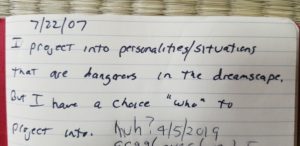
I used to have a dream journal, which I misplaced in a piece of luggage unused for over a decade. I would “wake up” without really being awake, and write some of the damnedest stuff, sometimes. Then, I would not even remember ever writing it. This is one of many that I never recalled writing. I found this one while on vacation in Japan in 2019
Are dreams potentially portals to other people’s lives, our own past lives, our subconscious minds, or just randomly generated internal videos? In April of 1987, after I had been sober for about one month after 16 years of chaos, and then, finally, hell for tge last three years, I had a series of three dreams, on three consecutive nights. In the first dream, I was an early teenager, hanging out with 4 or 5 other boys, who were my buddies. My name, in the dream, was Bobby Clements. In the second dream, we are all enlisting, as a group, to enter WWII. We told the recruiter that we all wanted to fly on the same plane, or we would not accept service. We were promised that the Air Force would do everything in their power to make sure that we all were on duty in the same location, and, perhaps, share space on the same military aircraft In the third dream, I am piloting an aircraft, with all of my buddies assuming support roles. We are flying into anti-aircraft shelling turbulence, and I can no longer keep the aircraft under control. My buddies stay in their positions, but apparently whatever hit us from below, is a fatal blow. I know that we are all going to die. The dream ends. I researched Bobby Clements substantially for two months (prior to advent of the internet) later in 1987. I drove to Philomath, Oregon with my wife Sharon, researching the Clements family there, but came up short. Several decades later, my sister took up the search for me. My sister is a STRONG BELIEVER in reincarnation, and she has memories from her own past life experiences. In her research, she came up with Robert “Bobby” Kelly Clements, of Nova Scotia, Canada.. Robert flew a Lancaster bomber for the RAF out of England, and he was allowed to hand pick his crew, according to the records. He picked his five Nova Scotia friends! His story was identical to what I saw in the three dream sequence, according to the family reports that she had read about “Bobby”, too. Umm, Bobby was an electrician prior to his enlistment. As an eight year old, I wanted to become an electrician more than anything, save becoming an Air Force pilot. I had a full ride scholarship to the Air Force, was in the ROTC at the U of Portland, then dropped out due to my first wife’s severe health issues. I eventually retired, as an electrician, in 2016,. I tried to commit suicide in 1986, when I finally realized that my childhood dreams of being, first an Air Force pilot, and then an astronaut, were never, ever to be realized in this incarnation. Eerie! Here is my letter to my sister, acknowledging the experience:
PENTAX Image

 Revisiting the Mysteries of Consciousness: A Case for the Interconnectedness of Lives
The Division of Perceptual Studies within the Department of Psychiatry at the University of Virginia School of Medicine has amassed a formidable collection of case studies that might just be the Rosetta Stone for understanding human consciousness and its complexities. These case studies focus on children who seem to recall moments, events, and intimate details of lives that are not their own, seemingly pointing a finger at the possibility of reincarnation, or at the very least, challenging our conventional frameworks of understanding identity and experience.
At the heart of the debate is the compelling evidence these case studies provide—evidence that nudges the scientific community to reconsider rigid perspectives on the boundaries of individual experience and the linear progression of life and death. What becomes of our understanding of the self if indeed these children are sharing an identity with someone long passed into the annals of history? This phenomenon dares to suggest that consciousness may not be as individualized and isolated as previously thought.
The concept of reincarnation, once relegated to the realm of religious belief and philosophical speculation, receives a breath of empirical life through these cases. The remarkable detail with which some of these children recount their ‘past lives’ stands as a testament to the need for a broader interpretative lens when examining human experience beyond birth and death. Rather than outrightly endorsing reincarnation, these instances invite a studious inquiry into the possibility of shared identities—portals into past lives, carried within the thread of cumulative human consciousness.
The alternative explanations of psychometry and telepathy open additional pathways to understanding these phenomena. The possibility that individuals might access memories, emotions, and experiences of others—living or deceased—through objects or dreams suggests a level of interconnectedness and collective consciousness that transcends current scientific explanation. My personal experiences with dreams, where I’ve accessed others’ lives and memories, underscore the multifaceted nature of consciousness and hint at a profound, shared human repository of experience.
The reluctance to bridge the gap between the empirical and the experiential often stymies progress in understanding phenomena that don’t fit neatly into established scientific paradigms. The evidence calls for an open-minded approach, one that dares to question, explore, and, ultimately, expand the scientific narrative to include the extraordinary and the unexplained.
The investigation into these phenomena should not be quickly dismissed as pseudoscience but encouraged as part of the broader endeavor to elucidate the mysteries of the human mind and consciousness. By acknowledging the possibility of reincarnation, psychometry, and telepathy, and by rigorously studying these phenomena, we inch closer to grasping the full spectrum of human experience—perhaps even the essence of consciousness itself.
In a world where the known and the unknown dance around the edges of scientific understanding, the work of the Division of Perceptual Studies serves as a beacon. It guides us toward a future where the exploration of consciousness and the potential interconnectedness of our lives are not just acknowledged but celebrated as crucial to unraveling what it means to be human.
Reflecting Back On These Two Dreams, through a 2024 Lens
I have always been deeply moved by my dreams. In my early life, my dreams were mostly terrifying. Yet, after the profound dream in 1964, my dreams gradually became more balanced, though certainly not always benign in nature and substance. Were my dreams the result of trauma in this incarnation, or also previous ones, the latest where I may have suffered through a fiery fatal plane crash?
When I became sober in 1987, my dreams became one of my greatest assets in the quest for self knowledge and insight.
But a question always remains–do we just project ourselves into someone else’s energy field when we have dreams or memories of a past life, and temporarily assume their identity, or is it an actual memory from our own soul’s progression through time?
I have no definitive answers.
The 1992 Dream: A Journey into the Eighth Chakra and Beyond 
In the vast tapestry of human consciousness, dreams serve as a bridge between the tangible and the ethereal. They beckon us to explore the uncharted territories of our psyche, offering glimpses of profound truths that often evade our waking mind.
It was in 1992, amidst the tranquil surroundings of Rock Creek, that I experienced a dream so vivid, so compelling, that it demanded to be shared—a testament to love, trust, and the unfathomable depths of the human spirit.
The dream took me back to my grandfather’s home, a place steeped in memories of childhood innocence and wonder. In my familiar bedroom, a “fierce, fiery cluster, or orb, of pure light and love” appeared above me. Though it lacked human form, I instinctively recognized it as my grandfather—a luminous embodiment of love transcending the physical realm. In shamanic terms, this was an encounter with the eighth chakra, a potent convergence of spiritual energy and ancestral presence.
This orb, this manifestation of divine love, began to draw me towards it. I felt a pull so powerful, so intense, that it threatened to consume my very being. My physical body, frail and inadequate to house such a force, would be destroyed by this “fire of love.” Yet, the promise of union with this radiant energy eclipsed all fear. I was ready to surrender, to rise up and merge with it, even if it meant leaving my earthly vessel behind.
In the physical world, my body mirrored the intensity of the dream. I was shaking, near convulsing, as if my very cells were trying to align with this higher frequency. Sharon, witnessing my distress, woke me from this state, ripping me away from what felt like a sacred communion. The disappointment was profound, yet the dream had imprinted on me an indelible understanding.
I realized that to truly engage with higher vibrations of love and consciousness, my entire being—both physical and mental—needed fortification. This insight became a catalyst for transformation, motivating me to cultivate strength and resilience, eventually leading to my evolution into an elite athlete by the age of 46.
The eighth chakra is often described as the doorway between our immortal soul and our earth-bound personality. It is the intersection where divine wisdom meets human experience, urging us to transcend our limitations and connect with our higher self. My dream was not merely a symbolic encounter; it was an invitation to embody these higher frequencies in the physical realm.
Fast forward to 2017, and the essence of that dream manifested once again, this time in the waking world. In my quest to share a message of hope and healing, while caring for both my dying friend, Marty C. and my father, I tapped into an extraordinary field of energy. However, this unleashing brought with it immense physical and psychological challenges. The energy threatened to overwhelm me, as I grappled with its intensity and the survival of my physical form.
Despite the profound fatigue that lingered for over a year, I understood that this experience was an extension of my 1992 dream—a continuation of my spiritual evolution. The energy field I accessed was both a burden and a blessing, a testament to the power of the eighth chakra and its role in guiding us towards our ultimate purpose.
Reflecting on this remarkable journey, I am reminded of the interconnectedness of our dreams, our spiritual essence, and our physical existence. The 1992 dream, with its fiery orb and ancestral light, served as both a warning and a guide. It taught me that true transformation requires strength, surrender, and a willingness to traverse the unknown.
To my fellow spiritual seekers, wellness enthusiasts, and creative minds, I offer this account not as a definitive truth, but as an invitation to explore the depths of your own consciousness. May you find the courage to connect with your higher self, to dance with the divine energies that beckon from beyond, and to bring forth the light of your soul into the world.
Radical Empathy Dreams: Blurring the Boundaries of Self
In our slumber, we occasionally encounter dreams that defy logic and challenge our understanding of self. Among these enigmatic nocturnal adventures are radical empathy dreams—experiences where one may find themselves witnessing life through another person’s eyes. These dreams raise compelling questions about the porousness of our identities and invite us to explore the fine line between personal and collective consciousness.
Radical empathy dreams present an intriguing challenge to the traditional boundaries that define self and other. They blur the distinction between our individual experiences and those of others, offering a glimpse into a shared human consciousness. When we dream as someone else—seeing their world, feeling their emotions—we question the solidity of our own identities. Are we merely isolated entities, or do we possess an innate capacity to transcend our sense of self and connect with the experiences of others?
The psychological and philosophical implications of radical empathy dreams are profound. They prompt us to contemplate the nature of identity and our capacity to understand others on a deeper level. Such dreams suggest that empathy might extend beyond mere imagination or cognitive perspective-taking, hinting at a more visceral and authentic connection with the lives of others. This notion challenges us to rethink our understanding of empathy, recognizing it as an inherent human ability that transcends the waking state.
An intriguing aspect of radical empathy dreams is their potential to enhance real-world empathy. Could experiencing life through another’s eyes in the dream state lead to greater understanding and compassion in our waking lives? It seems plausible that such dreams could act as a training ground for empathy, allowing us to refine our ability to connect with and comprehend the experiences of others. By nurturing this empathetic capacity, we may become better equipped to bridge the divides that often separate us.
However, in our modern world, the prevalence of technology and media may play a role in diminishing these profound empathetic experiences. The constant bombardment of digital stimuli and curated content can limit our imaginative capacities, leaving less room for the deep introspection required for radical empathy dreams to flourish. The challenge lies in finding a balance between engaging with technology and preserving the sanctity of our inner worlds.
Radical empathy dreams offer a powerful reminder of the interconnectedness of human experience. They challenge our notions of identity, urging us to explore the potential for empathy that exists beyond the confines of waking consciousness. By understanding and nurturing these dreams, we may unlock new pathways to compassion and connection, enriching our relationships with ourselves and those around us. Dream researchers, philosophers, and the general public alike must continue to investigate these radical empathy dreams
These are some of the most mysterious dreams, where the dreamer may actually have the experience of witnessing another person’s life through their actual eyes during the course of the dream. Questions of the porousness of our very identities come to the forefront during investigations of all such dreams.they hold the key to unlocking the true potential of human empathy.
Robert Clements Revisited
From the time I first had any recollection, I did not always respect authority or leadership. In sixth grade I was unexpectedly elected class president, and within days of that I was impeached for poor behavior. I also resisted the desire to become a leader in my adult life, allowing the circumstances of life to give me sufficient excuse for avoiding responsibility to my peers in any extraordinary leadership roles. I reluctantly became a foreman for two different electrical construction companies, but my advocacy for my workers kept me at odds with management, and the resulting stress always caused me to seek demotion and just fit in as one of the workers.
The three dreams of Robert Clements told me a remarkable story. Robert appeared to be at the forefront of several important decisions regarding his lifelong friends prior to their entry into Britain’s Royal Air Force. He showed leadership skills, and was trained to be the pilot of the aircraft that was to carry him and his comrades to their eventual deaths over wartime Germany. Robert had taken the responsibility for the safety, the very lives, of his friends, and as he fought and lost the battle to control the anti-aircraft weapons damaged airplane, he felt helpless, that he had let his friends down, and betrayed them all into death.
As a psychology student, it is easy to see if those qualities of Robert’s life were adopted by myself, either the over-identification with the dream figure Robert Clements life, or that I was actually the reincarnation of Robert, I could be influenced by his life through the continuity of the soul. The third possibility remains that I witness another person’s life experience while dreaming, seeing their life as if it were my own while using their life as a lens for viewing.
Rather than taking any leadership roles with my friends in this incarnation, I was pretty passive, usually following the crowd. I did aspire to become an electrician, and a pilot, just as Robert did in his life.
Journey Through Dreams: A Path to Insight and Mindfulness 
What if the true essence of consciousness was not confined to our waking hours but blossomed during the depths of our dreams? In a world where the lines between reality and dreams blur, profound insights await those intrepid enough to explore them.
In 1964, I experienced a dream that would forever alter my understanding of consciousness and self-awareness. To this day, I remain in wonder about THE DREAM, and the shaman that was my lens into the dream. I have had many profound dreams, and spiritual journeys, since, often showing neglected, forgotten, or exiled parts of myself.. Through healing and reintegration of the disassociated parts, I have found that the shaman of the dream, and other mysterious parts, have evolved throughout my life, and they are now supportive of my most fundamental nature.
I will not address the potential for reincarnation, though I have deeply explored two other primary elements of the dream.
- Unhealed trauma, the perceptual double-edged sword of projection, and the problem of evil
- The necessity of ending cultural and religious idolatry and facing oneself with honesty and without defense mechanisms
1. Unhealed trauma, the perceptual double-edged sword of projection and the problem of evil: The Face of Evil: A Societal Construct or Just In The Mind’s Eye?
Explore the Depths of Your Mind Through Dreams
Dreams serve as powerful tools for self-reflection and insight. By engaging with our dreams and exploring the rich tapestry of consciousness, we can uncover hidden truths about ourselves and the universe.
Are you ready to explore the profound possibilities of your own consciousness?
Delve into the depths of your mind through dreams, and unlock the secrets that await within.
In the realm of dreams, where reality and imagination intertwine, lies a path to profound self-discovery and mindfulness.
Those that embark on this journey awaken to more of the infinite possibilities of consciousness.
(formerly 70)
Living a life with unlimited bandwidth means exploring the areas of our lives where new possibilities may emerge and where our dreams become fertile ground for growth. Are dreams merely the chaotic firing of neurons in the sleeping brain, a nightly house-cleaning of the day’s mental debris? Or are they something more—whispers from the soul, coded messages from a deeper consciousness, or even a bridge to a transcendent spiritual reality? For too long, we have allowed the conversation around dreams to be fractured, forcing a choice between the sterile laboratory of neuroscience and the ethereal temple of spiritual mysticism. This is a false dichotomy. The truth is far more profound and integrated: dreams represent a nexus point, a sacred intersection where our neurology, psychology, and spirituality converge to facilitate healing, growth, and a deeper understanding of our place in the universe.
The modern world often dismisses the practical power of dreams, viewing them as fanciful, irrelevant, or too cryptic to be of use. This skepticism stems from a fundamental misunderstanding, not of dreams themselves, but of the very nature of consciousness. We have separated the quantifiable from the experiential, the brain from the mind, and the self from the spirit. To truly harness the transformative potential of our dreams, we must abandon these outdated divisions and embrace a more holistic paradigm—one that recognizes the sleeping mind not as a passive bystander, but as an active agent of our evolution.
The primary challenge in understanding dreams lies in reconciling the seemingly disparate worlds of science and spirit. On one hand, neuroscience provides compelling evidence for the biological underpinnings of dreaming. We know that during REM sleep, brain regions like the amygdala, which governs emotion, and the visual cortex become highly active, generating the vivid, emotionally charged landscapes of our dreams. Some theories even posit that our brains are simply running predictive simulations, using past experiences to game out future possibilities and sharpen our survival instincts—a neurological form of prophecy.
On the other hand, spiritual and wisdom traditions across millennia have revered dreams as divine communications. From the dream-temples of ancient Greece to the vision quests of Indigenous cultures, dreams have been seen as a primary channel for guidance, healing, and profound self-insight. These traditions don’t see brain activity as the cause of the dream, but rather as the instrument through which a deeper message is conveyed.
Where is the bridge between these two shores? It is found in the recognition that the brain is not just a biological machine, but a receiver and a translator. The electrical impulses and chemical reactions are the mechanics, but they do not negate the meaning. Just as the intricate wiring of a television allows it to receive broadcast signals and translate them into a coherent picture, our neurological hardware may be the very medium through which our subconscious—or a higher consciousness—communicates. The activation of the amygdala isn’t just a random event; it’s the neurological signature of the emotional healing work being done in the dream state.
A common frustration is that even when we recall our dreams, their bizarre and symbolic language can feel impenetrable. A dream about losing your teeth or flying over a city seems nonsensical if taken literally. This is where a new methodology for interpretation is required—one that is both deeply personal and universally resonant.
While cultures have vast differences in specific interpretations, a comparative analysis reveals a shared agreement on the potent spiritual value of dreams. The key is to move away from rigid, one-size-fits-all “dream dictionaries” and toward a more intuitive, contextual understanding. Dream symbols are not static; their meaning is unique to the dreamer’s personal history, emotional state, and cultural background.
The process of interpretation, therefore, becomes a form of sacred dialogue with the self. It involves:
- Emotional Resonance: How did the dream feel? The emotional tone is often more important than the literal content. A dream of a tidal wave might feel terrifying to one person (representing overwhelming anxiety) but exhilarating to another (symbolizing a powerful spiritual cleansing).
- Waking Life Parallels: Where are the themes of your dream—pursuit, loss, transformation, flight—showing up in your waking life? Dreams often use symbolic language to comment on concrete challenges and opportunities we face.
- Personal Associations: What does a particular symbol mean to you? A dog might represent loyalty and companionship to one person, but fear and aggression to someone who was bitten as a child.
This approach honors the deeply personal nature of the dream experience. It empowers the individual to become the ultimate authority on their own inner world, transforming dream analysis from a passive act of looking up meanings to an active engagement with the soul’s unique language.
When we learn to listen to our dreams, they cease to be mere nocturnal curiosities and become powerful agents of personal growth. Dreams offer a safe, simulated reality where we can confront our deepest fears, process unresolved trauma, and rehearse new ways of being without real-world consequences—an evolutionary advantage that serves our psychological and spiritual survival.
Personal stories abound of individuals whose dreams have led to life-altering realizations, creative breakthroughs, and profound healing. Dreams have a way of getting our attention, of bringing to the surface what our conscious, waking mind is too busy or too defended to see. They can illuminate hidden emotions, reveal self-sabotaging patterns, and guide us toward a more authentic path. For many, dreams have provided a connection to something larger than themselves, whether it is understood as a higher power, the universe, or the collective unconscious.
Your nightly dreams are not a distraction from your life; they are an essential part of it. They are a free, nightly source of therapy, guidance, and creative inspiration. To ignore them is to leave one of your most powerful innate resources for growth untapped.
I encourage you to begin exploring this inner frontier tonight.
- Keep a dream journal. Before you go to sleep, set the intention to remember your dreams. Upon waking, write down everything you can recall, no matter how fragmented or strange. Note the feelings, symbols, and characters.
- Engage in dialogue with your dreams. Ask yourself what messages these nocturnal narratives might hold for your waking life. Look for patterns over time.
- Consult a professional. For particularly powerful or recurring dreams, working with a trained dream therapist or spiritual guide can provide invaluable context and help you integrate the profound revelations your dreams have to offer.
To live on the unlimited bandwidth of life, we must embrace the infinite possibilities of this mystical realm. Approach your dreams not with skepticism, but with an open mind and a sense of wonder. Your inner world is calling—it’s time to start listening.
My dreams have always been an important part of my life, and I consider them as messages from the many facets of my Self. Dreams have long been regarded by me as a window into my subconscious and a channel for personal healing. They have illuminated hidden emotions, offered guidance, and even facilitated profound personal transformations. In two dreams I have encountered instances where I felt a deep and inexplicable connection with a spirit of a deceased friend or family member. The experiences I’ve had, along with countless anecdotes from others, reinforce the belief that dreams can serve as a conduit for spiritual connections.
In two separate instances, I had dreams that seemed to reveal fragments of past life experiences. These dreams were so vivid and emotionally charged that it compelled me to seek interpretation and explore the concept of past lives further. I have stepped into a dream and found myself in an unfamiliar time and place, experiencing events that felt oddly familiar. These dreams, perhaps, offer glimpses into our previous incarnations, or even into the lives of others who we never knew.. Some believe that these dreams provide insights into our present lives, shedding light on unresolved issues or patterns that continue to influence us. Exploring dreams as windows into past or other lives presents an opportunity for self-reflection, self-discovery, and a deeper understanding of our existence.
It is important to remember that dreams, spirit connections, and past lives are deeply personal experiences. Each individual’s journey is unique, and interpretations will vary. What may hold profound meaning for one person may not resonate with another. Embracing the infinite possibilities of the mystical realm encourages us to approach these experiences with an open mind and a sense of wonder.
If you have ever awakened from a dream, shaking from the experience of living in a very real, but alien, life experience, you have walked across the mysterious threshold into a higher dimension of understanding our self. Wisdom and insight are available through our “dream channels”. Atheists and agnostics have the same capacity as the saints, as far as the ability to access dream wisdom goes. We are much closer than we presently believe, and our beliefs keep us more separate as a human being, than together as spiritual beings.
Spiritually Significant Dream Categories
I am a spiritual and not a religious person, though I have joined with the community of many theologians who believe that dreams are one of God’s (or, Higher Power, Universe, Healing, Spirit, Grandfather Great Spirit, The One, etc.) primary ways of getting our attention. In the absolute, there is little difference between what we experience through our dreams and through our so-called waking reality. Awake or asleep, internally we respond in real time to what we witness as if both experiences have equal footing in reality. So could God/Truth be trying to tell us something while we are sleeping?
As we navigate the beautifully complex realm of dreams, spirits, and past lives, let us embrace the mysteries that unfold before us. Each dream, each spirit encounter, and each realization serves as a building block in our spiritual journeys. So, let us continue to explore, learn, and grow, as we unravel the extraordinary possibilities that lie within the mystical realm.
Here are ten spiritually significant categories of dreams that may be more than meets the mind’s eye. Often, our dreams will fit into two or more of these categories at the same time.
1. Visitation Dreams
A mutual dream is when two people—typically in separate locations—dream of the same thing at the same time. According to a 2017 study, shared dreams are 80 percent identical on average. They often occur between close friends or relatives. Interestingly, 4 percent of these dreams are shared by strangers. A most profound realization and insight may come to the dreamer, that the collective mind of man dreams through individuals, and individuals dream through the collective mind of mankind. We are one, after all, you and I.
7. Projection or Remote Viewing Dreams
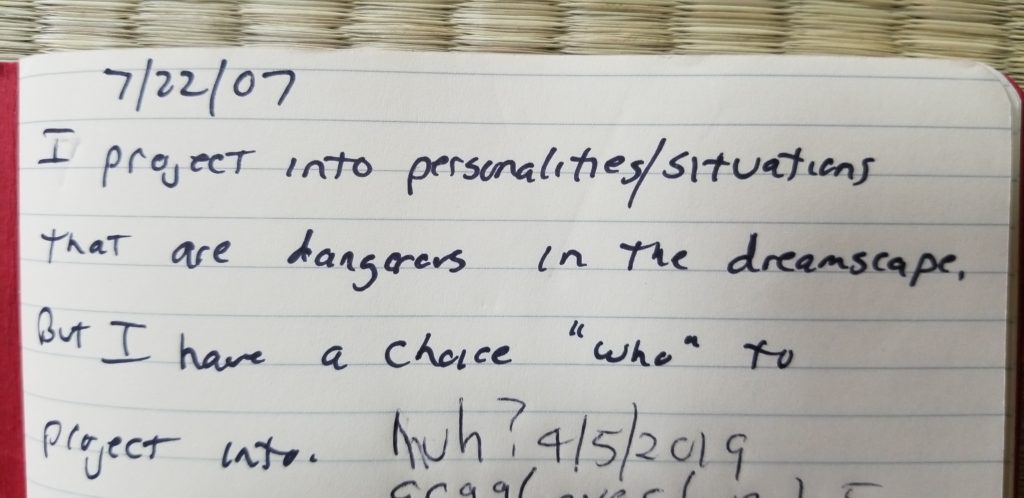
This note was written in 2007 while I was in a semi-conscious state in a dream journal that I misplaced in a piece of luggage that was not used again for twelve years. I forgot that I had ever written it. My surprise at what it said when I read it on a trip to Japan in 2019 when I found the journal is noted “HUH?”
Empathy plays a crucial role in the realm of dreams, serving as a window into our subconscious emotions and social connections. When we dream, our mind often reflects our daily experiences and relationships, providing insights that may not be readily apparent in waking life. This aspect of dreaming becomes particularly interesting when considering instances where we feel empathy for others within our dream narratives. For example, dreaming about feeling compassion for someone who is being scolded can indicate deeper insights into our emotional state and values.
In our slumber, we occasionally encounter dreams that defy logic and challenge our understanding of self. Among these enigmatic nocturnal adventures are radical empathy dreams—experiences where one may find themselves witnessing life through another person’s eyes. These dreams raise compelling questions about the porousness of our identities and invite us to explore the fine line between personal and collective consciousness.
Radical empathy dreams present an intriguing challenge to the traditional boundaries that define self and other. They blur the distinction between our individual experiences and those of others, offering a glimpse into a shared human consciousness. When we dream as someone else—seeing their world, feeling their emotions—we question the solidity of our own identities. Are we merely isolated entities, or do we possess an innate capacity to transcend our sense of self and connect with the experiences of others?
The psychological and philosophical implications of radical empathy dreams are profound. They prompt us to contemplate the nature of identity and our capacity to understand others on a deeper level. Such dreams suggest that empathy might extend beyond mere imagination or cognitive perspective-taking, hinting at a more visceral and authentic connection with the lives of others. This notion challenges us to rethink our understanding of empathy, recognizing it as an inherent human ability that transcends the waking state.
An intriguing aspect of radical empathy dreams is their potential to enhance real-world empathy. Could experiencing life through another’s eyes in the dream state lead to greater understanding and compassion in our waking lives? It seems plausible that such dreams could act as a training ground for empathy, allowing us to refine our ability to connect with and comprehend the experiences of others. By nurturing this empathetic capacity, we may become better equipped to bridge the divides that often separate us.
However, in our modern world, the prevalence of technology and media may play a role in diminishing these profound empathetic experiences. The constant bombardment of digital stimuli and curated content can limit our imaginative capacities, leaving less room for the deep introspection required for radical empathy dreams to flourish. The challenge lies in finding a balance between engaging with technology and preserving the sanctity of our inner worlds.
Radical empathy dreams offer a powerful reminder of the interconnectedness of human experience. They challenge our notions of identity, urging us to explore the potential for empathy that exists beyond the confines of waking consciousness. By understanding and nurturing these dreams, we may unlock new pathways to compassion and connection, enriching our relationships with ourselves and those around us. Dream researchers, philosophers, and the general public alike must continue to investigate these Radical Empathy Dreams
9. Personal Growth and the Act of Teaching
“This research opens the door to a deeper understanding of lucid dreaming as an intricate state of consciousness by pointing to the possibility that conscious experience can arise from within sleep itself,” Demirel said in a press release.
To identify what sets lucid dreaming apart from the rest of sleep, he and his team pulled previous studies—in which brain activity was measured with EEG sensors—together into what is now the most extensive dataset in this field of sleep research. The researchers then compared brain activity patterns for wakefulness, REM sleep, and lucid dreaming to find that that the eerie self-awareness experienced in lucid dreams has a connection to the electrical rhythms in neurons known as brain waves.
Perception and memory processing in the lucid dreaming state were found to be different from non-lucid REM sleep. The consciousness of existing in a dream was associated with with beta waves in the right central lobe (which controls spatial awareness and nonverbal memory) and parietal lobe (which controls the sense of touch and spatial awareness). Beta waves are a type of high-frequency electromagnetic activity in the brain involved in conscious thought processes like solving problems or making decisions. Our consciousness is dominated by beta waves when we are awake.
This might explain why there is so much cognitive control in lucid dreams. Dreamers deep in REM sleep have no sense of control over factors like thoughts, feelings, and behaviors, but those in lucid dreaming states do.
Maybe the most mind-bending thing about lucid dreams is that they are, according to the study, similar in the brain to the effects of psychedelic drugs such as LSD and ayahuasca. These types of psychedelic experiences are also associated with the precuneus, whose activity is modified when waking imagery is seen despite having closed eyes (something usually only experienced with psychedelics).
Interestingly, however, lucid dreams may even go a few experiential steps past psychedelics. “While psychedelics often lead to a dissolution of ego and decreased self-referential processing […] lucid dreams may actually harness elements of self-awareness and control,” Demirel and his team said in the study.
If you’re capable of lucid dreaming, you’re in for an awesome trip.
Key Takeaways:
- Dreams possess transformative powers, offering avenues for personal healing and self-discovery.
- Dreams can provide windows into past lives, offering insights and lessons for our present existence.
- Channeling spirits through dreams can provide a profound connection with the spiritual realm.
- Personal experiences and interpretations of dreams and spirit connections contribute to an individual’s spiritual growth.
Understanding our dreams can help us reflect on our relationships and interactions with others, promoting deeper self-awareness and meaningful connections.
DUPLICATIONS HERE (shaman plus Clements)
The main character in the dream was a priest or shaman of some sort, from an age and area where there was no technology. The priest had wandered off from his community and found himself overlooking his village. There, on his ” mountain top”, he received his new teaching to give to his community. The priest (my avatar in the dream), having received his directive from “on high”, then returned to his village along the lake in the high mountain region. He gathered all of the villagers together, and informed them that they were to take every golden figurine, every sacred symbol that they owned, and they were to throw them all into the lake, and never to think about them again. Then, he told each villager that they must each go into their own home, and face the “evil one” without any protection or care from any of their gods or their symbols of the sacred.

Lake Titicaca Peru-Bolivia-South-America The priest then returned to his own home, having tossed all of his own idols and treasures into the deep blue lake. He stripped himself bare of all clothing, and then began to summon the forces of the dark. He became surrounded by a fog, and as he lifted his hands, sparks started flying out of his fingertips at the unknown force of darkness that lay just beyond his visual field, still hidden beyond the boundaries of the fog. The priest refocused his energy into his arms, and hands, and the sparks grew into a steady energy field, extending from his body, his heart, and his spirit, towards his unknown adversary. He was determined to overcome this force, this dark energy, and he redoubled his efforts. The priest’s heart began to race out of control, he began to sweat profusely, and a growing sense of fear and dread began to take hold of his entire being, as he finally understood that his energy could not last forever. Yes, for him to continue this battle, he must sacrifice all of his life force. Yet, he felt that he had no choice but to keep engaging the enemy, to finally see the face of the force that had terrorized his village since time began. He desperately strained and stretched to see the object of his fear and disdain, even as the ebbing energy field flowing from his fingertips continued to cut through the fog. Suddenly, a face began materializing before his faltering gaze. As he collapsed to the floor, almost drained of all life, he could no longer fight an undeniable truth– the face of the evil one might be his own! This dream says it all, and even the unimaginative among us cannot miss out on the unmistakable message that is contained within it. Projection is a name given by psychologists to this experience, where we finally realized that the conscious world that we feared, the conscious world in which we created idols and gods, and self-protective psychological mechanisms, to protect us from the perceived or potential evil, was actually a world that we created through our own ignorance, both collectively, and individually. This manifests in all of the horrors that we witness on the world stage daily, and in all of the family and cultural dysfunction under which we were raised. We are all wounded by this process, and rather than find a way to heal from it, we ignorantly arm ourselves against further assaults from others, even though we are part of the attack against our own self in the first place. This is the most insidious component of the Common Knowledge Game, and the one whose existence must be acknowledged, or the normal negative outcome is inevitable. Ultimately, we heal together, or we die alone.
Bob and Dorothy Fero were friends that my parents had, from the time I can first remember my parents having friends. They shared the Oakey Doaks square dance group with my parents, and about twenty other local couples. We frequently camped with them in travel trailers during the summers from 1962-1970, and my sister and I spent many nights over at their home, staying with their children Michael and Robby, while my parents went out to dance and party with them on weekends. When I learned how to play golf as an twelve-year old, Dad and Bob would frequently take me with them, and I got to see both men on a different level than just my elders. I really grew to love and respect Bob, and I always assumed that he would be around forever.

Dorothy Fero (left) Bob Fero (center) at yet another party for the Oakey Doaks square dancing group.
Bob had anger issues, and it was best not to get Bob too riled up, or someone was going to feel the wrath. On the car driving trip home from Reno with Dorothy, in 1972, Bob’s anger came to a head. I do not know if he had been drinking, or what, but in a fit of anger at Dorothy, he recklessly passed cars on the way home, and took all sorts of suicidal chances with his driving. Finally, his risky behavior caught up with him, and he slammed his car head-on into an oncoming vehicle, killing Bob, and critically injuring Dorothy. Dorothy was to recover eventually, though her crushed hip remained an issue for the rest of her life. Bob had his funeral in Milwaukie at the Catholic Church. My father refused to attend, as he was so averse to funerals, and his grief over the loss of his friendship with Bob was just too overwhelming for Dad. I attended the funeral, not having the same aversion to death that my father had. Two nights later, I had a dream, where Bob came to me in the dream. He told me not to fear death, that is was beautiful and peaceful where he was, and that death was not the enemy. My father was not consoled by that dream from me, and it would have been much better for him had he received the insight, or the dream, himself.
In the first dream, I was an early teenager, hanging out with 4 or 5 other boys, who were my buddies. My name, in the dream, was Bobby Clements. In the second dream, we are all enlisting, as a group, to enter WWII. We told the recruiter that we all wanted to fly on the same plane, or we would not accept service. We were promised that the Air Force would do everything in their power to make sure that we all were on duty in the same location, and, perhaps, share space on the same military aircraft In the third dream, I am piloting an aircraft, with all of my buddies assuming support roles. We are flying into anti-aircraft shelling turbulence, and I can no longer keep the aircraft under control. My buddies stay in their positions, but apparently whatever hit us from below, is a fatal blow. I know that we are all going to die. The dream ends. I researched Bobby Clements substantially for two months (prior to advent of the internet) later in 1987. I drove to Philomath, Oregon with my wife Sharon, researching the Clements family there, but came up short. Several decades later, my sister took up the search for me. My sister is a STRONG BELIEVER in reincarnation, and she has memories from her own past life experiences. In her research, she came up with Robert “Bobby” Kelly Clements, of Nova Scotia, Canada.. Robert flew a Lancaster bomber for the RAF out of England, and he was allowed to hand pick his crew, according to the records. He picked his five Nova Scotia friends! His story was identical to what I saw in the three dream sequence, according to the family reports that she had read about “Bobby”, too. Umm, Bobby was an electrician prior to his enlistment. As an eight year old, I wanted to become an electrician more than anything, save becoming an Air Force pilot. I had a full ride scholarship to the Air Force, was in the ROTC at the U of Portland, then dropped out due to my first wife’s severe health issues. I eventually retired, as an electrician, in 2016,. I tried to commit suicide in 1986, when I finally realized that my childhood dreams of being, first an Air Force pilot, and then an astronaut, were never, ever to be realized in this incarnation. Eerie! Here is my letter to my sister, acknowledging the experience:
PENTAX Image
June 3, 1988 Dream (Healing and Visitation Dream)
Recently, I was reading my journal from March of 1989. There was an entry about a mysterious dream that I had on March 17, 1988, where I am looking for a discarded ring with 8 jewels. After feverishly looking about, I locate 7 of the jewels, and not the mounting, or the eighth jewel. The last jewel will be found mounted to the lost ring itself, the thought comes to me. I am with an unknown girlfriend at the time, though there is sadness associated with this friendship. I know that this “unknown woman” is not the final jewel, and my search must continue. The dream tells me that this is a view of the future, so when I woke up, I was a little more than just skeptical, to say the least. I was with Laurie H. at the time of the dream. I first met her in an ACOA (adult children of alcoholics) meeting in October of 1987. Laurie and I were engaged at that time, though several weeks later we cancelled the engagement, in June of that year. This opened the door to an eerie conclusion to this story, and yet another story of healing. Last night, Sharon showed me the ring that she bought for our 2nd wedding, in Las Vegas, in 2004. Sharon bought the ring in Portland, prior to our leaving for Las Vegas, and I was not involved in its purchase, though I asked her, prior to leaving, if she had a ring for our fun 2nd marriage. She then went to purchase it at Mother Goose, a store in Portland.

seven jeweled ring with big stone. Yes, Sharon is the big stone and the setting, for sure!
On it was mounted 7 small stones, with one large green eighth stone distinguishing the setting. I had seen it before, and yet never understood its significance, until I re-read my journal. WOW, the ring, and the story, straight from the dream! Sharon had never seen my journal before (it has been in storage since 1989), and I have never discussed its contents with her, either, nor had I even thought about it once in the intervening years.
My nighttime world has always been populated with many interesting and challenging dreams. In one 1987 dream, it was like the sky opened up, and “heaven” started singing a most beautiful song. The song spoke of Boston, Massachusetts. Then, I am flying in the dream, minus an airplane, and starting to go over what might be the Atlantic Ocean. The message comes to me that I will be leaving Randy Olson behind for this phase of my life. Well, OK, where did that come from, and what does it mean? All that I knew was that I needed to travel to “Boston, Massachusetts”, and that my lifelong friend Randy was to become less of a presence in my life from this point forward. I did fly to Boston, not knowing what the heck I was supposed to do there. One of my teachers, the mystic and healer Joel Goldsmith, had given me extensive teaching from Mary Baker Eddy’s work, in addition to his own, which is known as the Infinite Way. The Mother Church of the Church of Christian Scientists, is located in Boston and so I visited there. After an aide to the head minister noted my presence and had a conversation with me, I was escorted to Mary Baker Eddy’s private study, where I was allowed to read her notes, and to meditate in one of her “holy places”. Nobody else gets that privilege, so I may have been meant to visit there, but who knows for sure?

Randy R. Olson (1/21/1955-6/03/2013) on the right.
The last time that I saw Randy, he was placing a 12 pack of beer into his car at a Fred Meyer’s store. He was hesitant to acknowledge me, and I felt as if he was trying to avoid me. He appeared sick, and bloated, and I wanted to say something to him about it. But I did not, thinking that it was not my right to intrude upon his life now. I had phone conversations with him three more times over the last eight years, with the last time being in 2010. Our friendship on the “outer plane” of life apparently was already dead. And then, my wife Sharon reads his obituary in the Oregonian newspaper, shocking me to my core. My lifelong friend, Randy, was dead, apparently of a heart attack. His body was discovered in his car in his driveway, having just returned from a Subway sandwich shop. And yet, he lives within me. I am so grateful to have known Randy. I now know that I could not take him to the spiritual places that I was to visit. It would have been the least that I could do for Randy, if it were only possible. He only needed a little willingness to join with me, to experience some of the joys of being on the path of recovery, healing, and love.. Yet that willingness was something that none of us can give to another human being. I had pointed to the new direction, but he chose to look the other way. May you be at peace my dear friend, at the center of it all, from where you started, and to where you have finally returned. Save a place on your couch for me, will you please? I will know that I will be welcome in the Kingdom to come, if I see your apartment there.
 In 1992 , while living in the Rock Creek area with Sharon, I had a most amazing dream, and for me to even be willing to share it with you is the miracle of love, and trust, that I have (only Sharon has ever heard it , and she had no choice-she woke me up from the actual dream, fearing that I was having a horrific nightmare). In this dream, I was in my grandfather’s home, sleeping in the bedroom that i always slept in as a child. A “fierce, fiery cluster, or orb, of pure light and love” hovered over me, and though it did not have human form, I knew it to be “my grandfather”. In shamanic terms, it was an actual experience of my eighth chakra, though, in my dream state, I recognized it as my deceased grandfather. I was being drawn into his love light, and I knew that, for me to continue, this energy would destroy my body because my body was too weak to support this “fire of love” that came to me. I did not care, for I had finally found what I was looking for, and I began to rise up, and attempt to join with it, knowing my “body” would be destroyed in the process. Now, in real-time, in the physical world, my body was shaking and almost convulsing, and, to Sharon, my “crying and distress” showed that I was having a nightmare. In her concern, she woke me up, and I had never felt so disappointed to have to wake up, as it ripped me away from this most remarkable inner experience. But the dream carried many fruits with it into the world that our bodies inhabit (Also, the prayer of gratitude-Grandfather, Great Spirit, Thank You, appeared in my mind and heart back then, as well). I knew that if I wanted to entertain, or to even host, the higher vibrations of love, my body (both physical body and the body of thought constituting myself) I needed to be dramatically strengthened or my body would literally be destroyed, and this was part of the underlying motivation that culminated in my becoming nearly an elite athlete, by the time I was 46 years old. In the year 2017, this whole scenario, minus the 8th chakra (or grandfather’s dream light) played out in my real world. In my intense desire to finally bring forth my story of hope and healing to the world, the energy unleashed caused me incredible suffering, both physical and psychological, and I knew that I was going to die, if this energy did not get transmitted in such a way that my body could survive. I am hesitant to talk of it, even now, as there is no guarantee that this body of mine is still going to hang around. I gained access to an incredible energy field, yet, for over one year, I remain quite fatigued. But I know that I am supposed to be writing this account of my 1992 dream, as the “God Chills”, or horripilation, accompany my words.
June and Sharon in Las Vegas, 2017
I would like to share an interesting dream that I had in May of 2016. June, who now lives in Tucson, Arizona was visiting her sick brother Dale in Medford, Oregon, for a week in May of 2016. On a Friday evening in May, I awoke from a strange, disturbing dream. In the dream, I had fallen in an unfamiliar bathroom, and had become trapped between the toilet and the wall. When Sharon awoke, I told her about the unusual dream. It was so real to me that I was a little shaken up. Later that morning, June called Sharon, as she frequently does in the morning. June related to Sharon that she was still at Dale’s house, and that his health was not good. In the middle of the night, Dale had gone to the bathroom, fallen, and became trapped between the toilet and the wall!!! As I look at my life’s history, I am amazed by the dreams from its Mystery COINCIDENCE? Are dreams really just fantasies? Do we have the capacity to extend our awareness beyond the limits of our five senses? Well, I know the answers to those questions, but your answers may be different, for sure!.
Curiosity only thrives in an unconditioned mind. Drink freely from its chalice of the Spirit!
In the dream, I opened a door, and walked into a room that was well-lit. The room seemed unfamiliar to me. Inside of the room there was a man standing to the right of the entrance. He greeted me, holding a cup out to me in his hand. He gently offered it to me, and for a moment I considered what it’s contents might be. I then knew that if I drank from it, I would become “intoxicated”, but of a different nature that was still consistent with the path of “sobriety” I currently walked upon. I then noticed a table, where an opened map laid open upon it. The man walked with me to the table, still holding the cup. I looked at the map, and it was a topographic style map, similar to what I might use for traveling and/or hiking with. There were two distinct areas to it. The path or road, on the right side of the map, had only one dark, solid line drawn from the bottom to the top of the map. But, the section on the left side of the map had several dotted lines that only remotely “paralleled” the route on the right side of the map. I had no judgement about each of the path styles, yet I remained curious about the several dotted line paths, which intersected each other, while also “snaking” their unique individual routes up the map. I noted also that the “dotted line” paths also did not ever cross the path of the solid, dark line, though all of the paths had no distinct starting, or end point. At the Cosmic Christ workshop, Matthew asked if anyone had a dream that they wanted to share in the big group. Not being a spiritually “realized person”, I felt uncomfortable sharing the dream. But when it came time for a break, I took a book to Matthew for signing, and shared my dream with him. He refused to tell me what it might mean, but he had a smile on his face, and told me to let it tell me it’s meaning. On our drive home, Sharon White took controls of the car, and I started telling her the dream again. It was then that the horripilation (God chills) began in earnest, and the full meaning came through me. A complete mystical understanding, and teaching, was built into that dream, and it was then I realized that I had indeed drunk from the cup of the Spirit. The left side of the map represented the pilgrimage we all must take to find our truth. It is a dotted line path, because it is created through each new step that we take. Yes, I became quite “intoxicated” with Spirit, and I knew then that we had truly been blessed by the Master Teacher. I don’t expect anybody who remains stuck in their conditioned mind, or in the rut on the right side of the map to understand this dream. Those who travel on the left side, where thel pilgrimage into the unknown and the freedom to consciously wander is represented, will understand two main points:
Explore the Depths of Your Mind Through Dreams
Dreams serve as powerful tools for self-reflection and insight. By engaging with our dreams and exploring the rich tapestry of consciousness, we can uncover hidden truths about ourselves and the universe.
Are you ready to explore the profound possibilities of your own consciousness?
Delve into the depths of your mind through dreams and unlock the secrets that await within.
In the realm of dreams, where reality and imagination intertwine, lies a path to profound self-discovery and mindfulness.
Those that embark on this journey are living a life on unlimited bandwidth and awaken to more of the infinite possibilities of consciousness.
Dream on, dream until your dreams wake you up.
Chapter 53: Exploring the Mystical Realms–Dreams as a Gateway to Self-Healing and Empowerment (blend with other chapters)

(formerly 72)
DUPLICATIONS HERE (all dream chapters overlap)
Have you ever found yourself captivated by the enigmatic world of dreams? Are dreams just whispers from our biology, creations sprung from dreamtime imaginations, windows to our subconscious minds, hints of wisdom from our higher power, portals to other people’s lives, or even remote viewing of our past lives? We have all probably experienced vivid dreams that felt so real, they lingered in our mind long after we woke up. Or maybe we’ve felt an unexplainable connection with the spiritual realm, leaving us wondering about the mysteries of life and existence. By embarking on a journey into the mystical realm of dreams, spirits, and past lives, we can dive in and explore the extraordinary possibilities that await us.
Since the dawn of time, dreams have been a source of mystery and fascination. They are the stories our minds weave while we sleep, tales that often escape the grasp of our waking consciousness. But what are dreams really for? Are they critical cogs in the machine of our biological existence or do they serve a purpose beyond the physical realm? It is enlightening to explore dreams through various lenses – biological, psychological, neurological, and spiritual – to delve into the origins and value of this nocturnal phenomenon.
Neurologically, dreams are a consequence of brain activity during REM sleep. Studies with brain scans have shown that certain areas of the brain – like the amygdala, involved in processing emotions, are active during this state. Some neuroscientists speculate that dreaming is a byproduct of these electrical impulses and serves no direct purpose. However, other theories suggest dreaming could be a way the brain processes emotions or encodes memories. Research has even linked specific types of brain activity with the content of dreams. Scans have shown that the visual cortex’s activity may relate to the vivid imagery of dreams, whereas the limbic system’s activation might correlate with the emotional content.
On a more mystical plane, many believe that dreams hold spiritual significance, acting as messages from the divine and/or the subconscious. Dreams often weave intricate symbolisms that many spiritual traditions interpret as signposts for guidance, warnings, or insights into one’s deep self. Cultures throughout history have used dreams to make decisions or predict future events. A comparative analysis across cultures shows that despite the vast differences in interpretation, many agree on the potent spiritual value of dreams. Personal stories abound of individuals claiming that dreams led to life-transforming realizations and decisions, implying a higher significance to these nighttime visions.
What then are the origins of dreams? Evolutionary theories suggest dreams might have assisted our ancestors in survival, giving them a ‘safe space’ to simulate dangerous situations and practice responses. As cultures evolved, so did the understanding and appreciation of dreams, imbuing them with religious and spiritual importance. Yet the real value of dreams might not lie in any one perspective but rather in the interplay of all. They can be as much about biological programming as they are about confronting psychological truths or connecting with the universe’s deeper mysteries.
Clearly, dreams are multifaceted in their significance and importance. They are a nexus where our biological, psychological, neurological, and spiritual selves meet. Well beyond mere scientific curiosity, this intersection offers rich insights into the complexities of human consciousness and experience. With each dream we remember upon waking, we glimpse a reflection of our inner workings – and potentially, the essence of what it means to be human.
We all dream, whether we recall them, or not. Often, those who can recall their dreams have no context with which to interpret them, and the dreams are often just casually dismissed. But there are many of us who have developed a context of understanding for our dream works, and pay keen attention to them.
Sharon found this note that I had written while “asleep” in 2007. It was hidden in a dream journal that was found in our suitcase on our trip to Japan in 2019. Since then, I have had several experiences touching the psychic and occult levels of human experience. I prefer to “project” into happier environments, in both waking and sleeping environments.
My dreams have always been an important part of my life, and I consider them as messages from the many facets of my Self. Dreams have long been regarded as a window into my subconscious and a channel for personal healing. They have illuminated hidden emotions, offered guidance, and even facilitated profound personal transformations. In two. I have encountered instances where I felt a deep and inexplicable connection with a spirit of a deceased friend or family member in my dreams. The experiences I’ve had, along with countless anecdotes from others, reinforce the belief that dreams can serve as a conduit for spiritual connections.
In two separate instances, I had dreams that seemed to reveal fragments of past life experiences. These dreams were so vivid and emotionally charged that it compelled me to seek interpretation and explore the concept of past lives further. I have stepped into a dream and found myself in an unfamiliar time and place, experiencing events that felt oddly familiar. These dreams, perhaps, offer glimpses into our previous incarnations, or even into the lives of others who we never knew.. Some believe that these dreams provide insights into our present lives, shedding light on unresolved issues or patterns that continue to influence us. Exploring dreams as windows into past or other lives presents an opportunity for self-reflection, self-discovery, and a deeper understanding of our existence.
It is important to remember that dreams, spirit connections, and past lives are deeply personal experiences. Each individual’s journey is unique, and interpretations will vary. What may hold profound meaning for one person may not resonate with another. Embracing the infinite possibilities of the mystical realm encourages us to approach these experiences with an open mind and a sense of wonder.
I am not a religious person, though I have joined with the community of many theologians who believe that dreams are one of God’s (or, Higher Power, Universe, Healing, Spirit, Grandfather Great Spirit, The One, etc.)primary ways of getting our attention. In the absolute, there is little difference between what we experience through our dreams and through our so-called waking reality. Awake or asleep, internally we respond in real time to what we witness as if both experiences have equal footing in reality. So could God/Truth be trying to tell us something while we are sleeping?
Key Takeaways:
- Dreams possess transformative powers, offering avenues for personal healing and self-discovery.
- Dreams can provide windows into past lives, offering insights and lessons for our present existence.
- Channeling spirits through dreams can provide a profound connection with tspiritual realm.
- Personal experiences and interpretations of dreams and spirit connections contribute to an individual’s spiritual growth.
As we navigate the beautifully complex realm of dreams, spirits, and past lives, let us embrace the mysteries that unfold before us. Each dream, each spirit encounter, and each realization serves as a building block in our spiritual journeys. So, let us continue to explore, learn, and grow, as we unravel the extraordinary possibilities that lie within the mystical realm.
Here are seven spiritually significant dreams that may be more than meets the mind’s eye…
1. Visitation Dreams It’s common to have a visitation dream after a loved one passes. The deceased often appear in bodily form, healthy and luminous, in order to communicate an important message: “I’m okay.”, or “There is nothing to fear about death”. I have had several of these dreams over the years, with my most recent experience revolving around the recent death of a good friend.
2. Prophetic Dreams Our brains have built-in predictive hardware and algorithms, so it should be no surprise that we can prophesize, in both iur awake and sleeping times. Many people have had a “dream that came true.” Our dreams may use our past experiences to produce a probable series of future events—showing us patterns that help us make better choices when we’re awake. I have had several dreams that have predicted EXACTLY events that were to happen, yet they remain unreliable predictors of the future, because the future is always changing, depending upon changes made in the present.
3. Warning Dreams God—and our body—can sometimes speak in dreams to warn us about imminent danger, especially regarding health. We may dream of a specific body part or even receive a verbal warning. In a 2015 study of women diagnosed with breast cancer, 83 percent had dreams that were more vivid than normal. And 44 percent reported hearing specific words like “breast cancer” or “tumor.”
4. Healing Dreams These are the internal creations that bring us from an “out of balance” place into “harmony and balance.” They often involve a mystical encounter. I have experienced many healing dreams, I had one amazing dream with my deceased grandpa Henry which, to this day, inspires and confounds me.
5. Heavenly Dreams According to a 1989 study, more than half of healthy young adults who dreamed of death spent a significant amount of time in that dream in heaven. These dreamers sometimes go down a tunnel or pathway and arrive at heavenly destinations. They also frequently encounter deceased loved ones. I have had dreams where I have heard the songs and sounds of the “angels of heaven”, carrying a message of beauty beyond my ability to describe or define. 6. Mutual Dreams A mutual dream is when two people—typically in separate locations—dream of the same thing at the same time. According to a 2017 study, shared dreams are 80 percent identical on average. They often occur between close friends or relatives. Interestingly, 4 percent of these dreams are shared by strangers. A most profound realization and insight may come to the dreamer, that the collective mind of man dreams through individuals, and individuals dream through the collective mind of mankind. We are one, after all, you and I.
7. Projection Dreams In 2007, I was able to see that my sense of self had to include the much more expansive collective self that we all share as being conscious members of the human race. In a dream, I was shown how all of us may project ourselves into another human beings’ experience in our dream world, and experience their version of reality for a moment or two. If you have ever awakened from a dream, shaking from the experience of living in a very real, but alien, life experience, you have walked across the mysterious threshold into a higher dimension of understanding our self. Wisdom and insight are available through our “dream channels”. Atheists and agnostics have the same capacity as the saints, as far as the ability to access dream wisdom goes. We are much closer than we presently believe, and our beliefs keep us more separate as a human beings, than together as spiritual beings..
(this is a bad file above, there are 10 categories)
Whose Life Is It Anyway? Revisiting the Mysteries of Consciousness
Could dreams be the portals to other people’s lives? Could they even link us to our own past lives?
Dreams have always been a fascination for humanity. They are the theater where our subconscious mind performs, weaving stories that can be both mundane and extraordinary. But what if these nightly narratives are more than just figments of our imagination? What if they are, in fact, gateways to other dimensions of experience—perhaps even to past lives?
I once kept a dream journal, a practice that became profoundly more meaningful after I misplaced it for over a decade. When I rediscovered it, one entry, in particular, stood out—a series of dreams I had in April 1987, shortly after achieving sobriety. These dreams were unlike any others, leaving an indelible mark on my psyche.
In the first dream, I was an early teenager named Bobby Clements, hanging out with a group of friends. The second dream saw us enlisting for WWII, promising the recruiter we would serve, only if we could be kept together. Finally, in the third dream, I was piloting an aircraft with my friends as crew, flying into anti-aircraft shelling. The turbulence was fatal, and the dream ended with the certainty of our imminent demise.
The name Bobby Clements haunted me. I researched extensively, traveling to Philomath, Oregon, but found no concrete information. Decades later, my sister, a firm believer in reincarnation, discovered Robert “Bobby” Kelly Clements of Nova Scotia. His story mirrored my dreams.
This personal experience aligns intriguingly with the findings of the Division of Perceptual Studies at the University of Virginia School of Medicine. Their work on children recalling past lives offers compelling evidence that challenges the conventional boundaries of individual experience and the linear progression of life.
These case studies suggest that consciousness may not be as individualized and isolated as traditionally thought. Instead, they propose a shared human repository of experience, accessible through dreams or other means. This notion invites us to reconsider our understanding of identity and experience.
If dreams can indeed serve as portals to past lives or other people’s experiences, the implications for our understanding of consciousness are profound. It suggests a level of interconnectedness that transcends the physical boundaries of life and death. This perspective could revolutionize how we approach mental health and well-being, offering new avenues for healing and self-discovery.
While the concept of reincarnation has long been relegated to the realm of religion and philosophy, the empirical evidence gathered by institutions like the University of Virginia demands a broader interpretative lens. Rather than dismissing these phenomena as pseudoscience, we should encourage rigorous exploration.
Psychometry and telepathy offer additional pathways to understanding these experiences. The possibility that individuals can access memories, emotions, and experiences of others—whether living or deceased—suggests a collective consciousness that defies current scientific explanation.
The reluctance to bridge the gap between the empirical and the experiential often hinders our understanding of phenomena that don’t fit neatly into established scientific paradigms. By acknowledging the potential of dreams as portals to past lives and by rigorously studying these phenomena, we inch closer to grasping the essence of consciousness itself.
In a world where the known and the unknown dance around the edges of scientific understanding, the work of institutions like the Division of Perceptual Studies serves as a beacon. It guides us toward a future where the exploration of consciousness and the interconnectedness of our lives are not just acknowledged but celebrated.
Could your nightly dreams be tapping into a shared human consciousness? The exploration is just beginning. Let’s walk this fascinating path together, challenging conventional thinking and encouraging spiritual growth.
I researched Bobby Clements substantially for two months (prior to advent of the internet) later in 1987. I drove to Philomath, Oregon with my wife Sharon, researching the Clements family there, but came up short. Several decades later, my sister took up the search for me. My sister is a STRONG BELIEVER in reincarnation, and she has memories from her own past life experiences. In her research, she came up with Robert “Bobby” Kelly Clements, of Nova Scotia, Canada.. Robert flew a Lancaster bomber for the RAF out of England, and he was allowed to hand pick his crew, according to the records. He picked his five Nova Scotia friends! His story was identical to what I saw in the three dream sequence, according to the family reports that she had read about “Bobby”, too. Umm, Bobby was an electrician prior to his enlistment. As an eight year old, I wanted to become an electrician more than anything, save becoming an Air Force pilot. I had a full ride scholarship to the Air Force, was in the ROTC at the U of Portland, then dropped out due to my first wife’s severe health issues. I eventually retired, as an electrician, in 2016,. I tried to commit suicide in 1986, when I finally realized that my childhood dreams of being, first an Air Force pilot, and then an astronaut, were never, ever to be realized in this incarnation. Eerie! Here is my letter to my sister, acknowledging the experience:
PENTAX Image
The Transformative Power of Dreams

Lake Titicaca Peru-Bolivia-South-America
Dreams are windows to our innermost selves, providing glimpses into our subconscious minds and offering profound insights into our waking lives. In early childhood, dreams can be especially powerful, shaping our understanding of the world and our place within it. I now explore one such dream that has remained a guiding force throughout my life, shedding light on the influence of cultural and familial perspectives, the concept of self-awareness and spiritual awakening, and the remarkable experiences that can arise from a quest for answers.
At the tender age of eight, I experienced a dream so vivid, so real, that it has stayed with me to this day. During a time when sleep was elusive and nightmares were all too common, this dream stood out as a beacon of self-discovery and transformation. In it, a priest returned to his village in the high mountains, having received a directive from “on high.” He gathered the villagers and instructed them to cast every golden figurine and sacred symbol into the lake, then face the “evil one” without any protection or care from their gods.
The priest himself stripped bare, summoning the forces of darkness and engaging in a fierce battle with an unknown adversary. His energy waned as he struggled to overcome the dark force, and just as he collapsed, the face of the evil one began to materialize before him, revealing an undeniable truth—it might be his own.
At the time, I lacked the knowledge to fully comprehend the dream’s significance. I turned to my older sister, Pam, who at ten years old already claimed knowledge of reincarnation and psychic experiences. Her insights, though partial, provided some answers but left many mysteries unresolved. This familial exchange highlights the crucial role of older siblings and family narratives in shaping our interpretation of dreams and the beliefs we carry into adulthood.
The dream also marked the beginning of a deeper self-awareness and spiritual awakening. The priest’s struggle against the dark force can be seen as a metaphor for the battle between good and evil within ourselves. The realization that the face of the evil one might be his own reflects a profound understanding of personal identity and the duality of human nature.
Three years later, while studying World Geography in the 7th grade, I encountered the Incan civilization and Lake Titicaca, a sacred lake on the border between Peru and Bolivia. This discovery ignited a sense of familiarity and an insatiable curiosity about the Incan people and their lore. I devoured every book I could find on the subject and dreamed of one day traveling to Peru to seek answers and experience its culture firsthand.
In 2014, I finally fulfilled that dream by traveling to Peru, where I had a remarkable experience that resonated deeply with my early dream. This journey of self-discovery underscored the importance of physically visiting places that feature in recurring dreams and the potential for these experiences to offer a sense of closure or deeper understanding of oneself.
My dream at eight years old was more than just a fleeting vision; it was a catalyst for a lifelong quest for knowledge and self-awareness. It taught me that dreams have the power to transform our understanding of the world and ourselves, and that the pursuit of answers can lead to remarkable experiences that resonate deeply with our earliest memories and interests.
If you find yourself grappling with dreams that challenge your understanding of good and evil, or personal identity, consider the possibility that they may be guiding you toward a deeper truth. Embrace the journey of self-discovery, seek answers, and allow your dreams to illuminate the path to spiritual growth and understanding.
Are you ready to explore the transformative power of your own dreams? Connect with a community of dream analysts and spiritual seekers, and begin or continue your journey of self-discovery.
May 12, 2016 Dream
June and Sharon in Las Vegas, 2017
I would like to share an interesting dream that I had in May of 2016. June, who now lives in Tucson, Arizona was visiting her sick brother Dale in Medford, Oregon, for a week in May of 2016. On a Friday evening in May, I awoke from a strange, disturbing dream. In the dream, I had fallen in an unfamiliar bathroom, and had become trapped between the toilet and the wall. When Sharon awoke, I told her about the unusual dream. It was so real to me that I was a little shaken up. Later that morning, June called Sharon, as she frequently does in the morning. June related to Sharon that she was still at Dale’s house, and that his health was not good. In the middle of the night, Dale had gone to the bathroom, fallen, and became trapped between the toilet and the wall!!! As I look at my life’s history, I am amazed by the dreams from its Mystery COINCIDENCE? Are dreams really just fantasies? Do we have the capacity to extend our awareness beyond the limits of our five senses? Well, I know the answers to those questions, but your answers may be different.
Finding Meaning in Dreams and Loss
Grief and loss touch all our lives at some point, often leaving us searching for meaning and understanding. In 2017, I experienced a dream that profoundly impacted my perspective on life, health, and spiritual connection. This dream involved my dear friend Marty, who tragically succumbed to malignant melanoma three months later. Here, I share this dream and its significance with the hope that it resonates with those in grief support groups, cancer survivors, and spiritual seekers.
On a quiet April morning, I awoke at 2:45 am with an overwhelming sense of a higher power. It felt as if Marty, his wife Sharon, my wife, and I were gathered together in a moment of profound connection. I asked for a blessing for all of us, seeking solace and clarity.
I then entered a dream state, finding myself in a noisy industrial plant. There was an electrical system that needed reconditioning. Wearing soundproof headsets to block out the industrial noise, I was “told” to remove the security lock from the electrical panel. Marty and Sharon were witnessing my work, along with others who had already completed their tasks, leaving their tools in a nearby dumpster.
The industrial setting, the need for cooperation, and the presence of discarded tools were all rich in symbolic meaning. It was clear that my subconscious was communicating a message about trust, letting go, and navigating life’s overwhelming noise.
The dream’s symbols were clear to me:
- Electrical System: Representing the complex and often overwhelming nature of our lives and health.
- Security Lock: Symbolizing the need to release control and trust in a higher power or the process of life.
- Soundproof Headsets: Reflecting the necessity to shield ourselves from the distracting noise of our minds and daily activities.
- Cooperation and Discarded Tools: Signifying the importance of integrating our efforts with others and recognizing the cumulative nature of collective work.
The core message was about letting go of control, trusting in the process, and allowing others to support and guide us. This is particularly relevant in times of health crises and emotional turmoil, where the instinct to control and guard oneself is strong.
For those in grief support groups, cancer survivors, and spiritual seekers, this dream’s message holds universal truths. The process of healing and finding resilience often requires letting go of control, trusting in the support of others, and having faith in the greater process of life.
- Grief Support Groups: The dream encourages you to trust in the communal support and shared experiences within your group.
- Cancer Survivors: It highlights the importance of letting go of guilt and understanding that illness is not a personal failing.
- Spiritual Seekers: The dream speaks to the need for faith in a higher power or life’s inherent wisdom, even when surrounded by chaos.
This dream has profoundly influenced my journey of healing and finding meaning in loss. It has taught me the importance of trust, both in myself and in the process of life. By letting go of the need to control every aspect, I have found a clearer path to peace and acceptance.
My higher power had ultimate confidence in Marty, seeing his innocence and potential despite his illness. This realization helped me view him and his struggle with compassion and hope. Watching him lose hope and pursue Oregon’s Death With Dignity was initially quite a shock to me, but I understood his dilemna.
Reflect on your own experiences and the messages you receive, whether through dreams, intuition, or the support of others. Trust and faith are powerful tools in navigating life’s challenges. Your inner strength and resilience, supported by a higher power or life’s inherent wisdom, can guide you through even the darkest times.
If you find solace in these reflections, I invite you to share your thoughts and experiences with others you love and trust. Together, we can find meaning and healing in our shared journeys.
The Transformative Power of Dreams and the Eighth Chakra
In 1992, while living in the serene Rock Creek area with Sharon, I experienced a dream so profound that sharing it now feels like an act of love and trust. To this day, Sharon is the only one who has heard it, and that was merely because she woke me up from this incredible dream. This dream, a vivid tapestry woven with threads of light and love, continues to shape my spiritual path and understanding of the higher self.
The dream took place in my grandfather’s home, in the very bedroom where I spent countless nights as a child. A “fierce, fiery cluster, or orb, of pure light and love” hovered above me. This entity, though formless, was unmistakably my grandfather. In shamanic terms, I had encountered my eighth chakra, yet in my dream state, I recognized it as my deceased grandfather. This orb of light exuded an overwhelming love that beckoned me towards it.
I felt an irresistible pull to merge with this love light. However, I knew that my physical body was too weak to withstand the intensity of this energy. Undeterred by the potential destruction of my body, I began to rise, eager to join with the light. At that moment, nothing mattered except the profound connection I felt.
In the physical world, my body was convulsing, and Sharon, perceiving my distress, woke me up. The disappointment I felt upon waking was indescribable, as it tore me away from this remarkable experience. Yet, the dream left me with invaluable insights and a deep sense of gratitude— “Grandfather, Great Spirit, Thank You,” resonated within my mind and heart.
This dream marked the beginning of my understanding of the eighth chakra as the doorway between the immortal soul and the earth-bound personality. I realized that to host such high vibrations of love, my physical and mental bodies needed to be dramatically strengthened. This realization propelled me on a path of intense physical training, culminating in my near-elite athlete status by the age of 46.
Fast forward to 2017, and the scenario from my dream played out in my real life, minus the presence of my grandfather’s light. In my fervent desire to share my story of hope and healing, I encountered an incredible surge of energy that brought immense insight, and physical and psychological suffering. I knew that if this energy was not channeled correctly, it might destroy my body.
Even now, I hesitate to speak of it, as there is no guarantee my body will endure. I am sixty-eight years old, after all. Despite accessing an incredible energy field, in 2017, the exoerience drained me of much life force. But it drove me to the deepest levels of my consciousness, where I finally unearthed early childhood traumatic wounding.
The eighth chakra, often referred to as the soul star chakra, is the gateway to our higher self. It connects us to the divine and facilitates the flow of spiritual energy into our physical being. Accessing and strengthening this chakra can lead to profound spiritual awakening and transformation.
However, this process is not without its challenges. The physical and emotional toll of integrating higher vibrations of love and healing can be immense. It requires perseverance, self-care, and a balance between spiritual aspirations and physical limitations.
Dreams, like the one I experienced in 1992, have the power to guide us towards our deepest desires and spiritual connections. They offer a glimpse into the higher realms and provide insights into our true potential. By paying attention to our dreams and the messages they carry, we can unlock new dimensions of growth and transformation.
My journey has taught me that the path to spiritual awakening is both rewarding and challenging. It requires a willingness to confront and transcend physical and emotional limitations. It demands perseverance and a relentless pursuit of self-discovery.
Through my experiences, I have come to understand the immense human potential for growth and transformation. By aligning our physical and mental states with higher vibrations of love and healing, we can achieve a more profound understanding of ourselves and the world around us.
The dream I experienced in 1992 and the subsequent events in 2017 have shaped my spiritual path and understanding of the eighth chakra. They have taught me the importance of self-care, balance, and perseverance in the face of profound spiritual awakening.
To all wellness enthusiasts, spiritual seekers, and thought leaders, I encourage you to explore the transformative power of dreams and the potential of the eighth chakra. By doing so, you can unlock new dimensions of growth and transformation and achieve a deeper connection with your higher self.
For those seeking guidance and support on this journey, I invite you to connect with me and explore the possibilities of spiritual awakening and self-discovery together.
In gratitude and love,
Bruce Paullin
Rocking Chairs, Psychometry, and Rocking Lives 


 . The intersection of family history and my birth in November of 1955 has created some interesting, and, at times, amazing stories for me. My Uncle Worth died in February of 1955, 9 months in advance of my own birth. His photo is included here. He was married to his wonderful wife, Aunt Effie (who also died before I had any awareness, when I was less than a year old). My grandparents dearly loved their Uncle Worth and Aunt Effie. My mother and my uncle Wayne.also adored their great aunt and great uncle. When I was 4 years old, my grandfather Henry showed me the chair in the pictures. I immediately recognized it, and claimed it as my own.
Chapter 54: Mysticism, Sensorial Joy, The Symphony of Silence and Sound in Human Perception
(formerly 73)
Imagine the world without speech—a place where thoughts are shared through a glance, an outstretched hand, or the profound stillness of silence. Humans have long danced between two worlds of understanding—one born of words, the other whispered in quiet subtleties. These dual modes of perception—linguistic intelligence and non-verbal awareness—construct the very tapestry of our reality. This chapter dives into the intricate interplay of sound and silence in our perception, inviting you to explore the depth of human communication and its impact on how we live, connect, and grow.
Words. They are tools of breathtaking power, shaping the contours of our beliefs, framing perception, preserving knowledge, and constructing civilizations. Entire worlds are built through shared language. Yet with all its grandeur, language wears chains. It reduces experience to symbols, struggles against the vastness of the human soul, and confines itself to the structure and biases of culture.
Every word carries the sheer strength to mold reality, and this strength is also its weakness. Language invites collective wisdom yet can fragment what is immeasurable. It is an instrument humming at the heart of progress but often cannot grasp the weight of silence.
Before words existed, there were gestures, expressions, and movements of the body—a silent language spoken by the heart and understood by those willing to feel. Non-verbal awareness is ancient and universal, transcending the rigidity of spoken syntax. It reveals emotions, intentions, and subtle truths that words falter to express. Better yet, it is the gateway to connecting with deeper consciousness—through stillness, silence, meditation, and mindfulness.
Non-verbal understanding is the language of nature itself, observable in the rhythms of life, the stillness of a mountain, or the flow of a stream. While language maps the stars, non-verbal awareness paints constellations in the silence between words.
Words and gestures do not sit apart; they interact like two dancers, rising and retreating in conversation. Gestures bring warmth to our language, adding dimensions beyond syntax. Meanwhile, silence punctuates thought—a pause hovering between the spoken words, deeper than sound itself.
Yet, this interplay is not without tension. Sometimes, words cling where silence is needed. Other times, non-verbal cues go unnoticed, drowning in the noise of speech. To master this interaction requires awareness—a willingness to sense, to pause, to become attuned to what is seen, heard, and felt.
The synergy between verbal and non-verbal communication echoes through every layer of life.
- Education: Teachers wield gestures alongside speech, creating a dynamic environment where learning becomes alive, whole, and engaging.
- Relationships: Real, authentic connection emerges when spoken words match the unspoken language of the heart.
- Personal Growth: True growth arises when we attune to both inner languages—balancing articulation with introspection, sound with silence.
By refining these two dimensions of communication, we foster empathy, deepen understanding, and connect authentically with the world around us.
The dance of silence and words varies dramatically across cultures. High-context cultures, like Japan and India, treasure nuances, unspoken understanding, and what lies beneath words. Low-context cultures, like the U.S. and Germany, value directness, clarity, and articulation. Even eye contact—a small but profound non-verbal cue—is interpreted wildly differently across the globe.
Understanding these cultural subtleties enriches our ability to connect, transcending divides and encouraging harmony among diverse perspectives.
To align words and presence into a harmonious symphony requires practice. Here are some tools to start with the fine-tuning of your verbal and non-verbal expression:
- The 5-Minute Mirror Test: Observe yourself speaking. Align gestures, facial expressions, and words to authentically mirror the message you wish to convey.
- Mindful Eye Contact: Simply holding a steady gaze can ground you in presence, creating deeper connection.
- Storytelling and Pausing: Practice bringing your words to life. Experiment with pacing, dramatic pauses, and tonal shifts that amplify the power of your message.
Through conscious intention, we begin to align our speech and bodily presence, creating clarity that resonates beyond the spoken word.
Communication is more than an exchange of words—it is the articulation of life itself. The interplay of what we say and what we show mirrors an intricate symphony, one that requires equal measures of listening and expressing, sound and silence.
By mastering this symphony, we tap into something far greater than individual expression. We unlock the capacity for deeper empathy, profound connections, and self-discovery. Within every pause lies potential, and in every gesture, the heartbeat of humanity.
Choose to master this balance.
Observe.
Speak with intention.
In the pauses, find the wisdom of life that words alone cannot give.
Exploring the Transformative Power of Mysticism, Non-Verbal Awareness, and Sensorial Joy
In a world where a cacophony of voices demands our attention and productivity, there remains an untouched, primal territory within us – a place colored by the vibrancy of sensorial joy, the awe of mysticism, and the unadulterated power of curiosity. This isn’t the typical battleground of philosophers or productivity gurus; it lies deep within the recesses of our own sensorial experiences, waiting to be harnessed for an enriched existence. We must make a final break from the norm to champion the oft-neglected realms of sensorial and sexual joy, mysticism, and non-verbal awareness, and embrace their potential as forces for profound personal transformation.
The language of the senses transcends words. It’s a form of awareness that exists independently from our customary verbal engagements. At its apex, non-verbal awareness stands as a companion to our curiosity, opening doors to unspoken narratives that often surpass the limits of language. How do we cultivate this quiet knowing, this intuitive exploration?
This form of awareness requires a willingness to listen to the silence between words, to pay attention to body language, and to honor the messages whispered by our environment. It’s not about turning a blind eye to the verbal, but rather, it’s about broadening our perception to include the expansive realm of the non-verbal. Through meditation, mindfulness practices, and the resilience to tolerate a bit of uncertainty, we can expand our consciousness and learn to ‘read the room’ without needing a spoken lexicon.
Curiosity, this insatiable urge to know, is the engine that drives human advancement. But it’s not merely a means to an end; it’s a state of being that, when cultivated, invites continual personal growth. By asking questions without predetermined answers, by letting the ‘what ifs’ guide our explorations, our lives become richer, more vibrant. Curiosity thrives in the habitat of sensorial engagement, perpetuating a cycle where each begets more of the other, fostering an existence that’s alive, vivid, and continuously renewed by the unseen wonders that curiosity reveals.
More than just fleeting emotions, awe and wonder act as catalysts for personal transformation. To experience awe is to be humbled by something greater than oneself, to step outside the boundaries of the everyday and into a realm that inspires and elevates. Paired with wonder – that child-like fascination with the world – they become formidable tools for personal enrichment.
Awe can intrinsically shift one’s perspective, providing a mirror through which to reflect on the complexities of existence. Whether it’s gazing at the night sky or standing before the grandeur of nature, these moments invite introspection and, in their wake, often leave a residue of joy and contemplation that can fundamentally alter our outlook on life.
To nurture wonder is to keep the flame of curiosity burning bright. It’s about finding delight in the mundane, to see the universe in a grain of sand. By resisting the urge to normalize the extraordinary, we maintain our capacity for surprise, for delight, for the ongoing transformation that comes from a life richly lived.
Though often relegated to the private spheres of our lives, sexual and sensorial joy have the power to transcend mere pleasure and become vital pathways for personal growth. These experiences, when engaged with intention and presence, offer a direct line to our most primordial selves and can serve as wellsprings for creativity, vitality, and self-exploration.
The realm of sensorial joy is vast and all-encompassing, touching every aspect of our lives. To engage with the senses fully is to revel in the taste of food, the warmth of sunlight on the skin, the intoxicating scent of a flower – to allow these experiences to take center stage in our awareness. Similarly, the power of sexual joy, when liberated from social stigmas and entwined with consent and connection, presents opportunities for profound transformation, altering our relationship with pleasure and even our perception of self.
When we engage fully with our senses, we invite them to be active participants in our personal development. Each experience becomes a teacher, offering lessons in presence, patience, and the subtle art of surrender. It’s through these experiences that we cultivate a wellspring of joy that can feed into all aspects of our lives, spurring growth and transformation in unexpected ways.
The word ‘mysticism’ might conjure images of hermits in caves or cloaked figures for some, yet its essence lies in a deeply personal quest for meaning and connection. Mystic experiences bypass language and rationale, speaking directly to the soul. To engage with mysticism is to open ourselves to the transcendent, to peer beyond the veil of the everyday and into the cosmos of our own consciousness.
Mysticism presents a radical reorientation towards experience that transcends the purely material. It’s an interplay between the known and the unknowable, a dance with the ineffable. Whether through religious rituals, meditation, or the exploration of altered states of consciousness, engaging with mysticism provides a framework for personal transformation that extends far beyond the bounds of the rational mind.
When we allow mysticism into our lives, we welcome a mirror by which to examine the depths of our own being. Mystical experiences can bring to light repressed traumas, hidden joys, and forgotten desires, serving as catalysts for profound self-discovery. By weaving the mystical into our daily practice, we create a life that is at once grounded in the material and reaching towards the infinite, fostering a balanced sense of self that is both anchored yet lifted by the transcendent.
In a culture that often prizes productivity over presence and accomplishment over aliveness, the domains of sensorial joy, mysticism, and non-verbal awareness are radical acts of rebellion. They remind us that life is more than a series of accomplishments, that existence is rich with opportunities for transformation and transcendence. By engaging with these realms — fostering curiosity, awe, wonder, and the joy of the senses — we open doors to a life more deeply felt, more richly lived. This is not a call to eschew the pursuit of goals, but to infuse our journeys with the vibrancy of sensorial experience, the awe of the unknown, and the transformative power of mysticism. To do so is to unlock the potential for a life that is at once grounded in the present and endlessly reaching for the stars.
To see the world in a grain of sand,
And heaven in a wild flower,
Hold infinity in the palm of your hand,
And eternity, in an hour—-Auguries of Innocence, William Blake
This, my friends, is a life lived on Universal Bandwidth.
Chapter 55: Sexuality as a Sacred Gateway: Transcendence Through Intimate Connection (need personal experience added)
What if the most profound spiritual experiences aren’t found in silent meditation or on remote mountaintop retreats, but are hidden in plain sight, waiting within the intimate embrace between two souls? Human sexuality, when stripped of its layers of cultural shame and societal conditioning, reveals itself as one of nature’s most potent, and often overlooked, pathways to transcendence. It is a primal biological urge, yes, but it is also a gateway to experiences that dissolve the boundaries of the self and touch the infinite.
While society has often reduced sexuality to a purely biological function for procreation or confined it to the rigid structures of marital intimacy, a more expansive understanding is emerging. This modern perspective invites us to explore sexuality not just as a physical act, but as a multi-dimensional experience encompassing our emotional, psychological, and spiritual selves. It challenges us to look beyond the performative scripts of desire and discover the authentic, transformative power lying dormant within us.
Beyond the Physical: The Awakening of Sacred Biology
To view our bodies through the lens of reverence is the first step toward understanding sacred biology. This concept reframes our physical forms not as mere vessels of pleasure, but as sacred instruments of connection, creation, and transcendence. During moments of deep sexual intimacy, a complex and beautiful symphony of hormones, neurotransmitters, and energetic exchanges unfolds. This is not just random chemistry; it is a biological process perfectly designed to create the conditions for an expansion of consciousness.
Modern neuroscience is beginning to confirm what ancient wisdom traditions, like Tantra, have understood for millennia: sexual experiences can trigger profoundly altered states of awareness. The release of neurochemicals like oxytocin (“the love hormone”), dopamine (associated with reward and pleasure), and endorphins doesn’t just create a fleeting feeling of euphoria. In the right context of presence and intention, this neurochemical cocktail can facilitate a temporary dissolution of the ego—the very state of self-transcendence that mystics and monastics spend lifetimes seeking through disciplined practice. In these sacred moments, the rigid boundaries that define “me” and “you” soften and blur, offering a direct, felt experience of unity.
The Orgasmic Gateway to Divine Consciousness
The orgasm, so often relegated to a purely physical climax, holds a far deeper spiritual significance. It represents a moment of total surrender, where the thinking mind goes quiet and ordinary consciousness is momentarily suspended. In this peak experience, we can access a fleeting but powerful glimpse of a reality beyond our individual identity—a taste of the unified field of awareness from which all creation arises.
This is the foundational principle of many Tantric practices, which are not solely about prolonging pleasure but about using sexual energy as a vehicle for spiritual awakening. Couples who consciously engage in these practices often report experiences that defy conventional description:
- Shared Consciousness: A sense of their individual minds merging, experiencing thoughts and feelings as a single, unified entity.
- Spontaneous Insight: Receiving profound spiritual revelations or solutions to life problems without conscious effort.
- Deep Healing: The release of long-held emotional and psychological wounds in the safety of a connected, sacred space.
- Ego Dissolution: Experiencing a temporary loss of personal identity and a merging with the universal energy of life itself.
One modern couple, after attending a Tantric workshop, described their experience not as “making love” but as “becoming love.” They recounted a shared vision of light connecting their hearts and a feeling of being simultaneously themselves and part of a much larger cosmic dance. These are not romantic exaggerations; they are genuine spiritual phenomena that become accessible when sexuality is approached with intention, presence, and reverence.
Traditional moral frameworks have often sought to control sexuality by confining it within narrow, rule-based boundaries, most notably traditional marriage. While these structures may have served specific social functions, a conscious exploration of sacred sexuality calls for an ethics rooted not in external rules, but in internal principles. The key to sacred connection lies not in one’s marital status, but in the cultivation of genuine reverence, radical honesty, and mutual spiritual intention.
Engaging in sexuality as a spiritual practice requires a different kind of commitment—a commitment to presence. This elevated form of intimacy demands:
- Deep Vulnerability: The willingness to be seen completely, with all one’s flaws and fears.
- Clear Communication: Openly sharing intentions, desires, and boundaries to create a container of trust.
- Recognition of the Divine in the Other: Seeing your partner not just as a person, but as a unique manifestation of universal consciousness.
- A Commitment to Mutual Growth: Viewing the connection as a crucible for healing and evolution for both individuals.
This ethical framework moves beyond judgment and toward personal responsibility. Each individual must be guided by their own moral compass, centered on principles of compassion, respect, and enthusiastic consent. When these principles are the foundation, sexual connection, whether within or outside of marriage, can become a powerful force for positive transformation.
The beauty of this path is that it is not merely theoretical; it is deeply experiential. Modern practitioners are rediscovering and adapting ancient techniques to transform sexual encounters into a deliberate spiritual practice.
- Tantric Breathing: One of the simplest yet most powerful techniques is synchronized breathing. By inhaling and exhaling in unison, partners align their nervous systems and create a shared energetic field, amplifying the potential for expanded states of consciousness.
- Mindful Presence: The practice involves moving beyond goal-oriented sex focused solely on orgasm. Instead, the focus is on sustained presence, savoring each sensation, touch, and glance without rushing. This extended intimacy allows deeper, more subtle energetic states to emerge naturally.
- Creating Sacred Space: The simple act of intentionally creating a ceremonial environment can signal to the psyche that something profound is about to occur. Lighting candles, playing gentle music, or speaking an intention aloud can elevate the experience from the mundane to the sacred.
- Cultivating and Circulating Energy: Advanced practices teach individuals to become aware of sexual energy (often called kundalini or chi) and consciously circulate it throughout the body. Instead of being released solely through orgasm, this potent life-force energy can be used to vitalize the entire body and awaken higher centers of consciousness.
Communities dedicated to these explorations are growing worldwide. From tantra workshops in California to sacred sexuality retreats in Bali, a collective awakening is taking place. People are discovering that the artificial separation between body and spirit that has dominated Western thought for centuries is a false dichotomy. By reclaiming sexuality as inherently sacred, we are reclaiming one of humanity’s most direct and powerful tools for divine connection.
The path is not without its challenges. The vulnerability required can trigger our deepest wounds and insecurities—what is often called “shadow work.” However, for those willing to embrace both the ecstasy and the necessary healing, sexuality becomes a direct transmission of divine love, a living prayer that transforms us from the inside out. Your sexuality is not something separate from your spirituality; it is spirituality embodied, waiting to be awakened.
Chapter 56: Resonance, Rhythm, and the Musical Road to Cosmic Consciousness
(formerly 75)
Can music, with its intricate patterns of sound and rhythm, open a door to the universe? Can it synchronize us not just with others, but with a greater cosmic bandwidth of existence?
This isn’t a fanciful question. For centuries, mystics, philosophers, and musicians alike have spoken of music’s profound impact, its ability to tap into realms of consciousness we rarely access. Recent personal and collective explorations reveal that music isn’t just for entertainment; it can become a bridge between the ordinary and the extraordinary, a key to unlocking what some call cosmic consciousness.
And yet, this profound potential remains underappreciated. Too often, music is seen purely as a backdrop to daily life—a soundtrack for jogging, commutes, or parties. What if we could transform this perception? What if music’s role isn’t just to accompany us but to elevate us?
My own experience with this idea began at a rock concert in the summer of 1972. It was my first. The tickets were $3.00, the crowd massive. Rod Stewart, Savoy Brown, and The Grease Band headlined. My friends and I brought excitement—and, admittedly, a little Panama Red cannabis—into the Memorial Coliseum.
The moment the music began, something extraordinary happened. The routine hum of my everyday awareness dissolved. I wasn’t just an individual anymore; I Was The Crowd. The boundaries between “me” and “everyone” blurred. The music wasn’t outside of me—it was inside. It felt like I became the music, a vibration moving through a sea of shared humanity.
This wasn’t just about entertainment; it was a profound shift in awareness, something akin to transcendence. It was my first encounter with what could only be described as communal resonance, an almost cosmic cohesion powered by chord progressions and collective energy.
Does this sound familiar to you? Many concert-goers report a similar phenomenon—an altered state of consciousness where the music, the people, the environment, and something larger fuse together, even if only temporarily. It’s a fleeting taste of oneness, but in that moment, it’s as real as anything else.
Scientifically, the power of music is rooted in its vibrational effects. Every sound is a frequency, and great music is an exquisite arrangement of frequencies. When these vibrations interact with the neural networks of the brain, they have the potential to induce states of relaxation, euphoria, creativity, and even transcendence.
The altered states that music can unlock are not just personal but social. Group energy becomes vital. At a concert or ceremony, it’s not just your brainwaves syncing with the music, but the collective energy of the crowd joining in resonance. This creates what could be described as a harmonic convergence, enabling everyone to momentarily transcend their individual egos and experience the collective “One.”
At its core, this phenomenon isn’t just rooted in abstract theory. Music’s vibrational properties can be directly tied to the physics of electric circuits and resonant frequencies. Just as a circuit oscillates at a specific frequency when current flows, our brainwaves and cellular vibrations harmonize with external sound frequencies. Resonance serves as a bridge, allowing audio waves to interact with the human body’s bioelectrical rhythms. This coupling leads not only to personal sensations of harmony but also to a unifying flow that brings individuals within a crowd into sync.
Consider music as a waveform engineered through precise resonant frequencies. When a melody is created, the amplitude and pitch generate vibrations that propagate through air as waves. These sound waves act much like an oscillating electric circuit conducting current; both systems convert energy into rhythm, invoking order from chaos. Understanding this synthesis reveals how our experience of music is more than perception—it becomes an energy exchange between inner neurobiology and external physics, amplifying the profound resonance of shared musical journeys.
And this is where music connects to cosmic consciousness. Resonance within a group acts like an amplifier. The more people who sync up, the stronger the frequency becomes, until it feels like boundaries—between us, between time and space—begin to dissolve.
Consider the tribal drumming of ancient rituals. The pattern and rhythm weren’t for show; they were a tool to connect participants to something beyond themselves. These practices, though often dismissed by modern materialist perspectives, hold clues to the ways music can unlock universal bandwidths of awareness.
Despite these experiences, we live in a society skeptical of anything that deviates from quantifiable metrics. Music’s role in reshaping consciousness is often dismissed as anecdotal or overly mystical.
To those skeptics, the evidence is mounting. Studies now show that music can significantly alter brainwave patterns, moving us into alpha or theta states associated with deep relaxation and creativity. Musical therapy is being explored for its ability to relieve trauma, draw out repressed emotions, and deepen meditation. People suffering from dementia have profound experiences around music, with the music often lifting their damaged minds into a synchronized harmony with memories from the past and their innate joy of being. Performers like Tony Bennett and Glen Campbell performed magnificently on stage before adoring crowds even while suffering off-stage with the effects of dementia.
But the conversation shouldn’t just stop at scientific validation. Over-rationalizing music risks diminishing its mystery, its sacred power. Music doesn’t just work on our neural networks—it works on our souls. To reduce it to biology alone is to miss the entire point of its magic. It is in the balance between science and spiritual interpretation that we can begin to understand music’s place in aiding transcendence.
What’s fascinating is the universality of these transcendent effects. The music doesn’t have to come from a specific genre or part of the globe—it could be the primal beat of African djembe drums, the soaring harmonics of Western opera, or the ferocious riffs of heavy metal. What matters is the resonance it creates within individuals and groups.
Group energy enhances this connection. Whether it’s a jam-packed stadium of 50,000 fans or a drum circle of 10, the resonance between music and a group multiplies the intensity of the experience. The shared energy acts as an accelerator, deepening the communion between participants and creating a collective aperture into cosmic presence.
For spiritual seekers, this resonance offers a powerful tool for growth. By aligning oneself with the music, one can begin to explore deeper layers of consciousness, unmask the ego’s grip, and even bridge the inner self with a higher universal bandwidth.
The key to unlocking this potential lies in intention. How often do we truly listen to the music in our lives? For most of us, music is background noise, not a deliberate act of connection. If we listened fully—with mind, body, and spirit—what might we discover?
Steps to Tap into Music’s Cosmic Potential
- Choose with Intention: Experiment with genres and rhythms that align with your spiritual goals. Spotify playlists are fine, but live music tends to amplify resonance.
- Engage with the Group Energy: Whether at a concert, a meditation retreat, or a communal gathering, tap into the collective vibration. Use the power of the group to fuel your own connection.
- Close Your Eyes and Breathe: Relax your body, focus on the rhythm, and allow the vibrations to drift through you. Pay attention to the way your mind starts to naturally release its grip.
- Journal After the Experience: Reflect on how you felt, what you observed, and any moments of transcendence you may have experienced.
If we treat music not just as an art form but as a tool for spiritual growth, its possibilities for self-discovery and collective awakening are limitless.
Music speaks from our wholeness as spiritual beings to our wholeness as human beings.
Take that deep breath.
Listen.
The universal bandwidth has been waiting for you all along.
Chapter 57: Life, Love, and Death on Unlimited Bandwidth: The Potential of Psychedelics For Healing and Insight

Imagine unlocking the doors of perception, peering into realms of the mind previously unexplored, and discovering new pathways to healing and self-discovery. Welcome to the world of psychedelics. Psychedelics, such as ketamine, psilocybin, LSD, MDMA, Ayahuasca, and DMT, have long fascinated humanity with their ability to induce profound experiences.
Psychedelics have a rich history dating back centuries, intertwined with various cultures and spiritual practices. Ancient civilizations, such as the Aztecs and indigenous tribes of the Amazon, incorporated psychedelics into rituals and ceremonies, considering them gateways to divine realms and sources of profound wisdom. By exploring these historical uses, insight may be gained into the enduring fascination and reverence for these substances.
There are many personal stories and case studies available that provide powerful glimpses into the transformative potential of psychedelics. These narratives highlight the deeply profound experiences that individuals have undergone, often leading to insights, emotional healing, and personal growth. While personal stories should not be considered scientific evidence, they offer valuable perspectives on the impact psychedelics have had on many lives.
In the last two years, there have been several articles posted in Psychology Today, and in other scientific, spiritual and healing newsletters, about the possibility of some forms of psychedelics being useful in the treatment of depression and other mood disorders, as well as being an incredible aid to dying patients who may be facing the fear of death. Modern research may be confirming what has already been witnessed by many users of these mind-altering substances over the years.
Psychedelia comes under a different class of psychotropic experience than alcohol, pot, amphetamines, narcotics, or downers. They were referred to as mind-expanding drugs during the period when they were most popular, which began in the 1960s and extended through the 1970s period. I found psychedelics to be extremely challenging to use, yet they brought into my awareness some amazing and logic-defying experiences. I even had exotic, supra-normal types of personal events on several occasions.
The legal status of psychedelics varies across different countries and jurisdictions. While some psychedelics remain classified as Schedule I substances, impeding research and therapeutic use, there are signs of shifting attitudes. In recent years, breakthroughs in scientific research and growing public interest have led to legislative changes, allowing for expanded research and even decriminalization in certain regions.
In the early 1970s, I used LSD (lysergic acid diethylamide) close to twenty times. The trip would last up to 12 hours. I was also introduced to DMT, which was called “the businessman’s LSD” because it only lasted about 2-3 hours (who has the time for an all-day adventure?). I also used peyote once, and mushrooms on several occasions, but I had no extraordinary experiences with their use. LSD worked its magic for me in the 1970s, but I had no intention through its use to permanently erase the ego. Many who used LSD too frequently damaged their mental health, so there is a limit to suspending the ego chemically.
If you need psychedelics, natural or man-made, to get where you want to go spiritually, emotionally and/or physically, proceed with care.
Ram Dass would certainly approve.
Me?
I am not a businessman. I took the long path to my salvation. I know that we each are responsible for our spiritual salvation, not an ancient prophet or savior, or any new drug. My experience tells me that we each need to work long, and hard, to achieve our spiritual goals. No one will do this work for us. Our ego is not the enemy, as ignorance, self-delusion, and stupidity are the real culprits. Intelligence formed from listening to the silence within and having that insight inform our knowledge and memories will bring salvation to our planet, and to ourselves. Negating the value of the ego rather than fine-tuning it will not accomplish anything significant, other than further damaging one’s sense of self-esteem.
Work with integrity upon your traumas.
Work with integrity upon your spiritual path.
If you can’t find the sacred silence without Nature’s help, then, by all means, take advantage of her magic.
But beware of the consequences of bringing a highly chaotic mindset to this process. I recommend that you first have experienced a measure of healing. Otherwise, you may not find what you are looking for, except more chaos..

I never saw the use of LSD or psychedelics as dangerous or self-destructive, but instead as a delightful and eye-opening vacation from all of the dark certainties and crystallized structures of thought that characterized my troubled early life. It all depends on the state of the mind, and our intentions, to determine if the use of mind-altering chemicals is to be considered drug abuse or part of an evolutionary healing consciousness.
Psychedelics, and their use, could take a whole volume if I were to describe and define all of my experiences with them over the period 1972-1980. I used LSD and mescaline during my high school years over twenty times, from early 1972 through the summer of 1973. In college, I did not use them hardly at all, nor did I use them much after that, perhaps using them once or twice a year until 1980, when I ceased their usage..
The first time that I used LSD I was a sophomore in high school. I had no desire to ever use the drug as I was afraid of the potential effects on me. But, my sister Pam’s friend, Terry P., gave me a small pill that had been saturated with LSD liquid to give to her. Pam, at this point in her life, had no desire for the drug, so she gave it back to me and told me to return it to Terry. I kept it and then decided to try an ever-so-small amount of it, in case I had a dangerous reaction to it. I grabbed a razor blade, and scraped about one-fourth off of the pill, and ingested it, and then took a bus to downtown Portland, to hang out at the city library. An amazing feeling overtook me about one hour later. I became euphoric, and I had never felt so good in my life! I felt peace, and love for everybody and everything, and being only fifteen years old and having never experienced such an energy before, I thought that I had found the promised land. There were no visual or auditory hallucinations, because the dose was so low, and that was just fine with me. It took longer than usual to sleep that night, as my mind remained on high alert well into the early morning hours. There was no hangover nor did I regret taking the risk of using the drug.
Another time, while still a sophomore in high school, I attended a concert at Washington Park, where a man sold me something called DMT, which he called the businessman’s LSD because its effects only lasted 2-3 hours, versus the 10-13 hours LSD’s effects may cause. I became euphoric on this drug, and I had a fascinating experience. Every person that I would encounter for the next two hours, I felt an incredible kinship with. I also felt as if I could understand them at some level way beyond my normal capacity. It was as if I was able to feel all of their good thoughts, so to speak. So, it was an experience of the elimination of fear for me when dealing with strangers, and it gave me the sense of being connected with everybody at a level impossible to achieve while in a normal state. A more sedate and sane variation of this experience was to come to me more naturally fifteen years later, after recovery from drug addiction and alcohol abuse .
While a senior in high school I had another LSD experience worth commenting upon, when Marc A., Mike K. and I took LSD together. Mike had already dropped out of high school, and had his own “rat castle” so we enjoyed LSD’s effects at Mike’s place, out of public view. One amazing effect was that somehow Marc and I became entrained so that we would see the same hallucinations at the same time. I was now taking the drug in high enough doses that hallucinations were quite prominent. One of the biggest prolonged laughs that we all had together was when Mike turned into the Devil himself, with red horns, a tail, and a red face. Of course, Mike could not see it, but Marc and I saw him transform Exactly at the same time, and we could not stop laughing for ten minutes!!
One final experience that seems to have significance is one time I had secured a variation of LSD called Orange Sunshine while attending a summer concert at Delta Park in north Portland. The pill itself was a small phosphorescent orange color, and boy did it pack a wallop! Any kind of visual image or scene had the likelihood of changing into almost anything else, seemingly spontaneously. When I say that the walls were melting at times, if I was in a room, the walls did melt with the most wonderful synesthesia of blending colors and sounds. My psychological set was eliminated as well, meaning all of my personality was no longer accessible, so I was witnessing and experiencing the moment without my normal ways of experiencing reality through my conditioning. It was an incredible, disorienting, wild, and transformative experience while under LSD’s influence. I was to have a drug-induced awakening where I realized that I was the one controlling my very reality, and through the focus of my will and my heart, I could change what I was witnessing in the world. This took on rather bizarre manifestations, with colors swirling through new images, sometimes appearing as if some sort of internal kaleidoscope were projecting images out into my visual field, ALL UNDER MY CONTROL.
When I saw how I could also experience people in a thousand different ways, depending on the position of my internal kaleidoscope, I came to realize that I had a lot more say in how I experienced my fellow man than I ever realized. I can understand why Richard Alpert (Ram Dass), Timothy Leary, Bill Wilson, and so many other pioneers in the modern-day exploration of human consciousness have used LSD. LSD, under the right conditions, can reveal the awesome powers and potential of the unconditioned human mind. It can be temporarily transformational and quite beautiful, and, potentially, dangerous, as well.
I found that the older I got, the less of a positive experience that I had with psychedelics so I stopped all use. In 1980, I used LSD for the last time, sharing the experience with Dan Dietz. I had trouble coming down from the experience, and it took two days to return to my normal psychological set. That second day, I feared that I would never return to normal and that I would be stuck for the rest of my life in this in-between state of anxiety and mental illness. I was never tempted to use LSD again.
While there is a huge potential upside to the use of psychedelics, there can also be a downside to their use, and the person contemplating mind-altering drugs should research this subject, as if for an upper graduate degree. There are Ayahuasca excursions into the Amazon jungle, and now, local retreats, where shamans administer a concoction to the participants seeking a deeper understanding of their own life, and their spiritual connection with the absolute. Many, many suffering, dying people with death terrors, and addicts, alcoholics, and mentally ill human beings can greatly benefit from this form of therapy.
There are terminally ill patients therapeutically using psychedelics, which has been shown to reduce or eliminate “death terrors” for such patients, while also providing profound guidance for those terminally ill persons. Those seeking such experiences can find appropriate therapists who have access to these drugs and are willing to administer them to the appropriate patient, but they don’t advertise these capabilities on their websites.
I do not regret ever having used a psychedelic drug. As there are logical reasons for using them again, I am now considering them as viable therapeutic options. There are many great stories now available about the use of psychedelics in therapeutic and quasi-therapeutic settings.. It is not my intention to become just another cheerleader for those who want to use or continue to use them. Yet, through writings such as this I may become perceived as a proponent for the human experimentation of these mind-altering substances and their potential application for improving mental health and spiritual awareness.
So be it.
Psychedelics worked for me with the intentions, or lack of them, that I entertained for their use in the 1970s. The positive aspects of mind expansion without drugs have occurred for me in adulthood, and I value all such mind-altering and expanding experiences that have led to enhanced insight, wisdom, and healing for me. From 1987 through 2022, I was satisfied with my connection to the higher power that I had developed through the practice of meditation and mindfulness, exercise, healthy food, and social connections.
Bill Wilson of AA renown, 20 years after his own recovery from alcoholism in 1935, engaged in psychedelic therapy for his chronic depression, beginning in 1955. He believed that this therapy would be of great benefit to those recovering people who could not find, or experience, God (or Cosmic Energy, Spirit, Higher Power, etc). Deepak Chopra, the ever popular spiritual teacher, is also a strong proponent of this mind opening intervention. Gabor Mate, Dick Schwarz, and other internationally known healers are firmly in support of this form of healing. I attended my first PIR (psychedelics in recovery) meetings at the Alano Club, Portland on Thursday, October 12th, 2023. I also attended my first AA meeting in that same recovery house in 1981. I have attended nearly a thousand meetings there from 1984 through the early 1990’s. I have extensive experience and training in recovery issues. I have had a few relapses over the intervening years between 1980 and now, with the most dangerous ones in the 1980s while I was still unconscious. I have finally learned how to not fear alcohol consumption, but, instead, to practice mindful drinking, when I choose to consume such beverages. I still enjoy long periods of abstinence from drinking alcohol, whenever my spirit calls for a break. One of my longest breaks was 19 years, which ended when I had a malignant melanoma diagnosis in 2005. This led to a period in my life where I abused oxycontin to the point of needing two years of therapy to heal from that humbling experience. Abstinence from intoxicating, mind numbing drugs and practicing mindful drinking is part of a new understanding of recovery for me. But the biggest and most profound part of recovery is enhancing my spiritual connection, and embracing an indigenous/shamanic, Christian mystical, personal inquiry and insight practice coupled with continued 12 Step work ,and a Zen Buddhist approach to viewing reality. This conscious work began in 1971 when I first practiced meditation, and 1972 when I first listened to Alan Watts, the Zen Buddhist master. Watts’ death in 1973, and drug addiction and alcohol abuse took me away from all practices when I entered college. My usage of LSD in the early 1970’s revealed to me a vast, creative beauty embodied within the unexplored regions of my consciousness. But, at those late teenage years when I first used LSD, I did not have sufficient spiritual/emotional maturity with its enhanced context to support continued expanding consciousness. Sharon and I have been studying therapeutic applications and the benefits of psychedelics for years. Microdosing of psilocybin began for my wife and I late in 2022. I had my first journey with a facilitator in October of 2022, with dramatic and healing insights gained into the wounds that early trauma, and then culturally acquired trauma, left upon my heart/soul. This has allowed me to explore new paths of healing from an auto-immune disorder that has recently plagued me. I am not rejecting Western Medicine, yet using expensive medications with side-effects for the rest of my life is an unappealing option. If I can reach in consciousness the source of my dysfunction, I may be able to remove the factor(s) that encourage the continuance of my auto-immune disorder. We continue to move in greater circles of understanding and towards our own infinite unfolding as conscious beings. Inquiring minds such as our own want to know what are the best options for healing from trauma/ptsd, enhanced brain health, and continuous spiritual growth, while receiving positive social support, rather than negative judgments from others. We are now in contact, and have befriended, several facilitators of this mode of healing and insight. All the healing potential in the world has zero value, unless we access it, and put it into real-life practice.
While psychedelics show promise for mental health and personal growth, it is essential to be aware of potential risks and safety considerations. Psychedelic experiences can be intense and emotionally challenging, requiring careful preparation, adequate support, and a suitable environment. Risks include adverse psychological reactions, potential exacerbation of pre-existing conditions, and interactions with certain medications. It is crucial to approach psychedelics with respect, informed guidance, and a thorough understanding of individual factors and contraindications.
The potential of psychedelics for healing and insight is a compelling field of research and exploration. From their historical use in ancient cultures to the current resurgence of interest in therapeutic applications, psychedelics offer a unique lens into the human mind and its capacity for growth and transformation. As research continues to unfold and legal barriers evolve, it is an exciting time for individuals, mental health professionals, and researchers alike to explore the potential benefits of these substances.
Nature is a true healer. Mankind’s separation from Nature, and disrespect and disregard for its human/animal body is what creates many diseases, forms of mental illness, wayward politics and religions and Capitalism. Be careful when you follow the masses, for often the “m” is silent. When many are hypnotized by the same delusion, it is called mass hypnosis, which includes many religions, and, of course, Capitalism.
My advise to all is use extra caution when the latest trends, or even resurgence of ancient ones, captivate the attention of the general public, including within politics, religion, spirituality and psychedelic use.
Psychedelics and the Human Mind: A Pathway to Healing and Insight
Psychedelics have long fascinated humanity, from ancient cultural rituals to the cutting-edge research of today. These substances have the potential to unlock profound healing and insight, but with great power comes great responsibility. The resurgence of interest in psychedelics for therapeutic applications is not just a trend; it’s a paradigm shift in how we understand and approach mental health, personal growth, and consciousness.
One of the most critical aspects of a psychedelic experience is the concept of “set and setting.” First coined by Timothy Leary in the 1960s, these terms refer to the mindset (“set”) and the physical and social environment (“setting”) in which the psychedelic experience occurs. Historical contexts, such as the use of Ayahuasca in Amazonian tribes, highlight the significance of rituals and community in optimizing these experiences. Modern research supports this, showing that a favorable set and setting can significantly enhance the benefits and minimize the risks of psychedelics.
- Mindset Preparation: Engage in practices like meditation, journaling, and setting clear intentions before your experience.
- Controlled Environment: Choose a safe, comfortable space, preferably with someone you trust who can provide support.
- Positive Social Setting: Surround yourself with supportive, like-minded individuals who understand and respect the process.
While the psychedelic experience itself can be transformative, the real work begins afterward through integration. Integration involves reflecting on the insights gained during the experience and applying them to your daily life. This process is crucial for maximizing the long-term benefits and ensuring that the experience leads to meaningful growth.
Practical Steps for Post-Experience Reflection and Growth
- Journaling: Write down your thoughts and feelings about the experience.
- Therapy Sessions: Work with a therapist who specializes in psychedelic integration.
- Community Support: Join groups or forums where you can share your experiences and learn from others.
Psychedelics are not a one-size-fits-all solution. Individual factors such as medical history, psychological state, and current medications must be considered to ensure a safe and beneficial experience. Thorough medical and psychological assessments are essential to tailor the approach to each individual, minimizing risks and maximizing benefits.
Essential Personalized Approaches
- Medical Assessments: Consult healthcare providers to evaluate any potential contraindications.
- Psychological Screenings: Ensure you’re in a stable mental state, free from untreated mental health conditions.
- Informed Guidance: Seek advice from professionals experienced in psychedelic therapy.
Emerging research highlights the potential of psychedelic therapy in treating mental health conditions such as depression, anxiety, and PTSD. Substances like psilocybin, MDMA, and LSD are showing promise in clinical trials, offering new hope for those who haven’t responded to traditional treatments. However, professional guidance and a controlled environment are crucial for these therapies to be effective and safe.
Promising Research Areas
- Depression: Studies indicate that psilocybin can help alleviate treatment-resistant depression.
- Anxiety: MDMA-assisted therapy shows promise in reducing symptoms of anxiety, especially in patients with life-threatening illnesses.
- PTSD: Early trials suggest that MDMA can significantly reduce PTSD symptoms, even in chronic, treatment-resistant cases.
The field of psychedelic research and therapy is not without its ethical considerations and challenges. Issues such as informed consent, accessibility, and the potential for misuse must be carefully navigated. A balanced view recognizes both the promises and pitfalls, advocating for responsible use and equitable access.
Key Ethical Considerations
- Informed Consent: Ensure participants fully understand the potential risks and benefits.
- Accessibility: Advocate for equitable access to psychedelic therapies, regardless of socioeconomic status.
- Regulation: Support policies that promote safe and controlled use while preventing misuse.
As the landscape of psychedelic research continues to evolve, future directions should focus on promoting safe, informed, and equitable access. This includes advocating for policy changes that facilitate research, ensuring rigorous studies that validate the efficacy and safety of these treatments, and creating educational resources for both professionals and the public.
Proposed Future Directions
- Policy Advocacy: Support legislation that allows for expanded research and controlled therapeutic use.
- Rigorous Research: Fund and conduct studies to further understand the long-term effects and potential applications.
- Educational Resources: Develop training programs for mental health professionals to safely incorporate psychedelics into their practice.
The potential of psychedelics for healing and insight is a compelling field of research and exploration. From their historical use in ancient cultures to the current resurgence of interest in therapeutic applications, psychedelics offer a unique lens into the human mind and its capacity for growth and transformation. As research continues to unfold and legal barriers evolve, it is an exciting time for individuals, mental health professionals, and researchers alike to explore the potential benefits of these substances.
For those interested in taking the next step, consider consulting with professionals who specialize in psychedelic therapy and integration. By approaching psychedelics with respect, informed guidance, and a thorough understanding of individual factors and contraindications, we can unlock their full potential for healing and growth.
Chapter 58: Anger as Sacred Human Energy: A New Perspective on Spiritual Integrity

There is a growing dialogue within spiritual communities suggesting that expressing certain human emotions—particularly anger—contradicts the ideals of spiritual integrity. Proponents of this perspective claim that anger is destructive by nature and that the path to enlightenment lies exclusively in cultivating loving thoughts and forgiving actions. But should we indiscriminately suppress an intrinsic part of our humanity to conform to these ideals?
The assertion that anger has no place in spiritual practice deserves a more nuanced exploration. Anger, far from being a negative force, is a profound and vital human energy that, when properly understood, can serve as a tool for transformation and empowerment.
Anger is neither inherently positive nor negative; it is a manifestation of our natural, human energy. Like other emotions—love, joy, or fear—it emerges as a response to specific stimuli. Anger can arise spontaneously when we encounter harm, injustice, or threats to our personal safety or that of those we love. Suppressing this energy outright in the name of spiritual ideals risks severing us from the fullness of our sacred humanity.
Anger is often misunderstood because many associate it with destructive acts, such as aggression, hatred, or violence. However, these manifestations are not anger itself but imbalanced or distorted expressions of it. Healthy anger is an immediate, raw emotional response that can catalyze mindful action and awareness when channeled appropriately.
Consider this: If a parent witnesses their child in danger, anger stirs within them as an instinctive reaction, mobilizing their strength and courage to protect their loved one. Similarly, many of history’s most significant catalysts for social change—movements for civil rights, freedom, and equality—were sparked by a collective acknowledgment of injustice and the righteous anger that followed it.
There is a fine line between anger and hatred, and the two must be carefully distinguished. Anger, when grounded in the present moment, has a purity and immediacy that can empower individuals to act decisively and justly. Hatred, on the other hand, is anger that has been institutionalized or allowed to fester, taking root as a long-term grudge or prejudice. Hatred is anger stripped of its mindfulness and flexibility, hardened into dogma or vengeance.
For example, anger can rightly arise when someone experiences or witnesses an instance of racism, misogyny, or xenophobia. However, allowing that anger to calcify into hatred of entire groups or ideologies transforms a moment of clarity into prolonged division and suffering. The challenge lies not in suppressing anger but in discerning its message and responding with wisdom rather than reactivity.
Many spiritual teachings advise against anger entirely, equating it with harm and detachment from one’s higher self. While these teachings promote ideals of love and forgiveness, they often fail to address the complexity of human emotions, particularly in contexts where anger may serve a beneficial purpose.
Take teachings such as those of the Dalai Lama, who argues that anger damages the mind and soul. While rooted in centuries of spiritual practice, these perspectives emerge from cultural contexts distinct from the lived experiences of many modern individuals. An “American experience,” for example, with its unique challenges regarding individualism, freedom, and oppression, cannot be universally mapped to teachings developed in different socio-cultural landscapes.
The anger that arises when one witnesses oppression or injustice need not be suppressed or judged but understood as a sacred and necessary response. Anger, when acknowledged and integrated, can align with the broader spiritual pursuit of truth and justice, rather than detract from it.
Key to navigating anger is cultivating what can be called the “intelligence of the moment.” This involves discerning when anger is an appropriate response—when it serves a higher purpose rooted in self-preservation, justice, or the well-being of others.
When channeled mindfully, anger is not destructive. Instead, it becomes a vehicle for asserting boundaries, fighting oppression, and reclaiming personal power. It demands that we stay actively engaged with our full emotional spectrum, rejecting philosophies that simplify human experience into rigid dichotomies of “good” and “bad” emotions.
Unchecked, zealous anger fueled by personal memory or societal conditioning leads to the institutionalized forms we must seek to avoid—racism, xenophobia, or systemic injustice. But, to automatically repress anger is equally harmful, leading to cycles of suppression that disconnect us from our authentic selves. Here lies the importance of balance.
Anger must be acknowledged, studied, and employed with discernment. This means responding to situations with actions that reflect self-awareness and awareness of the context, channeling the energy into truth-telling, advocacy, or self-defense rather than impulsive retaliation.
If we look to human history, it’s evident that silence in the face of oppression breeds further harm. Movements like the civil rights protests in the U.S. or actions against apartheid in South Africa demonstrate that passive acquiescence to systemic wrongs perpetuates their existence. The reverend Desmond Tutu was at the forefront of this movement. Within his Capetown church they planned how to disrupt and defeat apartheid, and in his own words they “did not spend a lot of time just praying”. Anger inspired these movements but was tempered by discipline and focus, channeling what could have been chaos into structured, world-changing resistance.
Suppose we simply sit back and suppress righteous anger, assuming that silent prayers or inner peace will naturally affect the oppressors. Such inaction risks leaving us victimized and complicit in the continuation of injustice. Silence in the face of injustice is also injustice, as Desmond Tutu has said. Acting as vessels of feedback for the collective consciousness can demonstrate to wrongdoers that their actions have consequences and that they must recalibrate their behavior for coexistence.
However, acting without wisdom or restraint leads to aggression and chaos. Thus, anger must only arise when the situation genuinely calls for its energy and purpose.
Suppression of any part of our humanity—whether anger, grief, or fear—takes us further from the wholeness we seek on spiritual paths. Sacred humanity calls for us to honor all emotions as vital aspects of our experience, which, when integrated, lead to harmony, healing, and transformation.
Complete spiritual integrity demands we acknowledge the sacredness of every human impulse, including those that challenge traditional spiritual teachings. Anger itself deserves a seat at the table—not as a destructive force but as a guardian and guide for justice, self-preservation, and transformation.
Through integrating anger with wisdom, compassion, and courage, individuals not only reclaim their humanity but also inspire collective healing in a world desperately in need of balance.
 Silence or Action? The Role of Anger in Fighting Oppression
What happens when the world turns its back on injustice? When righteous anger is suppressed for the sake of maintaining peace, it allows oppression to quietly fester, entrenched deeper into the structures of society. This is not merely a philosophical question but a living, breathing testament to the uncomfortable reality of human history. Movements from the U.S. civil rights protests to the dismantling of South African apartheid have revealed this truth repeatedly. Desmond Tutu, standing at the epicenter of apartheid resistance, famously declared, “If you are neutral in situations of injustice, you have chosen the side of the oppressor.”
Tutu’s lessons persist today, urging us to confront systemic wrongs not with chaotic outbursts but with disciplined and focused action, transforming what might have been unproductive rage into lasting change. And yet, a challenging question remains for modern activists and change-makers: How do we balance anger with strategy, passion with discipline? How do we transform pain into power while avoiding the traps of despair, fatigue, or disillusionment?
Silence is as much an action as speaking out; it actively strengthens oppression, creating an enabling environment for injustice to thrive. Suppressing anger in the hopes that peace and change will naturally emerge is not neutrality—it is complicity. For those enduring systemic oppression, silence can turn into self-erasure, weakening both individual resolve and collective strength.
The psychology of oppression tells us why this dynamic is so potent. Oppressors thrive on the silence of the oppressed, interpreting quietude as compliance. The oppressed, on the other hand, may resign themselves to a belief that resistance is futile, feeding into a cycle of inaction. When individuals and communities fail to push back, oppressive systems sustain themselves unchecked. It is only through collective acknowledgment and action that this cycle can break.
History offers stark examples of silence being shattered by voices that could no longer bear the weight of injustice. From Desmond Tutu’s Capetown church where resistance strategies were mapped out with unwavering focus, to the streets of Birmingham where Martin Luther King Jr. led marches for equality, these movements demanded that oppression be met with a resounding refusal to comply.
But crucially, anger alone was never sufficient. It was the transformation of anger into action that made these movements unstoppable.
One of the hardest questions facing change-makers today is this: Where is the line between righteous anger and unproductive rage? Anger can fuel both inspiration and destruction, and unmanaged rage often isolates individuals, leading to burnout, disillusionment, and fractured movements.
This is where Desmond Tutu’s example resonates powerfully. His leadership was rooted in understanding anger as a tool. Yes, passion inspires—it energizes movements and spurs individuals into action. But unbridled, directionless anger risks becoming self-destructive. Tutu’s resistance was disciplined and strategic, focused on creating tangible outcomes. “We did not spend a lot of time just praying,” he once said, emphasizing that action—not blind fury—changes the course of history.
The challenge for today’s activists is to emulate this balance. Righteous anger can light the way forward, but it must be coupled with meticulous planning, strategic thinking, and a clear vision of what justice looks like.
To understand how to harness anger productively, we can look to successful movements for social change, which share some common elements worth considering.
- Nonviolent Resistance as Strategy, Not Submission
Nonviolence is often misunderstood as passive or weak, but movements led by figures like Mahatma Gandhi, Desmond Tutu, and Martin Luther King Jr. prove otherwise. Each approached resistance with unwavering assertiveness, using boycotts, protests, and institutional pressure to expose injustice and dismantle oppressive systems without resorting to violence. Nonviolence, when wielded strategically, disrupts the moral and political legitimacy of oppressors, forcing them to respond.
- The Role of Collective Action
Not all resistance begins—or succeeds—with one voice. Landmark social changes, from women’s suffrage to marriage equality, have relied on the power of collective activism. What makes collective action so powerful? It erodes the isolation upon which oppression feeds. When individuals see others standing beside them, their confidence in challenging the status quo grows. Research consistently shows that effective movements create sustained pressure not by individual heroics but by mobilizing communities en masse.
- Maintaining Momentum
History also teaches us the importance of sustaining focus. Social change does not happen overnight. Movements lose steam when leaders and participants succumb to fatigue, disillusionment, or burnout. To counter this, successful movements develop mechanisms for renewal—recruiting fresh energy, celebrating small victories, and renewing their commitment to long-term goals.
By adopting a strategic approach, today’s activists can learn from these lessons while addressing the unique challenges of contemporary movements.
To create structured resistance, consider the following steps to integrate anger into disciplined, impactful action.
1. Understand the Root Cause of Your Anger
Before taking action, take the time to understand what sparks your anger. Who is affected? Why does the injustice persist? This clarity will help channel your energy towards solving a specific problem rather than reacting impulsively.
2. Transform Anger Into Strategy
Use your anger as a source of motivation but pair it with planning. What actionable steps can you take? Can you join a grassroots organization, start a petition, or educate others on the injustice? Focused action amplifies your voice while minimizing the risks of burnout.
3. Engage with Community
You are never alone in your anger. Share your frustrations and solutions with others who feel the same. Get involved in local or national movements. The power of collective voices cannot be overstated.
4. Measure Your Impact
Achieving small wins is crucial to sustaining your momentum and morale. Whether it’s gaining signatures, staging a peaceful protest, or swaying public opinion, acknowledge progress, and continue to build upon it.
5. Protect Your Focus and Energy
Movements are marathons, not sprints. Take breaks when needed. Avoid frustrations that drain energy unnecessarily, like unproductive online arguments. Focus on actions where you can make real, tangible change.
Righteous anger and a willingness to act are lifebloods for social change. Anger spurs momentum, but disciplined, focused resistance makes progress. Today, as oppression continues to wear new masks across the globe, your refusal to remain silent is more critical than ever. You are a vessel for feedback—a voice that reminds systems of oppression that their actions have dire consequences.
Apply the lessons of history. Channel your anger with intention, cultivate community, and act strategically. The next great movement for justice could very well be the one you start or join today.
Choose to disrupt. Choose to rise. And choose to act. The world is waiting.
Chapter 59: Trump and The Deification of a Demon: Ignorance, Power, and a World Ablaze
(formerly 78)
Throughout history, humanity’s proclivity for elevating mere mortals into godlike figures has shaped civilizations, religions, and social orders. From the Pharaohs of Egypt, deemed divine incarnations of the gods, to Rome’s emperors, elevated as celestial rulers after death, history reminds us that the allure of imbuing leaders with divinity is nothing new. Often, this deification has been rooted in a desire to consolidate power by capitalizing on fear, ignorance, and blind reverence. When this act of idolization is channeled towards figures of divisiveness, the consequences reverberate far beyond mere allegiance, steering societies down treacherous paths of destruction and moral decay.
Nowhere do we see this phenomenon play out more acutely than in the modern deification of Donald Trump. To his staunchest supporters, Trump is not just a man or a former president; he is a symbol of rebellion, a purported savior in their fight against “elitism” and a fabricated enemy built upon decades of societal discontent. But the paradox is glaring. Trump, a man whose life of opulence and exploitation embodies the very structures he claims to oppose, wields power not through competence or service, but by exploiting ignorance, stoking fear, and weaponizing division.
The Corruption of a Faith Misguided
What is particularly disturbing is the role of evangelical Christianity in Trump’s ascension to near-messianic status. A faith that ostensibly champions love, compassion, and moral stewardship has been distorted to serve as a tool of political manipulation. Many in the American Christian right have abandoned the core teachings of their Christ in favor of self-serving interpretations that excuse cruelty, sexual abuse, criminality, lies, treachery, and power struggles, provided it furthers their perceived agendas. By aligning themselves with Trump, they’ve inverted their faith, glorifying a man who revels in dishonesty, greed, and vindictiveness, all in the name of a warped vision for societal “righteousness.”
Nowhere is this distortion more evident than in policies that target the vulnerable. Trump’s rhetoric on immigration, for example, is a jarring contradiction to the Biblical mandate to welcome the stranger and care for the alien. Yet swathes of his Christian supporters enthusiastically endorse dehumanizing practices that tear families apart, force asylum seekers into overcrowded detention centers, deport innocent immigrants into El Salvadoran concentration camps, and vilify those fleeing unimaginable hardship.
The Historical Deification of Darkness
History offers grim parallels to this phenomenon of glorifying destructive and divisive figures. Consider the Roman Republic’s fall into Empire. Julius Caesar, regarded as an extraordinary leader by many of his contemporaries, was posthumously deified by the Senate. His reign, while marked by military genius and political reform, also sowed brutality and brought an end to the republic’s fragile democracy. Citizens who yearned for strong leadership ignored his authoritarian streak, setting the stage for the rise of emperors like Nero, whose reign was marked by unspeakable cruelty.
Similarly, the rise of Adolf Hitler hinged on his ability to embody the grievances of a disenfranchised populace. Supported by propaganda that deified him as Germany’s savior, Hitler became the figurehead of a movement that preached superiority while crushing dissent and humanity alike. What followed was one of history’s darkest chapters. The masses turned their backs on inconvenient truths, allowing their blind faith in his vision of restoration to justify his heinous crimes.
The narrative is clear and eternal. The deification of divisive figures invariably centers on their seeming ability to give voice to suppressed anger or legitimate grievances. But in their ascension, the truth is often sacrificed, and power becomes a weapon wielded to sow discord, fear, and suffering.
The Faces of Suffering
Perhaps the clearest indictment of Trump’s deification lies in its tangible consequences on the marginalized. Among those most harmed are immigrants who sought refuge under the ideals America once prided itself on. Consider the story of Carmen, a mother of three from El Salvador, forced to flee her homeland after gang violence consumed her neighborhood. Hopeful for a new beginning, Carmen and her children embarked on the treacherous journey north. But upon reaching the U.S. border during Trump’s presidency, Carmen was met not with sanctuary, but with hostility. Her children, then aged 6, 9, and 12, were taken from her as part of the administration’s “zero tolerance” policy, a move explicitly designed to deter others from seeking asylum. What followed was months of anguish, with Carmen kept in a detention center, her children shipped to separate states without promise of reunification. The trauma her family endured was not an isolated incident, but a systemic practice justified by supporters who cheered Trump’s tough stance on immigration.
The inhumanity stretches further. Venezuelans fleeing economic collapse and persecution found themselves similarly demonized, labeled as criminals and subjected to policies that denied them refuge. Their pleas for help were drowned out by Trumpian rhetoric, which fueled a narrative of “dangerous outsiders” invading the land of opportunity.

The recent story of Mr. Abrego García, who was deported due to an “administrative error”, exemplifies the heartless mindset of this corrupt US President and his administration. Garcia was one of the 238 Venezuelans, and 23 Salvadoreans the Trump administration deported last month to El Salvador’s notorious Terrorism Confinement Centre (Cecot) under an arrangement between the two countries. Garcia was criminally detained and deported, as were many of the others sent to El Salvador.
These stories reflect the devastating cost of elevating leaders who thrive on division. When the persecuted become pawns in the political theater of deified demagogues, the collective moral fabric begins to unravel.
Accountability as the Antidote
The world burns not because of one man’s malice, but because of the corrupted society that emboldens and idolizes him. The unchecked power of ignorance, combined with the fervor of conviction, creates the conditions for catastrophic fallout. Believers, whether motivated by misinformation or personal biases, risk becoming complicit in systems that perpetuate suffering and destruction.
For Trump’s most devoted followers, accountability must start with introspection. The Christian community, in particular, must reckon with its moral abdication. Was Jesus not the one who broke bread with the outcast, embraced the downtrodden, and preached humility over hubris? To continue aligning with a figure who embodies the antithesis of these values is a betrayal not only of their faith but of their responsibility as stewards of compassion and truth.
When followers impose accountability on leaders, they force them to remain grounded in service rather than allowing them to ascend to divinity. This, in turn, creates healthier systems of governance, wherein leadership is about stewardship rather than spectacle.
The ultimate way to prevent both the deification of destructive figures and the metaphorical burning of the world is through the pursuit of awareness. Awareness is found in education, empathy, and the willingness to engage with diverse perspectives. Where ignorance sows division, awareness brings understanding.
This requires both collective effort and individual commitment:
- Seek Out Truth: Approach news and opinions with a critical eye. Verify sources, question motives, and avoid echo chambers that reinforce biases.
- Engage in Difficult Conversations: Dialogue with individuals who hold differing perspectives. True progress lies in bridging divides, not deepening them.
- Support Transparency: Push for systems of checks and balances that demand accountability from leaders.
- Educate for the Future: Prioritize education systems that teach critical thinking, ethical reasoning, and the courage to question authority.
While the imagery of a world burning paints a bleak picture, it is also a reminder of transformation. Fire can destroy, but it can also cleanse. A world scarred by ignorance and blind idolatry can rise again, healing through the pursuit of accountability, truth, and collective understanding.
The question, then, is whether humanity has the will to extinguish the flames before the damage is too great. Perhaps more importantly, will individuals recognize when they have handed the match to a “demon” in the first place?
A World Worth Saving?
You are not safe in Trump’s America. That’s the biggest difference between the first Trump administration and his second. This time around, President Donald Trump and his chief advisers are conducting themselves as though they have the right to do anything to anyone in the name of national security, with no factual justification necessary.
Whether you are a natural-born American Republican who worked in the Trump administration or a foreign-born pro-Palestinian student protester on a green card — anyone in this country, citizen or otherwise, can be deemed “bad people” by this government. And Trump is demonstrating that he will deploy the brute force of the most powerful office in the world on you, if he so chooses.
The continued survival of some of America’s most sacrosanct values — including due process, freedom of speech, and checks and balances on the executive branch — is not certain. This isn’t hyperbole. It’s no longer an abstract threat. There’s no reason to believe “it can’t happen here” as it’s already happening.

Turning the tide requires more than individual reflection; it demands systemic change. Leaders must face robust checks and balances to prevent them from ascending to untouchable status. Education systems must prioritize teaching critical thinking and ethical reasoning so that future generations are not so easily swayed by demagoguery. And as individuals, we must make a conscious commitment to seek truth, engage in dialogue, and reject the false promises of divisive figureheads.
Ultimately, the deification of divisive figures like Trump reveals deep fractures in our collective psyche. It demands that we question not only the leaders we elevate but also the societal conditions that allow them to rise unchecked. While the flames of division may currently rage, they also carry the potential for renewal. The question is whether we will summon the courage to extinguish ignorance and rebuild a world guided by empathy, accountability, and truth.
For if history teaches us anything, it is this: no idol, however powerful, is immune to the passage of time and the awakening of a people determined to reclaim their moral compass.
Yet, some people, because of their own despair or mental illness, just want to watch the collapse of our social order. For the world to “burn,” as the metaphor implies, it does not take literal flames. It takes the erosion of collective morality, empathy, and truth. A world on fire is one where deception triumphs over compassion, where systems of justice serve only the powerful, and where ignorance blinds the masses to the cost of their worship.
If ignorance is the match, then accountability is the fire extinguisher. The antidote to deification is transparency and truth. A society willing to hold its leaders accountable resists the trap of idolatry.
This is not to say that leaders must be perfect, nor that criticism itself be wielded irresponsibly. Rather, it is a call for balance—for recognition of both the strengths and flaws of those in power.
As our world burns, are we the gasoline, or the fire extinguishers?
It is your choice.

Michael Cain, acting as Alfred, in the Dark Knight
Chapter 60: The Mind Virus at Work: How Propaganda Masters Twist Cultural Symbols to Influence Us

Pause and consider this:
What does it mean when revered symbols of faith, love, and morality are replaced with figures that represent division and cruelty? This is no accident or organic evolution of thought. It is a deliberate act, a psychological intrusion crafted with precision to manipulate collective consciousness. This is the mind virus, and it thrives in our distracted, digital age. But how does it spread, and more importantly, how can we inoculate ourselves against its influence?
Images hold power. They resonate with emotions, bridging the gap between our reasoned mind and our spiritual core. Propaganda experts, like Stephen Miller, understand this instinctively. They exploit it.
When an image like Trump’s face replaces that of Jesus Christ or the Pope in memes or artwork, the effect is far more insidious than a mere political statement. Miller and his ilk latch onto culturally resonant and deeply sacred symbols because these images live in the recesses of our collective psyche. They represent truth, compassion, and moral guidance. The moment these iconic symbols are corrupted, the virtues they represent risk being tainted as well.

This deliberate substitution acts as a psychological Trojan horse. People subconsciously associate their cherished values with a new figurehead, no matter how antithetical that individual’s behavior or ideology may be to the original principles. The very foundations of ethical and spiritual frameworks are subtly replaced—not through direct argument but by hijacking emotional and cultural shorthand.
The real power of the mind virus lies in how effectively it shifts perceptions. No longer does cruelty stand in stark contrast to compassion. Instead, it’s rewritten as bravery, as strength. For instance, we’ve witnessed faith-driven Americans set aside teachings like “love thy neighbor” for policies and rhetoric rooted in exclusion, dominance, and fear.
This isn’t just a gradual drift in perspective. It’s a wholesale reprogramming of values. When loyalty to an individual replaces loyalty to higher ideals, moral standards erode, leaving an ideological void that can be filled with insidious doctrines. It explains the paradox of watching communities, grounded in morality and faith, unapologetically align themselves with principles they once condemned.
How does a strategy so blatant evade recognition? It preys on innate psychological tendencies, exploiting vulnerabilities that we ALL possess.
- Cognitive Biases: Our brains seek patterns and simplify complex realities. This makes us susceptible to emotional narratives tied to familiar symbols, even when the context subtly shifts.
- Authority Heuristics: Symbols of power, like religious imagery, promote subconscious trust and obedience. When paired with a figure like Trump, that trust is transferred, bit by bit, to the new “authority.”
- Reinforcement Through Echo Chambers: Social media algorithms intensify this effect. By feeding individuals similar messages over time, opposition voices are drowned out in favor of circular validation. Imagine a snowball rolling downhill, growing in mass and momentum until it’s a force powerful enough to bulldoze reason itself.
This is how the mind virus sustains itself—not as a single infection, but as a self-amplifying epidemic.
History is littered with lessons of how propaganda has infiltrated minds, reshaping moral consciousness.
- Nazi Germany: Hitler and his propagandists weaponized symbols like the swastika to evoke an imagined purity and supremacy. Existing mythology was reengineered into the Nazi ideology, turning cultural pride into blind allegiance.
- Stalinist Soviet Union: Religious iconography was systematically overtaken, with Soviet leaders being depicted as godlike saviors of the people. The shared reverence for community was reconstructed to revolve around autocratic might.

We are watching a modern, digital variation of these tactics unfold in real-time. Yet with tools such as social media, the scale is far wider, the reach far deeper, and the feedback loops far quicker.
What can we do when the very fabric of truth feels undermined? The antidote lies in awareness, critical thinking, and active resistance to manipulation.
1. Think Critically and Resist Passivity
Recognize when the symbols and language around you are being manipulated. Critical thinking starts with asking uncomfortable questions about why, and by whom, certain messages are being promoted. If a narrative feels suspiciously tailored to elicit strong emotions, approach it with caution.
2. Educate Your Circle
It’s not enough to recognize manipulation individually—we must also spread awareness. Warn your neighbors, friends, and family about the subtle ways propaganda can alter perceptions. Encourage meaningful conversations about ideas, not just emotions.
3. Invest in Media Literacy
Support initiatives that teach individuals how to discern credible information from biased or manipulated content. This is particularly critical for younger generations navigating a digital landscape saturated with half-truths and curated algorithms.
4. Foster Spiritual Resilience
For those of faith, return to the core principles of your spiritual practices. True morality transcends any political figure or cultural trend. Evaluate whether the actions and words you’re endorsing align with these deeper truths.

The mind virus is a silent epidemic that doesn’t just alter perceptions; it corrupts the very foundation of identity, ethics, and belief. To remain passive in the face of such an intrusion is to risk becoming complicit in it.
Instead, stand as an agent of clarity and courage. Think critically. Speak out. Refuse to allow centuries of wisdom embedded in cultural and spiritual symbols to be co-opted by those prioritizing power over humanity.
It’s time to inoculate our minds and communities before the virus spreads further. Arm yourself with knowledge, and support media literacy initiatives to illuminate the truth for others.
Together, we can dismantle the Trojan horses rolling into our collective consciousness.
The question is;
Are you ready to warn others and define what you truly value?

We are doomed if Trump becomes equivalent to God in too many minds.
Chapter 61: Navigating Faith In A Dark Age, Part 1, 2 The Collective Self-Organizing Principles of American Christianity and Democracy Are In Conflict: Disentangling Corrupted Christian Practices from Democracy’s Fabric
Navigating Faith in a Dark Age Part 1
The shadows are lengthening across our cultural landscape. We find ourselves in what many are calling a new dark age—an era marked by polarization, spiritual confusion, and the weaponization of faith itself. In this turbulent time, how do we maintain authentic spiritual grounding while witnessing the distortion of sacred principles into tools of division?
The question confronting us is not whether darkness exists—it manifestly does—but how we choose to respond to it. Do we retreat into religious fortresses, hurling theological stones at perceived enemies? Or do we seek something deeper, more enduring, in the sacred domain that transcends human constructs?
This exploration requires courage. It demands we examine not only the failures of others but the potential for corruption within our own hearts. Most challenging of all, it asks us to distinguish between genuine spiritual awakening and its many counterfeits.
True spiritual life rests upon three pillars that have withstood every dark age in human history: love for the Divine, love for our neighbors, and love for ourselves. These are not mere philosophical abstractions but living principles that transform how we engage with our world.
Love for God—however we understand the sacred—calls us beyond the narrow confines of sectarian thinking. It invites us into mystery, humility, and recognition that the Divine transcends our theological categories. This love prevents us from claiming exclusive ownership of truth or wielding faith as a weapon against those who see differently.
Love for our neighbors extends beyond those who share our beliefs, our politics, or our cultural background. It encompasses the stranger, the opponent, even those we believe to be deeply misguided. This radical inclusivity becomes our litmus test for authentic spiritual practice.
Perhaps most challenging is love for ourselves—not the narcissistic self-absorption that characterizes much of contemporary culture, but the deep acceptance of our own humanity, complete with its shadows and limitations. Without this self-compassion, we project our unresolved darkness onto others, creating the very divisions that tear apart the fabric of spiritual community.

We witness disturbing examples of faith being transformed into an instrument of division. Consider figures like Charlie Kirk, who began with seemingly genuine intentions to engage young people in meaningful dialogue about faith and culture. Yet somewhere along the journey, the message became distorted, transformed into something that serves not the sacred but the machinery of political and cultural warfare.
This transformation represents one of the great tragedies of our time. Individuals with genuine spiritual insights become unwitting agents of what can only be described as an anti-Christ spirit—not in the apocalyptic sense, but in the very real sense of opposing the fundamental message of divine love and reconciliation.
The tragedy deepens when we recognize that such figures often remain unaware of this transformation. They believe they are serving God while actually serving the forces that divide and destroy. This blindness is perhaps the most insidious aspect of our current dark age—the inability to distinguish between authentic spiritual authority and its sophisticated counterfeits.
The danger lies not just in obvious extremism but in the subtle ways that fear, anger, and the desire for power corrupt even well-intentioned spiritual movements. When faith communities become echo chambers that reinforce prejudice rather than challenge it, when religious language is used to justify cruelty rather than promote compassion, we know that something essential has been lost.
Physical violence against our fellow human beings represents an obvious betrayal of spiritual principles. Most faith traditions explicitly condemn such actions, recognizing them as antithetical to the sacred nature of human life. Yet we must expand our understanding of violence to include its more subtle but equally destructive forms.
Philosophical violence—the systematic attempt to dehumanize those who hold different beliefs—has become endemic in our discourse. We see it in the way political opponents are portrayed not merely as wrong but as evil, in the reduction of complex human beings to caricatures worthy only of contempt.
Pseudo-religious violence may be even more insidious. This involves the use of sacred language and concepts to justify hatred, exclusion, and cruelty. When scripture is cherry-picked to support prejudice, when divine authority is claimed for human opinions, when the name of God is invoked to sanctify division—this represents a profound violation of the sacred.
These forms of violence are particularly dangerous because they often masquerade as righteousness. They allow us to feel virtuous while engaging in the very behaviors that authentic spirituality seeks to heal. They transform houses of worship into recruiting stations for cultural warfare and turn sacred texts into ammunition for ideological battles.
The antidote to such violence is not passive acceptance of all ideas—some concepts truly are harmful and must be challenged—but rather the cultivation of what we might call sacred discernment. This involves the ability to oppose harmful ideas while maintaining love and respect for the persons who hold them.
The only sustainable response to our current crisis lies in what can be called the sacred domain—that realm of spiritual reality that exists beyond all human religious and philosophical constructs. This is not a place of theological relativism where all beliefs are equally valid, but rather a recognition that ultimate truth transcends our capacity to fully capture it in words or systems.
This domain is characterized by direct experience of the Divine rather than mere intellectual assent to doctrines. It involves what mystics across traditions have described as union with ultimate reality—a state of consciousness that naturally produces love, compassion, and wisdom rather than division and conflict.
Accessing this sacred domain requires what spiritual traditions call “kenosis”—a emptying of the self that makes room for divine presence. This means releasing our attachment to being right, our need to control others’ beliefs, and our tendency to identify the sacred with our particular understanding of it.
Those who touch this domain consistently report similar experiences: the dissolution of artificial barriers between self and other, a profound sense of connection with all life, and an understanding that love is not merely a human emotion but the fundamental fabric of reality itself.
Yet we must be honest about our limitations. None of us inhabit this sacred domain consistently while embodied in human form. We catch glimpses of it, have moments of genuine spiritual awakening, but inevitably return to the challenges of navigating ordinary consciousness with its fears, desires, and illusions.
Our current dark age may be a necessary prelude to genuine spiritual awakening. Throughout history, periods of greatest spiritual breakthrough have often been preceded by times of confusion, conflict, and apparent spiritual bankruptcy. The darkness forces us to question assumptions we have taken for granted and seek deeper sources of meaning and connection.
The challenge is maintaining faith during this transitional period without falling into either despair or false certainty. We must learn to hold paradox—acknowledging the reality of darkness while maintaining trust in the ultimate triumph of light, recognizing human limitations while remaining open to divine possibility.
This requires what might be called “faith in faith itself”—trust in the spiritual process even when we cannot see its ultimate destination. It means continuing to love even when love appears futile, continuing to hope even when hope seems naive, continuing to seek truth even when truth appears relative.
The path forward requires both individual transformation and collective awakening. We must begin with ourselves, examining our own capacity for spiritual violence, our own tendency to weaponize sacred concepts for ego gratification, our own resistance to the radical love that genuine faith demands.
This self-examination is not self-indulgent navel-gazing but the essential foundation for authentic spiritual authority. Only those who have honestly confronted their own shadows can help others navigate theirs. Only those who have experienced genuine spiritual transformation can distinguish it from its counterfeits.
Yet individual awakening alone is insufficient. We must also work to create communities and institutions that embody these sacred principles. This means fostering spaces where difficult questions can be explored without fear, where diverse perspectives can be held in loving tension, where the sacred can be encountered in its fullness rather than reduced to ideological talking points.
The work is both urgent and eternal. Each generation faces the choice between serving the forces of division or the power of love. Each individual must decide whether to contribute to the darkness or become a beacon of light. The outcome of our current dark age depends on how many of us choose the path of authentic spiritual engagement over the seductive alternatives of religious fundamentalism and secular cynicism.
Navigating Faith in a Dark Age Part 2
At the core of a democracy, the intricate weave of self-organizing principles maintains the tapestry of a free and just society. But what happens when religious practices, particularly those of the Christian faith, become entwined with insurrection, and in doing so, threaten to unravel the very fabric of democracy?
The events in the United States on January 6, 2021, stand as a stark reminder that religious ideologies, when corrupted, can be manipulated to incite actions that are antithetical to the foundational tenets of democratic society. The question we must grapple with is not about faith in itself, but rather the dangerous conflation of belief systems with the maintenance of public order and governance.
Corrupted Christian practices can manifest in several ways, from the misinterpretation of scriptures to serve political agendas to the ideological grooming of congregations for violent ends. Such distorted practices deviate from the teachings of love, compassion, and service that Christianity, at its purest, advocates for. When these deviations are leveraged to mobilize support for violent uprisings, they represent a perversion of faith that warrants scrutiny and condemnation.
The danger of such corruptions lies in their ability to galvanize large segments of the population under the guise of religious fervor, leading to insurrectionist activities that not only threaten immediate political stability but also sow long-term distrust in the democratic process.
The sinister hand of corrupted Christian practices extends beyond the dramatic scenes of insurrection to subtly weave its influence throughout the very essence of democratic principles. By eroding the trust in essential institutions, these practices undermine the ability of self-organizing democratic structures to function effectively.
The principles of democracy rely on the collective participation of a citizenry that believes in the transparency and fairness of electoral processes and the rule of law. Attempts to subvert these principles in the name of any ideology, including Christianity, strike at the heart of the democratic system, severely compromising its ability to represent the will of the people.
The amalgamation of Christian practices with insurrection is a dire threat to democratic societies everywhere. It is crucial that individuals and leaders across political spectrums challenge the normalization of these acts and disentangle the respectable aspects of religious freedom from the seditious agendas of religious extremism.
Efforts to separate church and state, far from being anti-religious, are the guardrails that protect the integrity of both domains. Recognizing and affirming the right to religious belief while denouncing the use of those beliefs to justify insurrection is a foundational step in safeguarding the purity of democratic governance.
The stakes of disentanglement could not be higher. Failure to act decisively risks a future where the self-organizing principles of democracy are overshadowed by the chaotic dictates of zealotry. During a time of growing polarization, it is our collective responsibility to sustain the sanctity of democratic principles by upholding the spirit of fair representation and the rule of law, irrespective of the religious affiliations of those involved.
We must remain vigilant against any encroachments into democracy’s fabric, whether from Christian extremists, terrorists of any creed, or autocrats under the guise of piety. The self-organizing principles of democracy demand such vigilance and, in their preservation, we find the greatest testament to our shared commitment to a free and just society.
Entering the Dark Ages
The shadows are lengthening across our cultural landscape. We find ourselves in what many are calling a new dark age—an era marked by polarization, spiritual confusion, and the weaponization of faith itself. In this turbulent time, how do we maintain authentic spiritual grounding while witnessing the distortion of sacred principles into tools of division? The question confronting us is not whether darkness exists—it manifestly does—but how we choose to respond to it. Do we retreat into religious fortresses, hurling theological stones at perceived enemies? Or do we seek something deeper, more enduring, in the sacred domain that transcends human constructs? This exploration requires courage. It demands we examine not only the failures of others but the potential for corruption within our own hearts. Most challenging of all, it asks us to distinguish between genuine spiritual awakening and its many counterfeits. True spiritual life rests upon three pillars that have withstood every dark age in human history: love for the Divine, love for our neighbors, and love for ourselves. These are not mere philosophical abstractions but living principles that transform how we engage with our world. Love for God—however we understand the sacred—calls us beyond the narrow confines of sectarian thinking. It invites us into mystery, humility, and recognition that the Divine transcends our theological categories. This love prevents us from claiming exclusive ownership of truth or wielding faith as a weapon against those who see differently. Love for our neighbors extends beyond those who share our beliefs, our politics, or our cultural background. It encompasses the stranger, the opponent, even those we believe to be deeply misguided. This radical inclusivity becomes our litmus test for authentic spiritual practice. Perhaps most challenging is love for ourselves—not the narcissistic self-absorption that characterizes much of contemporary culture, but the deep acceptance of our own humanity, complete with its shadows and limitations. Without this self-compassion, we project our unresolved darkness onto others, creating the very divisions that tear apart the fabric of spiritual community.

We witness disturbing examples of faith being transformed into an instrument of division. Consider figures like Charlie Kirk, who began with seemingly genuine intentions to engage young people in meaningful dialogue about faith and culture. Yet somewhere along the journey, the message became distorted, transformed into something that serves not the sacred but the machinery of political and cultural warfare. This transformation represents one of the great tragedies of our time. Individuals with genuine spiritual insights become unwitting agents of what can only be described as an anti-Christ spirit—not in the apocalyptic sense, but in the very real sense of opposing the fundamental message of divine love and reconciliation. The tragedy deepens when we recognize that such figures often remain unaware of this transformation. They believe they are serving God while actually serving the forces that divide and destroy. This blindness is perhaps the most insidious aspect of our current dark age—the inability to distinguish between authentic spiritual authority and its sophisticated counterfeits. The danger lies not just in obvious extremism but in the subtle ways that fear, anger, and the desire for power corrupt even well-intentioned spiritual movements. When faith communities become echo chambers that reinforce prejudice rather than challenge it, when religious language is used to justify cruelty rather than promote compassion, we know that something essential has been lost. Physical violence against our fellow human beings represents an obvious betrayal of spiritual principles. Most faith traditions explicitly condemn such actions, recognizing them as antithetical to the sacred nature of human life. Yet we must expand our understanding of violence to include its more subtle but equally destructive forms. Philosophical violence—the systematic attempt to dehumanize those who hold different beliefs—has become endemic in our discourse. We see it in the way political opponents are portrayed not merely as wrong but as evil, in the reduction of complex human beings to caricatures worthy only of contempt. Pseudo-religious violence may be even more insidious. This involves the use of sacred language and concepts to justify hatred, exclusion, and cruelty. When scripture is cherry-picked to support prejudice, when divine authority is claimed for human opinions, when the name of God is invoked to sanctify division—this represents a profound violation of the sacred. These forms of violence are particularly dangerous because they often masquerade as righteousness. They allow us to feel virtuous while engaging in the very behaviors that authentic spirituality seeks to heal. They transform houses of worship into recruiting stations for cultural warfare and turn sacred texts into ammunition for ideological battles. The antidote to such violence is not passive acceptance of all ideas—some concepts truly are harmful and must be challenged—but rather the cultivation of what we might call sacred discernment. This involves the ability to oppose harmful ideas while maintaining love and respect for the persons who hold them. The only sustainable response to our current crisis lies in what can be called the sacred domain—that realm of spiritual reality that exists beyond all human religious and philosophical constructs. This is not a place of theological relativism where all beliefs are equally valid, but rather a recognition that ultimate truth transcends our capacity to fully capture it in words or systems. This domain is characterized by direct experience of the Divine rather than mere intellectual assent to doctrines. It involves what mystics across traditions have described as union with ultimate reality—a state of consciousness that naturally produces love, compassion, and wisdom rather than division and conflict. Accessing this sacred domain requires what spiritual traditions call “kenosis”—a emptying of the self that makes room for divine presence. This means releasing our attachment to being right, our need to control others’ beliefs, and our tendency to identify the sacred with our particular understanding of it. Those who touch this domain consistently report similar experiences: the dissolution of artificial barriers between self and other, a profound sense of connection with all life, and an understanding that love is not merely a human emotion but the fundamental fabric of reality itself. Yet we must be honest about our limitations. None of us inhabit this sacred domain consistently while embodied in human form. We catch glimpses of it, have moments of genuine spiritual awakening, but inevitably return to the challenges of navigating ordinary consciousness with its fears, desires, and illusions. Our current dark age may be a necessary prelude to genuine spiritual awakening. Throughout history, periods of greatest spiritual breakthrough have often been preceded by times of confusion, conflict, and apparent spiritual bankruptcy. The darkness forces us to question assumptions we have taken for granted and seek deeper sources of meaning and connection. The challenge is maintaining faith during this transitional period without falling into either despair or false certainty. We must learn to hold paradox—acknowledging the reality of darkness while maintaining trust in the ultimate triumph of light, recognizing human limitations while remaining open to divine possibility. This requires what might be called “faith in faith itself”—trust in the spiritual process even when we cannot see its ultimate destination. It means continuing to love even when love appears futile, continuing to hope even when hope seems naive, continuing to seek truth even when truth appears relative. The path forward requires both individual transformation and collective awakening. We must begin with ourselves, examining our own capacity for spiritual violence, our own tendency to weaponize sacred concepts for ego gratification, our own resistance to the radical love that genuine faith demands. This self-examination is not self-indulgent navel-gazing but the essential foundation for authentic spiritual authority. Only those who have honestly confronted their own shadows can help others navigate theirs. Only those who have experienced genuine spiritual transformation can distinguish it from its counterfeits. Yet individual awakening alone is insufficient. We must also work to create communities and institutions that embody these sacred principles. This means fostering spaces where difficult questions can be explored without fear, where diverse perspectives can be held in loving tension, where the sacred can be encountered in its fullness rather than reduced to ideological talking points. The work is both urgent and eternal. Each generation faces the choice between serving the forces of division or the power of love. Each individual must decide whether to contribute to the darkness or become a beacon of light. The outcome of our current dark age depends on how many of us choose the path of authentic spiritual engagement over the seductive alternatives of religious fundamentalism and secular cynicism.

Was Charlie Kirk Truly Sanctified by God? A Critical Examination
The question of divine sanctification has echoed through centuries of theological discourse, yet few contemporary figures have sparked as much debate regarding their spiritual authenticity as Charlie Kirk. While some proclaim his divine calling, a deeper examination reveals troubling contradictions between his public persona and the fundamental teachings of love, compassion, and justice that form the bedrock of Christian doctrine. This exploration challenges us to look beyond charismatic oratory and political influence to examine whether Kirk truly embodied the sanctified spirit he claimed to represent. The answer, upon careful consideration of his words and actions against biblical principles, suggests otherwise. Kirk’s legacy reveals a man whose powerful rhetoric masked a profound disconnection from the divine love and universal compassion that characterizes true spiritual sanctification. Scripture provides clear guidance on the relationship between honor and righteousness. Throughout both the Hebrew Bible and the New Testament, we find consistent themes emphasizing that honor should be reserved for that which reflects divine goodness, mercy, and justice. The Psalms declare that God “does not delight in wickedness” (Psalm 5:4), while Jesus himself taught that we would recognize true prophets “by their fruits” (Matthew 7:16). The biblical framework establishes that authentic sanctification produces fruits of the Spirit: love, joy, peace, patience, kindness, goodness, faithfulness, gentleness, and self-control (Galatians 5:22-23). When we examine any figure claiming divine authority, these characteristics serve as the ultimate litmus test. To honor someone whose actions consistently contradict these divine attributes would be to honor that which stands in opposition to God’s nature. This principle becomes particularly relevant when evaluating public figures who wrap themselves in religious language while promoting ideologies that contradict the very essence of Christian love and universal brotherhood.
Kirk’s Oratorical Gift and Spiritual Blindness
Few could dispute Kirk’s remarkable abilities as a communicator. His eloquence, commanding presence, and rhetorical skills drew massive audiences and influenced countless individuals. These talents, however, represent gifts that can be used for either divine or destructive purposes. History provides numerous examples of charismatic leaders whose persuasive powers led people away from, rather than toward, spiritual truth. Kirk’s fundamental misunderstanding—or perhaps deliberate distortion—of Jesus’s teachings becomes apparent when examining his advocacy for systems of oppression and exclusion. Where Christ preached radical inclusion, embracing tax collectors, prostitutes, and social outcasts, Kirk promoted rigid hierarchies that elevated some while diminishing others. Where Jesus challenged the powerful and defended the marginalized, Kirk aligned himself with structures that perpetuated inequality and injustice. The disconnect between Kirk’s oratorical gifts and his spiritual comprehension reveals a troubling pattern: the use of religious language to legitimize worldly power rather than to serve divine love. This represents not sanctification, but its opposite—the corruption of sacred gifts for secular purposes. Perhaps most damning to any claim of divine sanctification is Kirk’s consistent promotion of ideologies fundamentally incompatible with the universal love that characterizes authentic spirituality. His advocacy for misogyny directly contradicts the biblical principle that all humans are created in God’s image (Genesis 1:27) and Paul’s revolutionary declaration that in Christ “there is neither male nor female” (Galatians 3:28). Kirk’s embrace of racist ideologies stands in stark opposition to the biblical vision of God’s kingdom as encompassing “every tribe and language and people and nation” (Revelation 5:9). His political machinations prioritized earthly power over spiritual truth, echoing Jesus’s temptation in the wilderness when offered “all the kingdoms of the world” in exchange for worship of false authority (Matthew 4:8-9). The promotion of patriarchal systems that diminish women’s dignity and worth represents perhaps the clearest contradiction of Jesus’s treatment of women as equals and disciples. These positions reveal not divine inspiration, but human prejudice masquerading as sacred truth.
Lifting Our Vision to True Divinity
The danger of false prophets lies not merely in their personal failings, but in their ability to distract seekers from authentic spiritual truth. When we elevate politically motivated figures who cloak their worldly ambitions in religious language, we risk losing sight of the transcendent love that represents God’s true nature. Jesus consistently pointed beyond himself to the Father, emphasizing service, humility, and self-sacrifice as the marks of authentic discipleship. True spiritual leaders follow this pattern, directing attention toward divine truth rather than personal aggrandizement. They build bridges rather than walls, heal rather than wound, and unite rather than divide. The One True God, as revealed through Christ’s teachings and example, calls us to love our enemies, care for the least among us, and work for justice and peace. These principles transcend political affiliations and cultural divisions, offering a vision of unity that encompasses all of humanity. The apostle John provides perhaps the clearest measure of authentic spirituality: “Beloved, let us love one another, for love is from God, and whoever loves has been born of God and knows God. Anyone who does not love does not know God, because God is love” (1 John 4:7-8). This litmus test of love—not rhetorical skill, political influence, or religious authority—reveals the true source of one’s inspiration. Kirk’s legacy, when measured against this standard, reveals consistent patterns of exclusion, condemnation, and division rather than the inclusive, healing love that characterizes divine presence. The loving spirit of our universe, as manifested in the natural world’s interconnectedness and in moments of human compassion that transcend all boundaries, stands in marked contrast to ideologies that separate and diminish. True sanctification produces humility, service, and an expanding circle of care that eventually encompasses all creation. While firmly rejecting Kirk’s teachings and influence, we must also lament any violence used to silence even misguided voices. The taking of human life represents a fundamental violation of the sacred principle that every person bears divine image, regardless of how distorted their understanding may have become. Violence as a response to hate speech creates martyrdom where accountability should exist. It transforms flawed humans into symbols and prevents the possibility of repentance, growth, and redemption that remains available to all people while they live. The sadness we feel over such events should encompass both the victims of hate and the complexity of human beings who become trapped in destructive ideologies.
Beyond False Prophets: Embracing Authentic Spirituality
The question of Kirk’s sanctification ultimately points beyond any individual figure to deeper questions about spiritual discernment and authentic faith. How do we distinguish between genuine divine calling and the all-too-human tendency to claim God’s authority for our own purposes? The answer lies in returning to fundamental principles of love, justice, compassion, and humility that characterize authentic spirituality across traditions. When we encounter figures who claim divine authority while promoting division, exclusion, and oppression, we can be confident that their source is not the God of love revealed in Jesus Christ. True sanctification transforms individuals into instruments of healing, bridges of understanding, and advocates for the marginalized. It produces not political power or cultural influence, but the quiet dignity of lives lived in service to divine love and human flourishing. As we reflect on these questions, let us commit ourselves to lifting our vision beyond the false prophets and hate mongers who parade in religious garments while serving worldly masters. The One True God calls us to higher ground—to love that transcends boundaries, justice that encompasses all people, and hope that transforms even the most broken circumstances. Take time to reflect on your own values and the voices you choose to follow. Ask yourself: do they lead toward greater love, deeper understanding, and more inclusive community? Or do they promote division, fear, and the diminishment of others? In answering these questions honestly, we discover not only the truth about figures like Kirk, but the path toward authentic spiritual growth in our own lives.

Chapter 62: The Journey from Suffering to Awakening-
Creating higher consciousness involves more than just following a set of steps; it requires a deep, ongoing commitment to self-awareness, honesty, and transformation. Recovery is not limited to those struggling with addiction but is a pathway for anyone seeking to heal and grow. “Be mindful, oh Mankind, of all the painful secrets that we must keep, For, by our suffering silence, we will not awaken, but just die alone, powerless, and asleep.” This advice reflects the essence of the 12 steps—breaking the silence, facing our truths, and striving for a higher state of being. This practice is a wonderful methodology for developing an expanded and insight filled life narrative. Realizing higher consciousness involves releasing attachments, transcending conditioned beliefs, and awakening to the present moment’s beauty and sacredness. Recovery and higher consciousness are about finding your personal truth and making amends with yourself and others. It’s a lifelong process that brings profound peace, joy, and fulfillment. And it creates perfect foundations for better life narratives. If you’re seeking to elevate your consciousness, consider exploring the 12 steps and reinterpreting them in ways that resonate with your spiritual and psychological needs. Remember, this journey is not just about overcoming addiction; it’s about achieving a higher state of being and living a life filled with purpose, love, and clarity. It is also about presenting to yourself, and to the world, the best possible life narrative. It is a long, happy life, for those who finally find their personal Truth.
- Whatever Happened to Truth?
- Has Modern Christianity Strayed from the Teachings of Jesus?
- What would Jesus say if He walked among us today and observed how His teachings have been interpreted and practiced?
- Would He recognize the faith He inspired, or would He find a disjointed and politicized religion far removed from its origins?
These questions force us to examine the heart of modern Christianity, a faith that, for many, no longer resembles the revolutionary teachings of Jesus of Nazareth.
The Family, a documentary that shocked many, cast a vivid light on the unsettling transformation of Christianity into a tool of political power. But its implications stretch beyond politics, prompting us to confront a deeper issue—how far we’ve wandered from the profoundly human and compassionate principles Jesus embodied. Particularly distressing is the way accountability and repentance—foundational pillars of his teachings—have been diluted into performative gestures or outright avoidance.
Christianity’s origins lie in teachings that emphasized humility, love, repentance, and personal accountability. Jesus’ call to “love your neighbor as yourself,” His prioritization of forgiveness, and the radical inclusivity of His ministry were, and remain, countercultural. Yet, these teachings often feel overshadowed today by practices that prioritize self-preservation and tribal loyalty over genuine accountability.
One critical departure is the concept of repentance. Historically, repentance in Jesus’ teachings was not a mere private act between an individual and God. It was a transformational turning point expressed outwardly through actions—making amends to those harmed, seeking reconciliation, and living differently moving forward. Contrast this with the modern phenomenon of Christians who view repentance as only an internal matter, sealed off from worldly consequences. When harm is done, corrections are minimized, secrets are kept, and accountability is replaced with a cultural conspiracy of silence, particularly within tight-knit “tribes” of the faithful. Public repentance—when it does occur—often seems triggered not by inward conviction, but by external exposure or public shame.
This dissonance leads to a troubling erosion of authenticity and integrity within faith practice. Jeff Sharlet’s expose The Family depicts a stark reality—Christianity wielded as a political weapon rather than a spiritual practice. The film captures how some influential Christians have reinterpreted Jesus’ teachings to justify power, control, and tribal favoritism. Within this distortion, a dangerous narrative emerges: believers are chosen and therefore above accountability to their fellow humans. Sins can be hidden, excused, or left unaddressed, so long as they are justified by allegiance to the “faithful tribe.” This selective interpretation of Christianity not only contradicts the character of Jesus but damages its public perception.
For many outsiders, Christianity now appears hypocritical—an institution more concerned with protecting its insiders than embodying the universal compassion it preaches. Through its intimate look at The Family, the documentary underscores the urgency of reclaiming the spirit of personal accountability and humility that has been lost. At its core, Jesus’ message was deeply interpersonal. Forgiveness was never meant to be an abstract transaction between a person and God, devoid of human connection. It was about repairing trust within the community. When Zacchaeus the tax collector resolved to repay those he had cheated (Luke 19), Jesus celebrated not just his resolve, but his tangible actions. This event underscores the biblical model of accountability—honest repentance coupled with real-world effort to right wrongs. Modern Christianity’s approach to forgiveness and repentance often skips these steps. Instead of bridging gaps between individuals or confronting injustice, forgiveness is treated as a singular act of divine absolution that bypasses earthly acknowledgment of harm. This misinterpretation leans on a God that excuses behaviors rather than inspires change—a deeply harmful drift from the original ethos of the faith. Our former brother-in-law, Michael Borg, was married twice to my wife’s sister Laretta. He claimed to be a devout and practicing Christian. During the first separation from his wife in 1996, Loretta moved up to Oregon from their Southern California home to live with us in Portland, Oregon. Mike was incensed that any family member would offer support to his estranged wife, and threatened to come up to Oregon and kill us all. Eventually there was a reconciliation between Michael and Laretta, but no reconciliation occurred with the rest of the family. I queried Michael on his beliefs in Christianity, and why he didn’t feel the need to make things right with the family that he had threatened with death. Mike stated that he was practicing “radical forgiveness” and the issue was only between him and God, and God forgave him, so we are misguided and on our own if we expect any amends from him. He advised that we all just need to “go to God and ask for forgiveness” for not forgiving Mike like God had already forgiven him. Well, as the reader might imagine, the family never welcomed Mike back into its good graces, fearing what would happen next if he ever lost his temper again. Mike did not make any effort at self-improvement and performed a spiritual bypass of Christianity’s basic tenets. Mike failed in regaining the trust of anyone and experienced the consequences for the rest of the time he was in the troubled relationship with Laretta. Mike failed to perform the hard work demanded of true Christians, much like too much of the rest of the Christian world. The divergence between modern practices and the teachings of Jesus creates a growing hunger for authenticity among spiritual seekers. Is there a way to bridge this gap and bring Christianity closer to its original blueprint? Here are some guiding principles:
1. Reclaim Repentance as Action Repentance must move beyond whispered prayers and internal resolutions. It requires courage to face those harmed, acknowledge wrongdoing, and take active steps toward healing relationships. Churches and Christian leaders have an opportunity to model this publicly, encouraging their communities to normalize the act of making amends.
2. Foster a Culture of Accountability Accountability must no longer feel like an attack, but a sacred practice that strengthens faith and community. Christians should prioritize transparency and mutual responsibility, reflecting the example of early Christian communities described in Acts, which shared openly and cared for one another.
3. Call Out Tribal Protectionism The tribal instinct to protect “insiders” often overshadows the call to love universally. Churches must be willing to address their own failings without defensiveness, recognizing that real repentance and humility are far more aligned with the teachings of Jesus than the preservation of reputation.
4. Integrate Compassion with Justice Forgiveness and justice must coexist. To forgive does not mean to overlook or justify harm but to seek ways to reconcile compassion with accountability. This balance leads to the deeper restoration that Jesus envisioned.
5. Engage in Open Dialogue Faith communities must move away from dogma and toward meaningful conversations about faith, accountability, and human connection. Welcoming spiritual seekers, doubters, and critics into these forums can help Christianity remain dynamic, introspective, and deeply human. The question remains—how can we restore a practice of faith that Jesus Himself would recognize as His own?
The answer lies in humility and courage. It lies in admitting when we’ve strayed and taking actionable steps to realign our practices with the timeless principles of love, accountability, and compassion. To spiritual seekers and critical thinkers, this is an invitation to join the conversation. Open dialogue about faith and accountability is not just a plea for reform within Christianity—it’s a call for us all to explore what it means to live authentically. Only when we are unafraid to question, confront, and grow can we hope to build a practice of faith that truly reflects the teachings of Jesus, a faith that heals rather than harms. Will you engage in this dialogue? Will you seek compassion over conformity and accountability over avoidance? Reach out, share your thoughts, and help us all rediscover the humanity at the heart of faith. And withdraw from American Christianity’s conspiracy of silence. Admit your failings to those you have harmed, and make amends for your misguided actions. We will all experience the joy of more peaceful, truth guided, forgiving, loving lives if American Christianity finally begins to practice real, Jesus of Nazareth inspired Christianity.
I am not holding my breath.
Chapter 63: The Contradictions of Faith and Power: Donald Trump and the Divergence from Historical Christianity
Christianity is a tapestry woven with the threads of love, humility, sacrifice, and justice. At its core, it beckons humanity toward selfless service, a concern for the marginalized, and a pursuit of truth that transcends personal ambition. And yet, amidst the shifting sands of modern political arenas, these very tenets risk being eroded—or at least conveniently overlooked—by those who align their faith with power structures that stand in stark contrast to historical Christianity. The relationship between Donald Trump and many of his Christian supporters is perhaps one of the most striking illustrations of this paradox. “Love your neighbor as yourself.” This landmark teaching of Jesus encapsulates the essence of Christian ethics. However, in Donald Trump’s rhetoric and policies during his tenure, this ideal often seemed eclipsed by divisive language and actions. From inflammatory comments targeting immigrants to dismissive attitudes toward the vulnerable, there have been repeated moments at odds with the selflessness that historical Christian figures like St. Francis of Assisi, Dietrich Bonhoeffer, or Mother Teresa embodied. How does one reconcile, for instance, the gospel call to care for the “least of these” with policies that separate families at borders or marginalize already disadvantaged communities? It’s tempting—and all too easy—to reinterpret scripture through the lens of nationalism or self-preservation. Yet, doing so risks diluting the radical love at the heart of Christ’s teachings. Humility is a hallmark of the Christian walk. The story of Jesus washing the feet of his disciples is the ultimate act of leadership rooted in humility and servitude. And yet, Trump, a leader often celebrated and defended by large swaths of Christian America, openly espouses a gospel of self-aggrandizement, branding his name as synonymous with success, power, and unrivaled authority. The grandeur of gold-laden towers starkly contrasts with “Blessed are the meek, for they shall inherit the earth.” Trump’s unabashed pride begs the question of how faith communities ought to grapple with their fidelity to a message that explicitly champions the opposite virtues—meekness, contrition, and repentance. Those who defend Trump often point to select passages of scripture to justify their loyalty—emphasizing the Bible’s directives to respect earthly leaders or seek influence in high places. However, selective application of scripture is not a new phenomenon. Some of the darkest chapters of Christian history—from the Crusades to the defense of slavery—arose when the faith was weaponized and stripped from its full ethical context. The gospel does not concern itself with cherry-picking that confirms biases; rather, it insists on holistic transformation. Many Christians tout alignment with specific moral issues like abortion or religious liberty as validation for their allegiance to Trump. Yet, it begs the question—should Christians trade the broader calling of justice, compassion, and humility for political wins in select battles? It’s a question the early church, unyielding to Roman imperialism and dedicated to the entirety of Christ’s message, would likely answer resoundingly. The global perception of Christianity has not gone unscathed in America. When Christian leaders and communities link themselves so visibly to a polarizing figure like Trump, the faith risks being perceived as politically expedient rather than spiritually transformative. Among non-Christians (and indeed, even many Christians), the alignment has sown seeds of distrust. Perhaps more troubling, globally, the image of Christianity as a beacon of universal love and justice risks eroding. Trump’s rhetoric—often laced with nationalistic overtones—is far less likely to inspire the universal brotherhood that Christianity proclaims. Instead, the alignment between political agendas and religion threatens to carve lines of division, even within the faith itself. History has given us countless examples of Christians who courageously lived their values without compromising them for political favor. Martin Luther King Jr., guided by his unshakable belief in dignity and justice rooted in scripture, confronted uncomfortable truths while eschewing the temptation to trade moral clarity for popularity. Desmond Tutu, in the face of apartheid, stood firm not in alignment with earthly powers but in solidarity with the dispossessed. What these figures teach us is that the credibility of Christian witness lies not in asserting dominance but in embodying the gospel—even when it costs. For progressive Christians, sociologists, and thinkers alike, this moment provides an opportunity to reflect deeply on the intersection of faith and politics. How can Christians fully embody their historical values within the public sphere without compromising them for the sake of political expediency? How can faith communities reclaim a vision of Christianity that values servanthood over supremacy, humility over hubris, and solidarity over separateness? To be clear, this critique is not an indictment of supporting political leaders or participating in governance. Instead, it is an invitation for Christian communities to examine their alignment critically. May the grace, justice, and profound humility that Christ exemplified guide the church’s engagement with power—not for the church’s gain, but for the sake of love, mercy, and the “least of these.” When Christianity aligns too closely with any earthly power, it risks losing sight of its heavenly calling. It is, after all, a faith not built on thrones of gold but on a cross of wood. Never forget that Jesus was crucified because the crowd wanted Barrabus, the legendary thief and murderer to be set free. The crowd has not changed, but Barrabus has changed into Donald Trump. The call remains the same today as it was then—to serve, not to be served; to love, not to dominate. When faith and power collide, may Christians have the courage to remain steadfast in the pursuit of love and justice, even when it means walking away from the allure of political victory.
Chapter 64: The Protest Movement Against Trump’s Autocratic Leadership and Trauma Responses

The fight for democracy is not always fought with grand speeches or sweeping gestures. Often it happens in the heat of a tense confrontation, on a street lined with protesters holding signs, on their faces a complex weave of hope, anger, and determination. For many, these moments of activism are empowering—an assertion of one’s voice and values against authoritarian overreach. But for others, these moments can stir echoes of past traumas, triggering physiological responses deeply embedded in the nervous system.
My intention today is to explore the profound intersection of trauma responses and political activism, focusing on how both intertwine in the high-stakes arena of protest movements. By illuminating the ways trauma manifests, we can understand how to transform these triggers into tools for not just resistance but also healing.
For two straight weeks, I stood alongside fellow citizens on a busy stretch of road, holding signs that challenged the authoritarian actions of Donald Trump’s administration. The energy in our group was electric—strangers united by a shared purpose, voices harmonizing into collective calls for change. Yet, not all voices joined that chorus peacefully.
At one point, an angry man stopped to confront us, his words sharp with fury. His reproach ignited something deep within me, and almost involuntarily, my voice rose to match his. My heart raced; I could feel a little adrenaline jolt. It wasn’t just anger—I could feel the tide of my fight-or-flight response rising, an ancient mechanism kicking into gear.
Just as I braced myself for verbal battle, another protester intervened. Instead of meeting the man’s anger with equal force, he calmly asked the angry man a question. “Why is this one issue causing you so much fear, when our democracy is under assault on so many fronts?” His approach wasn’t combative but curious, inviting dialogue rather than driving division. Over the next ten minutes, I watched as the man’s posture softened and his volume diminished. Was he swayed to join us? Perhaps not, though he walked away visibly less adversarial.
What lingered in the air afterward wasn’t just relief, but a revelation. This experience didn’t just challenge my ideas about activism—it illuminated the need to examine how my own trauma informed responses were shaping the way I engaged with the world when I felt under attack..
Trauma leaves marks on more than memory—it leaves echoes in the body. These echoes manifest in what psychologists call the four trauma responses: fight, flight, freeze, and fawn.
- Fight: This is the instinct to confront or attack when faced with a threat, perceived or real. It can look like raised voices, clenched fists, or a verbal sparring match during a heated protest.
- Flight: This refers to the urge to escape from the threatening situation entirely, whether by leaving the physical space or emotionally “checking out.”
- Freeze: The system shuts down under stress, leaving the person feeling immobilized or unable to act. Protesters experiencing freeze might be unable to speak or move during tense interactions.
- Fawn: This involves appeasing the perceived threat, often through over-compliance or people-pleasing behavior, to avoid conflict or danger.
These responses are not conscious choices; they are reflexes, honed for survival through millennia of human evolution. However, when triggered by non-lethal situations, such as an argument at a rally, they can derail effective communication and cause emotional distress.

Political protests frequently ignite the fight-or-flight response. Confrontations may mimic the dynamics of threat and survival, especially for those with a history of trauma. For example:
- Fight Mode: A protester might react to a heckler with an escalating argument, their tone defensive and their language combative. While this may feel validating in the moment, it can amplify tensions rather than dissolve them.
- Flight Mode: Another protester, overwhelmed by the hostility, might quietly step away from the scene, disheartened and unable to contribute further to the cause that brought them there.
Neither response, while understandable, is ideal for maintaining the focus and unity needed in effective activism.
If trauma inadvertently shapes our activism, how do we consciously respond rather than react? A trauma-informed approach can transform protest spaces into arenas not just of resistance, but also resilience.
- Practice Self-Awareness: Identify your personal triggers. How does your body react in confrontational situations? By recognizing the early signs of activation (a tight chest, a dry mouth, trembling hands), you can intervene before escalating.
- Leverage Breath as a Tool: Controlled breathing—slowing your exhale or practicing box breathing—signals your nervous system to move out of fight-or-flight mode.
- Ask, Don’t Accuse: Instead of meeting aggression with equal force, use questions that encourage the other person to pause and think. Gentle inquiry disarms defenses and builds mutual understanding.
- Create Anchor Points: Carry a small object (a worry stone, a piece of fabric) as a “grounding tool” when tensions arise. Touching it can help reconnect you with the present moment and lessen the intensity of activated responses.
- Build Community Care: Connect with fellow activists in the group before and after protests. Open spaces for debriefing can help diffuse built-up emotions and strengthen solidarity.
- Know When to Step Back: It’s okay to retreat to regain composure. Resistance requires sustainability, and caring for yourself contributes to the longevity of the movement.
The real alchemy of activism lies at the intersection of healing and action. Conscious responses don’t just disarm adversaries—they nurture the activist’s own growth and well-being, transforming momentary clashes into opportunities for deeper understanding.
Mindfulness practices, such as meditation or journaling, can develop the mental muscles needed to regulate emotional responses during high-pressure circumstances. The act of showing up—whole and aware—becomes an act of defiance against both external oppression and internal cycles of harm.
To protest consciously is to acknowledge that change begins within, rippling outward to shift the world.
Activism and trauma responses may seem like divergent paths, yet they intersect in surprising ways. Protests challenge not only oppressive systems but also the unspoken forces within us. By taking a trauma-informed approach, we strengthen ourselves and our movements, ensuring we can face the challenges ahead with clarity, courage, and compassion.

Our voice matters, our perspective matters, and our well-being matters. What we choose to protect in the world begins with what we honor in ourselves.
If this resonated with you, consider taking the next step:
- Share your personal experiences with trauma responses in activism in the comments below.
- Commit to practicing self-awareness and trauma-informed strategies in both your activism and your daily life.
- Spread this conversation by sharing this post with those who may benefit from these insights.
- Explore workshops or trainings on trauma-informed activism to deepen your understanding and support.
Together, we heal, resist, and rise.