To Be Born in a Long-Forgotten Past, To Be Reborn in the Now
Imagine the dawn of human consciousness. What would it feel like to wake up for the first time, not merely to the physical reality of survival but to a flicker of self-awareness? A spark, a thought, the faint inkling of “I am.” This emergence, the meeting point of our ancient biological instincts and our budding spiritual imagination, sets the stage for the most profound mystery of all—consciousness. The pursuit of understanding this enigma demands a collaboration of science, religion, and philosophy. Together, these realms help us explore not just where we come from, but also who and why we are today. By weaving their perspectives into a cohesive dialogue, we inch closer to integrating the scattered pieces of our existence into a clearer whole.
Humanity’s early history is shrouded in mystery, and any attempt to draw exact conclusions is complicated by the imperfections of memory and the limitations of records. Much like our individual recollections, human history is fragmented, shaped by social narratives, mythologies, and cultural lenses. Still, by examining these fragments through the tools of science, anthropology, sociology, mythology, and spirituality, we can attempt to piece together a complex portrait of our consciousness’s evolution.
Initially, early humans communicated through gestures, grunts, and body language, relying on instinct and necessity to convey meaning. But as vocal cords began to evolve, sounds took on greater significance. Over time, these sounds were standardized into rudimentary words—imitations of animal calls, representations of tools, and expressions of immediate needs. The leap from verbal communication to symbolic writing was revolutionary, enabling thoughts to endure beyond the moment and bridging the gap between individuals through shared understanding.
Imagine a time when the first etchings were drawn in caves, turning daily life into symbols, and those symbols into messages. This eventual progression into hieroglyphics and cuneiform alphabets did more than simply record reality—it created a new one. Language shaped perception, and written systems allowed humanity to craft worlds of ideas, dreams, and aspirations. It was as if a previously instinct-driven species suddenly discovered the magic of abstraction, forming connections not only with one another but also with realms beyond immediate experience.
This newfound tool of language gave birth to myths and legends, early humanity’s attempts to overcome silence, mystery, and existential unease. Stories like the Garden of Eden and creation myths across cultures signify humanity’s longing to understand the origins of suffering, consciousness, and morality. Were these tales merely a byproduct of creative imagination, or were they reflective of universal truths, dressed in symbolic language? Either way, storytelling marked a significant milestone in our evolution—a bridge between the physical and the metaphysical, the tangible world and the inner, spiritual one.
Even in the absence of written records for much of human history, clues of early consciousness are scattered across ancient art and rituals. Cave paintings in Spain and France, dating back over 30,000 years, suggest a reverence for both the seen and unseen worlds, perhaps an early understanding of interconnected existence. Sculpted fertility symbols, such as those of a pregnant woman or male genitals, point to humankind’s primal awareness of life’s perpetuation and its sacredness.
Indigenous traditions, like those of Australian Aboriginals with their 60,000-year oral histories and South American shamanic practices with their deep spiritual lineages, provide a grounding counterbalance to the sparse Western archeological record. These ancient cultures carried forward humanity’s first conscious steps—a narrative that bridges both the practical and the sacred.
One of the greatest enigmas lies in the origin of spoken language. What was the first word? Was it a cry of survival, a call to another individual, or perhaps the naming of the self? To consider the first word is to marvel at the transformation from an instinctive being to one capable of thought, perception, and spiritual exploration.
The Bible offers its own perspective on this, proclaiming,
“God said, ‘Let there be light,’”
as the first divine utterance. Humanity’s specific role in verbal creation follows in Genesis, with Adam naming the creatures of the world. These myths reflect a profound truth about the power of words—they not only describe the world but also shape it. Through names, abstract thoughts are born, a separation occurs between the self and the other, and the human experience begins to differentiate itself from instinctual nature.
What was the mental atmosphere of early humans as they navigated their environment? Theirs was a world driven by survival—fear of predators, competition for resources, and the dark shadow of “survival of the fittest” that ensured only the most adaptable would thrive. These conditions likely played a fundamental role in shaping the emergent human mind. Trauma and suffering were likely constants, introducing the seeds of self-awareness through adversity.
Was this the reason mythologies often speak of past paradises, such as the Garden of Eden? Perhaps these stories reflect the desire to return to an earlier, simpler state—a reflection on the loss of unity experienced with the advent of personal identity and choice. But are such myths memories of an actual state or simply projections of longing for a unity that never existed?
Looking at humanity’s past is not a straightforward endeavor. History is, more often than not, an amalgam of both subjective recollections and factual events. Just as an individual’s memory is shaped by both experience and imagination, so too is our collective history. Even modern written accounts spanning the past 5,000 years leave room for interpretation and revision. Historical narratives, whether from science or Indigenous traditions, must be approached with humility. They are lenses, not mirrors.
While our investigations into the past can only provide approximations, they offer profound opportunities to reflect on our current consciousness and appreciate the immense effort it took for humanity to arrive in this moment.
The emergence of language gave humanity the gift to construct not only systems of communication but also entire worlds of meaning. What started with guttural sounds transformed into complex vocabularies and written grammars. With this evolution came the ability to question, hypothesize, and even create spiritual frameworks. Language not only named objects but shaped relationships, dynamics, and inner worlds.
Perhaps one of the deepest spiritual journeys is in contemplating the interplay of silence and the spoken word. The first uttered sound—could it have been something sacred, an affirmation of life’s potential? Words have continued to construct the perceptual realms in which humans operate, yet they simultaneously delineate the boundaries of what we conceive as the “self” and the “other.”
By engaging in interdisciplinary exploration—marrying science, philosophy, and spirituality—we have the opportunity to refine our understanding of consciousness. Combining current theories of evolution, anthropological discoveries, and spiritual insights helps forge a holistic narrative. The quest is not about reaching definitive answers but about continually asking better, more informed questions.
We are creations of our biology, our culture, our language, and our history. Yet, we are also co-creators of the worlds we inhabit through the ideas we dare to imagine. What is most pressing is not our attachment to what was but the stories we craft moving forward.

The Book Of Genesis and the Power Of Verbal Creation
The Book of Genesis, the opening chapter of the Bible, holds unparalleled influence as one of the most well-known texts worldwide. Its verses have been studied, debated, and reflected upon by generations of theologians, scholars, and spiritual seekers. At its heart lies the awe-inspiring story of creation, a narrative that introduces the universe, the earth, and humanity itself.
But within these poetic verses exists a profound theme that transcends the surface narrative—the power of verbal creation. What does it mean for creation to be spoken into existence? How do phrases like
“Let there be light”
resonate beyond their immediate context? It will be informative to explore the deeper implications of verbal creation in Genesis. I offer diverse interpretations while examining its relevance in modern times.
The concept of verbal creation lies at the center of the Genesis creation story. Unlike other ancient mythologies where deities engage in laborious acts to bring the world into being, Genesis presents a Creator who forms reality through the spoken word.
The first act of creation,
“And God said, ‘Let there be light,’
and there was light” (Genesis 1:3), showcases this profound idea. Here, light is not created through physical actions or material manipulation—it is spoken into existence. With nothing more than words, the Creator brings form, function, and life to the void.
This is not simply a display of divine authority over creation; it is a demonstration of the intrinsic power of language. Words are depicted as forces capable of manifesting reality. They do not merely describe what exists but also actively generate existence. The act of naming animals (Genesis 2:19-20) further highlights this. Adam’s role in naming the creatures is a continuation of this divine gift, reflecting humanity’s unique capacity to shape and define reality through language.
The deeper message of verbal creation in Genesis is the link between consciousness and speech. Words are not just tools of communication but vehicles of clarity and intent. They reveal, illuminate, and bring structure to what is formless, much like light dispels darkness.
The theme of verbal creation has sparked a wealth of interpretation across theological and philosophical traditions. Each perspective reveals new dimensions of its meaning and significance.
1. Metaphorical and Symbolic Interpretations
Along with many scholars I argue that the account of verbal creation is not meant to be interpreted literally. Instead, it serves as a metaphor for the Creator within all of us when our internal light switch is turned on.. The phrase
“Let there be light”
becomes a symbol of revelation, clarity, and understanding.
I see this metaphor extending to human experiences, where creation through words echoes our own mental processes. Words have the power to generate thoughts, ideas, and resolutions—bringing light to our personal darkness, much like the Creator’s speech illuminated the primordial chaos.
2. Mystical and Esoteric Perspectives
From a mystical standpoint, verbal creation can be seen as an expression of vibrations and energies. The act of speaking is itself a resonant act, one that carries intention and transforms the unseen into the seen. This idea resonates with spiritual traditions that emphasize the vibrational nature of existence, such as Kabbalah or the concept of “Om” in Eastern practices.
Within this framework, human speech is a microcosm of divine creation. When we speak, we, too, harness divine-like powers to shape reality. This interpretation captures the intimate connection between divine and human creativity, offering a deeply spiritual perspective on verbal creation.
3. Philosophical Approaches
Philosophers have also explored the interplay between language and being in Genesis. Martin Heidegger famously wrote about language as “the house of being,” implying that our experience of existence is inseparable from our capacity to articulate it. For some, Genesis anticipates this insight, showing that the act of speech is, in itself, an act of making the world intelligible and habitable.
From this view, “And God said” is not simply an ancient narrative device but a profound commentary on how language forms and informs the human experience of creation..
While Genesis was written thousands of years ago, its message about verbal creation remains profoundly relevant in the modern world. Humanity’s relationship with words, language, and communication continues to shape our collective and individual realities.
Language remains one of the most powerful tools we wield. Just as Genesis illustrates the ability to create “light” through words, our language influences how we see the world, how we interact with it, and how we craft our futures. A kind word can heal, inspire, and motivate, while a careless or destructive one can harm or divide.
The Genesis narrative reminds us to choose our words wisely and recognize their creative (and destructive) potential.
The notion of speaking into reality also finds resonance in fields such as leadership, education, and therapy. From Martin Luther King Jr.’s galvanizing speeches to positive affirmations in personal growth practices, the power of verbal creation is evident in how words shape societies and individuals alike.
Living in a digital age saturated with words—tweets, texts, and blog posts—it is vital to remember the lesson of Genesis. Words hold weight. They are not mere strings of symbols; they are carriers of intention and potential. Genesis offers timeless wisdom about the importance of using them thoughtfully and purposefully.
Ultimately, the story of verbal creation in Genesis reveals more than just an account of how life began. It challenges us to see language as an extension of divine creativity—a bridge between thought and reality.
By understanding the deeper implications of phrases like “Let there be light,” we’re invited to reclaim this connection between consciousness and speech. Perhaps we find rest, as Genesis suggests, when words align with clarity, truth, and intentionality.
Whether you’re a biblical scholar or simply someone seeking deeper meaning, the message is this: words illuminate. They define our world, refine our understanding, and bring light where it once seemed absent.
Are you ready to continue to explore your relationship with words more deeply? Look within your personal stories and within your speech, and see the patterns of your.unique Creator, and its stories of creation.
With practice we can create in resonance with the Universal Bandwidth.
The Evolution of Human Communication: Parallels Between Pre-Verbal Sounds
Communication, the thread that weaves the very fabric of human society, is often seen as a sophisticated skill, honed and developed through the ages. But beyond the first words we speak and the complex language structures we have built, there lies a primordial echo. I believe that it is important to understand the pre-verbal sounds of a baby before their first words, and to draw a parallel between these delicate utterances and the pre-verbal grunts and groans that once laid the foundation of human communication in the time of our ancient ancestors.
As children, we are taught that the “goo” and “ga” sounds we first make are mere precursors to the richness of our spoken language. A harkening back to a time before enlightenment, clarity, and the ability to convey the intricate workings of our thoughts. Likewise, within archeological, anthropological, and biological studies, we catch whispers of a similar pre-verbal form of communication among our ancient ancestors.
The formative months of a child’s life are often filled with the joyous onset of sound. A mother may hear her child’s coos and see them as the bridge to language, the sweet murmurings that burgeon into the vibrant tapestries of communication. Developmental studies have long celebrated these pre-linguistic sounds, indicating that they are not just random noise but critical building blocks of comprehension and discourse.
These sounds, it seems clear, are the result of an innate ability to communicate and seek connection. Before language shapes thoughts, these early gurgles and cries are the tools infants use to gauge reactions and express their needs. They are the inbuilt machinery of social beings who crave interaction from the very start — and it is to this start that we now turn our gaze across millennia.
In the murky half-light of prehistory, our forebears cast about, not with words, but with the guttural unity of community life. Anthropologists studying prehistoric artifacts and cave paintings have pieced together a picture of a time when communication was not just vital but acted as the mortar that bound these early societies.
Echoes of this past are found in the vocal mimicry employed by apes and other primates, as well as in the various clicks and other non-linguistic sounds used by indigenous peoples today to communicate over distance without disturbing their surroundings. It was through these pre-verbal means that our ancient kin empathized, warned, and celebrated together in the wild.
At first glance, the connection between the pre-linguistic sounds of a baby and those of our early ancestors may seem tenuous. However, both are characterized by a shared intent — an urge to connect, express, and understand long before any “intelligence” as we define it was present.
These pre-verbal forms of communication, though raw, were the bedrock upon which the edifice of spoken language was built. Like the infant’s cooing, they served not just as primal screams of survival but as the initial layers of empathy and understanding that would evolve by slow degrees into the grand tapestry of our linguistic capacity.
Understanding these parallels deepens our appreciation of human biology and behavior. It provides a lens through which to view the first external manifestations of our cognitive evolution. Seeing the commonalities in these sounds — the linking of an infant’s beginning to the dawn of our species — is to unlock a narrative that flows seamlessly from past to present.
It also challenges the distinction we sometimes make between “animal” and “human” forms of communication. By recognizing these parallels, we acknowledge that all communication is a continuum, anchored in our shared ancestry with the rest of the animal kingdom.
This revelation prompts a personal reflection. As we witness the development of language in children, we are witnessing an echo of millions of years of evolutionary development. The simple “goo” and “ga” are not just precursors to something greater; they are the resounding call of our hominid ancestors urging us toward deeper reflection.
The implications are profound. They speak to an inherent need for connection and community that has marked our existence from the very beginning. These pre-verbal sounds are less about the conveyance of information and more about the fostering of kinship.
Our pre-verbal sounds, from the first cries of an infant to the grunts shared around the communal fire, are the unadorned first chapters of a vast and complex story. By drawing these parallels, we do more than revel in the cuteness of baby babble; we lay bare the basal aspects of human communication and the resonance they still hold in our species’ character.
In understanding these parallels, we not only see the beginnings of what makes us uniquely human but are also reminded of the inalienable connection we share with all living beings — a symbolic return to the cradle of our shared communicative birth.
We are an over- civilized race now, but humanity still has some very basic needs that must be met, or we will not prosper as a species, but instead experience the failure to thrive, as some emotionally and familialy disadvantaged babies tragically experience. Like our pre-verbal ancient ancestors empathized, cued off of each other’s smiles, warned, fosteres kinship, and celebrated together in the wild, so too must we access this non-verbal wisdom in our ordered modern existence.
we unravel the mysteries of identity within the tapestry of consciousness. Connect with a community that supports your quest for self-discovery and spiritual growth. Let’s walk this path together and redefine what it means to be genuinely ourselves.
Chapter 9: Are Archetypes Merely Reflections of Our Deepest Traumas?
Carl Jung’s proposition that archetypes shape our collective and individual behaviors stands out in the annals of psychology. But what if these archetypes are not merely age-old symbols embedded in our unconscious? What if they are, in fact, also manifestations of personal and collective wounds—fragments of trauma interwoven with fundamental and universal aspects of human personality that we are unconscious of and/or have disowned?
Ancient archetypes are numerous, perhaps mirroring many roles our ancestors were forced to take. The roles might be warrior, hunter-gatherer, shaman, healer, wise person, nature/animal talker-whisperer, home builder, comedian/fool/jester, etc.
Archetypes are often seen as universal, primordial images in our collective unconscious. They emerge in myths, dreams, and even our daily interactions. Yet, the challenge lies in recognizing that these archetypes also represent disowned traits often born from trauma—virtual secondary personality centers influencing our actions and decisions without our conscious approval. Remember the old adages ‘the devil made me do it!’ or ‘I could not help myself, I just had to do it’ ? Sometimes, we are motivated by unrecognized cheerleaders within our consciousness that encourage us to behave in inconsistent and non-life-affirming ways, adding chaos to the self-organizing principle of our sense of self.
There are countless anecdotes available describing how victims of trauma began their healing of hidden wounds by becoming conversational with the scars. The wounds had a voice and presence once they were consciously and spiritually connected to meditatively inspired healings and/or therapeutic processes. Becoming conversational with these long-forgotten wounds is a valid therapeutic process, resulting in enhanced awareness and a willingness to let the scars become optimistic advisors rather than dark energy sinks.
Without realizing it, humans can spin projections of the experience of deep unresolved pain into the fabric of their human energy field, where, much like the surface personality, the wounds become offshoot self-organizing systems attached to the field and become unconscious advisors to our personality. Though these centers act below the level of conscious awareness, they often tell the bodily systems, including the adrenal glands, that the stressor that initially caused the wound is still present, causing extra stress-inducing cortisol to be needlessly supplied to the body. This causes stress-related diseases and extra oxidation of healthy cells, often over several decades, resulting in poor health outcomes later in life.
Our minds excel at classification, and when finally becoming conscious of the wound’s influence through therapy or meditation, we assign a reasonable name to the overall effect that the wound has created.
Forces beyond our immediate perception often shape our lives. Just as the unseen undercurrents carve a river, these archetypal forces influence our behaviors individually and collectively. These archetypes, born from unrecognized traumas and ancestral archetypal influences, can subtly guide our egos, impacting everything from personal relationships to societal norms.
One of today’s most significant challenges is integrating psychological and spiritual perspectives in understanding archetypes. This integration is crucial for both personal healing and professional growth. For leaders and decision-makers, recognizing these archetypal influences can lead to more conscious and holistic leadership, promoting environments where individuals can thrive.
The realm of archetypes and their connection to trauma is ripe for exploration. More research is needed to uncover the layers of influence these archetypal forces exert on our psyche. By understanding these dynamics, we can develop practical applications that aid in the reconciliation of personal and collective traumas, fostering healthier societies.
It’s time for psychology enthusiasts, spiritual seekers, and leaders to take a bold step towards inner exploration. The unconscious forces attached to our life force demand our attention. By becoming aware of these energies, we can transform them from invisible puppeteers into allies in our quest for self-discovery and growth.
In the end, the question remains—are we ready to face these shadows and reclaim the disowned parts of ourselves that hold the keys to our true potential? Engage with these concepts, challenge conventional thinking, and become aware of the archetypal forces shaping your consciousness.
The path to self-awareness begins with a single step.
Will you take it?
Awakening the Archetypes of Our Youth
Have you ever paused to consider how your childhood dreams and fantasies continue to shape who you are today? Those seemingly innocent reveries were much more than whimsical thoughts. They were the nascent seeds of self-perception and identity that silently sculpted your present.
Archetypes first appear as the silent whispers in the dreams and fantasies of our youth, constructed from our nascent perceptions of family and the world. They become the blueprint for the roles we envision for ourselves. Take, for instance, my own childhood fantasy at age six, where heroism was my pathway to acceptance. It wasn’t just a whimsical daydream—it was a reflection of my fledgling self-esteem, my yearning for connection, and my internalized belief that worthiness was something to be earned through valor.
Such archetypes are not merely relics of an immature mind; they are foundational narratives that linger, influencing our adult psyche. They fashion our self-worth and influence how we perceive belonging and validation.
Understanding these childhood constructs is crucial for psychologists and spiritual seekers. Early fantasies often set the stage for lifelong patterns of behavior, affecting how we view ourselves and interact with others.
Consider the recurring dream of the shamanic leader I had at age eight. Despite its mystical veneer, it was an early rebellion against the rigid doctrines imposed by religious teachings. It was a subconscious critique of the idols and dogmas that did not resonate with my evolving understanding of divinity.
The struggle to reconcile childhood spiritual teachings with our developing worldview is a universal challenge. Many of us grapple with the doctrines and beliefs instilled in us during our formative years. Yet, it is in this very struggle that profound personal growth can occur. By critically examining these early spiritual imprints, individuals can forge an authentic path that aligns with their evolving values and beliefs.
Early dreams and fantasies do not merely fade into the background as we age. They continue to exert a subtle influence on our choices, values, and relationships. They act as guiding stars, steering us toward certain life paths while sometimes veiling others from view.
To truly understand ourselves, we must look backward as well as forward. Reflecting on our childhood fantasies and dreams can illuminate the motivations behind our behaviors and the narratives that drive our lives. For psychologists, spiritual seekers, and those on a quest for self-discovery, this introspection is a valuable tool for growth and understanding.
Take time to reflect on your own childhood fantasies and the role they play in your life today. Consider embarking on a personal journey to reconcile the beliefs of your youth with the person you are now. In doing so, you might discover a deeper, more fulfilling understanding of yourself and the world around you.
Awaken the archetypes of your youth, and allow them to guide you towards a more enlightened future.
Understanding Archetypes: The Key to Unlocking Personal Growth
What if I told you that your personality is crafted from timeless characters that have existed in the collective consciousness since the dawn of humanity? This isn’t the plot of a mythical story—it’s the profound insight offered by Jungian psychology. Archetypes are universal symbols that echo through religions and societies, providing a framework for understanding our behaviors and motivations.
Archetypes such as the hero, the caregiver, and the trickster serve as guiding lights through the chaos of existence. They resonate with the shared experiences of humanity, enabling us to connect our individual narratives with the timeless stories of our ancestors. In Jungian psychology, these archetypes dwell within both personal and collective consciousness, influencing our thoughts and actions on subconscious levels.
By examining religious narratives, we see these archetypes mirrored. Christianity, for instance, presents powerful figures like Jesus as the divine child and Satan or Judas as the betrayer, Peter as the denier, then the rock, reflecting the universal themes of redemption and temptation. Such parallels underline the common spiritual and psychological threads that bind human experience across cultures.
Despite their profound implications, archetypes are often met with skepticism. How do we bridge the gap between Jungian psychology and religious symbolism to make these concepts accessible? It begins with understanding that archetypes provide a shared language for interpreting the world, offering insights that transcend individual belief systems. Recognizing that these symbols are both universal and deeply personal allows us to apply them meaningfully to our lives.
To harness the power of archetypes, one must first understand their presence in personal and societal contexts. This involves reflecting on how archetypes manifest in daily life and acknowledging their influence on our decisions and relationships. They offer a lens through which we can view our strengths, weaknesses, and growth opportunities.
For example, the hero archetype may inspire resilience and courage in facing challenges. The caregiver may invoke compassion and nurturing instincts, guiding us in supporting others. By identifying these roles within ourselves, we gain clarity on our motivations and behaviors, setting the stage for personal transformation.
My most personally explored archetypes are that of the shadow, the divine child, the caretaker, the sage, the shaman/priest, the divine mother, the healer, and the trickster.
Archetypes first appear in our childhood dreams and fantasies about ourselves, and are often inspired by our immature perceptions of our family and the world. I remember having a fantasy at age six years where I would save a girl from a life threatening situation, and then they would respect me and want to be my friend. Examining that fantasy reveals many things: poor self-esteem, loneliness, need for a feminine presence in my life to make me whole, that I had to be heroic just fit in with others and have a similar life. At eight years old I had a dream where I was an ancient shaman/priest, and I directed the tribe to face itself honestly without the toys of worship the idols of gold, and the God that was obscurred by their ignorance and superstition. Going to church and being told that I was a sinner, and going to hell if I did not measure up to some remote and unbelievable God’s ideals did not set well with me, apparently.
Approaching archetypes requires nuance and openness. Misunderstanding or oversimplifying these complex symbols can lead to harmful stereotypes or restricted perspectives. It’s essential to appreciate the individuality of our experiences while acknowledging the universal themes archetypes represent. This balanced approach fosters self-awareness and encourages a more profound exploration of personal identities.
The study of archetypes is not about fitting into predefined roles; it’s about discovering the diverse qualities we embody and appreciating the depth they bring to our lives. By reflecting on how these ancient symbols manifest in your life, you open the door to self-discovery and personal growth.
Take a moment to consider which archetypes resonate with you. Are you the explorer, seeking new experiences? The sage, pursuing wisdom? Or perhaps the lover, cherishing connections with others? Reflect on these influences and how they shape your narrative.
By engaging with archetypes thoughtfully, you empower yourself to craft a richer, more meaningful story—one that honors both the shared heritage of humanity and your unique individual path.
Chapter 10: Navigating the Labyrinth of Trauma and Archetypes
Have you ever wondered how deeply buried wounds, hidden within the recesses of our consciousness, shape our emotional lives and spiritual paths? In a world where personal growth and healing are paramount, understanding the intricate dance between trauma and archetypes can unlock the gates to profound transformation.
Intergenerational trauma acts like an unseen current, subtly guiding our subconscious behaviors and emotional responses. Passed down through generations, these traumatic imprints often remain unspoken, yet they echo within us, influencing the very fabric of our identity. When we acknowledge this legacy, we recognize that our journeys are not only ours but are also entwined with the stories of those who came before us.
At the heart of our personalities lie archetypes—universal symbols that serve as both guides and mirrors. These archetypes shape our interactions with the world, each other, and ourselves. Yet, their influence does not operate in isolation. They intertwine with the repressed aspects of our psyche, including the shadow of trauma.
Trauma, whether personal or inherited, can disrupt our emotional balance and spiritual integrity. It creates fissures within our psyche, causing us to veer away from the harmonious path. When left unexamined, these wounds can manifest as unconscious behaviors that detract from our well-being, while negatively impacting our health now, and far into the future..
Acknowledging these traumatic wounds is a courageous act, for it is within this acknowledgment that healing begins. By becoming aware of the scars we carry, we open the door to profound self-discovery and growth. This process involves not only recognizing the pain but also understanding its role in shaping who we are.
Integrating trauma into our personal narratives is akin to weaving a tapestry of resilience. By doing so, we transform vulnerabilities into strengths and align our spiritual compass towards wellness. This integration requires deliberate strategies that empower us to harness the energy of our wounds, turning them into catalysts for personal evolution.
Practical Strategies for Integration
- Reflective Practices: Engage in meditation and journaling to explore and articulate your emotions.
- Therapeutic Support: Seek professional guidance to uncover and process deeply ingrained traumas.
- Mindful Awareness: Cultivate mindfulness to observe your thoughts and reactions without judgment.
- Community Engagement: Connect with others who share similar journeys to foster empathy and support.
- Creative Expression: Utilize art, music, or writing as channels for healing and self-expression.
The path to healing and balance is not one to be taken lightly, nor is it one that can be walked alone. It demands introspection, courage, and an open heart. Yet, the rewards are infinite—offering a life marked by authenticity, spiritual integrity, and a deep sense of inner peace.
Start your journey to healing and balance today. Explore the depths of your being, confront the shadows, and emerge as a beacon of light and resilience. Your story is a testament to the strength of the human spirit.
In this exploration of trauma and archetypes, I invite you to challenge conventional thinking, to seek self-discovery, and to grow spiritually. The labyrinth of the soul awaits—step boldly into its mysteries.
The Word Being Made Flesh, And Dwelling Amongst Us As Ourselves
With the advent of symbolic representation of the real world, a concurrent, though alternate “reality” was created that only existed in the minds of those entertaining those new concepts and symbols. To the point that this alternate reality created within the mind, both individually and culturally, matched up with the conditions of the real world, one could say that becoming verbally conscious was an amazing evolutionary leap for humanity. They now lived in two intimately related and interdependent worlds, that of their sensory inputs and biology, and that of their minds.
Once symbology is introduced into the human mind, absolutely remarkable, if not miraculous, phenomena start appearing. Consciousness expressed through symbology appears to have a self-organizing principle innate to it, and as it weighs and measures and assigns names to the objects of its awareness, a personal sense of being is also introduced into the biological system entertaining the symbology. Thus, the “word” or the act of first recognizing that a verbal sound or a specific set of symbols can represent an environmental influence is the initial generative force behind the creation of the awakening of the personal sense of self.
I began this chapter with a question about when mankind first became conscious, and the story of Helen Keller is a remarkable account of that very universal process happening to a handicapped individual. Helen Keller gives an outstanding narrative of the beginning of her sense of self, a new self that seemed to arise out of her more instinctual, or even chaotic biological response to life.
“The only thing worse than being blind is having sight but no vision.” – Helen Keller
Helen Keller’s story is one that has captivated and inspired generations. Born in 1880, she faced unimaginable challenges from a young age. At just 19 months old, a severe illness left her deaf and blind. But it was through her unwavering resilience and the pivotal moment that marked the beginning of her sense of self that she became an iconic figure, teaching us valuable lessons about human potential.
As I reflect on Helen Keller’s journey, I am struck by the profound significance of that breakthrough moment. It was a beautiful spring day when her teacher, Anne Sullivan, led her to the water pump. As the cool water flowed over one hand, Anne spelled out the word “water” into Helen’s other hand. In that instant, Helen made the connection between the tactile sensation and the word, and her world opened up. It was a transformative moment, not just for Helen, but for all those who have been touched by her story.
Anne Sullivan, herself visually impaired, played a crucial role in guiding Helen through her education. With innovative teaching methods and unwavering dedication, Anne helped Helen navigate the complexities of language and communication. Their bond went beyond that of student and teacher; it was a deep connection rooted in mutual understanding and trust.
Helen Keller’s journey has profound implications for our understanding of human potential. Her story reminds us that, even in the face of seemingly insurmountable challenges, we have the capacity to grow, learn, and achieve great things. It is a testament to the power of resilience and determination. It is a testament to the power inherent in becoming conscious.
In our own lives, we have the power to shape our identity and forge our own path. Helen Keller’s story teaches us that the choices we make, the knowledge we seek, and the connections we form all contribute to our sense of self. It is through these choices that we define who we are and what we can become.
Understanding the word and its symbolism opened the miraculous door to Helen Keller’s self, and both phenomena seem to have arisen concurrently. Helen Keller’s new sense of self arose out of a life-giving and sustaining symbol, and she grew into a creative, profound, and spiritually wise human being, beloved by all who knew her. The word water became flesh to her, covering her biological skeleton with the flesh of a life imbued with the meaning of words.
So far, neuroscientists have found that there are no images, videos, or sound bites in our brains. There are only patterns of synapses firing. Everything our senses see, hear, smell, taste, and feel is converted into these patterns. This is the only way we know the world. The sight, warmth, and flavor of our favorite foods all exist for us only as synapses firing in specific patterns. Even the obsession with chocolate bars is just a pattern. Our brains process all sensory data in the same way, whether it comes from our eyes, ears, mouth, fingers, or nose, or even areas, not under public scrutiny. Any pattern in the world that our senses can sense gets mapped by our synapses in pretty much the same way.
Helen Keller’s, and our own, experiences happened because our brain’s activity became another source of sensory input. This one seemingly small change would allow our brains to become aware of their processes, and themselves and to become conscious. And it would allow us–for the first time in history–to develop a sense of self. This is a direct result of the profound mystery of the development of the word that is first recognized within an individual self and then shared with others.
How does our brain do this, or is this a manifestation of something beyond the brain? Brains can process electromagnetic light waves, auditory sound waves, and molecules of aroma, but how, exactly, does it process the Word? Is just the sound of the word sufficient? As we now know, just the sound of the word is not sufficient for the creation of this interior insight and understanding. Something now is playing the keys of our brain’s interior synapses, and the music we hear is the melody of OUR SELF. Are our neural patterns creating our sense of self?
Ha, the mystery remains, as well as our sense of self.
Once humans evolved consciousness, our internal sensations, emotions, and thoughts went online and became available to make us aware of who we are. Our internally observed neural activity told us:
- what we like, and don’t like
- who we love, and don’t love
- how things make us feel, or how there is only numbness where feelings should be
- what we think, and what we think about what we think
- how, and maybe why, we behave in the sometimes odd ways that we do
- what we want, and how far beyond our moral boundaries we’ve increasingly gone to get it
Because this inward-directed, self-sensing part of our brain can itself be seen as an input, we can be aware of ourselves being aware of ourselves being aware our ourselves, times infinity.
The experience of having conscious awareness happens on levels beyond the physical plane, without typical sensorial awareness. It can feel so extraordinary and exalted that it seems like it must be the result of something more than just brain chemistry, perhaps even a manifestation of something of an otherworldly, or even divine, nature. Our nervous systems are a vast universe of sensations, feelings, and thoughts. Conscious awareness has added a window to this interior dimension where the immeasurable and the unknowable may be accessed, caressed, or manhandled, by our sense of self.
Consciousness has completely changed the nature of our experience, as well as the state of nature across the entire planet. There are real mysteries here, what exactly is, or isn’t consciousness, and what does it feel like to have it?
It can be argued that once the mind of man finally became conscious of its self, and then that others also might also have a self, it opened the doors to a collective mind that entertained and hosted the symbolic representations of all of the other individual life forms, human or animal, that it was witnessing, as well as itself. It also opened Pandora’s Box, or the doors to all manners of the mistaken judgment of others, and of self, opening the internal windows to illusion and fantasy, and that tragic fact of the unfoldment of consciousness remains not only a historical fact but a present reality.
When was mankind’s first W A T E R moment? Some neurobiologists guess that it happened when our neo-cortex first came online, about 30-60 thousand years ago. I am not so sure. It could be said that individual man, and collective man, may have left the Garden Of Eden state with that same evolutionary unfoldment in consciousness.
In the mystical literature of the Bible, as recorded through the words of New Testament scribe John:
“The Word. became flesh, and dwelt among us”.
We cannot be certain as to what the first words taught to each other in the dawning times of human consciousness were, but by historical evidence, it would appear that the language of survival, defense, killing, eating, competition for mates and sexual activity, and, eventually, attempts at understanding their place in the universe, probably dominated early language-building cultures. Remember, this matrix of information and ignorance becomes the very foundation of collective consciousness, the very consciousness that we continue to add to and access daily, even in our modern times.
With the advent of symbolic representation, our history was no longer dependent upon oral transmission, yet oral transmission still, to this very day remains a powerful, and primary, form of communication, especially for those not proficient in their reading ability, and lacking in intellectual and spiritual discernment. Words spoken in groups of people have infinitely more power in the present moment than words read from a book by an individual in the privacy of the home. We all have witnessed the remarkable power of the mob mind, and need only look at the insurrection on January 6, 2021, to see the insane, crazy-making energy they can stir up within people disconnected from reality.
There are two or more sides to every story, and the epoch of mankind certainly could have been defined historically by its nearly infinite number of interactions between members of our worldwide community, past and present, and all of the resultant stories derived through those connections, be they ordered or chaotic in nature. But, in the interest of brevity and our need to create meaning and bring order out of the apparent chaos of the limitless multitudes, we tend to select the stories that appear to not only carry the ethos of the age in which they originated but also appear to support the perceptual agendas of the writers.
Our present civilization now proudly touts its written “recorded history”. History is created and maintained by the institutionalized powers and transferred to all members of the community. Our history continues to be written to accommodate the prevailing victorious powers and understandings of the age in which it was first written..
In the distant past, and even today among the few uncivilized indigenous tribes left, the mother, father, and whatever tribe or supportive community transferred all of their wisdom and knowledge about hunting, weapon construction and use, tool construction and use, gathering, childbirth and rearing, wound care, fire building, and survival to the children, until they were of age, and could join their father, or their mother, in the daily grind, or branch out and seek their fortune elsewhere. Today, our parents and our culture continue the same process, transferring their knowledge, sacred or otherwise, to our children. So, not only do we live in two worlds, we also have two identities to deal with. Our collective/cultural self and our sense of self are rarely one person, though both now travel with us, wherever we might travel. The civilized being is plagued by schizophrenia, whether we want to face that difficult truth, or not.
We have more than a biological evolution, we also have an ongoing emotional, intellectual, and spiritual evolution. Our latter history, which is written, shows our ability to philosophize and to form creative narratives about what the world once was, what it is now, and where it might be going in the future. Our vision of what the world once was will always be just a best guess, and, just like now, our ancestors wrote their histories and proposed myths and legends to explain that which was pre-existent to their own lives. Our myths and legends serve us well in this regard, and many times they complement what we have discovered through all of the sciences, spiritual literature, as well as through our intuitive natures.
Who tells the story? Many times, the greatest, most courageous and intelligent heroes of our race remain anonymous, though their stories were captured by others.. They died before they could even create a story, thus the survivors, usually less qualified and relatively more uninformed, are the historians, and their story, not the story of the real heroes, is accepted as the narrative. Religious texts abound with such exposition. Our American history also has suffered under the need to present the prevailing propaganda of the time, as it looks back and interprets other’s historical accounts of what transpired, and molds it into a more self-supporting and self-aggrandizing cultural ethos and narrative.
When we were under the law of “survival of the fittest”, we had to measure up, and use all of our physical, emotional, and intuitive resources at maximum power, coupled with community and individual knowledge (wisdom) to have any hope of not becoming a meal for a stronger and hungrier predator than we were or a victim of a hunter/aggressor from another tribe.. Biologically, the men of our species usually were blessed with the greatest physical assets, while the women, through their capacity for becoming impregnated, were the carriers of the species’ future, plus messengers from a deeper realm of human potential through their heightened intuition and Earth-centered wisdom. Women within many ancient cultures were regarded as healers and carriers of “medicine”. They were loved, honored, respected, and protected by the community for those very reasons. Modern anthropological studies continue to confirm that early indigenous women were held in at least as high esteem as the hunter/gatherer/warriors of ancient times, so it can be surmised that in our pre-history the balance of the masculine and the feminine through mutual understanding, acknowledgment, and equality existed and supported the good for all.
The larger the community became, the more the equilibrium between men and women became disturbed, Size indicates prosperity, and the bigger communities either traded with friendly neighbors or were attacked by others seeking to help their tribes. As our history shows an almost universal, steady progression of conflict and war, cultures took their strongest citizens and made them into defenders, or aggressors, to preserve the tribe’s rights to resources, which were usually scarce. Biologically, the male warrior usually was considered as the best choice, and a whole consciousness eventually developed around that difference in biology. The best male might be considered the one who brings home the most game, gathers the most berries, raises the most crops (a more recent development) and/or is most fearless and aggressive, within certain community-proscribed limits. The best female might be considered the one most willing to support the hunter/gatherer and the defenders, through family support, maintenance of the home, meal preparation, healing of wounds, and birthing and raising the family, especially while the men go about their business.
Yet, mankind’s story, when told by the historical progression of women, would be much different than the story told by the history that men might present. History is rarely described and defined by the ones who were stuck at home caring for the wounded and the children, by the submissive ones, by the artists or sculptors, or by the losers in any conflict. Our history is no different, being described, and defined, by those in power, which are predominantly white male influences..
There is an imbalance within the field of the human spirit. Masculine energy has dominated our specie’s relationship with the universe, the world, the plants and animals, and with each other for most of the recorded time, and well before the human race had any capacity to keep records. Men carried the seed for life, yet they did not have the love, respect, and nurturing ability that the female of the species seemed to naturally possess. Was this merely an environmental response, or a biological response, or a combination of the two? The Hebrew Bible and its book of Genesis gives an interesting perspective,
Let me start by stating that metaphorical thinking is crucial when approaching all religious texts. The Book of Genesis stands as one of the most influential texts in human history, yet the interpretation of Genesis presents challenges when examined through the lens of modern science and historical context. While some still hold fast to its literal truth, others see the value in exploring its meaning through metaphorical interpretations. Viewing Genesis as a metaphor allows us to delve into deeper truths about our existence and the nature of consciousness. Though not scientifically or historically accurate, metaphors in religious texts serve as powerful tools for conveying timeless truths about the human experience and our place in the world.
Was it just a damned accident at our birth, when our mother ejected us from her womb’s safety, and forced us to figure out how we got here, and what we are supposed to be doing now that we are here in space and time? All religions have a point of view on that question! In the Hebrew-based mythological story of The Garden Of Eden, we even see the beginning of male denial and scapegoating of the female for humanity becoming alive and with consciousness.
In the story of the Garden of Ede, Adam and Eve,is a metaphor for the awakening of human consciousness. The forbidden fruit can be seen as symbolizing the pursuit of knowledge and self-awareness, as we collectively and individually become hypnotized by duality.. As Adam and Eve partake in this forbidden fruit, they gain consciousness and self-reflection, shedding light on the human journey towards understanding ourselves and the world around them.. With eating of the fruit of the tree of knowledge of good and evil, man, and woman, now may hesitantly approach divine knowledge, yet forever remain outside of their original non-dualistic state of being, or pure awareness. The “flamings swords of the cherubim” guard the Garden and keep us out, for eternity, or at least until the judgmental, dualistic .mind is quieted through spiritual practice, enhanced wisdom and understanding. That becones the window where divine forgiveness shines through and the resetting of conscious intention towards loving self and other occurs.
The serpent in the Garden of Eden remains a fascinating, enlightening archetypal image. The serpent is always in contact with the ground, or with the limbs in the trees, depending upon where it lives, so it serves as a great metaphor for those in continuous contact with our planet. And, mothers have a much more earth-centered understanding of life, being the bearers of human life itself, so the snake is also a metaphor for the earth-centered and connected woman. As the Earth gave life to us, so did the woman give life to the human. Women learned early about the Earth’s capacity to heal us, through judicious application of its plants and herbs, and spiritual awareness and empathy. Women tended to see a more complete picture than did the men, due to the very constitution of their neural networks. Women tended to see the forests and the trees, while the men remained obsessed about the trees. And, in a later development, the more earth-attuned women were persecuted and burned at the stake for being witches.
The serpent is also recognized for the way that it winds around its victims, or coils before it strikes. It is an obvious reference to the cunning nature of thought itself, winding around its victims and coiling before it strikes. Our limited thinking, even with all of its knowledge, attempts to baffle us with its bullshit, while it instinctively strikes out at others, or even ourselves, when feeling threatened. The serpent metaphor does successfully represent our biological and instinctual needs, like our unevolved thinking nature, our natural reflexes, our unenlightened sexual activity and our need for self-preservation. In some early cultures, the serpent was even worshiped as a God, or even feared as the devil, probably because of the pain, suffering, and sometimes death that ensued from failing to follow its edicts, such as avoiding contact with others, or thoughts within ourselves, of a poisonous nature. The greatest poison in existence is our so-called knowledge of good and evil when is used to attack ourselves and/or each other. The greatest deceit in history is when mankind began defining the Divine in terms that were merely projections of its own limited understanding, and hypnotizing others with their own self-assured ignorance.
In the words of Joseph Campbell, “Anything that can be said or thought of God is, as it were, a screen between us and God. If we take it literally, absolutely, we are in a way short-circuiting our own experience of an ultimately ineffable mystery, something that can not be talked about. Half of the people in the world think the reference of a metaphor is a fact. The other half of the world knows that it’s a lie. So we have people who believe in God as a fact and people who believe that he’s not a fact, both theists and atheists. The real position is to realize that the word God is metaphorical of a mystery, and the mystery is absolutely beyond all human comprehension”.
There is no return to the Garden of Eden while we ignorantly trust our collective perception derived knowledge of the divine. All religions thus must be regarded as mere representations of truth, and not Truth itself.
An artist paints or sculpts its representation of a revered object, but the creative work never becomes alive. As the Buddha proclaimed, the finger pointing at the moon is not the moon. Thus, our pseudo-knowledge parading as truth and accepted as such removes us from our direct divine connection.
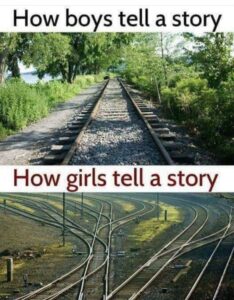
Before I enter the portion discussing the common knowledge game in detail, it is beneficial to provide some information about the physiological similarities and differences in the brain between men and women, and how we process information and express ourselves, as a result of those differences and similarities. I will also post some quotes from the New Testament of the Christian Bible, to show how men have attempted to suppress the nature of the feminine, both within the women in their lives and culture and within their own “masculine” minds. Both of these factors have ultimate importance in the Common Knowledge game, providing the basic foundation for perception of our collective consciousness, and unconsciousness.

Wow, there really is a difference! How did THAT get in there?
It’s no secret that men and women are different, biologically, historically, emotionally, and spiritually, and extend beyond what the eye can see. Research reveals major distinctions between male and female brains. Scientists generally study several areas of difference in male and female brains: including structure, activity, processing, and chemistry. The differences between male and female brains in these areas show up all over the world, but scientists also have discovered exceptions to every so-called gender rule. Some men are very sensitive, immensely talkative about their feelings, and naturally eschew the masculine way of doing things. As with all gender differences, no one way of doing things is better or worse. The differences are simply generalized differences in typical brain functioning, and it is important to remember that all differences have advantages and disadvantages.
The male and female brains are structurally different. “Structural” refers to actual parts of the brain and the way they are built, including their size and/or mass. Females often have a larger hippocampus, our human memory center. Females also often have a higher density of neural connections in the hippocampus. As a result, women tend to input or absorb more sensorial and emotive information than males do. Women tend to sense a lot more of what is going on around them throughout the day, and they retain that sensorial information more than men..Before birth, the male and female brains develop somewhat differently, with the right and left hemispheres of the male and female brains showing distinctive paths of development.
.
Females tend to have verbal centers on both sides of the brain, while males tend to have verbal centers on only the left hemisphere. This is a significant difference, as females tend to use more words when discussing or describing objects of their concern. Males have fewer verbal centers in general and have less connectivity between their word centers and their memories or feelings. When it comes to discussing feelings and emotions and senses together, women tend to have an advantage..Another difference worth looking closely at is the activity difference between male and female brains. The female brain, in part thanks to far more natural blood flow throughout the brain at any given moment (more white matter processing), and because of a higher degree of blood flow in a concentration part of the brain called the cingulate gyrus, will often ruminate on and revisit emotional memories more than the male brain.
.
Males, in general, are designed a bit differently. Males tend, after reflecting more briefly on an emotive memory, to analyze it somewhat, and then move on to the next task. During this process, they may also choose to change course and do something active and unrelated to feelings rather than analyze their feelings at all. Thus, observers may mistakenly believe that men avoid feelings in comparison to women or move to problem-solving too quickly.

Scientists have discovered approximately 100 gender differences in the brain, and the importance of these differences cannot be overstated. Understanding gender differences from a neurological perspective not only opens the door to a greater appreciation of the different genders, it also calls into question how we parent, educate, and support our children from a young age. None of us are doomed to remain tethered to a solely male or a female perspective, though our culture and our religions certainly have dedicated much time, historically, to maintaining the status quo and the division between the sexes.
.
There appears to be a physiological reason in the brain for why men and women see life differently from each other. Men and women tend to process information and emotions somewhat differently. Women tend to think more globally, and outwardly network with others, and also within all centers of their own brains, better than males. Yet, there are aspects of many styles of processing available to both men, and women, depending on their own internal natures, and intentions. And, through proper training, intention, and insight, men can actually process information and emotions in more intelligent, balanced, loving manners. And men can become much more interested in, and sensitive to the needs of others, and their own emotional needs, if this becomes a conscious intention for them. Studies have also shown that the internal nature of all brains can be changed, even after one reaches adulthood. Men can become much more “feminine” in the way their brain processes emotions and information, showing the powerful transformative force that conscious “nurture” has upon “nature”..The bible has so many revealing statements and texts about the subjugation and disempowering of women, all in the name of maintaining “Godly” relations.
.
The Christian bible is replete with aphorisms and statements relegating women to the background of the “church”, and in all relations with life. This oppression of women, and repression of so-called “feminine characteristics” within the male have been historically inculcated into the history and traditions of so-called “religious people”, and it reflects in the diseased and imbalanced relationships between some Christian and Jewish bodies of thought, and the world in general…These religious principles have also become established as conscious, and unconscious, norms for perception within the collective consciousness of America, and mankind in general. Just having a political and philosophical need to keep the church and the state separate is not quite enough, apparently, to establish healthier norms for relationships between the sexes. And, an unfortunate and dangerous outcome to this division between the man and woman is that the man is unconsciously conditioned to see the ‘feminine” aspects of himself in an objectified manner, and tries to oppress, control and dominate those aspects, emotions, and tendencies as if those parts were his “Christian wife”, rather than integrate them into a complete holism within himself..
- For man was not made from woman, but woman from man.-—1 Peter 3:1
- Likewise, wives, be subject to your own husbands, so that even if some do not obey the word, they may be won without a world by the conduct of their wives-–1 Corinthians
- The women should keep silent in the churches. For they are not permitted to speak, but should be in submission, as the Law also says. If there is anything they desire to learn, let them ask their husbands at home. For it is shameful for a woman to speak in church—-1 Timothy 2:12-14
- I do not permit a woman to teach or to exercise authority over a man; rather, she is to remain quiet. For Adam was formed first, then Eve; and Adam was not deceived, but the woman was deceived and became a transgressor.—-1 Timothy 2:
- To the woman he said, “I will surely multiply your pain in childbearing; in pain you shall bring forth children. Your desire shall be for your husband, and he shall rule over you.“—–Genesis 3:16
.So how on Earth, or in Heaven, do we bring balance back to ourselves, and with our relationships to each other, with our men and women, and with our planet Earth?.
Before I leave this discussion about myths and our origins, and the differences between the sexes, I would like to speculate that if I had a different early childhood, and if the first word that I learned was the unifying, life-giving word W A T E R, rather than the conflicted, confused, sometimes abandoned experience that I had around the words M O T H E R and F A T H E R, I too, might have had a much less fragmented understanding of life, and a more positive experience as a child and young adult. My early life experience and how consciousness ordered my sense of self was definitely not of the same nature as the beloved Helen Keller’s, though I was at least was loved by my grandparents, parents and pets.
.
Once we become conscious, there does not appear to be any obvious way of going back to permanent unconsciousness of our self, except through neurological damage or disease. Yet, many seekers of truth and knowledge throughout time have claimed that by meditating upon their body, their biology, and their breath, rather than the endless stream of words, thoughts, and concepts that seem to be constantly present, a door may open revealing the possibility of an enhanced experience of non-thought based awareness, however.
.
I propose that there is a way to be born again, but it can be an unusual path for some, characterized by a surprise intuitive connection, or another, much more common path that embraces much pain and suffering initially. In the latter situation, the aspirant must be disgusted with the past, and be willing to be freed from it and be open to new possibilities for a refreshed life experience.
.
Does anyone know the way back “home”?
.
Would we return to a pre-verbal or nonverbal state of being, or would we recognize words for what they are, and use them with more love and care, or perhaps a conscious blend of the two states? Perhaps we will discover that words only have limited, relative value rather than absolute value, in the search for our real origins.
.
Jesus, in the New Testament, proclaims:
- “Unless you are born again, you cannot enter the kingdom of God.“, and
- ““It is easier for a camel to go through the eye of a needle than for a rich man to enter the kingdom of God”, and, finally
- “My Kingdom is not of this world”.
.
So, even prophets and biblical writers understood the difficulty of such an undertaking. Jesus knew that those already rich, or overburdened, with their religious knowledge would be least likely to want to let it all go, and start over once they learned that they really knew nothing of the timeless divine knowledge. It is quite an insult to the ego, no matter how much so-called religious knowledge it is disguised with..
Most of the human race continues to be born into ancient times, using the tools of ancient, unenlightened thought, and they embody a continuation of the same mental and material processes that our ancient, mostly unenlightened ancestors practiced. If we can discontinue thinking the same thoughts about subjects we really don’t understand, our now opened minds become the now innocent wombs for the birth of new understanding and awareness. This is the “virgin birth” metaphorically referred to for Jesus Christ’s entry into this world.
“The best and most beautiful things in the world cannot be seen or even touched – they must be felt with the heart.” – Helen Keller
Yet, not all of our ancestors were ignorant, disconnected beings. In the optimistic assessment of John Trudell, all human beings are descendents of tribal people who were spiritually alive and intimately in love with the natural world, and children of Mother Earth. When we were tribal people, we knew who we were, we knew where we were, and we knew our purpose. This sacred perception of reality remains alive and well in our genetic memory. We still carry it inside of us in a long neglected dusty box in the mind’s attic.
There is an exciting alternative to the repetition and continuation of our human and personal history, however, but to be a part of that evolutionary leap, we must either access this long neglected dusty box, and/or be born again. You don’t need to study my works to find the Truth, you just need to learn how to study yourself. You are the greatest teacher, healer, and redeemer that you will ever find, once you tune up your understanding. We have to understand that which we attempt to understand with. We finally understand that to search for our divine source with just a mind stuffed with scriptures, words, and thoughts is like chasing a sunbeam with a flashlight. But, in the quietness and love of our heart, we may finally discover our real self, and, perhaps, see with the real mystery of life. It may become the greatest challenge of your life, yet the rewards make the whole process meaningful beyond all description.
Is it possible to finally learn who is the being searching for the divine?
Is it possible to see the divine in everyday life?
Have fun and learn, and then teach, or unteach, your children well!
What about the rest of you? Well, you will do what you feel that you need to do, without question, and your learning will come with much suffering and pain as a continuation of the historical momentum of humanity. Why would anybody want to change, anyway? I changed because I was going to die, and I wanted to see if life had any lasting, eternal meaning. I had to stop telling Life solely what it meant to me and be watchful and silent enough so that Life could reveal more of its undiscovered meaning to me. I had to let go of my misunderstandings of the words that I used and applied to Creation that I had oppressed and limited by using them ignorantly.
Are you ready to transmogrify?
Welcome to the next chapter!
“If everything around seems dark, look again, you may be the light”. —Rumi
