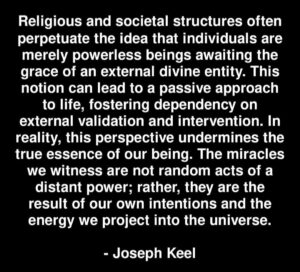
The Quantum Theory and the Evolution of Human Consciousness: A New Understanding
In the labyrinthian realm of quantum physics, where particles seem to dance in a state of infinite possibility, a thread weaves through the astonishing discoveries—consciousness. It’s an enigmatic concept, often relegated to the inscrutable black box of our cognitive architecture, yet a new understanding propelled by a quantum lens is poised to redefine not just science, but our perception of reality and our place within it. As an ardent believer in the interconnectedness of all things, I stand firmly in the camp that quantum theory holds the key to exploring the depths of human consciousness.
Quantum theory, with its central theses of superposition and entanglement, and Heisenberg’s uncertainty principle, has consistently defied our intuitive grasp of the universe. It is a theory of probabilities and potentialities, where at the most fundamental levels, nature appears to be indeterminate and the act of observation irrevocably tied to the nature of reality. At first glance, these principles may seem arcane and applicable only to the microcosm of the atomic and subatomic, but their implications ripple throughout the tapestry of existence.
Traditionally, consciousness has been the domain of philosophy, psychology, and the mystical elements of religion, its origin and workings a subject of much conjecture and mythology. From the book of John in the Christian bible, cassical dawn of philosophical musings to Freud’s iceberg model of the mind dividing consciousness and unconsciousness, there has been an enduring fascination with deciphering the mechanisms that underpin human awareness and experience. Yet, the more we sought to unravel consciousness’s riddle, the more it seemed to slip past our intellectual grasp.
The convergence of quantum theory with consciousness encompasses various schools of thought. One prominent theory posits that consciousness functions akin to a quantum computer, processing information through non-locality and quantum tunneling. This would open the door to a unified theory of the brain-mind relationship, where consciousness is not an emergent property but a fundamental aspect of existence. Such paradigms would also entail reevaluating the anthropocentric view of consciousness, suggesting that complex interplays of quantum phenomena abound throughout nature.
Emerging from this union is a proposed ‘quantum mind,’ a conceptual framework where consciousness is inseparable from the underlying quantum field, and the mind is a participant in the creation of reality. This echoes the idealistic view often associated with quantum physics and aligns with ancient spirituality—an interpretation that relegates physical reality to the realm of the mental. Quantum mind proponents assert that quantum phenomena may occur at macroscopic levels within the brain, giving rise to the multifarious experiences we attribute to consciousness.
The implications of such a paradigm shift are profound. Our understanding of mental health, of what it means to be sentient, and the very nature of life and death could be transformed. Integrated with neuroscience and psychology, quantum consciousness could forge new paths for treating disorders of the mind and illuminating the human condition. Moreover, it could foster a more holistic approach to science, where the subjective element of observation is acknowledged and factored into the objective analysis of phenomena.
This assertion of the quantum mind has not escaped scrutiny and skepticism. Many within the scientific community remain wary of what they dub “quantum mysticism,” arguing that the application of quantum principles to consciousness is a mere analogy, stripped of the rigorous mathematical formalism at the core of quantum physics. Detractors also cite the flimsy experimental evidence and the vulnerability of quantum theories to misinterpretation and misuse.
In the alchemy of this new alliance between quantum theory, spirituality, and consciousness, we stand at the brink of an intellectual and spiritual renaissance. As we peel back the layers of quantum phenomena and the veils of mind, a picture emerges—one that speaks to the indivisibility of the universe and the interconnected dance of the observer and the observed. We have not yet unlocked the entirety of this cosmic puzzle, but the pieces are falling into place in ways that could radically redefine what it means to be alive and aware. As we continue to stride forward, guided by the specter of the not-yet-understood, let us not shy away from the great potential that quantum theory may hold for the evolution of our consciousness, and with it, the evolution of our species.
Exploring the Quantum Cosmos: The Collective Observer and Universal Reality
The mysteries of quantum mechanics have long challenged our understanding of reality. Beneath its complexity lies a fascinating truth—a simple act of observation changes the very fabric of the universe. Known as the observer effect, this principle suggests that the quantum field, an all-encompassing field of probabilities, reacts to the presence of a conscious observer.
Yet, if the observation of a single individual can alter quantum phenomena, what happens when humanity’s collective gaze—over 8 billion observers—focuses on reality? How does the amalgam of diverging perspectives shape the quantum field? More intriguingly, what role do other forms of consciousness on Earth and potentially alien life forms play in this infinite dance of quantum observation?
Let’s explore the interplay between quantum mechanics, consciousness, and observation. We’ll venture into thought-provoking territory in search of answers to questions that confront the boundaries of science, philosophy, and spirituality.
At its core, quantum mechanics unveils a reality of probabilities rather than certainties. Unlike the deterministic world of classical physics, quantum particles exist in multiple states at once. This phenomenon, known as superposition, collapses when observed, as the particle resolves into a single outcome based on the observer’s interference.
The observer effect brings into focus a curious paradox: the universe appears to respond to consciousness. You, with just your act of attention, play a fundamental role in the universe’s design. The quantum realm, governed by invisible probabilities, seemingly manifests into reality through observation, intertwining science and the mysteries of existence.
But here lies a grand question—what happens when observation isn’t confined to a single observer? With billions of active, conscious participants interacting with the quantum field, does shared observation amplify, disrupt, or harmonize these influences?
The human population of Earth surpasses 8 billion people, each one a distinct observer. With divergent perspectives, we observe, interpret, and assign meaning to our environment. According to quantum theory, each observation contributes to the collapse of potentialities into materialized outcomes.
Does this collective observation create coherence—an ordered focus that strengthens reality—or does the sheer diversity of human experience introduce chaos into the quantum field?
Some theorists argue that collective attention holds the key to shaping reality on a grand scale. Consider joint human efforts—like millions watching a solar eclipse or participating in global meditations. Such phenomena suggest a unifying ripple effect sent across the quantum field when collective attention converges.
If this is true, is it possible that our disjointed perceptions—shaped by differences in culture, identity, and belief—produce a fragmented, chaotic influence within the quantum field? Perhaps what we call “chaos” in global events mirrors the complexity of intertwining quantum realities shaped by billions of simultaneous perspectives.
Humans are far from alone in the grand circuitry of Earth’s consciousness. Dolphins, elephants, whales, and even crows—a pantheon of extraordinary beings possess profound intelligence, memory, and awareness. Cities, interconnected hubs of human activity, could even be seen as superorganisms with multifaceted consciousness, continuously observing and interacting with reality.
What are these non-human observers contributing to the quantum field? If a great blue whale, gliding silently beneath the ocean surface, observes its environment, does that observation ripple into and interact with the same quantum field humans observe? Could the consciousness of ecosystems—forests, marine systems, or entire cities—be reinterpreting and reshaping our understanding of what “observation” entails?
One could argue that we’re part of an intricate, multilayered chorus of observation—a symphony in which every life form plays its part. If so, our interpretation of reality must extend beyond humanity. The quantum influence of interconnected species highlights the profound interdependence (and shared agency) shaping existence itself.
Now comes the proverbial elephant in the room—or more aptly, alien intelligence in the galaxy. There are an estimated 200 billion stars in the Milky Way alone, many of which host planets that may harbor conscious life. If quantum mechanics dictates that mere observation influences materials at both local and universe-wide scales, how does conscious extraterrestrial life influence the quantum field we, as Earthly inhabitants, call home?
Could alien perspectives shift our understanding of reality, impacting everything from universal constants to how our own observations collapse probabilities? Speculatively, life spread across galaxies may inadvertently entangle itself within the same shared quantum canvas, adding dimensions to our perception of existence.
This raises another profound question—are we actively influencing each other across the chasm of space, creating a network of interconnected observers communicating through a deeply quantum bond? Perhaps humanity’s quest to observe alien life might ultimately highlight how alien life has shaped us all along.
The interplay between observation, quantum mechanics, and consciousness compels us to reconsider our place in reality. Humanity is not just living within the universe; we could very well be co-creating it. Every thought, emotion, and act of attention contributes to the grand symphony of probability collapsing into real-time events.
This exploration demands humility. If consciousness extends beyond human life and perhaps even beyond Earth, we hold shared responsibility for the harmonies woven within the universal quantum field. Differences should no longer create divides—they should highlight the extraordinary richness and collaborative lenses through which reality emerges.
Practical reckonings must follow these contemplations. How does quantum entanglement of observation reshape concepts like morality, ethics, and coexistence across sentient life—be it human, animal, or extraterrestrial? Can humanity devise frameworks to engage with such profound quantum interconnectivity responsibly and harmoniously?
The dialogue surrounding collective observation and the quantum field is as much a philosophical frontier as a scientific one. It invites quantum physicists, consciousness explorers, and curious laypeople alike to ponder the mysteries of their role as observers of reality.
It’s an invitation to broaden our perception, to expand beyond individuality, and to consider how our shared presence impacts the fabric of everything—and everyone—around us.
The quantum cosmos asks for our attention, not just as isolated participants, but as a collective with the power to shape a harmonized, interconnected reality. The next step is as clear as it is infinite—continue to question, explore, and connect.